
Building a multi-agent AI system isn’t cheap, fast, or plug-and-play. It’s complex software that involves multiple intelligent agents working together or independently across different environments. These agents might handle different goals, operate with varying levels of autonomy, and even collaborate in real-time. That kind of functionality doesn’t come with a fixed price tag, but it does come with patterns we can break down.
Let’s explore how much it actually costs to build a multi-agent system in 2026, what drives those numbers, and where to start budgeting.
What Is a Multi-Agent AI System and How Much Does It Cost?
A multi-agent AI system brings together multiple intelligent agents, each designed to carry out specific tasks or represent different roles within the same environment. Depending on the architecture, agents may coordinate asynchronously or collaborate in near real time.
These systems are also showing up in areas like smart city management and unified customer experience platforms, where many parts need to work in sync. But the setup is far from plug-and-play. Building a multi-agent architecture requires more than just stacking bots together – you need frameworks that handle inter-agent communication, conflict resolution, shared memory, and real-time decision-making across various data streams.
As for cost? It varies widely depending on complexity, but here’s a ballpark range:
- Small-scale systems (e.g. internal logistics or CX bots): $50,000 – $150,000
- Mid-range setups (e.g. warehouse robotics or city traffic management): $200,000 – $500,000
- Large, enterprise-grade systems with simulation or predictive capabilities: $600,000 to $1.5 million+
These numbers reflect the full development lifecycle – planning, modeling, integration, testing, and long-term support.

Our Perspective at AI Superior
At AI Superior, we’ve seen firsthand how complex and high-value multi-agent systems can be when they’re built with the right foundation. We focus on designing and delivering end-to-end AI applications that require a combination of strong architecture, reliable machine learning components, and deep domain understanding.
What sets our projects apart is the level of customization they require. Off-the-shelf tools aren’t enough when your agents need to collaborate across business units or perform in high-stakes environments. That’s why our team, which includes data scientists and engineers, works closely with each client to map out the best approach, whether it involves natural language interfaces, computer vision modules, or predictive models that guide agent behavior in real time.
We don’t just build systems that work, we build systems that make sense in the context of your data, infrastructure, and long-term goals. And when it comes to multi-agent setups, that means starting lean, validating performance early, and scaling only when the architecture can support it reliably. If you’re exploring agent-based solutions, we’ll help you move with clarity, not guesswork.
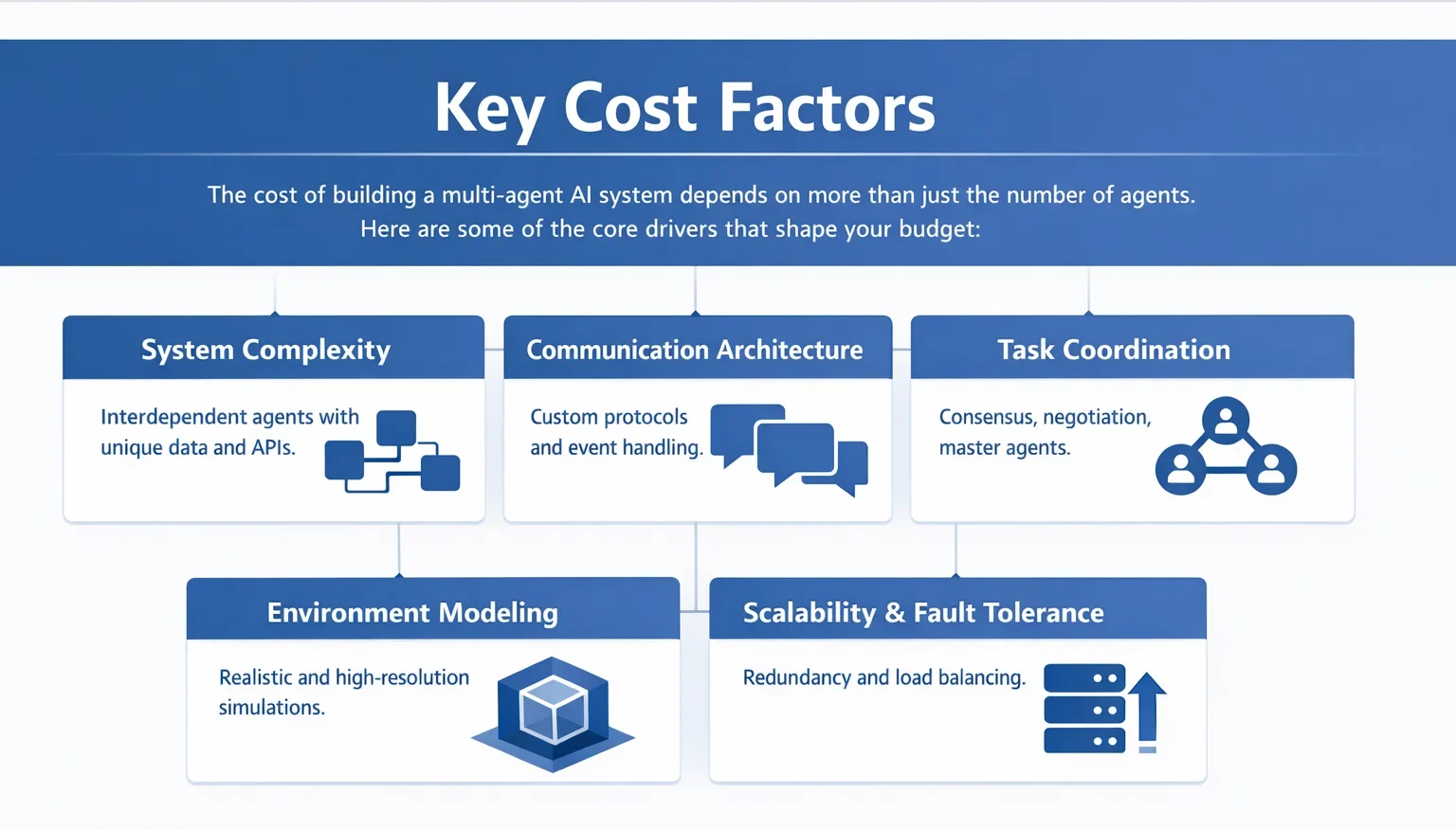
Key Cost Factors
The cost of building a multi-agent AI system depends on more than just the number of agents. Here are some of the core drivers that shape your budget:
1. System Complexity
More agents doesn’t always mean higher cost, but more interdependent agents usually does. If each one needs its own data stream, environment model, or API access, you’re looking at significant overhead.
2. Communication Architecture
Agents need to talk to each other. That might involve custom protocols, shared memory systems, or distributed event handling. Building this communication layer adds both engineering time and operational cost.
3. Task Coordination
How do agents make decisions together? Do they vote? Negotiate? Rely on a master agent? Building coordination strategies (like consensus algorithms or reinforcement learning policies) adds technical depth.
4. Environment Modeling
Many multi-agent systems simulate or interact with real-world environments. Creating those environments, especially in 3D, high-resolution, or real-time, requires additional modeling, sensors, and computational resources.
5. Scalability & Fault Tolerance
When agents go down, the system shouldn’t crash. Building redundancy, load balancing, or recovery strategies into multi-agent designs increases development scope.
Estimated Development Costs in 2026
Pricing out an AI agent isn’t like shopping for a SaaS subscription. There’s no one-price-fits-all deal. The numbers vary wildly depending on what kind of agent you’re building, how smart it needs to be, and what sort of problems it’s meant to solve. Some are simple helpers that follow rules. Others learn, adapt, and operate across entire workflows.
| System Type | Description | Estimated Development Cost |
| Basic Coordination System | 2-3 agents, rule-based, fixed task domain | $50,000 – $100,000 |
| Moderate Complexity | 4-8 agents, contextual coordination, shared data layers | $120,000 – $250,000 |
| Enterprise Workflow System | 10+ agents, dynamic role assignment, live data streams | $150,000 – $500,000 |
| Simulation Environment | AI agents acting in a simulated world (e.g. traffic, military, finance) | $500,000 – $1M+ |
| Autonomous Multi-Agent System | Self-learning agents, real-time planning, full environment modeling | $100,000 – $1M+ |
Ongoing costs (cloud compute, data storage, fine-tuning, monitoring, compliance) can add 15% to 25% annually.
Where the Budget Actually Goes
Breakdown for a mid-level multi-agent system ($250,000 build):
- Planning & architecture: $25,000 – $40,000
- Agent logic & development: $80,000 – $100,000
- Communication & coordination layer: $40,000 – $60,000
- Testing & validation: $25,000 – $35,000
- Integration & deployment: $30,000 – $50,000
- Monitoring & support setup: $15,000 – $25,000
These are just development-phase costs. Don’t forget cloud costs, API fees, security reviews, and compliance documentation for enterprise deployments.
Hidden Costs You Might Miss
Even well-planned AI agent projects tend to run into expenses that were not obvious at the start. These costs are not mistakes, but they do catch teams off guard if they are not discussed early.
Training and Adoption Time
Agents do not replace human workflows overnight. Teams need time to learn how to work with them, review outputs, and adjust processes. Internal training, documentation, and change management all require budget and attention.
Data Labeling and Preparation
Clean data is not free. Preparing datasets, resolving inconsistencies, and labeling examples often take weeks or months. In multi-agent systems, where agents rely on shared context, data quality issues multiply quickly.
Compliance and Legal Oversight
If agents interact with regulated data or make decisions that affect customers or employees, legal review becomes unavoidable. Privacy checks, audit trails, and policy alignment all add costs that are easy to underestimate.
API and Usage-Based Fees
Model calls may seem cheap at first, but usage grows fast in production. Multi-agent systems often trigger more calls than expected due to coordination logic, retries, and background reasoning loops.
Infrastructure Scaling
What works for ten users will not hold up for a thousand. Load balancing, logging, monitoring, and failover systems are not optional once the system becomes business-critical.
Being honest about these hidden costs does not make a project riskier. It makes it realistic. And realistic plans are the ones that actually reach production.
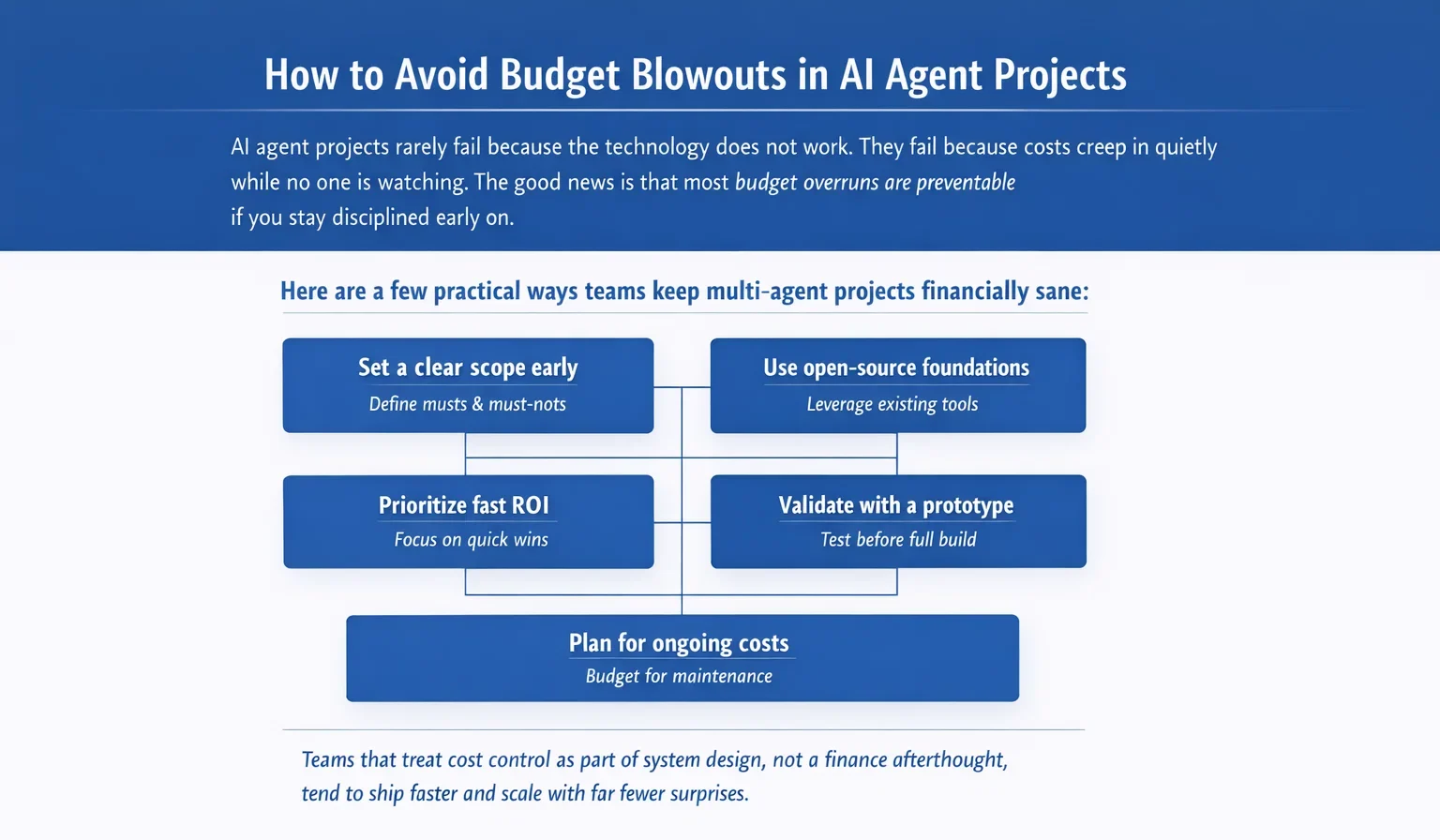
How to Avoid Budget Blowouts in AI Agent Projects
AI agent projects rarely fail because the technology does not work. They fail because costs creep in quietly while no one is watching. The good news is that most budget overruns are preventable if you stay disciplined early on.
Here are a few practical ways teams keep multi-agent projects financially sane:
- Set a clear scope early: Decide what the agent must do and what it absolutely does not need to do yet.
- Use open-source foundations where possible: You do not need to reinvent orchestration logic, vector search, or communication layers from scratch.
- Prioritize use cases with fast ROI: Start with agents that replace repetitive work or unblock bottlenecks.
- Validate with a prototype before full build: A small proof of concept can reveal integration issues, data gaps, or performance limits early.
- Plan for ongoing costs, not just development: Infrastructure, monitoring, retraining, and compliance all add up.
Teams that treat cost control as part of system design, not a finance afterthought, tend to ship faster and scale with far fewer surprises.
Final Thoughts
If you’re building a true multi-agent AI system, the cost reflects the complexity. This isn’t about tacking on a chatbot to your website – it’s about designing multiple independent (and often intelligent) actors to work in harmony. Expect months of development, multiple teams, and long-term investment.
But if your use case is mission-critical, fast-evolving, or relies on dynamic environments, a well-built multi-agent system can offer serious returns.
FAQ
1. What’s the ballpark cost to build a multi-agent AI system?
It depends on the size and complexity, but most systems fall somewhere between $100,000 and $500,000+. A basic setup with 2-3 coordinated agents might land closer to the low end, while larger systems with dozens of agents, real-time collaboration, and custom environments can easily cross the $1M mark. It’s not a small lift – this is infrastructure, not a plugin.
2. Why are multi-agent systems so expensive to develop?
You’re not just building one smart tool, you’re building a whole network of them. Each agent may need its own logic, data flow, and communication layer. Add in environment modeling, coordination strategies, fault tolerance, and testing, and suddenly it’s less like coding a bot and more like engineering a distributed system. That’s where the cost adds up fast.
3. Can I just string together a few GPT-based agents and call it done?
Not really. Using pre-trained models is a good start, but multi-agent systems need orchestration, meaning agents have to interact, resolve conflicts, share context, and adapt. Without a solid backbone to manage this, you’ll likely end up with chaos. Think of it less like adding tools and more like designing a digital team that can actually work together.
4. How long does it usually take to build one?
Some teams get a prototype running in 2-3 months. But for production-grade systems, especially those tied to real operations, 6 to 12 months is a more realistic range. If there’s compliance, legacy integration, or simulation involved, you’ll be looking at the longer end of that timeline (or beyond).
5. What are the biggest hidden costs in these projects?
Monitoring and maintenance. Once the system is live, it needs regular care: retraining, compliance updates, logging, human-in-the-loop checks. Then there’s infrastructure – bandwidth, GPU time, failover systems. All of it adds up. Teams that only budget for the initial build usually get surprised around month three.
6. Is a multi-agent system overkill for most businesses?
Sometimes, yes. If your goal is to automate a single workflow or build a narrow assistant, it’s probably better (and cheaper) to start with a standalone agent. Multi-agent setups make more sense when you’re coordinating across departments, automating decision chains, or simulating complex environments.
 English
  German
  Arabic
  French
  Dutch
Dutch  Spanish