
“Smart city software” sounds expensive before anyone even opens a spreadsheet. And sometimes it is. But more often, the real cost problem isn’t the technology itself. It’s unclear scope, rushed decisions, and underestimating what happens after launch.
Cities rarely build a single app and call it a day. Smart city software usually means a mix of platforms: data collection, analytics, dashboards, integrations with existing systems, and tools that different departments rely on every day. Transportation, utilities, public safety, citizen services, all of them touch the same digital backbone.
This article breaks down what it actually costs to develop smart city software today. Not marketing numbers. Not best-case demos. Real cost drivers, typical ranges, and why two cities with similar goals can end up with very different budgets.
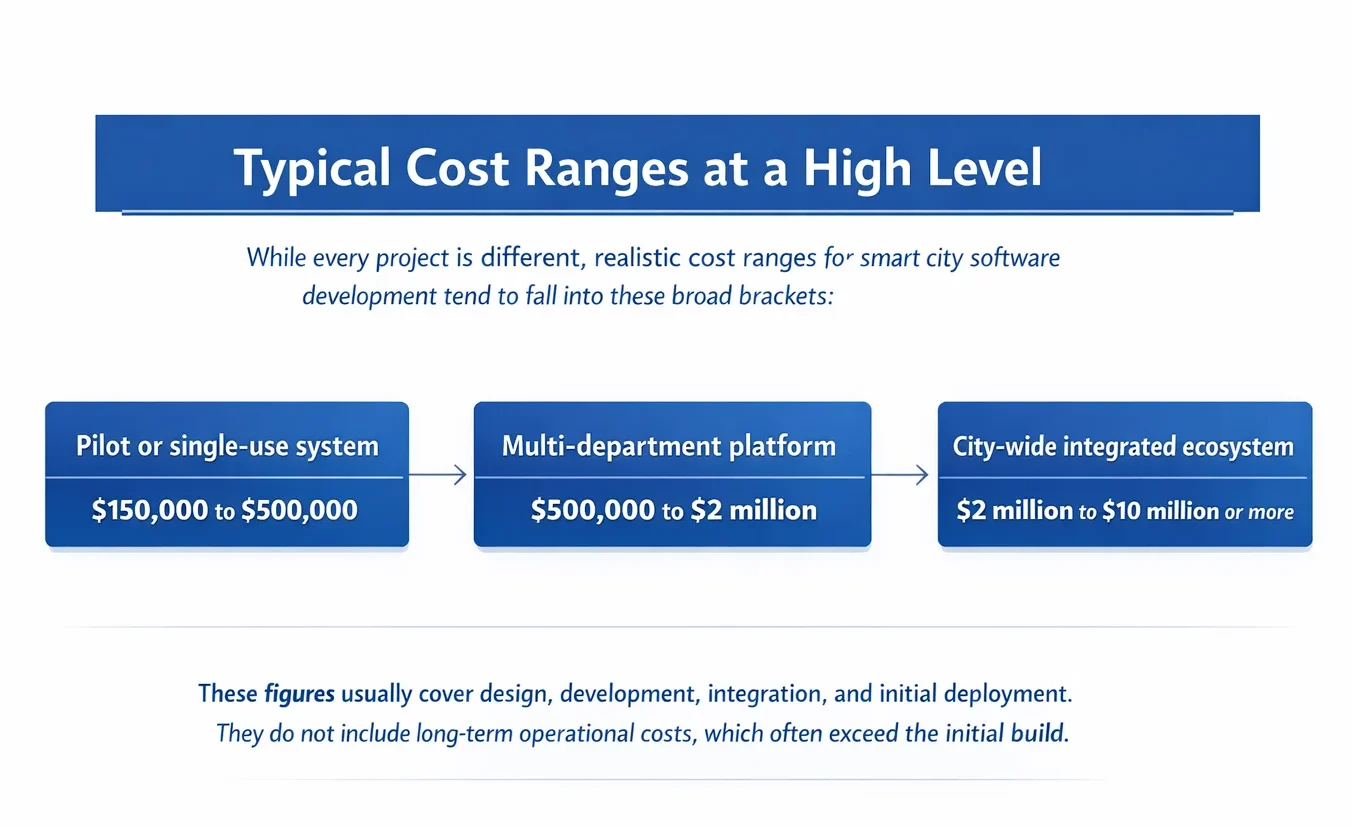
Typical Cost Ranges at a High Level
While every project is different, realistic cost ranges for smart city software development tend to fall into these broad brackets:
- Pilot or single-use system: $150,000 to $500,000
- Multi-department platform: $500,000 to $2 million
- City-wide integrated ecosystem: $2 million to $10 million or more
These figures usually cover design, development, integration, and initial deployment. They do not include long-term operational costs, which often exceed the initial build.
Core Cost Components Explained
Planning and Discovery
This phase is often underestimated or rushed, and that is where problems begin.
Discovery includes defining goals, mapping existing systems, identifying data sources, and deciding what success actually looks like. Cities that skip this phase tend to build software that looks impressive but fails to get used.
Typical Cost Range
- $50,000 to $200,000
This cost pays for workshops, technical assessments, architecture planning, and early risk identification. It often saves several times its cost later.
Data Infrastructure and Platforms
Data is the backbone of any smart city system. Whether data comes from traffic sensors, utility meters, cameras, or third-party sources, it needs to be collected, stored, cleaned, and secured.
Costs here depend on volume, velocity, and variety of data.
Typical Cost Range
- $200,000 to $1.5 million
Cloud-based platforms reduce upfront investment but introduce recurring costs. On-premise systems require higher initial spend and specialized staff.
Integration with Existing Systems
This is where budgets often start to stretch.
Most cities already have traffic systems, utility platforms, legacy databases, and vendor-managed tools. Making them talk to each other is rarely straightforward.
Integration costs rise when:
- Systems use proprietary formats
- Documentation is outdated or missing
- Multiple vendors are involved
- Real-time data exchange is required
Typical Cost Range
- $150,000 to $1 million
Integration complexity is one of the main reasons smart city projects exceed initial estimates.
Analytics and Decision Tools
Raw data is not useful unless it leads to decisions.
Analytics layers include dashboards, alerts, predictive models, and reporting tools tailored to different departments. Transportation teams need different views than utilities or public safety.
Typical Cost Range
- $100,000 to $800,000
Costs increase when advanced analytics, AI-driven predictions, or custom visualizations are required.
Citizen-Facing Applications
Public portals, mobile apps, and transparency dashboards are often the most visible part of a smart city project, but they typically receive the smallest share of the budget.
Despite that, they play a major role in public trust and adoption.
Typical Cost Range
- $50,000 to $300,000
Costs rise when accessibility, multilingual support, or real-time updates are required.
Security, Privacy, and Compliance
Smart city systems handle sensitive data. Security cannot be added at the end.
This includes encryption, access controls, audit logs, compliance with local and international regulations, and ongoing monitoring.
Typical Cost Range
- 8 to 15 percent of total development cost
Cities that underfund this area often face expensive corrections later.

Building Practical Smart City Software That Scales With AI Superior
At AI Superior, we help cities turn smart city ideas into working software that delivers measurable results. Our focus is not on flashy demos, but on systems that fit real operational needs and stay reliable as they scale.
We design and build end-to-end smart city platforms, from data pipelines and AI models to secure, production-ready applications. Our teams work across computer vision, predictive analytics, NLP, and large-scale data systems, often in complex, regulated environments. We start with focused use cases, validate value early, and expand step by step to keep costs under control.
Throughout the process, we work closely with city stakeholders to ensure transparency, flexibility, and long-term viability. The goal is simple: smart city software that supports better decisions today and continues to work years down the line.
Ongoing Costs Many Cities Overlook
Launching smart city software is not the finish line. Once the system is live, the real work begins. Data keeps flowing, systems evolve, and expectations rise. Cities that budget only for development usually discover the real cost later.
Lifecycle Costs Often Exceed the Build
Over time, operational expenses commonly reach two to three times the original development cost. This is not a sign of failure. It is simply the reality of running city-scale digital infrastructure that must stay reliable, secure, and usable year after year.
Core Ongoing Expenses
Several cost areas continue long after launch:
- Cloud hosting and data storage. Ongoing fees grow as data volume increases and more services come online.
- Software maintenance and updates. Bug fixes, performance improvements, and compatibility updates are continuous, not occasional.
- Device and sensor management. Connected devices require monitoring, calibration, firmware updates, and replacement over time.
- Cybersecurity monitoring. Threats evolve constantly, which means security must be actively maintained, not set once.
- Staff training and operational support. Teams change, systems expand, and staff need regular training to use tools effectively.
- System upgrades and expansion. New use cases and regulations often require software changes that were not part of the original scope.
What Annual Operating Costs Typically Look Like
For most smart city platforms, annual operational costs fall between 15 and 30 percent of the initial development cost. This range varies based on system complexity, data volume, and security requirements.
Why Early Planning Matters
Cities that plan for these costs from the beginning avoid emergency funding requests, rushed decisions, and stalled projects. Ongoing costs are not hidden expenses. They are predictable ones – if acknowledged early.
How IoT Changes the Cost Equation
Smart city software is tightly connected to IoT infrastructure.
Sensors, cameras, meters, and connected devices generate the data that software depends on. While hardware costs are often budgeted separately, software must be designed to handle device management, data quality, and scaling.
Cities that treat IoT and software as separate projects usually end up paying more in integration and maintenance.
The Role of Transparency and Governance
One of the most common failures in smart city projects is software that functions exactly as designed but delivers little real-world value. Dashboards exist, data flows in, yet decision-making does not improve and outcomes remain unclear. This usually happens when governance and measurement are treated as secondary concerns instead of core design elements.
Cities that invest in transparency standards, independent validation, and clear outcome tracking often achieve stronger results with smaller budgets. Publishing data in structured, accessible formats makes it easier to spot issues early and adjust course. Independent reviews help separate claims from reality, while stakeholder involvement brings practical context that technical teams may miss. When governance is built into the system from the start, it reduces waste, limits unnecessary expansion, and keeps projects aligned with real needs. Governance is not a cost add-on. It is one of the most effective tools cities have to control costs over time.
How City Size Impacts Cost
City size does influence smart city software costs, but not simply because bigger cities have bigger budgets. The real difference shows up in complexity. Small and mid-sized cities often move faster because they operate with fewer legacy systems, fewer vendors, and shorter decision chains. That speed can reduce planning overhead, integration effort, and time-to-value. A focused project in a smaller city can deliver impact without the heavy coordination that slows larger organizations down.
Large cities, on the other hand, benefit from scale. Once systems are in place, costs per department or per service can decrease. But reaching that point takes more time and money. Large municipalities usually face stricter compliance requirements, more stakeholders, and deeper system interdependencies. Each new feature must work across multiple departments and districts, which increases development and governance costs. In practice, what matters more than population size is clarity of objectives. Cities that know exactly what they want to solve tend to spend less, regardless of how big they are.
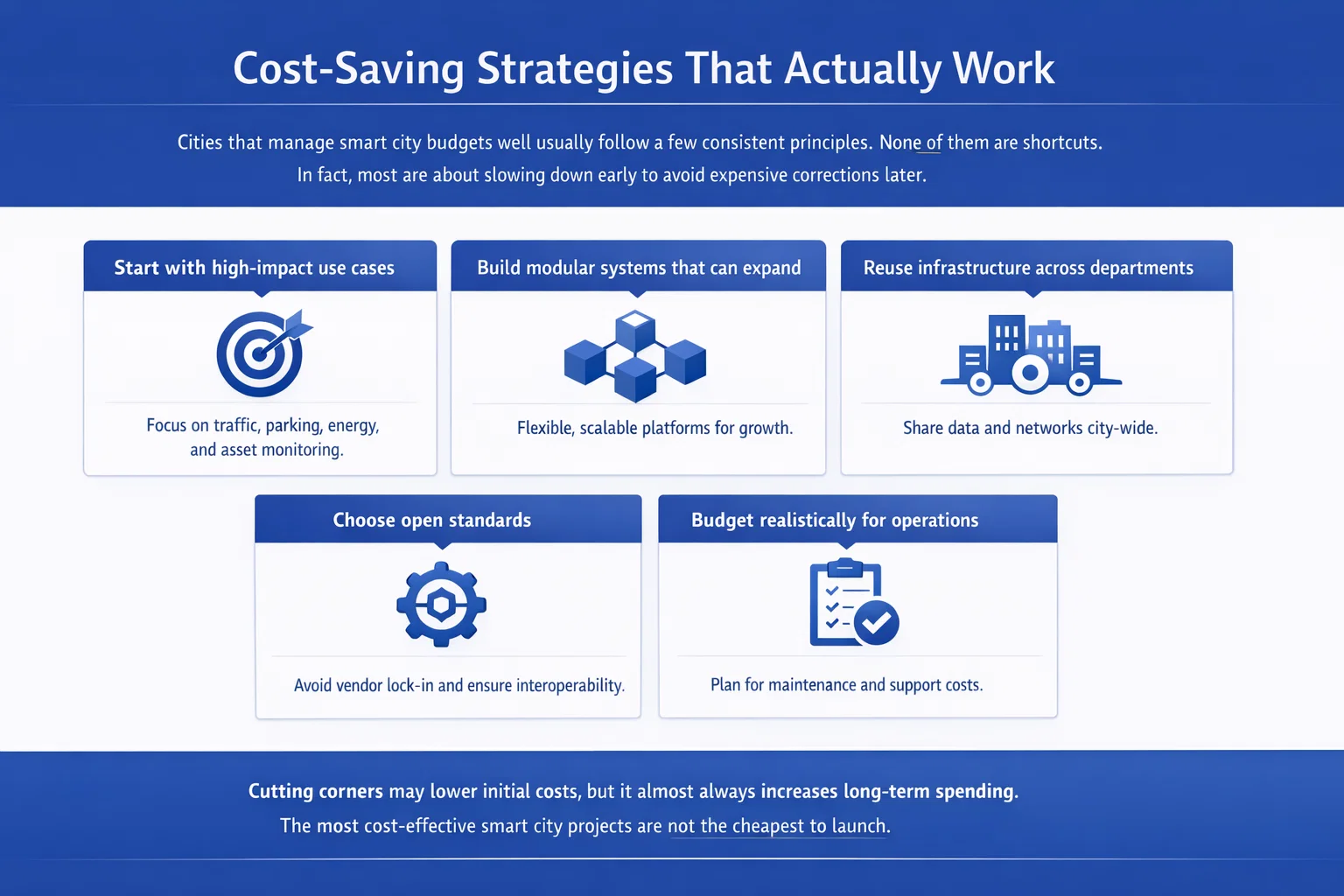
Cost-Saving Strategies That Actually Work
Cities that manage smart city budgets well usually follow a few consistent principles. None of them are shortcuts. In fact, most are about slowing down early to avoid expensive corrections later.
- Start with high-impact use cases. Instead of trying to solve everything at once, successful cities focus on problems that clearly affect daily operations, such as traffic flow, parking, energy usage, or asset monitoring. These use cases tend to deliver measurable value quickly and help justify further investment.
- Build modular systems that can expand. Modular architectures allow cities to add new services without rebuilding the entire platform. This makes it easier to scale gradually, test ideas, and adapt to new requirements without triggering major redevelopment costs.
- Reuse infrastructure across departments. Shared data platforms, networks, and analytics tools reduce duplication. When transportation, utilities, and public safety rely on the same digital backbone, cities spend less overall and gain better visibility across operations.
- Choose open standards. Open standards reduce vendor lock-in and simplify integration with new tools. They also make it easier to replace components over time without costly migrations or contractual constraints.
- Budget realistically for operations. Long-term costs like hosting, maintenance, security, and support should be treated as part of the project, not as future problems. Cities that acknowledge these expenses early tend to maintain systems longer and with fewer disruptions.
Cutting corners may lower initial costs, but it almost always increases long-term spending. The most cost-effective smart city projects are not the cheapest to launch. They are the easiest to sustain.
Final Thoughts
Smart city software is not cheap, but it does not have to be wasteful.
The real cost is not in building dashboards or deploying sensors. It is in poor planning, fragmented systems, and ignoring long-term realities.
Cities that treat smart city software as shared infrastructure, rather than isolated projects, tend to spend less and achieve more.
The question is not “how much does it cost,” but “how thoughtfully is it built.”
When those answers align, smart city investments start to make sense – financially and socially.
Frequently Asked Questions
How much does smart city software development usually cost?
Costs vary widely depending on scope and complexity. A focused pilot or single-use system may start around $150,000, while a multi-department platform often ranges from $500,000 to $2 million. Large, city-wide systems that integrate multiple services can exceed $5 million, especially when long-term scalability and security are required.
Why do smart city projects often exceed their initial budgets?
Budget overruns usually come from underestimating integration complexity, retrofitting legacy systems, and ongoing operational costs. Many cities also expand project scope after seeing early results, which increases cost if not planned for upfront.
Is smart city software a one-time expense?
No. Development is only the beginning. Ongoing costs such as hosting, maintenance, cybersecurity, device management, and staff training typically add 15 to 30 percent of the initial development cost every year. Over the full lifecycle, total costs can reach two to three times the original build.
Can smaller cities afford smart city software?
Yes. Small and mid-sized cities often have an advantage because they can start with narrower, high-impact use cases and scale gradually. Clear goals and modular design matter more than city size when controlling costs.
What is the biggest cost driver in smart city software?
Integration. Connecting existing systems, vendors, and data sources usually consumes more time and budget than building new features. Cities with fragmented infrastructure should plan accordingly.
 English
  German
  Arabic
  French
  Dutch
Dutch  Spanish