
Smart city consulting is rarely a line item with a fixed price. It sits at the intersection of strategy, technology, public policy, and long-term planning, which makes costs harder to pin down than most professional services.
In practice, the price depends less on buzzwords and more on scope. A short feasibility study for a mid-sized city looks very different from a multi-year program covering data platforms, mobility, energy, and governance. Some projects are about advice. Others include hands-on design, vendor coordination, and ongoing oversight.
This article breaks down what smart city consulting actually costs today, how those costs are structured, and what cities and organizations are really paying for when they hire external experts.
What Smart City Consulting Actually Costs
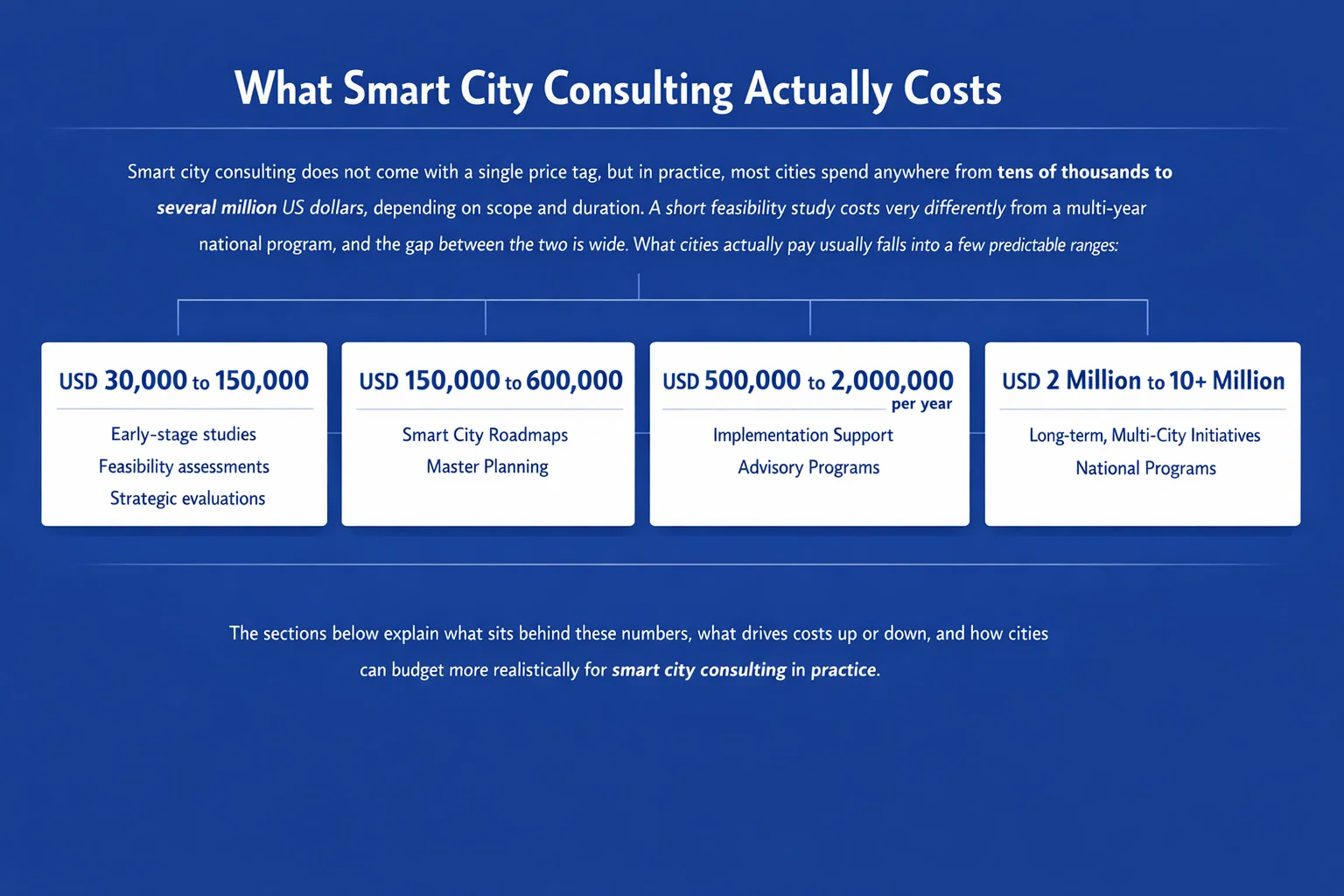
Smart city consulting does not come with a single price tag, but in practice, most cities spend anywhere from tens of thousands to several million US dollars, depending on scope and duration. A short feasibility study costs very differently from a multi-year national program, and the gap between the two is wide. What cities actually pay usually falls into a few predictable ranges:
- USD 30,000 to 150,000 for early-stage studies, feasibility assessments, and strategic evaluations
- USD 150,000 to 600,000 for full smart city roadmaps and master planning
- USD 500,000 to 2,000,000 per year for ongoing implementation support and advisory programs
- USD 2 million to 10+ million for long-term, multi-city or national smart city initiatives
The sections below explain what sits behind these numbers, what drives costs up or down, and how cities can budget more realistically for smart city consulting in practice.
Typical Cost Ranges Cities Actually Pay
While no two smart city projects are identical, real-world budgets tend to fall into a few recognizable bands. The biggest cost drivers are scope, duration, and how deeply consultants stay involved beyond planning.
Early-Stage Studies and Feasibility Work
These engagements are usually the first step for cities testing the waters or preparing funding applications.
Typical Price Range
- USD 30,000 to 150,000
Smaller municipalities often stay closer to the lower end, especially for narrowly defined studies. Large cities, national agencies, or donor-funded programs tend to land higher due to broader stakeholder involvement and reporting requirements.
Most feasibility projects run two to four months and involve a small team focused on assessment, high-level architecture, and recommendations rather than execution.
Full Smart City Roadmaps and Master Plans
Once a city commits to a broader vision, consulting costs rise accordingly.
Typical Price Range
- USD 150,000 to 600,000
These engagements cover multi-domain planning such as mobility, energy, data platforms, digital services, and governance models. They require deeper analysis, workshops with multiple departments, and alignment with regulatory and sustainability frameworks.
Costs move toward the upper end when consultants are expected to deliver detailed implementation plans, cost models, timelines, and measurable KPIs, not just strategic direction.
Multi-Year Programs and Implementation Support
When consultants remain involved during rollout, pricing shifts from project-based fees to sustained annual budgets.
Typical Price Range
- USD 500,000 to 2,000,000 per year
These programs often include vendor evaluation, technical oversight, pilot management, integration support, and ongoing performance monitoring. Large cities commonly operate at this level when smart city initiatives become part of daily operations rather than one-off projects.
The longer the engagement and the more hands-on the role, the closer costs move toward the seven-figure range.
Long-Term Retainers and National Programs
At the national or regional level, consulting contracts scale significantly.
Typical Price Range
- USD 2 million to 10+ million over multiple years
These programs usually span several years and cover multiple cities or regions. Consultants support standard-setting, capacity building, policy alignment, and cross-city coordination, often working alongside government agencies and international partners.
While total contract values are high, the per-city cost is often lower due to shared frameworks and economies of scale.

How We Approach Smart City Consulting at AI Superior
At AI Superior, we approach smart city consulting with one core principle in mind: decisions have to be realistic, affordable, and implementable in the real world. Cost matters, but so does avoiding complexity that cities cannot sustain once consultants step away.
We work closely with cities and public-sector organizations to define clear scope from the start. That means understanding existing data, internal capacity, and budget constraints before proposing AI-driven or data-intensive solutions. When advanced technology makes sense, we design for it. When it does not, we focus on simpler, more practical paths forward.
Our projects are usually phased. We often begin with feasibility studies or targeted pilots, then scale only after results justify further investment. This helps cities control costs, reduce risk, and make capital decisions based on evidence rather than assumptions.
When needed, we stay involved beyond planning, supporting vendor evaluation, system integration, and ongoing optimization. The goal is not just to launch smart city initiatives, but to help cities build systems that continue to deliver value long after the initial rollout.
The Main Types of Smart City Consulting Engagements
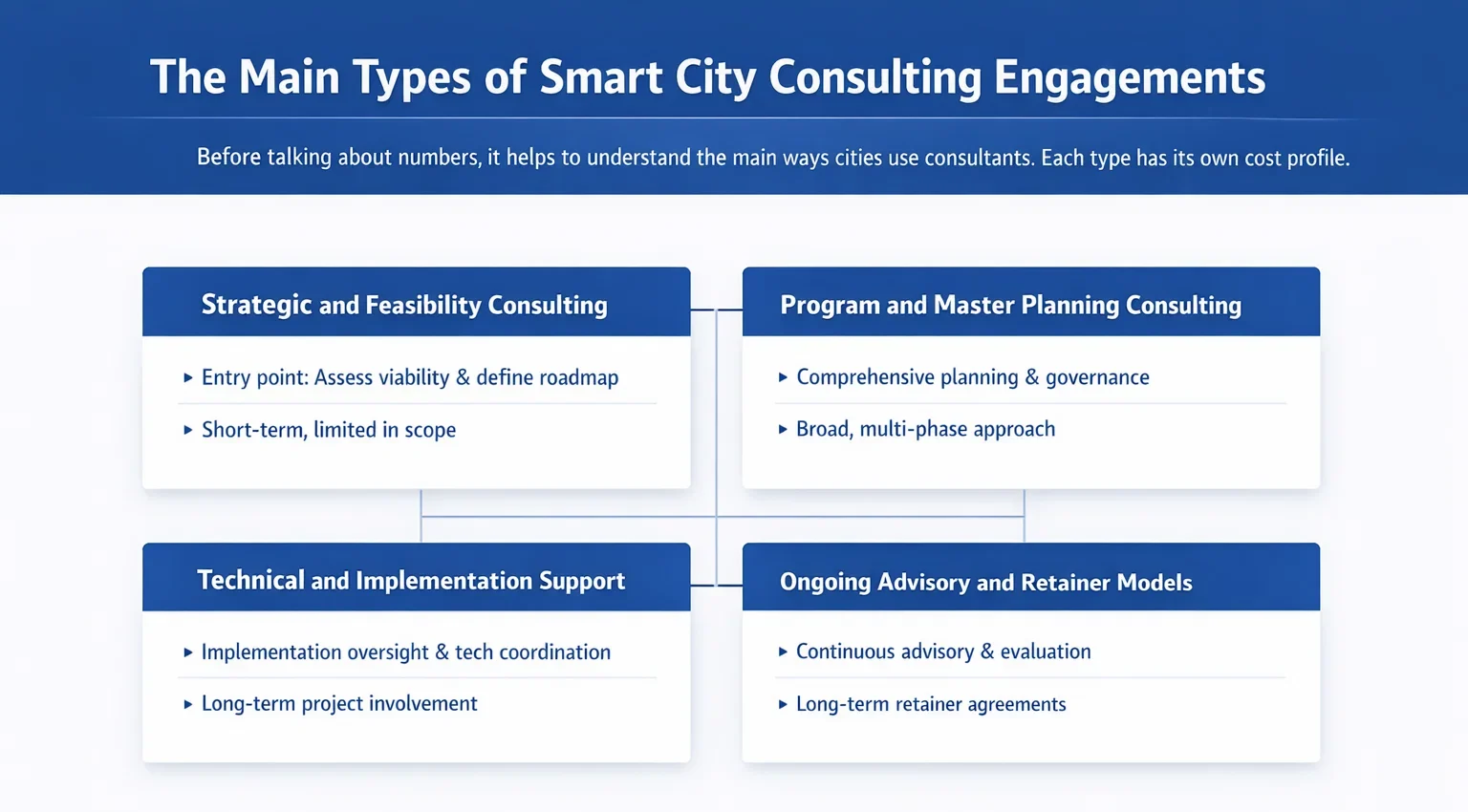
Before talking about numbers, it helps to understand the main ways cities use consultants. Each type has its own cost profile.
Strategic and Feasibility Consulting
This is usually the entry point. Cities hire consultants to answer basic but critical questions: Is this idea viable? Where should we start? What technologies make sense given our budget and constraints?
Typical work includes needs assessment, stakeholder interviews, high-level architecture design, and a roadmap outlining priorities over three to ten years.
These engagements are limited in scope and time. They are often used to support funding applications or political decision-making.
Program and Master Planning Consulting
Once a city commits to a smart city initiative, the scope expands. Consultants help define standards, select focus areas, design governance models, and align different departments around a shared plan.
This phase often includes detailed planning for mobility, energy, data platforms, digital services, and interoperability between systems. It also involves aligning with national regulations and sustainability goals.
Costs rise here because the work is deeper, more collaborative, and harder to compress into a short timeline.
Technical and Implementation Support
Some consultants stop at planning. Others stay involved during implementation. This can include vendor evaluation, technical specification reviews, pilot project oversight, and coordination between technology providers and city teams.
This is where smart city consulting starts to resemble long-term operational support. It requires continuous involvement and usually spans months or years.
Ongoing Advisory and Retainer Models
Larger cities and national programs often retain consulting firms on an ongoing basis. Instead of hiring them for a single project, they act as strategic advisors, helping evaluate new initiatives, review vendor proposals, and adapt to emerging technologies.
This model spreads cost over time but adds up significantly over the long term.
What Actually Drives Smart City Consulting Costs
The headline price is only the surface. Several factors consistently push costs up or down.
1. Scope Creep and Ambiguity
The biggest cost driver is unclear scope. Smart city projects evolve as stakeholders learn more. New priorities appear. Pilot projects expand. Without clear boundaries, consulting hours multiply.
Cities that invest time upfront to define scope usually spend less overall.
2. Stakeholder Complexity
Projects involving multiple departments, agencies, or public-private partnerships require more coordination. Meetings, workshops, and approvals take time, and that time is billable.
A technically simple project can become expensive if governance is complex.
3. Data Readiness and Infrastructure
Cities with poor data quality or fragmented systems require more groundwork. Consultants spend time cleaning data, mapping systems, and filling gaps before meaningful analysis can begin.
That preparatory work adds cost but is often unavoidable.
4. Regulatory and Procurement Constraints
Compliance with procurement rules, data protection laws, and public reporting requirements adds overhead. Consultants must document decisions carefully and adapt to formal processes that do not exist in private-sector projects.
5. Location and Market Maturity
Consulting costs vary by region. Cities in major innovation hubs or high-cost countries pay more for the same expertise. Emerging markets may pay less but face higher risk due to limited local capacity.
CapEx vs OpEx in Smart City Consulting Budgets
One of the most common misconceptions in smart city planning is that consulting sits entirely under operating expenses. In reality, smart city consulting spans both capital expenditure and operational expenditure, and treating it as only one or the other often leads to budgeting problems later on.
When Smart City Consulting Falls Under Capital Expenditure
Consulting tied to system design, technology selection, and infrastructure planning is closely linked to capital investment decisions. When consultants help define data platforms, IoT architectures, control centers, or interoperability standards, their recommendations directly shape long-term capital spending.
Decisions made at this stage influence procurement contracts, vendor lock-in, and infrastructure lifecycles. Poor advice here does not just affect consulting fees. It can lock cities into costly platforms, rigid architectures, or fragmented systems that are expensive to correct later.
When Smart City Consulting Is an Operating Expense
Ongoing advisory work typically falls under operational budgets. This includes program oversight, performance monitoring, vendor coordination, governance support, and continuous optimization of systems already in place.
These services focus less on building new assets and more on making sure existing investments perform as expected. Cities that plan for this operational layer avoid the common pattern of launching smart city initiatives only to see them stagnate once initial funding runs out.
Cities that clearly separate CapEx-related consulting from OpEx-related consulting tend to budget more realistically. They invest enough in early, high-impact planning while also funding the long-term support needed to keep smart city systems functional, secure, and relevant over time.
Is Smart City Consulting Worth the Cost?
This is the question every city asks, sometimes too late.
The value of consulting depends on how it is used. Consultants do not replace internal capacity. They complement it. When cities expect consultants to do everything, costs rise and outcomes suffer.
The best results come when consultants bring structure, experience, and external perspective while city teams retain ownership of decisions.
Smart city failures are often more expensive than consulting fees. Failed pilots, unused platforms, and abandoned systems waste far more public money than well-scoped advisory work.
Common Mistakes That Inflate Costs
Cities tend to run into the same problems again and again, and each of them quietly pushes consulting costs higher than planned.
- Hiring consultants without a clear mandate. Vague goals lead to endless workshops, shifting priorities, and reports that sound polished but say very little. Time gets billed, but direction gets lost.
- Choosing firms based on reputation alone. Well-known names do not always mean relevant experience. When consultants lack hands-on knowledge of public-sector delivery or smart city implementation, projects take longer and cost more without improving outcomes.
- Underestimating internal workload and capacity. When city teams are already stretched thin, consultants often step in to fill operational gaps they were never meant to cover. This increases fees and blurs responsibility between internal staff and external advisors.
- Focusing on technology before governance. Jumping into platforms and pilots without clear decision-making structures, data ownership rules, and accountability models almost guarantees rework later. Fixing governance issues after systems are deployed is always more expensive.
The Bottom Line
There is no single price for smart city consulting. In practice, cities pay anywhere from modest five-figure sums for targeted studies to multi-million-dollar budgets for long-term programs.
What matters most is not the number on the contract, but what that number buys. Clarity, coordination, and credible expertise save money in the long run. Confusion and overreach do the opposite.
Smart city consulting is expensive only when it is poorly defined. When used thoughtfully, it is one of the least costly parts of building cities that actually work.
Frequently Asked Questions
How much does smart city consulting usually cost?
In practice, smart city consulting ranges from USD 30,000 for focused feasibility work to several million dollars for long-term, multi-city programs. Most cities fall somewhere in between, depending on scope, duration, and how involved consultants are beyond planning.
Why do smart city consulting prices vary so widely?
Because smart city consulting is not a single service. Costs depend on factors like city size, project scope, data readiness, stakeholder complexity, regulatory requirements, and whether consultants are advising only or actively supporting implementation.
Is smart city consulting a one-time cost or an ongoing expense?
It can be both. Early-stage strategy and planning are often one-time costs, while implementation support, monitoring, and advisory services are ongoing expenses that may last several years.
Do small and mid-sized cities pay less than large cities?
Generally, yes. Smaller cities usually commission narrower studies or pilots, which cost less. Larger cities often require broader coordination, more stakeholders, and deeper technical work, which increases consulting fees.
What parts of smart city consulting fall under capital expenditure?
Consulting related to system design, platform selection, data architecture, and infrastructure planning often supports capital investment decisions. These costs are typically justified as part of larger infrastructure or digital transformation budgets.
 English
  German
  Arabic
  French
  Dutch
Dutch  Spanish