
Designing a smart city isn’t just about adding sensors or building futuristic towers. It’s about creating a place where tech, people, and infrastructure work in sync – on a large, complicated scale. That kind of planning comes with a serious price tag, but the range is wider than most expect. Depending on the size, goals, and location, costs can swing from a few million to well into the billions.
In this guide, we’ll break down what actually goes into smart city planning budgets, where the money tends to go, and why the “design” phase alone can stretch years and require deep coordination across tech, policy, and urban development.
What Are Smart Cities and How Much Their Design and Planning May Cost
Smart cities aren’t just urban areas with Wi-Fi and smart traffic lights. They’re deeply integrated ecosystems where infrastructure, digital services, sustainability goals, and community needs converge. And before anything gets built, a massive amount of planning and design has to happen behind the scenes.
If you’re wondering how much that part costs alone, the short answer is: it depends. But for context, design and planning for a smart city can range from $5 million for a small pilot to several hundred million for large-scale projects. Full greenfield developments may exceed $100 billion in total cost, with planning typically representing a smaller portion of that.
What Does “Smart City Planning” Mean?
Designing a smart city is not like drawing up plans for a residential block. It’s a multidisciplinary effort that touches everything from traffic systems and energy grids to data infrastructure, governance, and human behavior.
Here’s what typically needs to be covered in the design phase:
- Urban layout and land use.
- Transport and mobility planning (including EVs and autonomous vehicles).
- Utility infrastructure (smart grids, water, waste systems).
- Telecommunications backbone (5G, fiber, IoT networks).
- Energy modeling and sustainability planning.
- Digital services integration (e-government, public Wi-Fi, surveillance).
- Cybersecurity and data governance frameworks.
- Economic feasibility and regulatory review.
- Community engagement, accessibility, and inclusion planning.
And all of that comes before the first contractor shows up.

How We Contribute to Smart City Technology Planning
When cities and urban developers think about embedding intelligent systems into infrastructure, they need more than ideas. They need solid technological design and implementation support. At AI Superior, we specialize in delivering custom artificial intelligence solutions, from consulting and software development to advanced data science models. These capabilities are relevant to smart city planning because digital services, analytics, and automated systems are now core components of modern urban design.
We help teams recognize and assess areas where AI can add value, whether that is in transportation, utility efficiency, predictive maintenance, citizen engagement, or data-driven decision-making. That first step of identifying potential applications is critical in smart city design, and it often occurs during early planning before heavy investment is made.
With expertise in computer vision, natural language processing, predictive analytics, and big data analytics, our team builds technology that cities can use to improve services and inform strategic decisions. By offering consulting, tailored AI software development, and training, we support organizations seeking to make their infrastructure smarter, more efficient, and better prepared for future challenges.
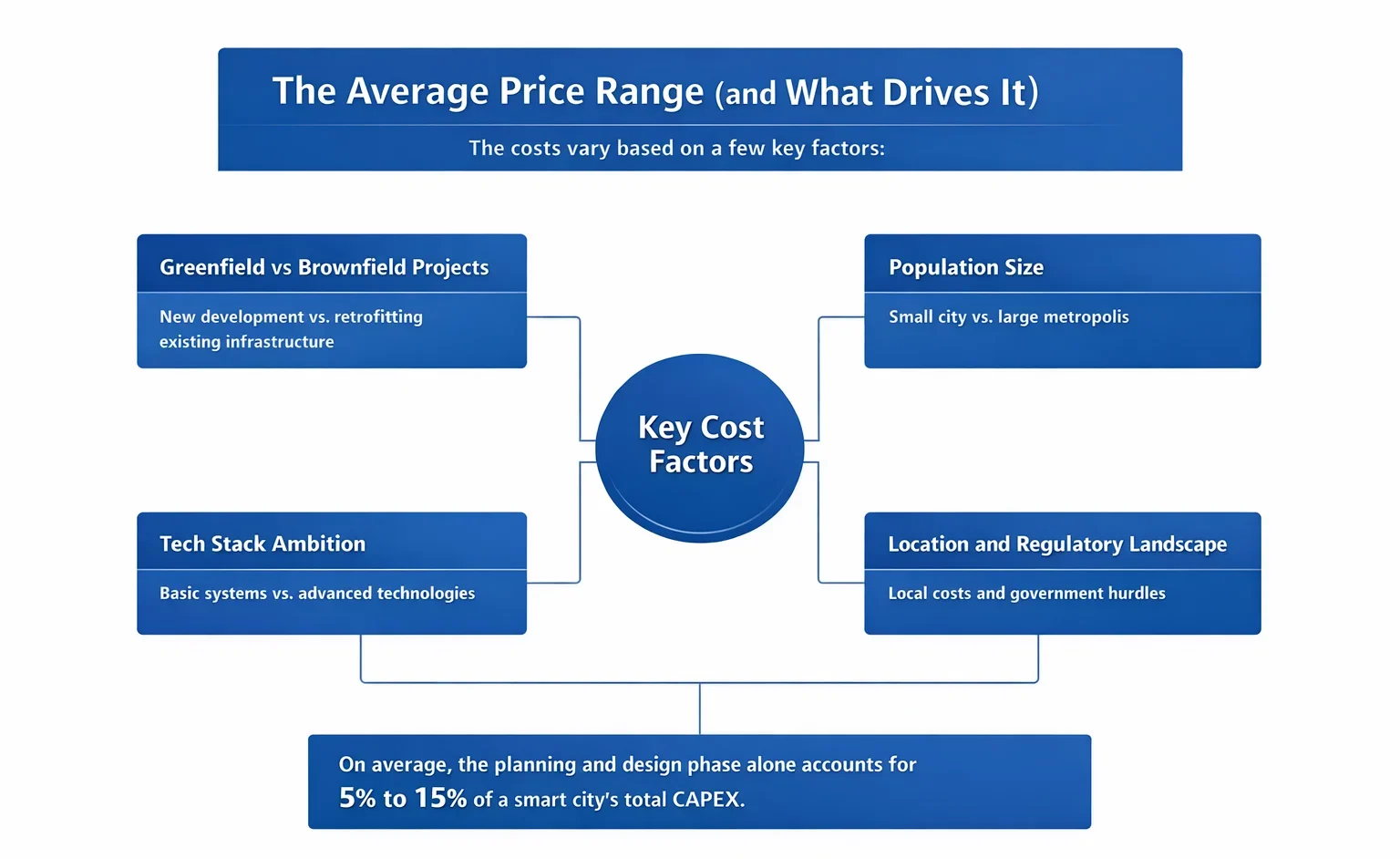
The Average Price Range (and What Drives It)
The costs vary based on a few key factors:
Greenfield vs Brownfield Projects
Starting fresh with a greenfield smart city means you’re building from the ground up – literally. That includes land development, laying down new infrastructure, and designing every layer of the system from scratch. It gives you flexibility but also drives costs way up. On the other hand, brownfield projects work with what’s already there. Retrofitting an existing city can be more complicated in terms of integration, but it often reduces the cost of foundational work like roads, utilities, and zoning.
Population Size
The more people you’re designing for, the more complex the system becomes. More residents means more transportation routes to plan, more data to manage, more services to connect, and more stress testing required across the board. A city of 50,000 is a different universe from one with 5 million.
Tech Stack Ambition
Not all smart cities aim for the same level of digital sophistication. If the plan includes AI-powered transit systems, predictive energy grids, autonomous vehicles, or real-time digital twins, expect a big bump in both planning time and cost. Those features require deeper technical modeling and far more coordination across sectors.
Location and Regulatory Landscape
Where you build also affects the budget. Land prices, environmental impact assessments, and permitting processes can vary widely between regions. And in areas with strict governance or slower bureaucratic processes, just getting approvals can take months or even years, adding time, cost, and uncertainty to the planning phase.
On average, the planning and design phase alone accounts for 5% to 15% of a smart city’s total CAPEX.
Typical Cost Ranges by Project Type
Here’s a practical look at how costs scale depending on the type of project:
| Project Type | Population | Design & Planning Cost Range |
| Smart District Pilot | 10,000 – 50,000 | $5M – $50M |
| Medium City Upgrade | 100,000 – 300,000 | $50M – $200M |
| Large Citywide Modernization | 1M+ | $200M – $2B |
| Full Greenfield Smart City | 100,000 – 1M | $25M – $750M |
These estimates include conceptual design, modeling, assessments, consultations, and legal groundwork.
Where Exactly Does the Money Go?
Planning a smart city is a team sport involving engineers, designers, urban planners, economists, data scientists, and policy experts. The most common budget items include:
- Feasibility studies: Land use, environmental impact, transport modeling, and climate risk.
- Smart infrastructure audits: To identify integration opportunities with legacy systems.
- Technology architecture: Plans for data platforms, sensor networks, and software interoperability.
- Simulation and digital twins: 3D modeling of infrastructure and services to test performance before building.
- Stakeholder workshops: Engagement with residents, business owners, government agencies.
- Regulatory review and permitting: Legal planning, zoning, and compliance analysis.
- Project management and governance design: Roadmaps, phase planning, and decision-making frameworks.
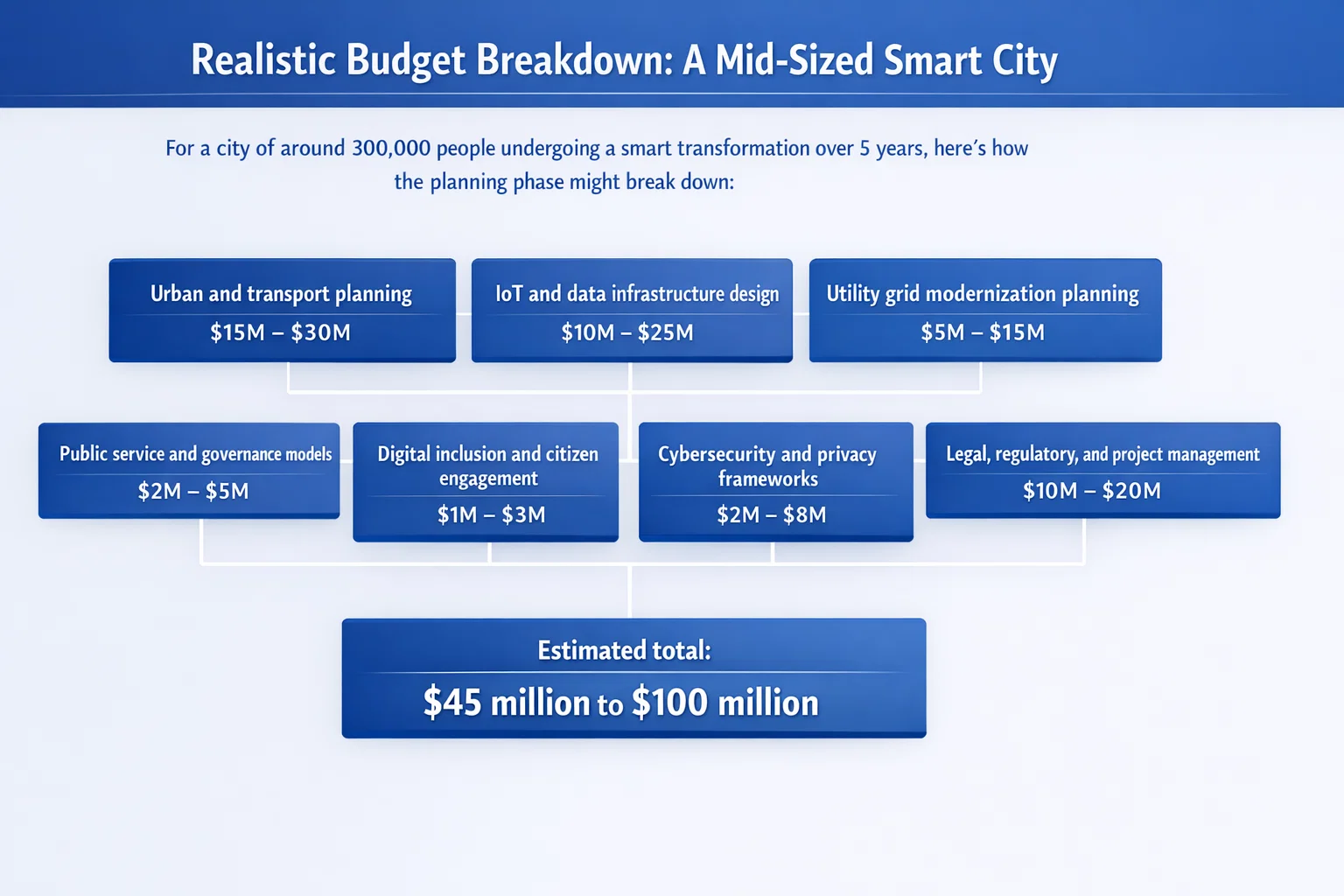
Realistic Budget Breakdown: A Mid-Sized Smart City
For a city of around 300,000 people undergoing a smart transformation over 5 years, here’s how the planning phase might break down:
- Urban and transport planning: $15M – $30M
- IoT and data infrastructure design: $10M –$25M
- Utility grid modernization planning: $5M – $15M
- Public service and governance models: $2M – $5M
- Digital inclusion and citizen engagement: $1M – $3M
- Cybersecurity and privacy frameworks: $2M – $8M
- Legal, regulatory, and project management: $10M – $20M
Estimated total: $45 million to $100 million
Other Important (and Costly) Elements
As smart city projects scale up in complexity, certain components that were once considered optional are now increasingly built into early-stage planning. These elements may not always be prominent in initial budgets, but they can have a major impact on cost control and long-term functionality. Skipping them often leads to more expensive fixes later, when redesigns are harder to implement.
1. Digital Twin Modeling
Many cities now incorporate digital twins as part of their planning tools. These 3D simulations help test infrastructure performance, service delivery, and urban dynamics before construction begins. While not mandatory, they are becoming more common for identifying design issues early and reducing costly changes down the line.
2. Smart Regulations
Creating a smart city often involves writing new governance frameworks around privacy, AI, and open data. Working with legal experts to draft and validate these policies is increasingly built into early-stage budgets, especially in regions with strict compliance requirements.
3. Citizen Feedback Mechanisms
Smart cities must serve real communities. Gathering input through surveys, focus groups, and prototype testing ensures the city’s services align with public needs. While not always included in technical planning, these efforts play a critical role in long-term usability and acceptance.
The Cost of Doing It Wrong
Underfunded or rushed planning phases tend to create problems later. Here are some of the long-term costs of poor planning:
- Fragmented systems with no interoperability.
- Vendor lock-in due to lack of tech standards.
- Expensive rework during implementation.
- Public pushback from ignored communities.
- Missed sustainability and equity targets.
Spending more up front on careful design reduces these risks and usually results in smoother builds and better public outcomes.
Smart City Planning Is Not a One-Time Task
Smart city design isn’t static. Technology changes, needs evolve, and cities grow. That’s why part of the planning budget needs to be set aside for continuous improvements.
Cities should expect to revisit their digital plans every few years and allocate funds for:
- System upgrades and decommissioning outdated tech.
- Monitoring and evaluation tools.
- Rolling out new services based on citizen behavior.
- Emergency response updates and failover planning.
Final Thoughts
Smart city planning and design is the invisible foundation under everything that follows. It’s not just architectural work or digital wishlists. It’s about making thoughtful, flexible, human-centered choices at scale.
Whether you’re planning a small district or a large-scale city from scratch, the investment in upfront design will shape how effectively that city serves its people over decades. Budget accordingly, think holistically, and remember: the smarter the plan, the fewer surprises down the road.
FAQ
1. Is it possible to plan a smart city on a small budget?
Yes, but scale and focus matter. You won’t get a full-fledged, tech-integrated city for a few million, but you can design a smart district or run a pilot program. Many cities start small – think sensor-enabled traffic systems or predictive waste management – and expand from there as budget and experience grow.
2. Why is the planning phase so expensive?
Because you’re not just sketching buildings – you’re mapping out interconnected systems, digital infrastructure, governance models, and public services that need to function as one. You also need specialists: urban planners, data scientists, AI architects, civil engineers, policy analysts. Planning a smart city is basically building a whole operating system before the physical part even starts.
3. How long does smart city planning usually take?
Timelines vary, but for anything beyond a basic concept, you’re looking at 12 to 36 months just for design and strategy. That includes feasibility studies, modeling, stakeholder approvals, and regulatory reviews. And that’s before construction or deployment begins.
4. What’s the biggest mistake cities make when budgeting for smart tech?
They underestimate the cost of integration and long-term management. Buying the tech is one thing. Making sure it works across departments, complies with laws, evolves with future needs, and stays secure? That’s the real work and the real cost.
5. Does every smart city need AI?
Not necessarily, but it helps. AI isn’t required, but it can improve traffic flow, predict energy use, and automate data analysis. Cities can function without it, but AI makes systems faster, smarter, and easier to scale.
 English
  German
  Arabic
  French
  Dutch
Dutch  Spanish