
Quick Summary: Image recognition for cars uses convolutional neural networks (CNNs) to automatically identify vehicle make, model, type, and other characteristics from photos. These systems achieve accuracy rates of 83-97% and power applications from autonomous driving to parking management. The technology relies on deep learning models trained on large datasets of labeled vehicle images. Image recognition for cars has become essential technology across the automotive industry. From automated toll systems to classic car valuation apps, AI-powered vehicle identification solves real problems every day. But how does a computer actually recognize a sedan from an SUV? The answer lies in convolutional neural networks trained on thousands of vehicle images.
How Car Recognition Systems Work
Vehicle recognition systems process images through multiple layers of neural networks. Each layer identifies different features—edges in early layers, then shapes, and finally complete vehicle characteristics like grille patterns or body styles. According to IEEE research on vehicle detection, convolutional neural networks have become the standard approach for car model recognition. These deep learning models analyze both holistic appearance and specific vehicle parts to make accurate identifications. The technology captures images across a wide spectral range. Research from Princeton’s Computational Imaging Lab shows that RCCB stereo arrays capture from 380 to 1050 nm, with a 0.76 m baseline distance. This setup delivers 30% improved nighttime performance compared to conventional RGB cameras. 
Develop Computer Vision Software With AI Superior
AI Superior builds AI-based applications and custom software products using machine learning and AI models. Their team supports projects from discovery and data review to MVP development, integration, and result evaluation. For automotive use cases, this can help with vehicle detection, damage checks, part recognition, camera-based inspection, or other image-based workflows.
Need Computer Vision for Vehicle Data?
AI Superior can help with:
- building image recognition systems
- detecting and classifying objects in images
- creating custom AI models for visual analysis
- connecting AI tools with existing workflows
👉 Contact AI Superior to discuss your project.
Accuracy and Performance Metrics
Modern car recognition APIs achieve impressive accuracy. As of 2026, industry-leading vehicle recognition systems integrated with Generative AI and LLM validation layers achieve accuracy rates between 98% and 99.9%. Research on 3D object detection methods found that the Triangulation Learning Network performed best with the highest Average Precision and Orientation Score compared to other approaches. The Monocular 3D Object Detection method showed approximately 6% improvement in both AOS and average precision over baseline methods. Training data quality matters significantly. Data augmentation techniques improve model performance across various training scenarios.
| Detection Method | Average Precision | Orientation Score |
|---|---|---|
| Triangulation Learning Network | 0.9467 | 0.9965 |
| Monocular 3D Detection | 0.9204 | 0.9958 |
| Deep Learning & Geometry | 0.8678 | 0.9821 |
Real-World Applications
Vehicle recognition powers diverse applications across industries. Automated parking systems use classification to identify vehicle types—minivans, SUVs, and sedans—for space allocation. Toll collection systems benefit from real-time vehicle identification for accurate billing. Transportation monitoring networks track traffic patterns by vehicle category. The Classic Valuer app demonstrates consumer applications, identifying classic cars from photos with 83% accuracy and providing valuation data. The system operates as a real-time data aggregator consuming data from over 600,000+ vehicles and 50+ auction houses daily, providing dynamic valuations rather than just static image matching.
Autonomous Vehicle Integration
Self-driving systems rely heavily on vehicle detection and classification. Princeton’s driving datasets specifically address adverse weather conditions—snow, heavy rain, fog—which remain critical challenges for autonomous perception. Modern sensor arrays combine visual spectrum imaging with near-infrared capture. The Onsemi AR0820AT image sensor is optimized for low-light performance and the Princeton Computational Imaging Lab research mentions 140 dB on-sensor HDR dynamic range in related sensor applications, enabling robust detection across lighting conditions.
Training Data Requirements
Effective car recognition models require substantial training datasets. Data must be collected across multiple viewpoints, lighting conditions, and real-world scenarios to train robust classification systems. The Car Model Recognition Dataset includes 1,717 original images and 11,265 augmented images through data augmentation techniques. Images capture multiple viewpoints, lighting conditions, and real-world scenarios collected from diverse environments. Dataset diversity directly impacts model performance. Collections must represent various car positions, angles, and environmental conditions to train robust classification systems. 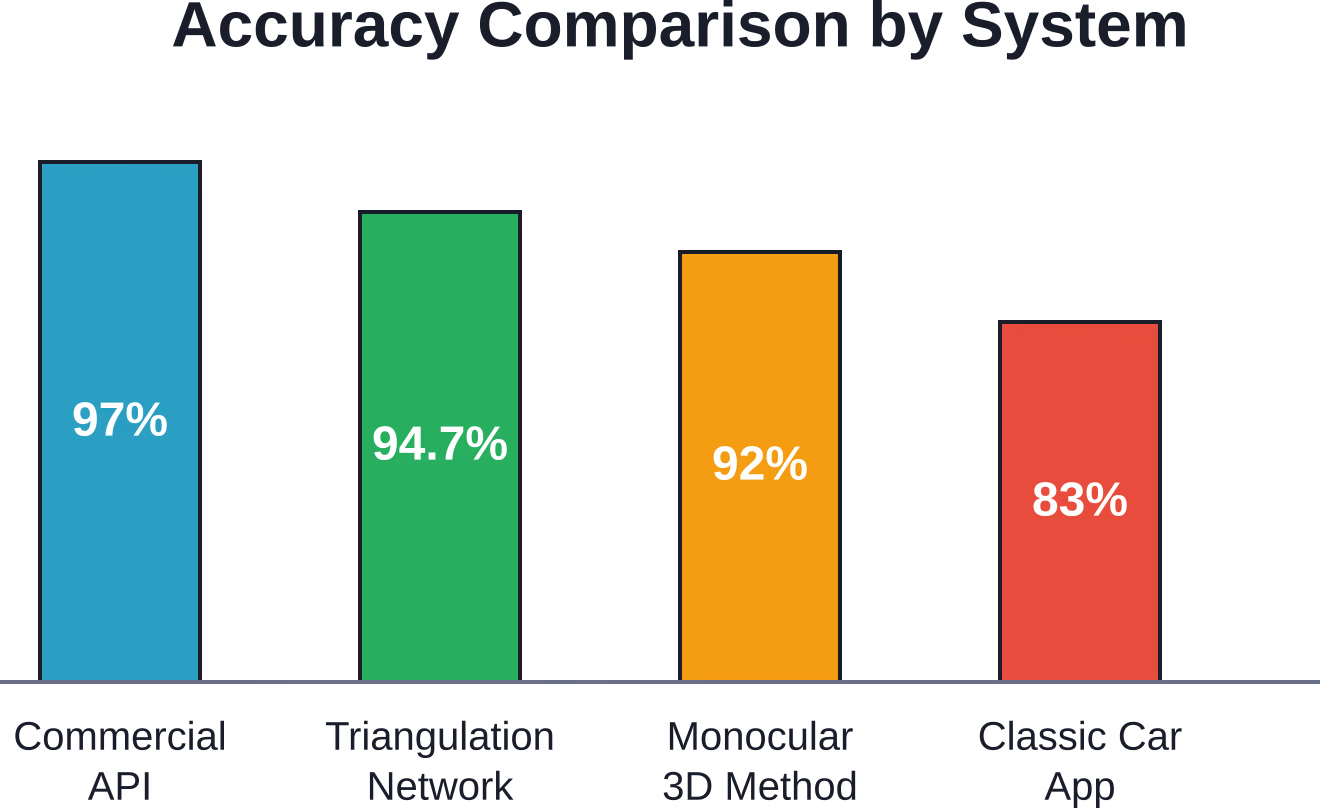
Implementation Considerations
Organizations implementing vehicle recognition face several technical decisions. Cloud-based APIs offer immediate deployment but require ongoing subscription costs. Custom model training provides greater control but demands computing resources and machine learning expertise. Microsoft Azure AI services support vehicle recognition model training through managed infrastructure. Azure AI custom vision enables teams to train models on proprietary datasets without provisioning dedicated computing instances. Image quality requirements vary by application. Systems need sufficient resolution to capture distinguishing features—grille patterns, headlight shapes, body contours. Minimum recommended resolution depends on vehicle distance and identification granularity required.
Future Developments
Ongoing research addresses remaining challenges. Weather robustness continues improving through specialized training datasets capturing adverse conditions. Multi-modal sensor fusion combines visible light with infrared and radar data for enhanced reliability. Fine-grained recognition accuracy keeps advancing. Current systems distinguish broad categories reliably; next-generation models aim for year-specific model identification and aftermarket modification detection. Edge computing deployment enables real-time processing without cloud connectivity. Optimized neural networks run directly on vehicle-mounted hardware or embedded cameras for reduced latency and improved privacy.
Frequently Asked Questions
How accurate is car image recognition technology?
Commercial car recognition systems achieve 98-99.9%% accuracy for make and model identification. Research systems like the Triangulation Learning Network demonstrate 94.67% average precision in controlled evaluations. Accuracy depends on image quality, lighting conditions, and the specific vehicle database size.
What technology powers vehicle image recognition?
Convolutional neural networks form the core technology for car recognition. These deep learning models process images through multiple layers to extract features and classify vehicles. Training requires large datasets of labeled vehicle images—typically thousands of examples per model category.
Can image recognition identify vehicle color and type?
Modern systems identify multiple vehicle attributes including color, type (sedan, SUV, minivan), make, model, and sometimes generation year. Advanced systems detect orientation and 3D positioning with orientation scores exceeding 0.99 in research environments.
What are common applications of car recognition?
Vehicle recognition powers automated parking systems, toll collection, traffic monitoring, vehicle valuation apps, law enforcement databases, and autonomous driving perception systems. Applications range from consumer mobile apps to enterprise transportation infrastructure.
How much training data is needed for car recognition?
Effective models require hundreds to thousands of images per vehicle category. Published datasets contain 1,700+ original images, often augmented to 10,000+ training examples. Research datasets typically allocate 30% of images for testing, with diverse images captured per collection to ensure robust evaluation.
Does weather affect vehicle recognition accuracy?
Adverse weather conditions like rain, fog, and snow significantly challenge recognition systems. Specialized datasets address these scenarios through diverse capture conditions. Modern sensors with extended spectral ranges (380-1050 nm) and high dynamic range (140 dB) improve performance in difficult lighting and weather.
Can I use pre-trained models for vehicle recognition?
Commercial APIs offer pre-trained models accessible via subscription. Cloud platforms like Microsoft Azure provide custom vision services for training specialized models. Open-source implementations exist, though production deployment requires infrastructure for model hosting and inference processing.
Conclusion
Image recognition for cars represents mature technology solving practical challenges across automotive and transportation sectors. With accuracy rates approaching 97% and diverse application scenarios, vehicle recognition systems continue expanding into new use cases. Whether deploying automated parking, building traffic analytics, or developing consumer apps, understanding CNN-based recognition fundamentals helps teams select appropriate solutions. Check current API pricing and model performance benchmarks when evaluating commercial options for your specific application.