
Quick Summary: Image recognition for field sales uses AI and computer vision to automatically audit store shelves, detect products, and verify planogram compliance from photos captured by field reps. Modern platforms achieve above 95% accuracy on production shelves, cutting audit time from 12-15 minutes per store to under 1 minute while improving on-shelf availability by 15% and freeing field teams to focus on relationship-building and execution instead of manual data entry. Manual audits are expensive. Not in dollars spent on clipboards, but in what gets missed while your field rep is counting facings in aisle three. Every minute spent logging SKU positions is a minute not spent negotiating shelf space, coaching a store owner, or fixing an out-of-stock that’s bleeding revenue right now. The math is brutal: a rep covering 25 outlets a day burns 12 to 15 minutes per store on planogram checks, SKU counts, and compliance photos. That’s five to six hours of pure data collection every single day. Image recognition changes that equation. Point a phone camera at a shelf, tap once, and the platform delivers a full compliance report—facings, out-of-stocks, planogram violations, share-of-shelf—in under 4-6 seconds. No typing. No guessing. No emailing photos to HQ for someone else to decode three days later. This guide walks through what actually matters in 2026—accuracy thresholds that hold up in production, deployment speed for CPG realities, and the difference between a platform that detects products and one that drives decisions. No fluff. Just the criteria that separate tools that work from tools that get abandoned after the pilot.
What Is Image Recognition for Field Sales?
Image recognition for field sales is computer vision applied to retail execution. Field reps photograph shelves, coolers, displays, or point-of-sale setups using a mobile app. The platform analyzes each image using trained neural networks to identify products, measure facings, detect out-of-stocks, verify planogram compliance, and calculate share-of-shelf—all automatically. The output is structured data: which SKUs are present, how many facings each holds, whether the arrangement matches the agreed planogram, and where gaps exist. That data flows into dashboards, triggers alerts, and feeds into broader field execution or distribution management systems. It’s not just OCR or barcode scanning. Modern image recognition uses convolutional neural networks and deep learning models to recognize products from their visual appearance—packaging shape, label design, brand colors—even when barcodes are obscured, labels are worn, or lighting is poor. The technology works across retail formats: modern trade with standardized shelving and lighting, general trade where every store layout is unique, and emerging channels like quick-commerce dark stores where speed matters more than perfection.
Why Field Sales Teams Adopted Image Recognition
Manual audits don’t scale. A field rep covering general trade might visit 25 to 30 outlets daily. Spending 12 to 15 minutes per store on compliance checks and data entry adds up to half the working day. That’s time not spent selling, training, or solving the stockout that’s costing the brand money every hour it persists. In India, 85% of FMCG sales still flow through general trade—roughly 13 million kirana stores, each one run by an owner who makes 80% of merchandising decisions based on what moved last week. Compliance is less a matter of enforcing corporate planograms and more a negotiation rooted in real-time data. If your rep walks in with a hunch but no proof, the conversation goes nowhere. Walk in with a photo-backed share-of-shelf analysis showing the competitor gained three facings last month while your brand’s velocity stayed flat, and now there’s a data point to anchor the ask. Image recognition also closes the visibility gap. HQ teams used to rely on self-reported surveys or random photos emailed by reps. No consistency, no structure, no way to trend the data or compare across regions. With automated image analysis, every store visit generates the same structured dataset—same SKU list, same metrics, same format—making it possible to spot patterns, benchmark regions, and measure the ROI of trade spend. And it surfaces problems faster. A manual audit might catch an out-of-stock during the next scheduled visit, which could be a week away. Image recognition flags it the moment the photo uploads. If the rep is still in the store or nearby, they can act immediately—reorder, restock from the back room, or escalate to distribution. 
Create AI Tools for Image-Based Workflows With AI Superior
AI Superior helps companies move from an AI idea to working software through discovery, data review, MVP development, integration, and result evaluation. This makes their work practical when image recognition needs to fit an existing process, not sit outside it. For field sales teams, this can help with store visit photos, shelf checks, product placement reviews, and visual reports from the field.
Need Image Recognition for Daily Workflows?
AI Superior can help with:
- building custom computer vision tools
- classifying objects in store or field images
- testing image recognition ideas with PoC or MVP work
- integrating AI into existing systems
👉 Contact AI Superior to discuss your project.
How Image Recognition Actually Works in the Field
Image recognition in retail usually starts with a simple shelf photo. The process looks easy from the rep’s side, but several steps happen in the background before the data reaches the team.
The Rep Captures the Shelf
The field rep opens the app, selects the store record, and starts the audit module. The app activates the camera, and the rep frames the shelf section - a single bay, cooler door, display, or full category run. Some platforms guide the photo with an overlay or warn the rep if the angle, distance, or lighting may affect accuracy.
The System Analyzes the Image
After the photo is taken, the image either uploads to the platform’s servers or processes locally on the device if the model supports edge inference. The neural network then breaks the image into sections, detects individual products, matches them against the trained SKU library, counts facings, measures shelf space, and compares the layout with the planogram on file.
The App Shows Results in Seconds
Within seconds, the rep sees the audit results. This may include a visual overlay with recognized SKUs, a compliance score, out-of-stock items, planogram issues, and share-of-shelf percentages by brand. The rep can review the results, correct any misidentified products if the platform allows it, and submit the audit.
The Data Syncs With HQ
Once submitted, the data updates the back-end system, dashboards, and any connected alerts or workflows. Category managers can then review OSA trends by region, planogram compliance by store format, share-of-shelf changes, and competitor movement. Field managers can also check individual store audits and coach reps based on real execution gaps.
The Main Advantage Is Speed
A fast platform can complete the photo-to-insight cycle in about 4-6 seconds per store. Compared with manual counts and clipboard audits, that speed can save serious time for CPG field teams while giving managers cleaner, more consistent data.
Accuracy: The Only Metric That Matters First
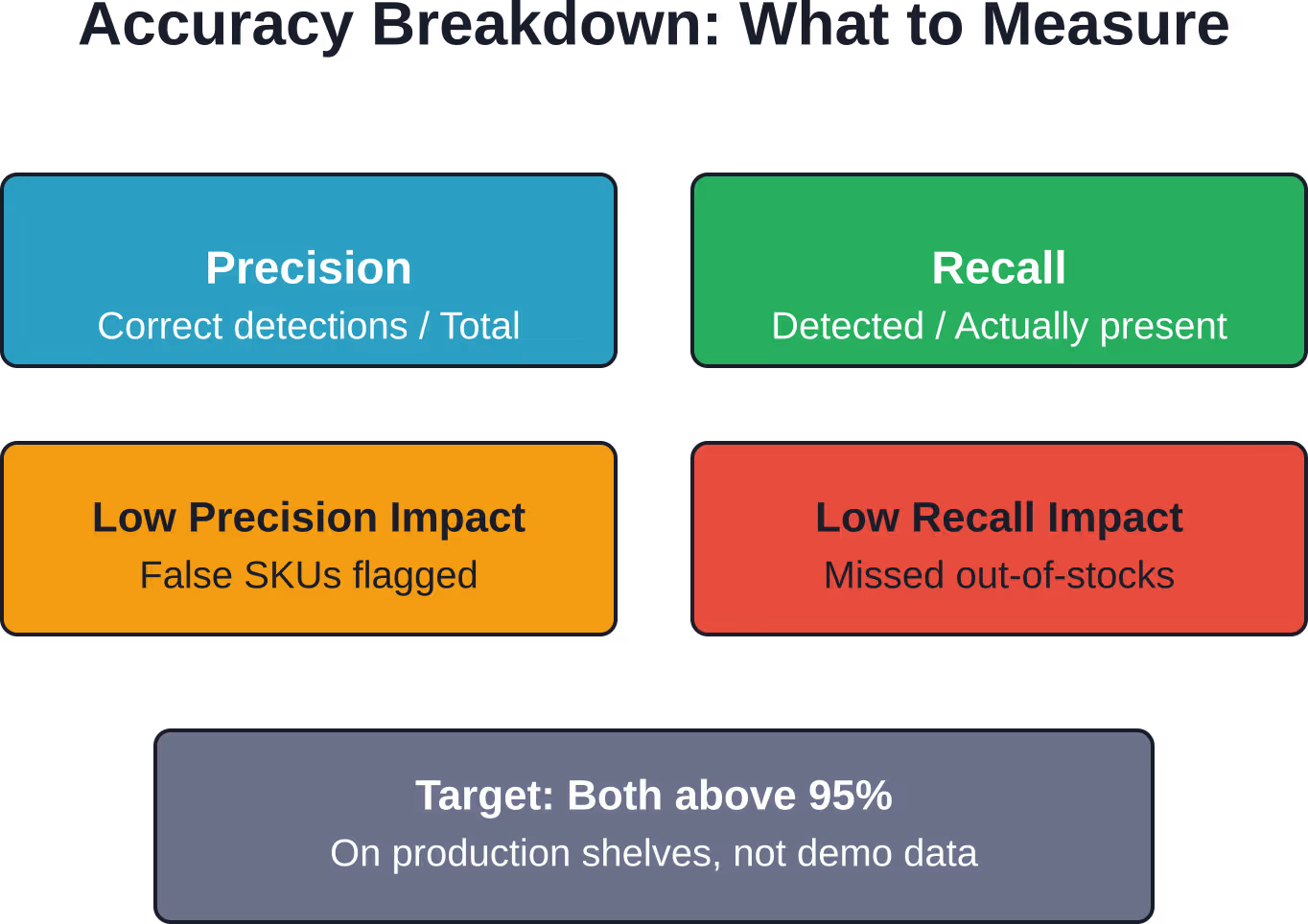
Every platform claims high accuracy. Look for numbers above 95% on production shelves, not just on controlled demo photos. Below 90% accuracy, reps spend so much time correcting false positives and missed SKUs that the tool becomes slower than manual audits. But accuracy isn’t a single number. It breaks into precision (how many detected SKUs are correct) and recall (how many actual SKUs present were detected). A platform with 98% precision but 85% recall will miss one in seven products—useless for out-of-stock detection. A platform with 90% precision but 99% recall will flag products that aren’t there—useless for compliance scoring.
- Look for platforms that publish separate precision and recall figures. Research on engineering drawing recognition frameworks achieved 98.98% accuracy with 99.33% recall on electrical diagrams., and the lowest recall across eight symbol classes was still 98.7%. Similar benchmarks should apply to retail shelf recognition if the training data and model architecture are solid.
- Also ask about accuracy degradation in real-world conditions: poor lighting, angled shots, cluttered shelves, worn packaging, partial occlusions. A model trained only on clean, front-facing product images will fail the moment it hits a crowded kirana shelf at dusk. The best platforms train on images captured in the field by actual reps, not staged in a studio.
- And ask about new SKU onboarding speed. When your brand launches a new flavor or package size, how long before the model recognizes it? Platforms with pre-trained libraries covering 1.3 million SKUs sound impressive until you realize your specific SKU isn’t in there and onboarding takes three weeks. Others let you upload reference images and retrain the model in hours.
Deployment Speed and SKU Library Coverage
Accuracy means nothing if deployment takes six months. The best platforms offer pre-trained SKU libraries covering major CPG categories. If your portfolio sits inside that library, you can pilot in weeks: configure the app, assign reps, and start capturing audits. But most mid-market brands and regional players won’t find their SKUs pre-loaded. That’s where onboarding speed matters. Some platforms require you to ship physical samples to a lab for photography and manual labeling—expect four to eight weeks. Others let you upload reference images directly and use transfer learning to fine-tune the model in days. Ask how many reference images per SKU the platform needs. Five angles per SKU? Fifty? The lower the number, the faster you scale. Also ask whether the model improves over time as reps capture real-world photos. Platforms that feed field images back into training loops get more accurate with use; static models stay frozen at pilot-level performance. And consider multi-market deployments. If you operate in six countries, does the platform handle regional SKU variants, different languages on packaging, and local competitors in the same model? Or do you need to train six separate models and manage six separate deployments?
What to Test Before You Sign
Run a controlled pilot before committing to an enterprise contract. Pick a representative sample: mix of store formats (modern trade and general trade), range of lighting conditions (bright supermarkets and dim kirana shops), and your full SKU portfolio including the hard-to-detect items—similar packaging, small sizes, dark labels. Have reps capture 50 to 100 audits using the platform’s app. Then manually audit the same shelves and compare results. Calculate precision, recall, and overall accuracy. If the platform claims 97% but your pilot shows 88%, walk away or renegotiate. Test edge cases: products behind price tags, partially occluded SKUs, competitor products that look nearly identical to yours, shelves photographed at steep angles, images captured in dim light or backlit by windows. These are the conditions your reps face daily. If the platform fails here, it will fail in production. Measure speed end-to-end: time from photo capture to results displayed in-app, and time from submission to data visible in the HQ dashboard. If the rep waits 30 seconds staring at a loading spinner, they’ll skip audits when they’re behind schedule. If HQ sees data with a two-hour lag, they can’t act on stockouts in time. And test integration. Does the platform push data to your existing field execution software, CRM, or BI tools via API? Or does it trap data in a proprietary dashboard with no export? Siloed data is expensive data—you’ll spend more on manual reporting than you save on audit time.
Top Use Cases Driving ROI in 2026
Image recognition delivers measurable value across several field sales workflows. The most common use cases in 2026:
Planogram Compliance Verification
Compare shelf reality to the agreed planogram. The platform overlays the ideal layout on the captured image, highlights deviations, and scores compliance as a percentage. Field managers spot execution gaps by region or rep. Category teams see which planogram elements get ignored (hint: it’s usually the ones that are hardest to execute) and revise plans accordingly. One CPG brand using automated compliance audits found that front-facing product boxes lifted sales by 20%, but 70% of stores weren’t executing it. Manual audits missed the pattern because reps self-reported compliance. Image recognition surfaced the gap within two weeks, and targeted retraining fixed it in a month.
Out-of-Stock Detection and Alerts
The platform flags missing SKUs instantly. If the rep is still on-site, they can check the back room or trigger a reorder. If the stockout persists across multiple visits, the system escalates to distribution or supply chain. Brands report 10% to 15% improvements in on-shelf availability within the first quarter of deployment, driven entirely by faster detection and response.
Share-of-Shelf Measurement
Calculate the percentage of shelf space occupied by your brand versus competitors. Track changes week-over-week and correlate with sales data to validate the space-to-sales relationship. For instance, if a sparkling water brand accounts for 40% of category sales in a region but only occupies 25% of shelf space, there’s a clear opportunity to negotiate for more facings—or evidence that the retailer is underweighting a high-velocity SKU.
Promotional Execution and POS Compliance
Verify that promotional displays, standees, posters, and price tags are present and positioned correctly. Image recognition detects not just products but also branded POS materials. Brands launching a trade promotion can audit execution across thousands of outlets in days, spot underperforming regions, and reallocate support before the campaign ends.
New Product Introduction Tracking
Monitor distribution and shelf placement of newly launched SKUs. See which stores received stock, which placed the product on-shelf versus in the back room, and which gave it prominent versus buried placement. Accelerate time-to-shelf by identifying bottlenecks—distribution delays, retailer reluctance, or rep coaching gaps—early in the launch cycle.
Comparing Platforms: What Separates Leaders from Laggards
The image recognition market for retail has consolidated around a few platform types. Here’s how they differ:
All-in-One Field Execution Suites
Platforms that bundle image recognition with route planning, task management, order capture, and CRM. Good if the entire field stack needs replacement. Less fit if a robust field execution system is already in place and only a best-in-class recognition layer is needed.
Pure-Play Image Recognition APIs
Platforms that do one thing—analyze shelf images—and do it extremely well. They integrate with existing field apps via API. Ideal when the current mobile app works but lacks vision capabilities, or when building a custom solution in-house.
Category-Specific Platforms
Tools trained exclusively on beverage coolers, or beauty shelves, or pharmacy OTC aisles. Higher accuracy within their niche because the training data is hyper-focused, but they don’t generalize. Useful for single-category brands; limiting for diversified portfolios.
Custom-Trained Enterprise Solutions
Platforms that treat each client as a bespoke deployment: custom model training, custom SKU libraries, custom integration. Maximum flexibility and accuracy, maximum cost and deployment time. Usually reserved for large CPG enterprises with hundreds of SKUs and complex requirements.
| Platform Type | Deployment Speed | Accuracy | Cost | Best For |
|---|---|---|---|---|
| All-in-One Suite | Medium (8–12 weeks) | Good (92–96%) | Medium | Full field stack overhaul |
| Pure-Play API | Fast (2–4 weeks) | Excellent (95–98%) | Low to Medium | Adding vision to existing app |
| Category-Specific | Fast (2–3 weeks) | Excellent in niche (96–99%) | Low | Single-category brands |
| Custom Enterprise | Slow (12–20 weeks) | Excellent (97–99%) | High | Large CPG with complex SKU sets |
Integration and Data Flow
Image recognition isn’t valuable in isolation. The insights need to flow into systems people already use: field execution dashboards, BI tools, CRM, supply chain planning, trade spend management. Check whether the platform offers:
- RESTful API for real-time data pull and push
- Webhook support to trigger actions (alerts, workflows) when conditions are met
- Pre-built connectors for popular field sales and ERP platforms
- Bulk export in standard formats (CSV, JSON, XML) for ad-hoc analysis
- Embedded analytics that can be white-labeled or iframed into existing dashboards
Platforms that trap data in proprietary dashboards with limited export force teams to log into yet another tool. Adoption suffers, and the data never makes it into the workflows that drive decisions.
Cost Structure and Total Cost of Ownership
Pricing models vary widely. Some platforms charge per user per month—straightforward but expensive if the field team is large. Others charge per image analyzed, which scales with usage but makes budgeting harder. A few charge a flat annual license fee plus onboarding costs. Look beyond the sticker price. Factor in:
- Onboarding and training: Does the vendor provide on-site or virtual training for reps and managers? Or is it self-service documentation only?
- SKU library setup: Are reference images and model training included, or billed separately?
- Integration work: Does the vendor handle API integration and testing, or does that fall on your IT team?
- Ongoing support: Is support included in the license, or charged per incident?
- Model retraining: When SKUs change or new products launch, is retraining free or metered?
A platform priced at half the competition’s rate can end up costing more if onboarding takes twice as long and requires consultants to integrate.
Common Pitfalls and How to Avoid Them
Plenty of image recognition pilots fail. Not because the technology doesn’t work, but because expectations weren’t aligned or the wrong platform was chosen for the use case.
Piloting with Perfect Conditions
Testing only in well-lit modern trade stores with clean shelves gives a false sense of accuracy. When the platform hits general trade—dusty shelves, poor lighting, non-standard layouts—performance craters. Always pilot in the hardest environments first.
Ignoring Rep Adoption
If the app is clunky, slow, or requires five taps to capture an audit, reps will revert to manual methods. Involve field reps in platform selection. Let them test the UI and provide feedback. A technically superior platform that reps hate will deliver zero ROI.
Expecting Perfection Day One
Even the best platforms need a few weeks of real-world data to fine-tune accuracy. Don’t abandon a pilot because the first 50 audits show 92% accuracy instead of the promised 97%. If the vendor is responsive and accuracy improves as more images feed the training loop, that’s a good sign.
Overlooking Change Management
Field teams accustomed to clipboards and manual counts may resist adopting image recognition, viewing it as surveillance or a threat to their autonomy. Frame the technology as a tool that frees them from data entry so they can focus on selling and relationship-building. Share early wins—time saved, out-of-stocks caught—to build buy-in.
What’s Coming Next in Image Recognition
The technology keeps improving. Neural network architectures are getting smaller and faster, enabling more processing on-device rather than in the cloud. This reduces latency and works better in low-connectivity environments—critical for emerging markets where field reps often work offline. Multi-modal models are emerging that combine image recognition with other data sources: sales data, foot traffic, weather, promotional calendars. Instead of just reporting that a shelf is out-of-stock, the platform predicts which SKUs will stockout next week based on velocity trends and suggests preemptive reorders. Generative AI is being tested to automate planogram creation: feed the system sales data and shelf dimensions, and it proposes an optimized layout. Early results are promising but adoption is slow—category teams are reluctant to hand layout decisions to an algorithm without extensive validation. And fine-grained classification is improving. Research on insect species recognition using crowdsourced images achieved top-1 accuracy of 86.10% to 89.90% and top-5 accuracy of 95.60% to 97.40% depending on the model and dataset used. even with high visual similarity between species. Similar techniques are being applied to near-identical SKU variants—same brand, slightly different flavors or package sizes—where current models still struggle.
Picking the Right Platform for Your Team
- Start with your constraints. If the field team is already using a mobile app they like, a pure-play API that integrates with that app is the fastest path. If the entire field stack is outdated, an all-in-one suite makes sense. If the SKU portfolio is small and category-focused, a niche platform will be cheaper and more accurate.
- Run a pilot with realistic conditions: mix of store formats, full SKU range, real reps (not just HQ staff), and production workflows. Measure precision, recall, speed, and adoption. Compare results against the vendor’s claims. If the gap is wide, walk away or negotiate a discount.
- Check vendor stability. Image recognition for retail is a crowded space with dozens of startups. Some will consolidate, some will pivot, some will shut down. Pick a vendor with a track record, paying customers, and financing to survive the next 24 months. Getting locked into a platform that disappears is worse than sticking with manual audits.
- And remember: the platform is a means, not an end. The goal is better execution—more on-shelf availability, tighter compliance, faster responses to gaps. If image recognition delivers that, it’s worth the investment. If it becomes another dashboard no one checks, it’s just expensive shelfware.
Frequently Asked Questions
What accuracy should I expect from image recognition platforms?
Look for platforms that achieve above 95% accuracy on production shelves, not just demo environments. Both precision (correct identifications) and recall (detection of all present SKUs) should exceed 95%. Below 90%, the platform generates too many false positives or misses too many SKUs to be useful, and reps will spend more time correcting errors than they save on data entry.
How long does it take to deploy image recognition for a field team?
Deployment speed depends on SKU library coverage. If the platform has pre-trained models covering your products, expect two to four weeks for setup, integration testing, and rep training. If custom SKU onboarding is required, add four to eight weeks for reference image collection and model training. Pure-play API solutions deploy faster than all-in-one suites.
Can image recognition work offline or in low-connectivity areas?
Some platforms process images on-device using compressed neural network models optimized for mobile inference, enabling offline operation. The app captures the photo, analyzes it locally, stores the results, and syncs when connectivity returns. Other platforms require cloud processing, which means reps need reliable internet during audits. Ask vendors explicitly about offline capabilities if field teams work in low-connectivity regions.
How does image recognition handle new SKU launches or packaging changes?
Platforms vary. Some require manual SKU onboarding—upload reference images, label them, and wait for model retraining—which can take days to weeks. Others use transfer learning to adapt quickly from a few reference images. The best platforms allow field reps to capture and label new SKUs directly in the app, feeding those images into the training pipeline for near-instant recognition updates.
What’s the typical ROI timeline for image recognition in field sales?
Most CPG brands see measurable ROI within three to six months. Time savings are immediate—audits drop from 12–15 minutes to under 1 minute per store—freeing 30% or more of field capacity. On-shelf availability improvements of 10%–15% typically appear in the first quarter as faster out-of-stock detection and response kick in. Full ROI, including better compliance and share-of-shelf gains, compounds over six to twelve months.
Does image recognition replace field reps or just change their work?
Image recognition automates data collection, not relationship-building or selling. Reps spend less time counting facings and more time negotiating shelf space, coaching store owners, and solving execution gaps. The technology shifts the role from data clerk to strategic executor. Brands that redeploy the freed capacity toward higher-value activities see the biggest returns.
How do I compare accuracy claims across vendors?
Ask for precision and recall numbers separately, not just a single accuracy percentage. Request benchmarks on production shelf images, not studio photos. If possible, run a controlled pilot with the same set of stores and SKUs across multiple platforms and compare results directly. Vendors that refuse to share detailed metrics or won’t support a head-to-head pilot are usually hiding weak performance.
Conclusion
Image recognition for field sales isn’t a nice-to-have anymore. It’s the difference between field teams that spend half their day on clipboards and teams that spend that time selling, coaching, and fixing execution gaps. The technology works. Accuracy is high enough—above 95% on production shelves—that most reps adopt it within weeks. Speed is fast enough—under 4-6 seconds per audit—that it fits into existing visit workflows without adding time. And ROI is measurable: 30% faster visits, 15% better on-shelf availability, and data-driven shelf negotiations that shift share points. But picking the wrong platform wastes six months and burns trust. Pilot in real conditions. Test with hard cases—dim kirana stores, cluttered shelves, near-identical SKUs. Measure precision and recall separately. Check integration capabilities, onboarding speed, and vendor stability. And involve the field reps who will actually use the tool, because adoption is the only metric that predicts success. The brands that move first on image recognition are already seeing the compounding benefits: better execution, cleaner data, faster response cycles, and field teams focused on strategy instead of data entry. The question isn’t whether to adopt image recognition. It’s how fast to deploy it before the competition does.