Quick Summary: Image recognition for retail uses AI and computer vision to automate shelf audits, track inventory, monitor planogram compliance, and analyze customer behavior in physical stores. IEEE technical research shows systems achieving 95-99% accuracy in product detection and shelf monitoring. Retail brands deploy these platforms to improve execution speed, reduce out-of-stocks, and increase per-store sales through real-time visual data captured by field teams or in-store cameras. The retail industry has undergone a seismic shift. While e-commerce platforms collect terabytes of behavioral data every hour, physical stores operated in the dark for decades. That imbalance is ending. Image recognition technology now gives brick-and-mortar retailers the same visibility into shelf conditions, inventory levels, and customer interactions that online sellers have enjoyed for years. CPG brands and retailers are deploying computer vision systems to digitize store audits, monitor compliance, and capture real-time execution data. According to industry reports as of 2026, the biometric technologies market has grown to $75.63 billion. But does image recognition actually deliver measurable results? The short answer: yes, when deployed correctly.
What Image Recognition Technology Does in Retail Environments
Image recognition applies deep learning algorithms to photographs or video streams, identifying products, shelf layouts, pricing tags, promotional displays, and even customer demographics. IEEE technical publications document multiple retail computer vision applications. Store product recognition and counting systems automate inventory tracking. Object recognition enables automated billing in shopping environments. Real-time retail analytics extract customer traffic patterns, entry-exit rates, age distribution, and gender demographics from camera feeds. The technology handles three core tasks:
- Product detection and classification: Identifies individual SKUs on shelves, distinguishing between hundreds or thousands of product variants.
- Shelf layout analysis: Maps product positions, measures facings, detects gaps, and compares actual shelves against planogram diagrams.
- Compliance monitoring: Flags out-of-stocks, misplaced items, incorrect pricing, and promotional execution failures.
Retail commodity image recognition research—including studies using WS-DAN architectures—demonstrates that specialized models achieve high accuracy on dense retail product datasets.
How the Core Technology Works
Modern retail image recognition platforms rely on convolutional neural networks trained on massive product image libraries. Academic research on planogram compliance in Taiwan convenience stores describes the typical pipeline: shelf detection, product detection, classification, and alignment with digital planograms. That study developed datasets containing 15,232 images for shelf detection, 99,135 images for product detection, and 471 product categories averaging 210 images each for classification training. YOLOv8-based detection models in that research achieved 99.23% precision and 98.93% recall for shelf detection. Product detection reached 94.61% precision and 93.02% recall. ResNet101 and FAN-based Transformer models hit 99.86% accuracy on real-world retail datasets, with few-shot experiments showing 98.39% Top-1 accuracy even with only five samples per product class. Here’s the thing though—lab accuracy numbers don’t always translate to production environments. Lighting variations, camera angles, shelf clutter, and product overlaps introduce real-world complications. 
Build Image Recognition Tools With AI Superior
AI Superior develops custom AI software, including computer vision and image processing solutions. Their team can build systems for image analysis, object detection, image segmentation, OCR, face recognition, and contextual image classification. For retail teams, this can help with tasks like product detection, shelf image analysis, visual search, stock checks, or turning store images into data that can be used in daily operations.
Need Image Recognition Built Around Your Data?
AI Superior can help with:
- building custom computer vision solutions
- detecting and classifying objects in images
- testing ideas through PoC or MVP development
- integrating AI tools into existing systems
👉 Contact AI Superior to discuss your project.
Real-World Use Cases Transforming Retail Operations
Image recognition solves specific, high-value problems that previously required manual effort.
Automated Shelf Audits and Out-of-Stock Detection
Field teams traditionally spent 30-45 minutes per store manually counting products, recording facings, and noting gaps. Image recognition collapses that process into 5-10 minutes of photo capture, with AI handling the analysis. The impact on field productivity is measurable. Industry data indicates field team productivity increases up to 50% with ShelfScan when image recognition handles audit workflows, freeing representatives to focus on corrective actions rather than data collection.
Planogram Compliance at Scale
CPG brands invest heavily in planogram design—the optimal arrangement of products on shelves. But compliance rates in physical stores often hover around 60-70% without systematic monitoring. Real-world deployments show the technology’s scalability. Academic research describes a planogram compliance system deployed across over 7,000 7-Eleven stores in Taiwan, monitoring shelf layouts continuously and flagging deviations from approved planograms.
Platform Selection: What Actually Matters Beyond Marketing Claims
Every vendor claims accuracy above 95%, real-time insights, and seamless integration. Those features are now table stakes. What separates effective platforms from expensive disappointments?
Pre-Trained SKU Libraries vs. Custom Training
Platforms with extensive pre-trained SKU databases—such as Store360 with 1.3M+ SKUs—provide immediate recognition capability. Brands capture photos, and the system recognizes products immediately. But proprietary or regional products require custom training. The question becomes: how quickly can the platform ingest new product images and retrain models? Few-shot learning capabilities—demonstrated in academic research achieving 98%+ accuracy with only five training samples per product—are critical for brands with frequent SKU launches.
Deployment Speed and Integration Friction
Production deployment timelines vary dramatically. Some platforms require weeks of IT integration, custom API development, and infrastructure provisioning. Others operate as standalone mobile apps with cloud processing, deployable in days. Integration with existing field execution software matters. Brands already running comprehensive field management stacks may only need an image recognition layer that feeds data into existing workflows.
Production Accuracy on Your Shelves
Look for platforms that publish accuracy metrics on production shelves—not just lab datasets. Validation should cover the specific product categories, shelf types, and lighting conditions your teams encounter. Testing before signing is non-negotiable. Run pilot programs in 10-20 representative stores, comparing image recognition output against manual audits. Calculate precision, recall, and false positive rates on your actual shelves. 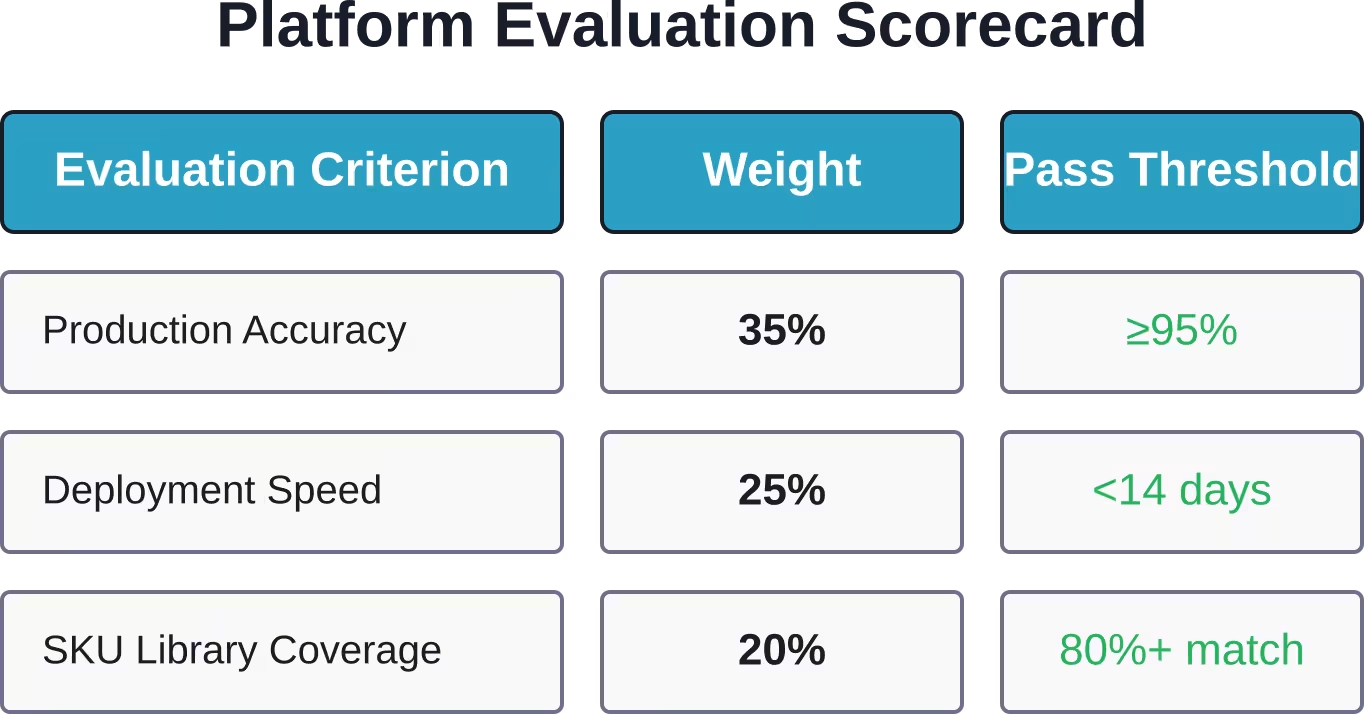
Deployment Models: Field Teams vs. Fixed Cameras
Two primary deployment architectures dominate retail image recognition.
Mobile-First Field Team Solutions
Field representatives use smartphone apps to photograph shelves during store visits. Images upload to cloud processing engines, returning analysis within seconds or minutes. Advantages: lower infrastructure cost, human oversight at capture time, flexibility across store formats. Limitations: audit frequency tied to visit schedules, potential for inconsistent photo quality, dependence on field team adoption.
Fixed In-Store Camera Systems
Retailers install dedicated cameras above shelves, capturing continuous or interval-based imagery. Edge computing devices process streams locally or relay to cloud infrastructure. Research on retail analytics describes algorithms running on embedded systems, achieving high performance of 13 frames per second for customer tracking and demographic analysis on embedded systems. Advantages: continuous monitoring, no field team dependency, consistent capture angles. Limitations: higher upfront cost, installation complexity, maintenance requirements. Hybrid approaches are emerging. Fixed cameras monitor high-value endcaps or promotional displays continuously, while field teams handle aisle-by-aisle comprehensive audits on visit schedules.
Measuring ROI: What Success Actually Looks Like
Image recognition investments need clear performance metrics. Inventory accuracy improvements are measurable. Repsly reports inventory accuracy up to 98% with ShelfScan due to SKU recognition, significantly reducing human error, compared to 75-85% with manual audits. Out-of-stock reduction drives revenue impact. Detecting and resolving stockouts faster translates directly to recovered sales. A 10% reduction in out-of-stock incidents can increase category sales by 2-3%. Field efficiency gains appear quickly. When audit time drops from 40 minutes to 10 minutes per store, teams complete more visits per day or invest saved time in merchandising and relationship-building.
| Metric | Before Image Recognition | After Deployment | Improvement |
|---|---|---|---|
| Audit time per store | 35-45 minutes | 8-12 minutes | 70-75% reduction |
| Inventory accuracy | 75-85% | 95-98% | +13-20 points |
| Planogram compliance | 60-70% | 85-92% | +20-25 points |
| Out-of-stock detection speed | 5-7 days | Same day | Real-time visibility |
Challenges and Limitations to Expect
Image recognition isn’t a silver bullet. Real-world complications persist. Lighting variability remains problematic. Dim store sections, glare from windows, or inconsistent LED color temperatures degrade recognition accuracy. Training data must include lighting variations representative of production environments. Product overlap and occlusion confuse algorithms. When products lean against each other, obscuring labels or barcodes, classification confidence drops. Multi-angle capture or higher-resolution imaging helps, but adds complexity. SKU proliferation creates maintenance burden. Brands launching dozens of new products quarterly must continuously update training datasets. Platforms with slow retraining cycles create lag between product launch and reliable recognition. Integration friction with legacy systems can stall projects. Retailers running decades-old inventory management software face API limitations, data format incompatibilities, and security constraints that complicate cloud-based image recognition integration.
Future Directions: What’s Coming in Retail Computer Vision
Research pipelines indicate several emerging capabilities. Synthetic training data generation reduces dependency on manual image collection. Generative models create thousands of realistic product images in varied lighting and shelf arrangements, accelerating model training for new SKUs. Multi-modal fusion combines visual recognition with other sensor data. Weight sensors on shelves, RFID tags, and point-of-sale systems feed unified inventory models, cross-validating visual recognition output and catching edge cases. Predictive restocking uses historical recognition data to forecast demand and trigger proactive replenishment. Rather than reacting to detected out-of-stocks, systems predict depletion timing and schedule restocking before gaps appear. Automated compliance resolution connects recognition systems to robotic restocking. Warehouse robots retrieve products flagged as low or misplaced by computer vision, preparing corrective restocking without human intervention.
Frequently Asked Questions
What accuracy should retailers expect from image recognition systems?
Research on production deployments shows accuracy ranging from 95% to 99% depending on product categories, shelf complexity, and environmental conditions. IEEE studies document shelf detection precision above 99% and product detection precision around 94-95% in real convenience store settings. Validate accuracy on your specific shelves during pilots—lighting, product density, and SKU similarity affect results.
How long does implementation take for a typical CPG brand?
Deployment timelines vary by platform architecture. Mobile-first solutions with pre-trained SKU libraries can pilot in 7-14 days. Fixed camera systems requiring physical installation take 4-8 weeks. Custom model training for proprietary products adds 2-4 weeks. Integration with existing field management software introduces additional timeline variability.
Can image recognition work with existing field team workflows?
Yes, most platforms integrate into existing visit routines. Field representatives photograph shelves using mobile apps during normal store audits. Cloud processing returns analysis within the visit window or shortly after. Some systems operate standalone; others feed data into broader field execution platforms via APIs.
What’s the difference between image recognition and computer vision in retail?
The terms overlap significantly. Computer vision is the broader field encompassing all visual data processing. Image recognition specifically refers to identifying and classifying objects—products, logos, price tags—within images. Retail computer vision also includes video analytics, motion tracking, and spatial mapping beyond static image classification.
Does image recognition require extensive IT infrastructure?
Not necessarily. Cloud-based platforms handle processing remotely, requiring only internet connectivity and mobile devices or cameras. Edge computing deployments—processing on local devices like NVIDIA Jetson modules—reduce bandwidth needs but increase upfront hardware costs. Infrastructure requirements scale with deployment model and processing volume.
How do privacy regulations affect retail image recognition?
Product recognition faces minimal privacy constraints—photographing shelves doesn’t capture personal data. Customer analytics using facial recognition or demographic inference trigger privacy regulations. NIST guidance on facial recognition technology highlights the need for transparency and consent in commercial applications. Retailers must navigate GDPR, CCPA, and similar frameworks when deploying customer-facing computer vision.
What ROI timeline is realistic for image recognition investments?
Field efficiency gains appear within the first quarter after deployment. Out-of-stock reduction and improved planogram compliance typically show measurable revenue impact within 6-9 months. Full ROI—including reduced audit labor, increased sales, and better promotional execution—often materializes within 12-18 months for mid-to-large CPG deployments.
Taking the Next Step with Retail Image Recognition
Image recognition has moved from experimental technology to production-ready tool. Platforms demonstrate consistent accuracy on real shelves, integrate into field workflows, and deliver measurable efficiency and revenue improvements. But successful deployment requires clear use case definition, rigorous vendor evaluation, and realistic expectations about accuracy and integration timelines. Start with a focused pilot. Select 10-20 representative stores, define success metrics upfront, and compare image recognition output against manual audits. Measure audit time reduction, accuracy improvement, and field team adoption rates. Validate accuracy on your specific products and shelf conditions. Lab benchmarks don’t guarantee production performance. Test the platform on your SKUs, in your lighting, with your shelf density. And remember—technology enables better decisions, but it doesn’t make decisions. Image recognition surfaces problems faster and more accurately than manual audits. The value comes from acting on those insights: restocking faster, correcting planogram violations, optimizing promotional placement, and coaching field teams based on objective data. The retailers winning in physical spaces are the ones who closed the visibility gap. Image recognition is how they did it.