
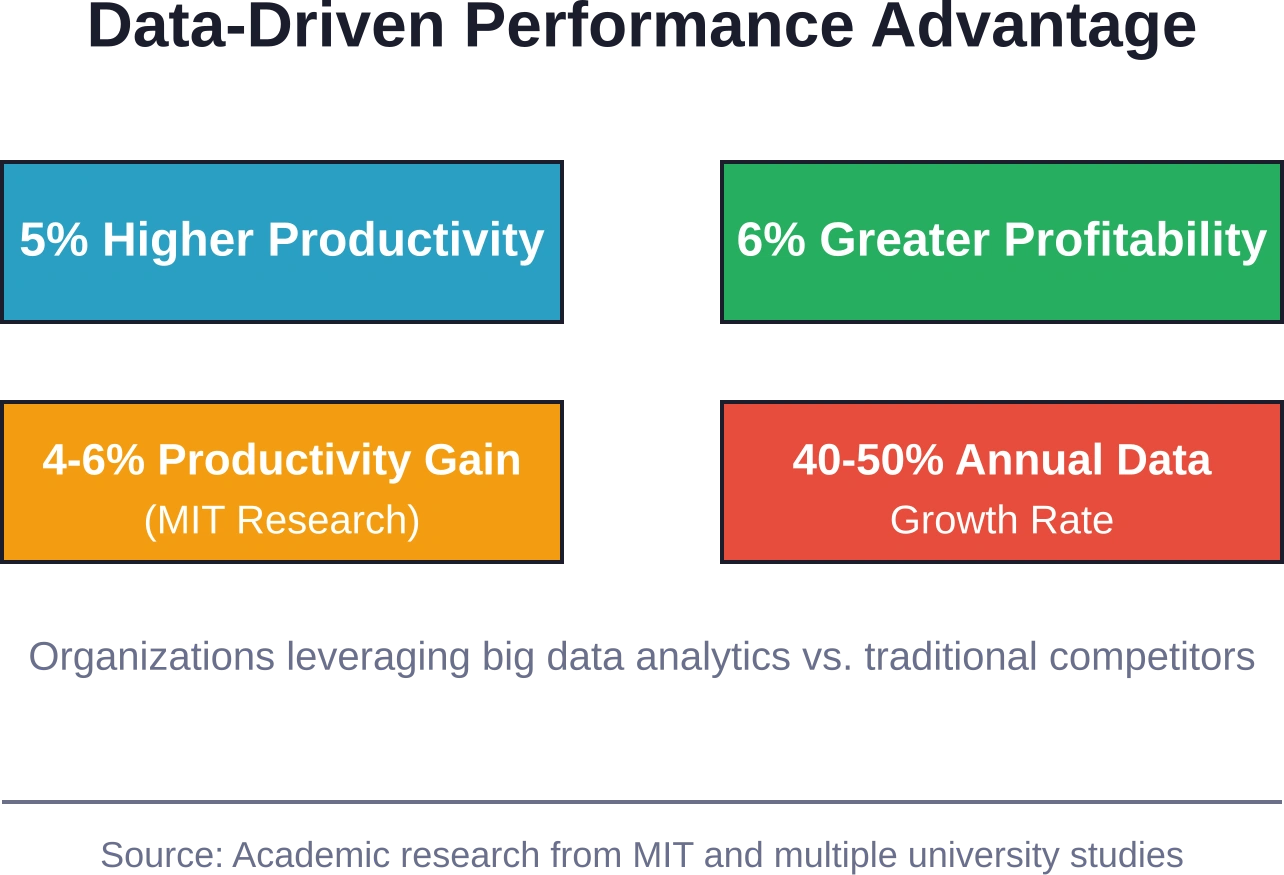
Quick Summary: Big data has fundamentally transformed business operations by enabling data-driven decision-making, improving customer experiences, and creating competitive advantages. Organizations leveraging big data analytics demonstrate 5% higher productivity and 6% greater profitability compared to competitors, while the global big data market continues expanding toward 180 zettabytes by 2025.
Every single day, businesses generate massive amounts of information. Customer transactions, social media interactions, sensor readings, website clicks—all of it piles up faster than traditional systems can handle.
And that’s precisely where big data comes in.
Big data refers to enormous datasets that traditional data processing tools simply can’t manage. We’re talking about information that arrives in massive volumes, at high velocity, and in various formats—structured database entries, unstructured social media posts, semi-structured log files, and everything in between.
But here’s the thing: big data isn’t just about size. It’s about what businesses do with that information that matters.
What Makes Big Data Different
Traditional data management worked fine when companies dealt with gigabytes or maybe a few terabytes. Sales records, inventory counts, customer databases—these fit neatly into standard systems.
Big data operates at a completely different scale.
| Characteristic | Traditional Data | Big Data |
|---|---|---|
| Volume | Gigabytes to terabytes | Terabytes to petabytes and beyond |
| Velocity | Low to moderate generation rates | High to extremely high data generation |
| Variety | Primarily structured | Structured, semi-structured, unstructured |
| Processing | Batch processing | Real-time and batch processing |
| Storage | Centralized databases | Distributed storage systems |
Academic research indicates significant annual data volume increases, with studies noting growth rates in the range of 40-50% annually. That’s not a typo. Every year, the information organizations manage grows by nearly half.
MaxCDN, a content delivery network, developed a framework to handle 32 TB of daily web server log data. Their solution reduced managed environments by two-thirds while requiring only one-tenth the CPU cycles compared to alternative approaches—all while achieving 100% billing accuracy.
Real talk: most businesses can’t afford to ignore data at this scale anymore.
How Big Data Transforms Business Decision-Making
Here’s where it gets interesting. Big data doesn’t just create storage headaches—it fundamentally changes how businesses make decisions.
Traditional decision-making relied heavily on intuition, experience, and limited data samples. Managers looked at last quarter’s sales report, maybe ran a focus group, then made their best guess.
Data-driven decision-making flips that model entirely.
Research documented in MIT Sloan Review suggests organizations implementing big data strategies experience productivity increases linked to data-driven decision-making approaches. And according to broader academic studies, data-driven organizations outperform competitors by 5% in productivity and 6% in profitability.
Those percentages might sound modest. But in competitive markets, a 5-6% edge often means the difference between market leadership and irrelevance.
Consider how predictive analytics works. Instead of reacting to customer churn after it happens, companies analyze patterns to identify at-risk customers weeks in advance.
That’s not future-thinking anymore. It’s happening right now.

Build Big Data Solutions With AI Superior
AI Superior builds AI and machine learning solutions for big data analytics, BI, predictive analytics, NLP, and custom software development. Their work can help companies process data from different sources and turn it into usable tools for analysis, forecasting, and reporting.
For business teams working with large datasets, this can support clearer reporting, pattern detection, operational insights, and better use of existing company data.
Need Better Use of Business Data?
AI Superior can help with:
- building big data analytics solutions
- creating BI and reporting tools
- developing predictive analytics models
- connecting AI tools with existing platforms
👉 Contact AI Superior to discuss your project.
The Economic Impact Reaches Every Industry
The numbers tell a compelling story about big data’s economic reach.
Academic research projected big data would reach 180 zettabytes by 2025. To put that in perspective, one zettabyte equals one trillion gigabytes. We’re operating at scales that were pure science fiction a decade ago.
But the impact varies significantly across sectors.
Academic studies found that during the 2020s, interest in big data actually decreased by more than 15% in manufacturing, computers, and electronics industries. Meanwhile, real estate, sports, and travel sectors saw average growth of 10% in big data adoption.
Why the difference? Some industries face data overload and struggle with implementation complexity. Others discovered clear, immediate value propositions.
Real Business Applications Across Industries
Let’s get specific about how different sectors actually use big data.
Retail and E-Commerce
Online retailers track millions of transactions daily, monitoring customer behavior patterns, purchase histories, browsing habits, and cart abandonment rates. This information powers recommendation engines, dynamic pricing, inventory optimization, and personalized marketing.
When an e-commerce platform starts collecting data on millions of daily transactions—tracking parameters like customer website behavior, additional purchases, session duration, and device types—that’s when traditional systems break down and big data solutions become necessary.
Healthcare and Medical Research
Medical institutions analyze patient records, treatment outcomes, genomic data, and real-time monitoring information. Big data enables earlier disease detection, personalized treatment plans, and drug development acceleration.
Healthcare generates some of the most sensitive and valuable data streams. Hospitals can predict patient admission rates, optimize staffing, reduce readmissions, and identify treatment protocols that deliver better outcomes.
Financial Services
Banks and investment firms process transaction data for fraud detection, risk assessment, algorithmic trading, and customer service personalization. Financial institutions analyze patterns across millions of transactions to identify suspicious activity within seconds.
Fraud detection systems flag anomalies in real-time, preventing losses before they occur rather than discovering theft after the fact.
Manufacturing and Supply Chain
Manufacturers embed sensors throughout production lines, tracking equipment performance, quality metrics, and maintenance needs. Supply chain managers monitor inventory levels, shipping routes, and demand forecasts across global networks.
Key Benefits Driving Business Adoption
So what exactly do businesses gain from all this effort?
Enhanced Customer Understanding
Big data analytics reveals customer preferences, behavior patterns, and pain points with unprecedented detail. Companies segment audiences with precision, personalize experiences, and predict needs before customers articulate them.
Operational Efficiency Gains
Process optimization becomes possible when organizations track every operational metric. Businesses identify bottlenecks, reduce waste, automate routine decisions, and allocate resources more effectively.
Competitive Intelligence
Market analysis tools process competitor data, industry trends, pricing patterns, and consumer sentiment. Organizations spot opportunities and threats faster than ever before.
Risk Management
Predictive models assess risks across operations—from credit defaults to equipment failures to supply chain disruptions. Early warning systems enable proactive responses rather than reactive damage control.
Innovation and Product Development
Customer feedback analysis, usage pattern tracking, and market gap identification inform product roadmaps. Companies test concepts, iterate designs, and launch solutions that better meet actual market needs.
The Challenges Nobody Talks About Enough
But wait. If big data delivers all these benefits, why hasn’t every business jumped on board?
Because implementation is hard. Really hard.
Data Quality Issues
More data doesn’t automatically mean better insights. Incomplete records, duplicate entries, inconsistent formats, and plain errors plague many datasets. Some implementations have achieved significant reductions in data inconsistencies through quality standards (referenced in competitor content: 40% reduction in data inconsistencies).—highlighting that inconsistency was the baseline problem.
Garbage in, garbage out remains true at any scale.
Technical Infrastructure Requirements
Big data demands specialized storage systems, processing frameworks, and analytics platforms. Traditional IT infrastructure simply can’t handle the volume, velocity, and variety involved.
Building or migrating to these systems requires significant capital investment and technical expertise that many organizations lack.
Skills Gap
Data scientists, analytics engineers, and specialized developers remain in short supply. Companies compete fiercely for talent that can actually extract value from big data systems.
Training existing staff takes time. Hiring experts costs money. Many organizations find themselves stuck with powerful tools but nobody qualified to use them effectively.
Privacy and Security Concerns
The Federal Trade Commission has repeatedly examined big data’s impact on consumer privacy. Large-scale data collection raises serious questions about surveillance, consent, discrimination, and security vulnerabilities.
A 2024 FTC staff report found major social media and video streaming companies engaged in vast surveillance with inadequate safeguards for young users. Regulatory scrutiny continues increasing.
Businesses must navigate complex regulations while protecting sensitive information from breaches. One mistake can destroy customer trust and trigger massive legal liabilities.
Integration Complexity
Most organizations run multiple legacy systems that don’t communicate well. Integrating big data platforms with existing infrastructure while maintaining business continuity presents enormous technical challenges.
| Challenge | Impact | Mitigation Strategy |
|---|---|---|
| Data Quality | Unreliable insights, poor decisions | Implement validation rules, cleansing processes |
| Infrastructure Costs | High initial investment barrier | Cloud solutions, phased implementation |
| Talent Shortage | Cannot extract value from data | Training programs, consulting partnerships |
| Privacy Compliance | Legal risks, reputation damage | Governance frameworks, regular audits |
| System Integration | Operational disruption, delays | API-first architecture, incremental rollout |
Getting Started With Big Data Implementation
Organizations serious about leveraging big data need a practical approach.
- Start with clear business objectives. What specific problems need solving? Which decisions would improve with better data? Define success metrics before touching any technology.
- Assess current data assets and infrastructure. What information already exists? Where are the gaps? What systems can handle increased data loads?
- Build or acquire the right technical foundation. Cloud platforms offer scalable storage and processing without massive upfront infrastructure investments. Open-source tools like Hadoop provide powerful capabilities at lower cost than proprietary solutions.
- Develop data governance policies. Establish who owns what data, how it’s collected, where it’s stored, who can access it, and how long it’s retained. Privacy and security must be built in from the start, not bolted on later.
- Invest in people—through training, hiring, or partnerships. Technology alone solves nothing. The human expertise to ask the right questions, design appropriate analyses, and interpret results creates the actual value.
- Start small and scale gradually. Pilot projects on specific use cases demonstrate value, build organizational confidence, and surface implementation challenges before they become catastrophic.
The Artificial Intelligence Connection
Here’s something crucial: big data and artificial intelligence feed each other.
AI algorithms need massive training datasets to learn patterns and make predictions. Big data provides that fuel. Meanwhile, AI tools help analyze big data at scales impossible for human analysts.
Machine learning models identify complex patterns across millions of variables. Natural language processing extracts insights from unstructured text. Computer vision analyzes images and video at speed.
The combination creates capabilities neither technology delivers alone. Businesses implementing both big data infrastructure and AI analytics unlock the most significant competitive advantages.
Academic research on big data as a driver of business innovation emphasizes this combination particularly in manufacturing, though adoption has varied across sectors.
Looking Ahead
The big data revolution isn’t slowing down.
Data volumes continue growing exponentially. More devices, more sensors, more digital interactions—all generating information streams that businesses can potentially leverage.
Edge computing pushes analytics closer to data sources, enabling real-time processing. Quantum computing promises to solve optimization problems currently beyond reach. Advanced AI continues improving its ability to extract insights from complex datasets.
But technology evolution also brings escalating challenges. Privacy regulations tighten globally. Cybersecurity threats grow more sophisticated. The ethical implications of data-driven decision-making demand serious attention.
Organizations that master big data—balancing technical capability with governance, ethics, and practical business focus—will define the competitive landscape for decades.
Those that ignore it risk irrelevance.
Frequently Asked Questions
What exactly qualifies as big data versus regular data?
Big data typically involves volume (terabytes to petabytes rather than gigabytes), velocity (real-time or near-real-time generation), and variety (structured, semi-structured, and unstructured formats). When traditional database systems can’t efficiently store, process, or analyze the information, it crosses into big data territory. A weekly sales report isn’t big data. Millions of daily transactions with behavioral tracking across multiple channels qualifies.
How much does big data implementation typically cost?
Costs vary dramatically based on organization size, data volume, and implementation scope. Cloud-based solutions reduce upfront infrastructure expenses compared to on-premise systems. Small pilot projects might run tens of thousands, while enterprise-wide implementations can reach millions. The largest ongoing costs typically involve skilled personnel rather than technology licensing. Check current cloud platform pricing for specific budget planning.
Can small businesses benefit from big data or is it only for large enterprises?
Small businesses absolutely can benefit, though their approach differs from enterprise implementations. Cloud platforms offer scalable solutions that grow with the business. Many small companies start by analyzing customer data, website analytics, or social media engagement. The key is focusing on specific business problems rather than trying to implement everything at once. Even modest data insights can drive significant improvements in small business operations.
What’s the difference between big data and business intelligence?
Business intelligence traditionally focuses on structured data from internal systems, using reporting and dashboards to track known metrics. Big data encompasses much broader sources (including external and unstructured data), larger volumes, and often exploratory analytics to discover unknown patterns. Modern BI tools increasingly incorporate big data capabilities, blurring the distinction. Think of BI as asking specific questions about known data, while big data enables discovering unexpected insights from diverse sources.
How long does big data implementation typically take?
A focused pilot project might deliver initial results in 3-6 months. Comprehensive enterprise implementation often spans 18-36 months or longer. The timeline depends on existing infrastructure, data quality, organizational readiness, and scope. Phased approaches work better than attempting everything simultaneously. Organizations should expect ongoing refinement rather than a one-time project with a fixed end date.
What are the most common reasons big data projects fail?
Lack of clear business objectives tops the list—implementing technology without knowing what problems to solve. Other common failures include poor data quality, insufficient technical skills, inadequate infrastructure, unrealistic expectations, and lack of executive support. Privacy breaches or compliance failures can also derail projects. Success requires aligning technology, people, processes, and business strategy rather than treating big data as purely an IT initiative.
Is big data still relevant or has it been replaced by newer concepts?
Big data remains highly relevant as the foundation for newer developments like AI, machine learning, and advanced analytics. The terminology may seem less trendy than it was five years ago, but the underlying capabilities continue growing in importance. Organizations still face the same challenges of managing massive, diverse datasets—they just integrate those capabilities with AI and other emerging technologies rather than treating big data as a separate initiative.
Conclusion
Big data has moved from hype to reality. The statistics prove it—5% productivity gains, 6% profitability improvements, 30% marketing efficiency increases, and economic impacts reaching hundreds of billions.
But here’s the truth: technology alone doesn’t create value. Organizations that succeed with big data combine technical infrastructure with clear strategy, skilled people, strong governance, and relentless focus on actual business outcomes.
The competitive advantages are real and measurable. Data-driven organizations outperform their peers across virtually every industry metric.
The challenges are equally real—data quality, infrastructure costs, talent gaps, privacy concerns, and integration complexity all present genuine obstacles.
And yet, with only 12% of organizations currently implementing big data strategies, enormous opportunity remains for businesses willing to make the investment.
The question isn’t whether big data impacts business. The research settles that debate conclusively.
The question is whether your organization will capture that value or watch competitors pull ahead.
Start with one specific business problem. Build the foundation. Invest in people. Scale what works. The data’s already there—waiting to be turned into competitive advantage.