
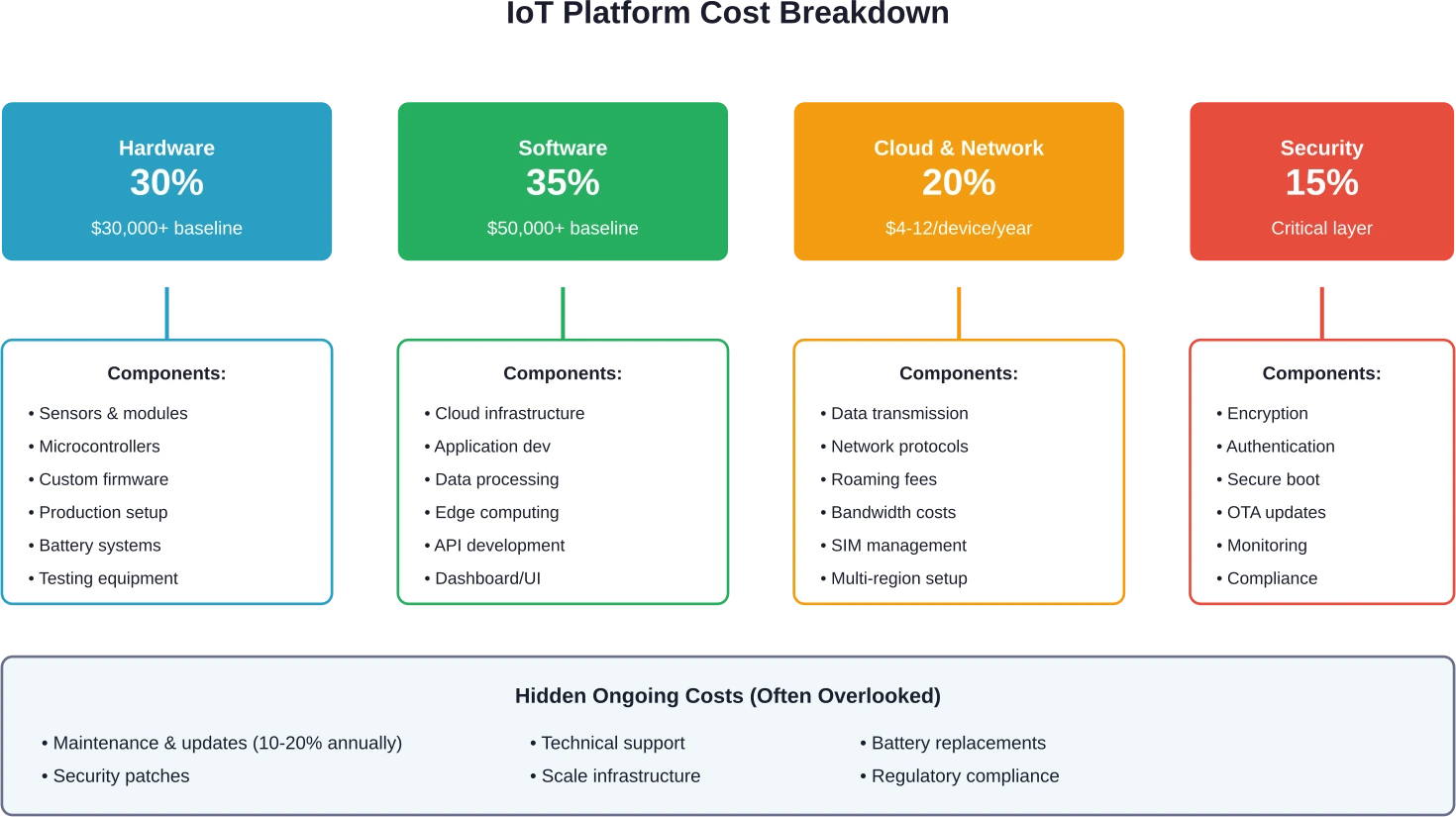
Key Points: IoT platform development costs typically range from $50,000 to $500,000+ depending on hardware complexity, software requirements, connectivity needs, and security features. Key cost drivers include device components ($30,000+), cloud infrastructure ($50,000+), firmware development, ongoing maintenance, and network expenses ($4-$12 per device annually). Understanding total cost of ownership (TCO) beyond initial development is critical for accurate budgeting.
Planning an IoT platform project means wrestling with budget questions that don’t have simple answers. The connected device market continues expanding rapidly, with the global IoT professional services market was valued at USD 110.69 billion in 2022 and is expected to grow to USD 206.90 billion at a CAGR of 6.5% during the forecast period, according to industry analysis. That growth brings opportunities, but it also brings complexity when estimating what development will actually cost.
Here’s the thing though—most cost estimates focus narrowly on upfront development expenses. The real financial picture includes hardware procurement, software architecture, cloud services, connectivity fees, security implementation, and years of maintenance. Research from Eseye published in Computer Weekly indicates that organizations fixating on cheap connectivity often face hidden costs and performance gaps that undermine entire project business cases.
This guide breaks down the actual cost components of IoT platform development in 2026, with real ranges pulled from multiple development projects and industry analyses.
Understanding IoT Platform Development Components
Before diving into numbers, it’s worth clarifying what “IoT platform development” actually encompasses. The terminology gets confusing fast.
An IoT ecosystem includes the entire environment: connected devices, platforms, applications, and data storage. Large-scale organizations implementing comprehensive solutions across facilities work at this level. An IoT solution refers to a specific implementation addressing particular business problems—like predictive maintenance in manufacturing or cold chain monitoring in logistics.
The IoT platform itself is the middleware connecting devices to applications. It handles device management, data ingestion, processing, storage, and API services. IoT applications are the end-user interfaces—mobile apps, dashboards, and analytics tools that surface insights.
Development costs vary dramatically depending on which components a project requires building from scratch versus leveraging existing platforms.
Core Cost Drivers for IoT Platform Projects
Several factors determine whether a project lands at $50,000 or pushes past $500,000. Understanding these variables helps create realistic budgets.
Hardware Integration Complexity
Physical devices represent approximately 30% of total IoT expenses. The hardware budget depends on component quality, quantity, and customization requirements.
Basic setups with off-the-shelf sensors and microcontrollers start around $30,000. But custom firmware tailored to specific sensors requires specialized embedded programming skills, pushing costs higher. Production setup expenses add another layer—testing equipment, manufacturing partnerships, and quality assurance protocols all carry price tags.
In tracking use cases, battery costs alone represent roughly 70% of total material cost for an IoT device, according to connectivity analysis. Any factor reducing battery life directly impacts long-term expenses through replacement cycles or device failures.
Software Architecture and Cloud Services
Software development typically begins at $50,000 and scales based on complexity. This includes cloud service fees, application development, and firmware programming.
Cloud platforms like AWS IoT in select AWS Regions support up to 100 messages per second. Bosch IoT Suite’s standard plan supports up to 1,000,000,000 messages per tenant per month. The message volume requirements directly affect monthly cloud costs.
Edge computing has become increasingly integral to IoT architectures. Processing data closer to the source reduces latency and bandwidth usage while enabling real-time response for applications requiring immediate data analysis, such as industrial automation and autonomous systems.
Connectivity and Network Expenses
Network costs range from $4 to $12 per device annually, depending on data volume, geographic coverage, and network type. This seemingly small per-device cost compounds across thousands of units over multi-year deployments.
Global roaming introduces hidden pitfalls. While roaming sounds convenient for multi-country deployments, poorly configured roaming solutions drain battery life and inflate data costs. The connectivity strategy selected during development phase has compounding implications throughout the device lifecycle.
Security Implementation
Security can’t be an afterthought. IoT devices create new attack surfaces, and breaches carry catastrophic consequences—from data exposure to physical safety risks in industrial settings.
Security costs include encryption implementation, authentication systems, secure boot mechanisms, over-the-air update infrastructure, and ongoing vulnerability monitoring. Budget-constrained projects that skimp on security face exponentially higher costs when breaches occur.
Project Tier Cost Ranges
Real-world IoT platform projects fall into distinct tiers based on complexity and scale. These ranges come from multiple development analyses and represent 2026 market conditions.
| Project Scope | Estimated Cost Range | Key Characteristics |
|---|---|---|
| Simple IoT Application | $30,000 – $70,000 | Limited connected devices, basic UI, minimal automation, off-the-shelf components |
| Mid-Range Solution | $70,000 – $150,000 | Moderate device count, custom firmware, cloud integration, mobile app, analytics |
| Complex Platform | $150,000 – $300,000 | Large-scale deployment, custom hardware, advanced security, edge computing, predictive analytics |
| Enterprise Ecosystem | $300,000 – $500,000+ | Multi-site deployment, custom platform development, AI/ML integration, comprehensive security |
These ranges represent total development costs but don’t capture the complete financial picture. That requires understanding total cost of ownership.
The Total Cost of Ownership Problem
Here’s where many projects run into trouble. Development costs represent only the beginning of the expense curve.
Research from Eseye published in Computer Weekly indicates that organizations often fixate on cheap connectivity while overlooking TCO. This narrow focus leads to hidden costs and significant performance gaps that undermine project business cases.
In a worked example from Eseye’s research, a partnership with a global advertising brand assessed connectivity strategy over five years and identified a net saving of £8.8 million. These savings came from eliminating redundant hardware, reducing connectivity failures, extending battery life, and lowering support overhead.
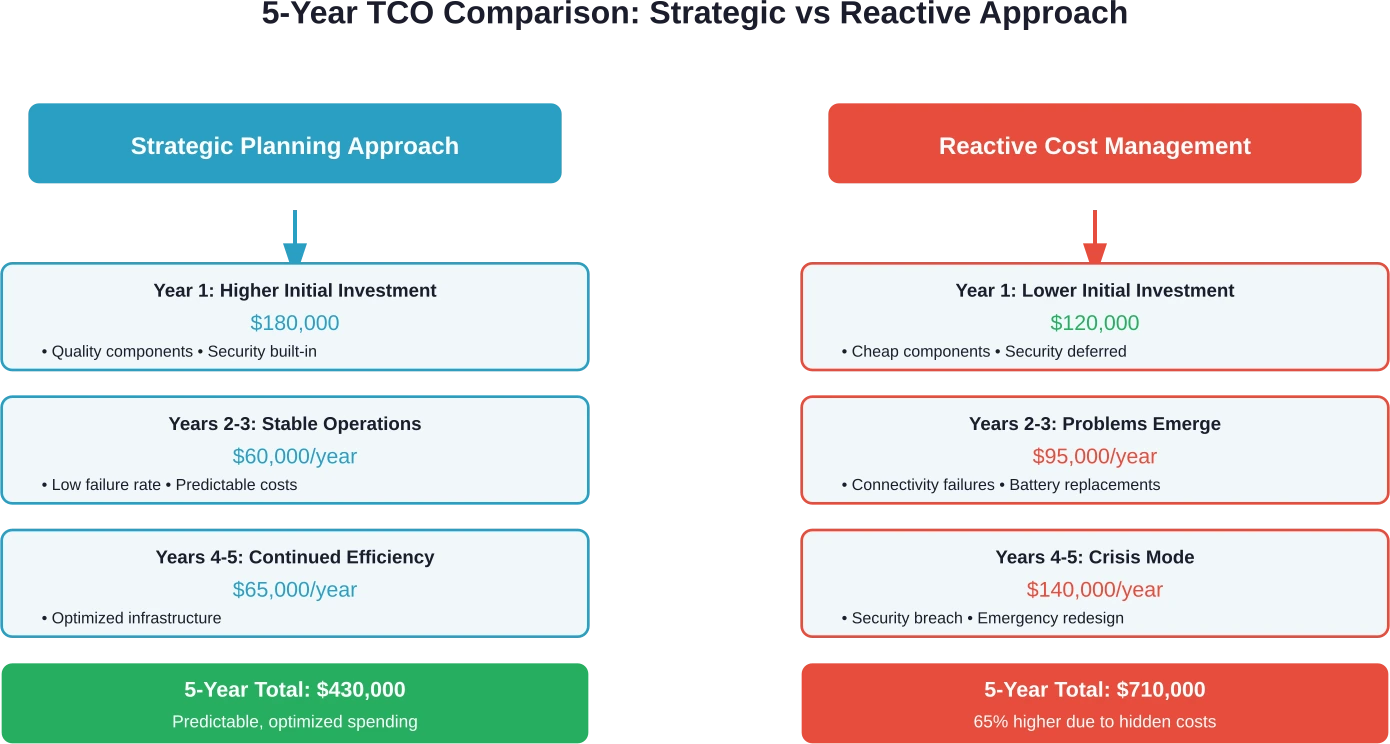
That £8.8 million swing represents the difference between strategic TCO planning and reactive cost management.
Installation and Deployment Realities
Installation costs frequently exceed estimates. According to analysis, 75% of IoT projects take twice as long as planned, leading to massive budget blowouts. Field conditions differ from lab environments. Device placement challenges emerge. Network coverage gaps appear. Integration complications arise.
These delays don’t just push timelines—they compound labor costs, extend project management overhead, and delay revenue realization.
Ongoing Maintenance Requirements
IoT isn’t “set and forget.” Periodic security patches remain vital. Battery management requires monitoring and eventual replacement. Firmware updates address bugs and add features. Cloud infrastructure scales with device growth. Technical support handles device failures and connectivity issues.
Many experts suggest budgeting 10-20% of initial development costs annually for maintenance. A $200,000 platform requires $20,000-$40,000 yearly for proper upkeep.

Plan IoT Platform Costs with Technical Validation from AI Superior
IoT platform budgets depend on architecture, data pipelines, device communication, cloud infrastructure, and analytics layers. AI Superior supports companies at the architecture stage to prevent cost overruns caused by poor technical planning.
They assist with:
- System architecture design
- Edge vs cloud strategy
- Data engineering and real-time analytics
- AI integration for predictive insights
Before committing to development, get a detailed technical roadmap and cost structure from AI Superior to understand infrastructure, scalability, and long-term operational expenses.
Stage-by-Stage Development Cost Breakdown
Breaking costs down by development stage provides clearer budgeting visibility.
| Development Stage | Cost Range | Activities Included |
|---|---|---|
| Discovery & Requirements Analysis | $3,000 – $7,000 | Feasibility study, specifications, architecture planning, vendor evaluation |
| Prototype/MVP Development | $20,000 – $50,000 | Basic firmware, proof-of-concept app, limited cloud setup, initial testing |
| Full Development | $50,000 – $300,000+ | Complete firmware, production hardware, cloud infrastructure, applications, security implementation |
| Testing & Quality Assurance | $10,000 – $40,000 | Functional testing, security audits, performance testing, field trials |
| Deployment & Integration | $15,000 – $80,000 | Installation, system integration, user training, documentation |
This phased approach allows for decision points. After prototype validation, teams can refine requirements before committing to full development budgets.
Cloud Platform Subscription Considerations
Many IoT platforms charge subscription fees based on connected devices, data usage, or feature requirements. Understanding these models matters when comparing build-versus-buy decisions.
Research from PMC analyzing IoT cloud platforms shows significant variation. AWS IoT in select AWS Regions supports up to 100 messages per second. Blynk, designed primarily for rapid prototyping and small-scale deployments, limits requests to 50 per second per device. Bosch IoT Suite’s standard plan supports up to 1,000,000,000 messages per tenant per month.
These message limits directly impact operating costs at scale. A deployment pushing 200 messages per second requires infrastructure beyond basic tiers, triggering higher subscription costs or requiring custom enterprise agreements.
Cost Optimization Strategies
Strategic decisions during the planning phase create substantial long-term savings. Here are approaches that actually work in practice.
Start with MVP Validation
Build the minimum viable product first. Validate core functionality, test market assumptions, and gather user feedback before committing to full-scale development. Many projects invest heavily in features users don’t value.
Leverage Existing Platforms Where Possible
Building custom platforms from scratch costs significantly more than leveraging established IoT platforms like AWS IoT, Azure IoT, or Google Cloud IoT. These platforms provide device management, data ingestion, processing, and storage infrastructure.
The trade-off involves less customization control but dramatically lower development costs and faster time-to-market. For many use cases, platform-based approaches deliver 60-70% cost reductions compared to fully custom development.
Optimize Connectivity Strategy
Network costs compound across thousands of devices over years. The cheapest SIM card often becomes the most expensive choice through hidden fees, coverage gaps causing device failures, and battery drain from poor network selection algorithms.
Investing in smarter connectivity management—including multi-network SIMs, optimized data transmission schedules, and local processing to minimize data transmission—pays dividends throughout the device lifecycle.
Design for Battery Life
Since battery costs represent roughly 70% of device material costs in tracking applications, extending battery life generates massive savings. Strategies include optimizing transmission frequency, implementing sleep modes, selecting efficient components, and using edge processing to reduce radio usage.
Implement Security from Day One
Retrofitting security costs 10-15 times more than building it in initially. Design with encryption, authentication, secure boot, and update mechanisms from the start. The upfront investment prevents catastrophic breaches and expensive emergency remediation.
Hidden Costs That Sink Projects
Beyond obvious expenses, several hidden costs catch teams off-guard.
Regulatory compliance varies by industry and geography. Medical IoT devices face FDA approval processes. Automotive applications require safety certifications. European deployments must address GDPR data privacy requirements. These compliance activities add legal fees, documentation overhead, and sometimes design changes.
Data storage and processing costs scale with deployment. IoT generates massive data volumes. A fleet of 10,000 devices transmitting sensor readings every minute creates 14.4 million data points daily. Cloud storage and processing for that volume compounds monthly.
Support infrastructure gets overlooked in initial budgets. Customer support teams need training. Technical documentation requires creation and maintenance. Troubleshooting tools need development. These operational requirements represent ongoing expenses that don’t stop after launch.
When to Build Versus Buy
The build-versus-buy decision significantly impacts costs. Custom platform development offers maximum flexibility but carries the highest price tag and longest timeline.
Building makes sense when competitive differentiation depends on unique platform capabilities, when existing platforms can’t meet specific technical requirements, or when long-term costs of platform subscriptions exceed custom development amortized over deployment lifespan.
Buying or leveraging existing platforms makes sense for faster time-to-market, when core functionality matches standard platform capabilities, for smaller deployments where subscription costs remain reasonable, and when internal technical expertise for platform maintenance is limited.
Many successful projects take hybrid approaches—leveraging platform infrastructure for commodity functions while building custom applications and algorithms that deliver competitive advantage.
Frequently Asked Questions
What’s the minimum budget needed for IoT platform development?
Simple IoT applications start around $30,000-$70,000 for basic functionality with limited devices and off-the-shelf components. This covers prototype development, minimal cloud setup, and basic mobile interface. More complex requirements push budgets significantly higher.
How much do ongoing IoT platform costs typically run?
Generally speaking, ongoing costs range from 10-20% of initial development expenses annually. This covers maintenance, security updates, cloud services, connectivity fees, and technical support. A $200,000 platform typically requires $20,000-$40,000 yearly for proper operation.
What percentage of IoT budget should go to security?
Security typically represents 15-20% of total development costs but delivers disproportionate value. Skimping on security creates catastrophic risk—breaches cost 10-15 times more to fix after launch than implementing properly during development.
How do connectivity costs scale with device count?
Network expenses run $4-$12 per device annually depending on data volume and coverage needs. This compounds significantly at scale—10,000 devices mean $40,000-$120,000 yearly in connectivity alone. Optimizing transmission frequency and data volumes reduces these costs substantially.
Should I build a custom IoT platform or use existing services?
Platform services like AWS IoT or Azure IoT reduce development costs by 60-70% compared to fully custom platforms and accelerate time-to-market. Custom development makes sense only when unique requirements can’t be met by existing platforms or when competitive advantage depends specifically on platform capabilities.
Why do IoT projects often exceed budget estimates?
Based on available data, 75% of IoT projects take twice as long as planned due to underestimating integration complexity, field deployment challenges, connectivity issues, and the gap between lab testing and real-world conditions. Building contingency buffers of 25-40% helps manage these realities.
What causes the biggest IoT TCO surprises?
Battery replacement costs catch many teams off-guard since batteries represent roughly 70% of device material costs in tracking applications. Connectivity failures from cheap network solutions, security incidents from inadequate protection, and maintenance overhead from poor initial architecture also drive unexpected expenses. A strategic TCO assessment can identify multi-million dollar savings, as demonstrated in the case where proper planning revealed £8.8 million in net savings over five years.
Planning Your IoT Platform Budget
Accurate IoT platform budgeting requires moving beyond sticker-price thinking to comprehensive TCO analysis. The development costs represent only the beginning—connectivity, maintenance, security, and operational expenses compound over device lifecycles measured in years.
Start with clear requirements and realistic scope. Validate assumptions with MVP development before committing to full-scale builds. Factor in ongoing costs from day one rather than treating them as surprises later. Invest in quality components, robust security, and optimized connectivity strategy despite higher initial costs—these investments pay for themselves many times over through reduced failures, extended battery life, and lower support overhead.
The difference between a $430,000 five-year TCO and a $710,000 one isn’t luck. It’s strategic planning that accounts for the real, compounding costs beyond initial development. Understanding these dynamics before project kickoff transforms IoT development from a budget risk into a calculated investment with predictable returns.
 English
  German
  Arabic
  French
  Dutch
Dutch  Spanish