Quick Summary: Machine learning in biomedical engineering combines advanced algorithms with medical data to revolutionize healthcare through improved diagnostics, personalized treatments, and medical device innovation. From detecting diseases with over 90% accuracy to enabling real-time patient monitoring, ML transforms how engineers and clinicians approach complex biological challenges. This convergence accelerates drug discovery, enhances surgical planning, and creates intelligent prosthetics that adapt to patient needs. The convergence of machine learning and biomedical engineering represents one of healthcare’s most transformative developments. Engineers now build systems that learn from vast datasets without requiring explicit programming for every scenario. Traditional biomedical models relied on strong assumptions about biological systems. Machine learning flips this approach—algorithms detect patterns directly from data, often describing complex physiological processes better than conventional models ever could. The National Academy of Engineering emphasizes that while biological modeling aims to describe data, machine learning provides both engineering solutions and essential benchmarks for advancing system understanding. This dual role makes ML indispensable for modern biomedical research.
Core Machine Learning Approaches in Healthcare
Machine learning encompasses multiple algorithmic strategies, each suited to different biomedical challenges. Understanding these approaches helps engineers select the right tool for specific clinical applications. Supervised learning dominates medical diagnostics. Algorithms train on labeled datasets—images marked as healthy or diseased, genetic sequences linked to conditions, sensor readings tagged with patient outcomes. The model learns associations between input features and outcomes, then predicts labels for new, unseen data. Deep neural networks, particularly convolutional neural networks, excel at medical imaging tasks. These multi-layered architectures automatically extract hierarchical features from raw pixel data, eliminating manual feature engineering. Research published in Bioengineering demonstrates that deep learning approaches achieve remarkable accuracy across diverse tasks. Renal histopathology classification systems distinguish benign tissue from malignant renal cell carcinoma tumors with scores greater than 90%, directly supporting therapy management decisions. Unsupervised learning finds hidden structure in unlabeled data. Clustering algorithms group patients with similar symptom profiles or identify disease subtypes based on genetic markers. These techniques reveal patterns clinicians might miss through manual analysis.
Real-World Performance Metrics
Quantifying algorithm performance matters enormously in clinical settings. Recent studies showcase impressive accuracy benchmarks across multiple domains:
| Application | Accuracy | Technology |
|---|---|---|
| Autistic brain classification (fMRI) | 98.8% | ML with five-fold cross-validation |
| Malaria detection (blood smears) | 98% | Computer vision algorithms |
| Peripheral circulation impairment | 82% | Decision trees from facial video |
| COVID-19 diagnosis (sound analysis) | 90% | Convolutional neural networks |
| Early Alzheimer’s detection | 90% | Speech-based AI models |
These aren’t laboratory curiosities. Applications like xRapid-Lab and xRapid-Malaria deliver malaria diagnoses through iOS-based mobile applications, analyzing blood smear images with over 98% accuracy and providing real-time parasite counts at the point of care. 
Apply ML to Biomedical Engineering With AI Superior
Machine learning is influencing biomedical engineering by enhancing data analysis, system modeling, and performance insights. AI Superior develops tailored AI/ML solutions that can be applied to technical challenges involving complex data.
Explore AI Applications for Biomedical Engineering
AI Superior delivers machine learning capabilities, including:
- Data‑driven pattern detection and modeling
- Predictive analytics for system trends and performance
- Automation of analytical workflows and data processing
👉Contact AI Superior today to discover how their AI solutions can assist your biomedical engineering efforts.
Medical Imaging and Diagnostic Innovation
Medical imaging generates massive datasets perfectly suited for machine learning analysis. A single CT scan contains hundreds of images; a hospital system processes thousands of scans monthly. Human radiologists can’t possibly extract every pattern buried in this data deluge. Machine learning algorithms process entire imaging archives, learning subtle features that distinguish healthy tissue from disease. The FDA now maintains a comprehensive list of AI-enabled medical devices authorized for marketing in the United States, reflecting rapid regulatory acceptance of these technologies. Diabetic retinopathy detection exemplifies this transformation. AlexNet deep neural networks, built on convolutional architecture, enable computer-aided diagnosis by analyzing fundus photographs. The system flags diabetic changes earlier than traditional screening, preventing vision loss through timely intervention. But imaging applications extend far beyond static image classification. Machine learning models now predict treatment response, estimate disease progression timelines, and identify patients who’ll benefit from specific interventions. 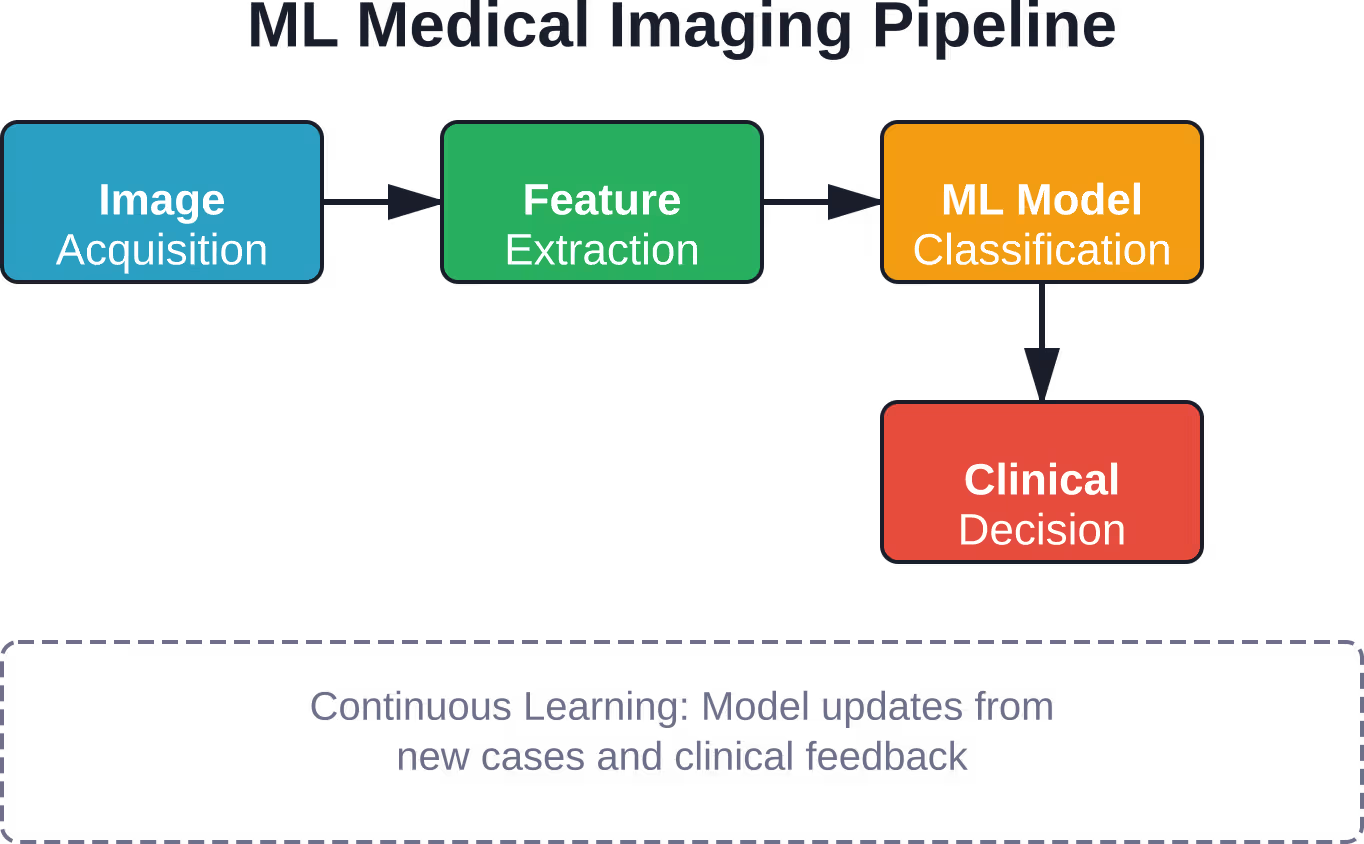
Challenges in Medical Image Analysis
Real-world deployment reveals important limitations. Bias in training data leads to disparate performance across demographic groups. Models trained predominantly on one population may underperform when applied to patients with different characteristics. Research published through the National Institutes of Health highlights that bias in medical imaging manifests through multiple pathways—access to imaging modalities, acquisition protocols, interpretation standards, and treatment decisions all introduce systematic variations. Generalizability remains another hurdle. A model performing brilliantly at the institution where it was developed might struggle when deployed elsewhere due to different equipment, protocols, or patient populations.
Wearable Devices and Continuous Monitoring
Machine learning enables a new generation of medical devices that learn from continuous physiological data streams. These systems move healthcare from episodic clinical encounters to persistent monitoring. Edge computing brings ML capabilities directly to wearable devices. The HearCough system demonstrates this approach—continuous cough event detection runs on hearables using built-in active noise cancellation microphones with on-chip machine learning. The technical specifications are impressive: HearCough tracks cough events with 90.0% accuracy every 0.5 s by consuming an additional 5.2 mW power. That efficiency allows all-day monitoring without draining batteries. But continuous monitoring creates new challenges. Algorithms must distinguish meaningful physiological signals from noise, movement artifacts, and environmental interference. They need to operate reliably across diverse real-world conditions—not just controlled laboratory settings. Privacy concerns intensify when devices collect persistent health data. Strong encryption, secure data transmission, and clear user consent frameworks become essential engineering requirements, not optional features.
Drug Discovery and Molecular Engineering
Machine learning accelerates pharmaceutical development by predicting molecular properties, identifying drug candidates, and optimizing compound structures before expensive laboratory synthesis. Traditional drug discovery tests thousands of compounds, hoping to find a few with desired properties. ML models screen millions of virtual compounds computationally, prioritizing the most promising candidates for actual synthesis and testing. Algorithms trained on databases of known drug-target interactions predict binding affinity between new molecules and therapeutic targets. This computational screening reduces the chemical search space dramatically, focusing experimental resources on high-probability candidates. Protein structure prediction, recently revolutionized by deep learning, enables rational drug design. Understanding how proteins fold reveals binding sites for potential therapeutics, transforming drug development from trial-and-error to targeted engineering.
Regulatory Landscape and Clinical Validation
The FDA actively shapes how AI-enabled medical devices enter clinical practice. Regulatory guidance emphasizes safety, effectiveness, and transparent performance evaluation. Good Machine Learning Practice principles guide development of safe, effective, and high-quality medical devices. These principles address the unique challenges ML systems present—complexity, iterative development, and data-driven performance characteristics. The FDA’s draft guidance on AI-enabled device software functions recommends specific documentation for marketing submissions. Developers must demonstrate not just initial performance, but sustained accuracy as models encounter real-world data diversity. Real-world performance monitoring becomes crucial for AI devices. Unlike traditional medical equipment with fixed behavior, ML models may drift as input data distributions shift. Continuous validation ensures algorithms maintain accuracy across diverse patient populations and clinical settings. The FDA maintains an AI-Enabled Medical Device List providing transparency about authorized products. This resource helps developers understand regulatory expectations and current device landscape while fostering innovation.
Neuroscience Applications and Brain-Computer Interfaces
Machine learning unlocks insights from neuroscience data that would be impossible through manual analysis. Brain imaging, neural recordings, and behavioral data all benefit from algorithmic pattern detection. Functional MRI generates massive datasets capturing brain activity across thousands of voxels and multiple time points. ML models identify activation patterns associated with specific cognitive states, neurological conditions, or treatment responses. Research demonstrates that ML approaches achieve 98.8% balanced accuracy classifying autistic brain patterns from fMRI data using five-fold cross-validation. This level of performance supports early diagnosis and personalized intervention planning. Speech and language analysis offers non-invasive windows into brain function. Algorithms detecting subtle changes in speech patterns identify early Alzheimer’s disease with 90% accuracy, enabling intervention before severe cognitive decline. Brain-computer interfaces rely heavily on machine learning to decode neural signals into control commands. Algorithms learn associations between neural activity patterns and intended movements, enabling paralyzed patients to control prosthetic limbs or computer cursors through thought alone.
Ethical Considerations and Bias Mitigation
The World Health Organization emphasizes that AI technologies must serve public benefit across all countries while respecting human rights and ethical principles. This requires deliberate attention to fairness, transparency, and accountability. Algorithmic bias emerges when training data doesn’t represent the full diversity of patients who’ll ultimately use the system. Models trained predominantly on one demographic group may perform poorly for others, potentially exacerbating existing healthcare disparities. Addressing bias requires diverse datasets, careful validation across subgroups, and ongoing monitoring after deployment. Developers can’t assume that high overall accuracy guarantees equitable performance across all patient populations. Transparency presents another challenge. Deep neural networks operate as “black boxes,” making predictions without human-interpretable explanations. Clinicians need to understand why an algorithm reached a particular conclusion, especially when making high-stakes treatment decisions. Explainable AI techniques help address this limitation by highlighting which input features most influenced a prediction. But achieving genuine interpretability without sacrificing performance remains an active research area.
| Ethical Challenge | Mitigation Strategy | Implementation Approach |
|---|---|---|
| Training data bias | Diverse dataset collection | Actively recruit underrepresented populations; audit data demographics |
| Algorithmic opacity | Explainable AI methods | Feature importance analysis; attention visualization; counterfactual examples |
| Privacy risks | Federated learning | Train models on distributed data without centralizing sensitive information |
| Performance drift | Continuous monitoring | Track accuracy metrics across subgroups; retrain on updated data |
Future Directions and Emerging Technologies
Generative AI represents the newest frontier in biomedical applications. Large multi-modal models process diverse data types—text, images, genomic sequences—enabling unprecedented analytical capabilities. The WHO recently released guidance on ethics and governance of large multi-modal models for healthcare. These powerful systems can generate new content, suggest treatment plans, and assist clinical decision-making, but they also introduce novel risks requiring careful oversight. Federated learning enables model training across multiple institutions without sharing raw patient data. Algorithms learn from distributed datasets while preserving privacy—each site’s data stays local, with only model updates transmitted centrally. This approach addresses a fundamental tension in medical AI: models improve with more data, but privacy regulations limit data sharing. Federated learning provides a path forward, enabling collaboration while respecting patient confidentiality. Reinforcement learning optimizes sequential treatment decisions. Instead of predicting single outcomes, these algorithms learn entire treatment strategies by simulating patient responses and adjusting actions to maximize long-term health outcomes. 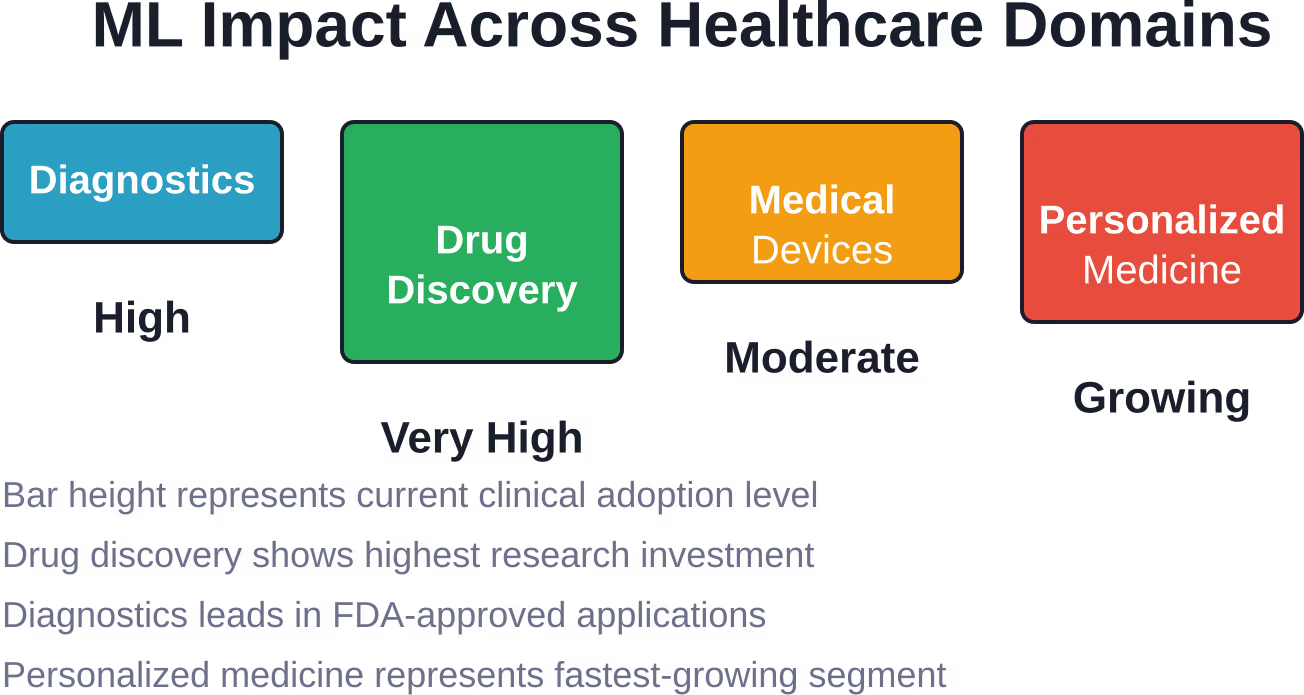
Practical Implementation Considerations
Successfully deploying ML systems in clinical environments requires more than accurate algorithms. Integration with existing electronic health records, workflow compatibility, and clinician training all determine whether promising technology actually improves patient care. Data quality fundamentally limits model performance. The principle “garbage in, garbage out” applies with full force—no algorithm can extract meaningful patterns from noisy, inconsistent, or mislabeled data. Biomedical engineers must work closely with clinicians throughout development. Understanding real clinical workflows, decision-making constraints, and information needs ensures models address actual problems rather than creating technically impressive solutions nobody uses. Computational requirements matter, especially for real-time applications. Edge devices need efficient algorithms that run on limited hardware. Cloud-based systems must handle latency, connectivity issues, and data transmission costs. Maintenance and updating present ongoing challenges. Models require periodic retraining as medical knowledge advances, patient populations shift, or equipment changes. Organizations need processes for monitoring performance degradation and deploying updates safely.
Frequently Asked Questions
What’s the difference between machine learning and traditional biomedical models?
Traditional biomedical models rely on explicit assumptions about biological systems and mathematical relationships derived from theoretical understanding. Machine learning algorithms learn patterns directly from data without requiring hand-coded rules, often achieving better predictive accuracy for complex phenomena. ML excels at handling high-dimensional data and discovering subtle patterns humans might miss.
How accurate are machine learning diagnostic systems compared to human clinicians?
Performance varies by application and context. For specific narrow tasks like detecting diabetic retinopathy or classifying skin lesions, ML systems match or exceed specialist performance. Recent studies show 90% accuracy for malaria detection, 98% for certain cancer classifications, and 98.8% for brain pattern analysis. But algorithms complement rather than replace clinicians—they excel at pattern recognition while humans provide contextual judgment and patient communication.
What prevents wider adoption of AI in clinical practice?
Multiple barriers slow clinical deployment: regulatory approval processes, integration challenges with existing hospital systems, clinician trust and training requirements, reimbursement uncertainties, liability concerns, and data quality issues. Additionally, many promising research results come from controlled settings that don’t reflect real-world clinical complexity. Validation across diverse patient populations and care environments takes time.
Do machine learning medical devices require special regulatory approval?
Yes. The FDA regulates AI-enabled medical devices through existing pathways (510(k), De Novo, PMA) but with additional requirements addressing ML-specific characteristics. Developers must demonstrate not just initial performance but also plans for monitoring real-world performance, handling software updates, and managing algorithmic changes. The FDA maintains specific guidance on Good Machine Learning Practice and continuously updates regulatory frameworks as technology evolves.
Can machine learning algorithms be biased against certain patient groups?
Absolutely. Algorithms trained on datasets that underrepresent certain demographics may perform poorly for those groups. Bias enters through multiple pathways: unrepresentative training data, biased labels reflecting historical disparities, features that correlate with protected characteristics, and evaluation metrics that mask subgroup performance differences. Research published through NIH highlights that medical imaging bias affects access, acquisition, interpretation, and treatment—all of which can propagate into ML systems. Addressing bias requires deliberate diverse data collection, fairness-aware algorithm design, and continuous monitoring across patient subgroups.
What educational background do you need to work in this field?
Most professionals combine expertise from multiple domains. Common backgrounds include biomedical engineering degrees with additional coursework in computer science and statistics, computer science degrees with biology or healthcare informatics focus, or clinical degrees (MD, nursing) with data science training. Strong foundations in mathematics (linear algebra, calculus, probability), programming (Python, R), and domain knowledge (anatomy, physiology, clinical workflows) prove essential. Many universities now offer specialized programs in medical AI or computational medicine.
How do privacy regulations like HIPAA affect ML development?
HIPAA and similar regulations create both constraints and important safeguards. Protected health information requires strict access controls, encryption, and audit trails. De-identification helps but doesn’t eliminate all privacy risks—ML models can sometimes leak information about training data. Federated learning and differential privacy techniques enable model training while preserving confidentiality. Organizations need robust data governance frameworks, secure computing environments, and clear patient consent processes. These requirements add complexity but protect patient rights and build public trust essential for healthcare AI success.
Conclusion
Machine learning fundamentally transforms biomedical engineering by enabling systems that learn from data, adapt to new information, and discover patterns beyond human perception. From diagnostic algorithms achieving over 90% accuracy to wearable devices that monitor health continuously, ML applications span the entire healthcare spectrum. The technology has moved beyond research laboratories into clinical practice. The FDA now authorizes hundreds of AI-enabled medical devices, regulatory frameworks continue maturing, and healthcare systems invest heavily in algorithmic infrastructure. But challenges remain. Ensuring algorithmic fairness across diverse populations, maintaining performance as systems encounter real-world variability, integrating seamlessly into clinical workflows, and preserving patient privacy all require ongoing engineering attention. The most successful applications combine technical excellence with deep understanding of clinical needs. Biomedical engineers who bridge computational methods and healthcare domain knowledge will drive the next generation of intelligent medical systems. Whether you’re developing diagnostic algorithms, designing smart medical devices, or building decision support tools, the intersection of machine learning and biomedical engineering offers unprecedented opportunities to improve human health at scale.