
Quick Summary: Machine learning in customer analytics transforms raw data into actionable insights by predicting behavior, segmenting audiences, and personalizing experiences at scale. Organizations leverage ML algorithms like clustering, classification, and neural networks to reduce churn, optimize marketing spend, and deliver better customer experiences. Random Forest models in documented implementations achieved accuracy rates of 99% in classification tasks, alongside significant improvements in retention. The explosion of customer data has created both an opportunity and a challenge. Every interaction—from website clicks to support tickets—generates information that could reveal patterns, preferences, and future behaviors. But here’s the thing: humans can’t process that volume at scale. Machine learning can. Organizations now deploy ML algorithms to analyze customer behavior patterns, predict churn before it happens, and segment audiences with precision that manual analysis simply can’t match. The technology learns from historical data to forecast what individual customers will do next, enabling businesses to act proactively rather than reactively. This shift from descriptive analytics to predictive intelligence fundamentally changes how companies serve customers. Instead of asking “what happened,” teams now ask “what will happen” and “how can we influence it.”
How Machine Learning Transforms Customer Data
Traditional analytics tools report what occurred. Machine learning algorithms go several steps further by identifying patterns invisible to human analysts and making predictions about future behavior. The process starts with data collection across multiple touchpoints—purchase history, browsing behavior, support interactions, social media engagement, and demographic information. ML models ingest this information and identify correlations that reveal customer segments, risk factors, and opportunities. Classification algorithms categorize customers into predefined groups based on their characteristics and behaviors. Clustering techniques discover natural groupings within customer bases without preset categories. Neural networks detect complex, non-linear relationships between variables that simpler models miss. Real talk: the technology isn’t magic. It’s pattern recognition at massive scale, but that capability unlocks insights that directly impact revenue. Organizations can now predict which customers are likely to churn within the next 30 days, which prospects will convert, and which products individual customers want next—all before those customers explicitly signal their intentions. 
Create AI Tools for Customer Analytics With AI Superior
AI Superior develops AI-based applications and custom software products using machine learning models and algorithms. Their work also covers predictive analytics, BI solutions, big data analytics, and data analysis tools. For customer analytics, this can support segmentation, behavior analysis, retention models, product recommendations, campaign insights, or dashboards powered by machine learning.
Need Better Use of Customer Data?
AI Superior can help with:
- building customer analytics tools
- creating predictive machine learning models
- analyzing behavior, retention, and engagement data
- integrating AI into existing reporting systems
👉 Contact AI Superior to discuss your project.
Predictive Customer Behavior Analysis
Prediction as a capability represents what many consider the Holy Grail for foreseeing each customer need and personalizing products and services accordingly. From the consumer’s perspective, when ML’s ethical pitfalls are avoided, prediction can be the ultimate antidote to the information overload that everyone faces daily.
- Predictive models analyze historical behavior to forecast future actions. These models answer questions like: Will this customer renew their subscription? Which product category will they browse next? What price point triggers conversion?
- The algorithms examine dozens or hundreds of variables simultaneously—recency and frequency of purchases, average order value, browsing patterns, email engagement rates, support ticket history, and more. Through training on past data where outcomes are known, the models learn which combination of factors correlates with specific behaviors.
- Once deployed, these models score every customer in real-time. A customer with a high churn probability score might receive a targeted retention offer. Someone predicted to be interested in a premium tier gets personalized upgrade messaging.
The business impact can be substantial. Organizations using predictive models report better resource allocation—marketing spend flows toward prospects most likely to convert, and retention efforts focus on customers actually at risk rather than blanket campaigns.
Customer Segmentation Through Clustering
Clustering algorithms group customers based on similarities without requiring predefined categories. This unsupervised learning approach discovers natural segments that might not align with traditional demographic divisions. The most common clustering technique, K-means, partitions customers into K groups by minimizing the variance within each cluster. Hierarchical clustering builds a tree of nested groups, revealing both broad segments and fine-grained subsegments. What makes clustering powerful for customer analytics is its ability to find segments based on behavior rather than just demographics. Two customers might share age and location but exhibit completely different purchase patterns, engagement levels, and lifetime value trajectories. ML clustering identifies these behavioral segments automatically by analyzing variables like purchase frequency, average order value, product category preferences, channel usage, support contact frequency, and engagement with marketing materials. The resulting segments enable targeted strategies. High-value customers with frequent purchases but low engagement with marketing emails might prefer a different communication approach than bargain hunters who respond well to promotional campaigns.
Clustering Process and Implementation
Implementation starts with feature selection—choosing which customer attributes to include in the analysis. Too few features miss important distinctions. Too many create noise that obscures meaningful patterns. Data preprocessing normalizes variables so attributes measured on different scales contribute appropriately to the clustering algorithm. Purchase frequency (ranging from 1 to 50) and average order value (ranging from $10 to $5,000) need normalization before clustering treats them comparably. The algorithm then iteratively assigns customers to clusters and refines cluster boundaries until it reaches stability. Visualization techniques like scatter plots and cluster profiles help analysts interpret what distinguishes each segment. Organizations typically identify anywhere from 4 to 10 actionable customer segments through this process, each with distinct characteristics and requiring different engagement strategies.
Classification Models for Customer Prediction
While clustering discovers patterns, classification assigns customers to predefined categories based on their characteristics. These supervised learning models answer specific business questions with categorical outcomes. Will this customer churn? (Yes/No) Which product category fits this customer best? (Electronics/Apparel/Home Goods) What customer tier should this person be assigned to? (Bronze/Silver/Gold/Platinum) Random Forest models in documented implementations achieved accuracy rates of 99% in classification tasks, indicating strong ability to correctly predict customer categories. The model works by training on historical data where outcomes are known—customers who did or didn’t churn, purchases that did or didn’t occur. It learns which combination of customer attributes correlates with each outcome. 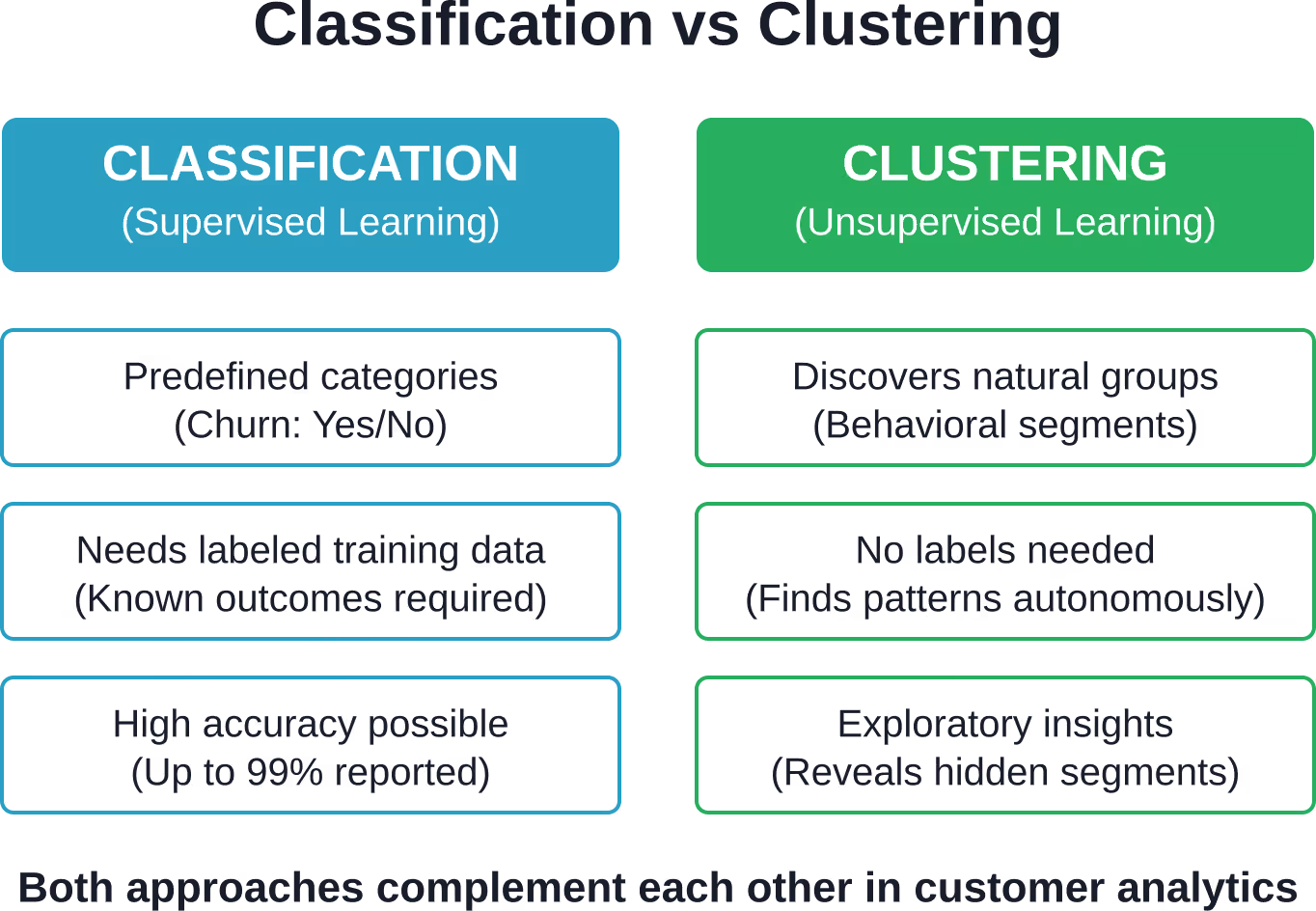 Decision trees, support vector machines, logistic regression, and neural networks represent alternative classification approaches, each with strengths for different scenarios and data types. The confusion matrix—a visualization of prediction accuracy—illustrates the model’s ability to correctly predict customer categories by comparing predicted outcomes against actual outcomes. High-performing models show strong diagonal values (correct predictions) and minimal off-diagonal values (errors).
Customer Churn Prevention
Customer churn is important to every for-profit business because of the direct loss of revenue associated with lost customers. Acquiring a new customer costs significantly more than retaining an existing one, making churn prevention a top priority. Machine learning transforms churn management from reactive to proactive. Instead of discovering a customer has left only when they cancel, predictive models identify at-risk customers weeks or months in advance. Churn prediction models analyze engagement patterns, usage trends, payment history, support interactions, and competitive activity signals. A customer whose login frequency has declined, who recently contacted support with unresolved issues, and whose payment method failed might receive a high churn risk score. But prediction alone doesn’t prevent churn. Organizations need intervention strategies tailored to the specific risk factors. A customer at risk due to product complexity might benefit from personalized training resources. Someone showing price sensitivity could receive a retention offer. Customers with unresolved technical issues need proactive support outreach.
| Churn Risk Factor | ML Detection Method | Recommended Intervention |
|---|---|---|
| Declining engagement | Usage pattern analysis | Re-engagement campaign with value reminders |
| Support issues | Sentiment analysis of tickets | Proactive resolution outreach |
| Price sensitivity | Competitor pricing monitoring | Targeted retention offer or discount |
| Product misfit | Feature usage clustering | Personalized training or alternative product suggestion |
| Payment failures | Transaction monitoring | Payment method update prompts |
The models continuously learn from intervention outcomes. Which retention offers worked? Which customers responded to which messages? This feedback loop improves prediction accuracy and intervention effectiveness over time.
Personalization at Scale
Generic marketing messages and one-size-fits-all experiences don’t cut it anymore. Customers expect relevance—content, recommendations, and offers that match their individual preferences and needs. Machine learning enables personalization at a scale impossible for human analysts. Recommendation engines predict which products each customer wants to see. Content selection algorithms choose articles, videos, or promotions most likely to resonate with each individual. These systems analyze past behavior to predict future preferences. A customer who previously bought outdoor equipment and browsed hiking content likely wants to see new trail gear, not kitchen appliances. Collaborative filtering—the “customers who bought X also bought Y” approach—identifies patterns across similar customers. Content-based filtering examines product attributes and matches them to customer preferences. Hybrid systems combine both approaches. The result is better customer experience and improved business metrics. Customers receive less junk mail and higher quality recommendations, among many other things. These improvements to customer experience aren’t only a nice-to-have, pleasant side-effect of profit-driven ML deployments. After all, a happier customer is a more loyal customer, and a higher customer retention rate means a higher customer growth rate.
Real-World Applications Across Industries
- Retail organizations use machine learning to optimize inventory based on predicted demand patterns, reducing both stockouts and excess inventory. The algorithms analyze historical sales, seasonal trends, promotional impacts, and external factors like weather or local events.
- Financial services firms deploy ML for fraud detection, analyzing transaction patterns to flag suspicious activity in real-time. The models learn normal behavior patterns for each customer and alert when transactions deviate significantly.
- Telecommunications companies predict which customers will upgrade devices, switch plans, or leave for competitors. This intelligence informs retention campaigns, upsell timing, and customer service prioritization.
- E-commerce platforms use machine learning to optimize pricing dynamically, adjusting based on demand, inventory levels, competitor pricing, and individual customer price sensitivity. The system might offer different prices to different segments based on their willingness to pay.
- Service organizations analyze support interactions to identify common pain points, predict ticket volume, and route inquiries to the most appropriate agents. Sentiment analysis flags frustrated customers for priority handling.
B2B Customer Analytics
Machine learning in B2B contexts focuses on account-level insights rather than individual consumer behavior. The models predict which accounts will expand, contract, or churn based on usage patterns, stakeholder engagement, renewal history, and business outcomes. Lead scoring algorithms rank prospects by conversion probability, helping sales teams prioritize their efforts. The models consider firmographics, behavioral signals, intent data, and engagement patterns. Contract renewal prediction identifies at-risk accounts months before renewal dates, giving customer success teams time to address concerns and demonstrate value.
Implementation Considerations
Successfully deploying machine learning for customer analytics requires more than just algorithms. Organizations need quality data, appropriate infrastructure, skilled teams, and clear processes. Data quality determines model performance. Incomplete records, inconsistent formats, and siloed information across systems undermine prediction accuracy. Data preparation typically consumes 60-80% of an ML project timeline. Integration with existing systems ensures models can actually influence customer interactions. A churn prediction sitting in a data science notebook doesn’t prevent churn—the insights need to flow into CRM systems, marketing automation platforms, and customer service tools. Model governance addresses critical questions: How often should models retrain on fresh data? Who reviews predictions before they trigger automated actions? How does the organization handle incorrect predictions that harm customer relationships? Ethical considerations matter increasingly as regulations and customer expectations evolve. Organizations must ensure their ML systems don’t discriminate, respect privacy preferences, and provide transparency about how customer data gets used.
| Implementation Phase | Key Activities | Common Challenges |
|---|---|---|
| Data Preparation | Collect, clean, integrate, normalize customer data | Siloed systems, incomplete records, inconsistent formats |
| Model Development | Select algorithms, train models, validate accuracy | Algorithm selection, feature engineering, overfitting |
| Integration | Connect to CRM, marketing, service platforms | Legacy system compatibility, real-time data flow |
| Deployment | Put models into production, monitor performance | Scaling infrastructure, model drift over time |
| Optimization | Refine models based on outcomes, retrain regularly | Feedback loops, continuous improvement processes |
Measuring Success
Machine learning initiatives need clear metrics that connect model performance to business outcomes. Technical metrics like accuracy, precision, and recall matter, but business stakeholders care about revenue impact. For churn prevention, measure not just prediction accuracy but actual retention rate improvements and the ROI of intervention campaigns. Did the model correctly identify at-risk customers? Did interventions work? What’s the cost per customer saved versus customer lifetime value? Personalization engines should demonstrate increased engagement rates, higher conversion rates, and improved customer satisfaction scores—not just technically impressive recommendation accuracy. Segmentation initiatives prove value through better campaign performance within each segment, increased relevance scores, and more efficient marketing spend allocation. Organizations should establish baseline metrics before ML deployment and track improvement over time, while accounting for external factors that might influence results.
Future Trends in ML Customer Analytics
The field continues evolving rapidly. Several trends are shaping the next generation of machine learning customer analytics capabilities.
- Real-time processing enables immediate responses to customer behavior. Instead of batch predictions that update daily or weekly, streaming ML analyzes actions as they happen and triggers instant personalization or interventions.
- Automated machine learning (AutoML) tools lower the barrier to entry by automating algorithm selection, feature engineering, and hyperparameter tuning. Organizations with limited data science resources can still deploy effective models.
- Explainable AI addresses the “black box” problem by making model decisions interpretable. When a model predicts churn, explainable AI shows which factors contributed most to that prediction, helping teams design better interventions.
- According to NIST guidance, including a report published in March 2025, organizations increasingly focus on trustworthy and responsible AI, particularly addressing adversarial machine learning concerns as AI systems continue their global expansion trajectory.
- Privacy-preserving techniques like federated learning enable model training on distributed data without centralizing sensitive customer information, addressing both regulatory requirements and customer preferences.
- Multimodal learning combines structured data (purchase history, demographics) with unstructured data (support call transcripts, product reviews, social media posts) for richer customer insights.
Getting Started
Organizations new to machine learning customer analytics should start with well-defined, high-impact use cases rather than attempting comprehensive transformation immediately. Churn prediction often provides strong ROI because the business case is clear and the data requirements are typically achievable. Organizations already track customer status (active/churned) and have historical data on customer attributes and behaviors. Customer segmentation offers another accessible entry point, particularly for organizations already doing manual segmentation based on simple rules. ML-powered clustering can quickly reveal segments that manual approaches miss. Start with pilot projects that prove value before scaling. Choose use cases where success is measurable, data is available, and stakeholders are engaged. Early wins build organizational momentum and justify larger investments. Partner selection matters. Whether building in-house capabilities, hiring consultants, or adopting vendor platforms, evaluate options based on industry experience, technical approach, and ability to integrate with existing systems. Most importantly: focus on business outcomes rather than technical sophistication. The goal isn’t to deploy the most advanced algorithms—it’s to improve customer experiences and drive measurable business results.
Frequently Asked Questions
What’s the difference between machine learning and traditional customer analytics?
Traditional analytics describes what happened using historical data—reports on past purchases, demographic breakdowns, and aggregate metrics. Machine learning predicts what will happen by identifying patterns in data and forecasting future customer behaviors. ML systems also improve automatically as they process more data, while traditional analytics requires manual updates to reports and rules.
How much data do you need for machine learning customer analytics?
Requirements vary by use case and algorithm, but generally thousands to tens of thousands of customer records provide a starting point for useful models. More complex predictions need larger datasets. Quality matters more than quantity—accurate, complete, relevant data produces better results than massive volumes of messy data. Organizations can start with available data and expand as models prove value.
Can small businesses use machine learning for customer analytics?
Yes, though approaches differ from enterprise implementations. Many platforms now offer accessible ML tools that don’t require data science expertise. Small businesses can start with vendor solutions that provide pre-built models for common use cases like churn prediction or product recommendations. Focus on high-impact applications where even modest improvements deliver meaningful revenue benefits.
How do you prevent machine learning models from becoming biased?
Bias prevention requires intentional effort throughout the ML lifecycle. Start with representative training data that doesn’t over-represent or under-represent customer segments. Regularly audit model predictions across different demographic groups to identify disparate impacts. Use fairness metrics alongside accuracy metrics during model evaluation. Implement human review for high-stakes decisions, and retrain models regularly as customer populations evolve.
What’s the typical ROI timeline for machine learning customer analytics?
Initial insights often emerge within 3-6 months for focused use cases like churn prediction or segmentation. Full ROI realization typically takes 12-18 months as models refine, integrations mature, and organizations optimize intervention strategies based on results. Quick wins from pilot projects can demonstrate value faster and justify continued investment before comprehensive ROI materializes.
How often do machine learning models need retraining?
Retraining frequency depends on how quickly customer behavior patterns change. E-commerce businesses with rapidly shifting preferences might retrain models monthly or even weekly. B2B organizations with slower-moving customer bases might retrain quarterly. Monitor prediction accuracy over time—when performance degrades noticeably, retrain with fresh data. Automated retraining pipelines help maintain model effectiveness without manual intervention.
What happens when machine learning predictions are wrong?
No model achieves perfect accuracy, so organizations need processes for handling incorrect predictions. For low-risk decisions like product recommendations, occasional errors cause minimal harm. High-stakes predictions like fraud detection or churn intervention should include human review before action. Track prediction errors systematically to identify patterns that indicate model drift or blind spots, then use those insights to improve future model versions.
Taking Action on Customer Intelligence
Machine learning has moved from experimental technology to essential capability for customer-focused organizations. The gap between companies using predictive analytics and those still relying on descriptive reports will only widen. The technology enables what was previously impossible: understanding individual customer needs at scale, predicting behaviors before they occur, and personalizing experiences in ways that strengthen relationships rather than annoy with irrelevant messaging. But technology alone doesn’t create value. Organizations need strategy, quality data, appropriate infrastructure, skilled teams, and—most importantly—commitment to acting on insights. A perfect churn prediction model delivers zero value if the organization lacks processes to intervene with at-risk customers. Start with one high-impact use case. Prove value. Learn from initial deployments. Then expand to additional applications as capabilities mature and organizational confidence grows. The organizations winning with machine learning customer analytics aren’t necessarily the ones with the most sophisticated algorithms. They’re the ones consistently turning predictions into actions that improve customer experiences and drive business results. Your customer data contains patterns that reveal opportunities and risks. Machine learning surfaces those patterns at scale. The question isn’t whether to deploy ML for customer analytics—it’s how quickly you can start and how effectively you’ll act on what the models reveal.