Quick Summary: Machine learning in customer service uses algorithms that learn from data to automate support tasks, predict customer needs, personalize interactions, and analyze sentiment at scale. Modern conversational analytics platforms can now analyze 100% of customer conversations across 30-50 channels, enabling businesses to improve response times, reduce costs, and deliver more consistent experiences. The technology ranges from intelligent chatbots and automated ticket routing to predictive analytics and real-time quality assurance. Customer expectations have shifted dramatically. People want instant answers, personalized interactions, and seamless experiences across every touchpoint. Traditional support models can’t keep up. That’s where machine learning changes the game. It’s not about replacing human agents—it’s about making them smarter, faster, and more effective. And the results speak for themselves: mature AI adopters reported a 24% higher customer satisfaction score compared to organizations still relying on manual processes alone. Here’s the thing though—machine learning isn’t a single tool. It’s a collection of techniques that work with data, identify patterns, and make predictions without explicit programming. For customer service teams, this translates into practical applications that handle everything from routing tickets to predicting churn before it happens.
What Machine Learning Actually Means for Customer Service
Machine learning is a subset of artificial intelligence focused on building systems that learn from experience. Instead of following rigid rules, these systems improve their performance as they process more data. In customer service contexts, machine learning algorithms analyze historical interactions, identify patterns in customer behavior, and make intelligent decisions about how to respond. The technology can work with both labeled data (where outcomes are known) and unlabeled data (where the system discovers patterns on its own). According to industry analyses, over 85% of organizations are now exploring or actively planning to incorporate machine learning into their operations. Customer service sits at the forefront of this adoption wave. The practical applications fall into three broad categories: automation of repetitive tasks, prediction of customer needs and behaviors, and personalization of interactions based on individual preferences and history.
Why Businesses Are Investing in Machine Learning for Support
Customer service has traditionally been viewed as a cost center. The focus has been on reducing expenses rather than maximizing value. Machine learning flips this equation.
- First, the technology enables support teams to handle dramatically higher volumes without proportional increases in headcount. Chatbots and virtual assistants can manage routine inquiries 24/7, freeing human agents to tackle complex issues that require empathy and creative problem-solving.
- Second, machine learning systems don’t forget. Every interaction becomes training data. The system remembers what worked, what didn’t, and which responses led to satisfied customers. This institutional knowledge compounds over time.
- Third, speed matters. Customers won’t wait. Machine learning can analyze customer queries, route them to the right specialist, and even suggest solutions to agents in real-time. Response times drop from hours to seconds.
Research published in MIT Sloan Review (January 2020) emphasizes that the future isn’t about AI replacing humans—it’s about AI-human collaboration. Chatbots aren’t eliminating customer service jobs; they’re making agents more efficient by handling the repetitive work that burns them out. 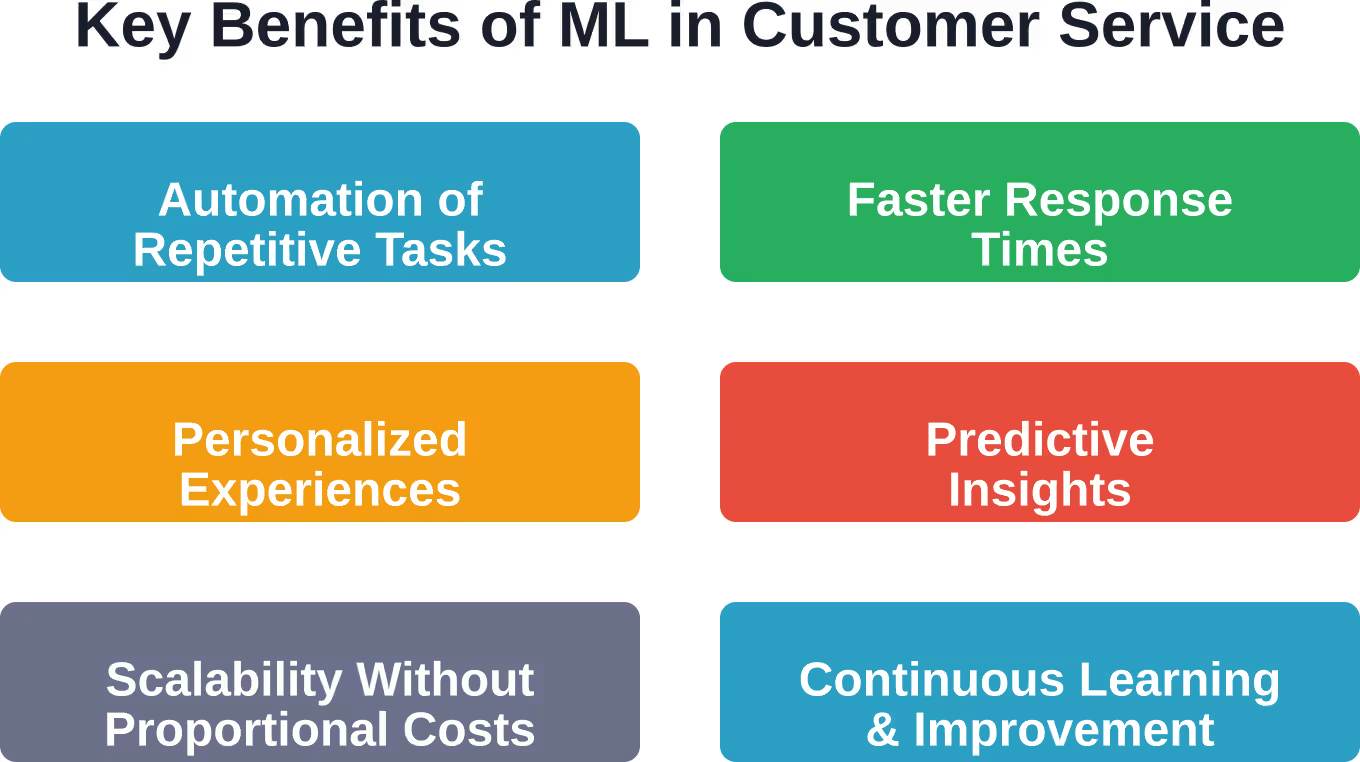

Develop AI Tools for Customer Service Workflows
AI Superior builds AI and machine learning solutions for data analysis, NLP, predictive analytics, BI, big data analytics, and custom software development. Their NLP work can help process large volumes of customer text from email, chat, support tickets, and other channels. For customer service teams, this can support ticket classification, response suggestions, sentiment analysis, knowledge search, or support automation.
Need AI Connected to Support Data?
AI Superior can help with:
- creating NLP and machine learning models
- analyzing customer messages and support data
- testing automation ideas through PoC or MVP work
- connecting AI tools with existing platforms
👉 Contact AI Superior to discuss your project.
Core Use Cases: Where Machine Learning Makes the Biggest Impact
Real talk: not every customer service problem needs machine learning. But several high-impact areas benefit dramatically from the technology.
Intelligent Chatbots and Virtual Assistants
Modern chatbots aren’t the clunky rule-based systems from a decade ago. Machine learning-powered conversational agents understand context, handle multi-turn dialogues, and learn from every interaction. These systems handle tier-one inquiries—password resets, order tracking, basic troubleshooting—without human intervention. When they encounter questions beyond their capability, they route customers to the appropriate specialist along with full conversation context. The efficiency gains are substantial. A single chatbot can manage thousands of simultaneous conversations, something impossible for human teams.
Automated Ticket Routing and Prioritization
Not all support tickets are created equal. A customer reporting a security breach needs immediate attention. Someone asking about a minor feature can wait. Machine learning systems analyze incoming tickets, categorize them by topic and urgency, and route them to the agent best equipped to handle them. Research from London Business School by Yueyang Zhong, Assistant Professor of Management Science and Operations, introduced the Learn-Then-Schedule method, which uses machine learning to reduce call abandonment rates by intelligently deciding which customers to serve first even when information is incomplete. This isn’t just about speed—it’s about matching expertise to need. The algorithm learns which agents excel at which types of problems and optimizes assignments accordingly.
Sentiment Analysis and Real-Time Quality Assurance
Here’s the thing: managers can’t listen to every customer call or read every chat transcript. Machine learning can. Sentiment analysis algorithms process customer conversations in real-time, detecting frustration, confusion, or satisfaction. When sentiment turns negative during an interaction, the system can alert a supervisor to intervene before the situation escalates. With modern conversational analytics platforms, businesses can analyze 100% of customer conversations across 30-50 channels, not just a sample. This comprehensive visibility reveals patterns that would otherwise remain hidden.
Predictive Analytics for Customer Behavior
The best support interaction is the one that never needs to happen. Machine learning systems can identify customers at risk of churning based on behavior patterns—reduced product usage, increased support contacts, negative sentiment trends. Armed with these predictions, proactive support teams can reach out with targeted assistance before the customer decides to leave. The same technology identifies upsell opportunities by recognizing when customers would benefit from additional features or products.
Personalization at Scale
Generic responses frustrate customers. Machine learning enables personalized interactions by analyzing customer history, preferences, and context. When a customer contacts support, the system instantly surfaces their purchase history, previous issues, communication preferences, and even their current emotional state. Agents can tailor their approach to the individual rather than following a one-size-fits-all script. A randomized field experiment published in Management Science and conducted with a meal delivery company examined how artificial intelligence affected customer service. The research demonstrated measurable improvements in both agent performance and customer satisfaction when AI-powered tools provided real-time assistance during interactions.
Knowledge Base Optimization
Self-service resources only work if customers can find the right information. Machine learning analyzes search patterns, identifies gaps in documentation, and even suggests content improvements based on which articles successfully resolve issues versus which ones lead customers to contact support anyway. The technology also powers intelligent search that understands intent rather than just matching keywords. A customer searching for “can’t log in” gets results about password recovery, account lockouts, and two-factor authentication issues—all relevant even though the exact phrase might not appear in those articles.
Voice of Customer Analysis
Customer feedback comes from everywhere—surveys, social media, support tickets, product reviews, chat transcripts. Machine learning tools can process this unstructured data at scale. Research from Yale SOM by K. Sudhir (published July 21, 2020) developed approaches to extract insights from customer reviews using machine learning, learning not just from what customers explicitly say but also inferring meaning from what remains unsaid. This technology identifies recurring pain points, emerging feature requests, and sentiment trends across thousands of interactions. Support teams can spot systemic issues before they explode. Product teams get prioritized feature requests based on actual customer language rather than filtered summaries.
Implementation Considerations: What Actually Matters
Okay, so what about actually deploying this technology? Several factors determine success or failure.
Data Quality and Volume
Machine learning systems need data to learn. Poor quality data produces poor quality predictions. Garbage in, garbage out. Organizations need sufficient historical interaction data—ideally thousands or tens of thousands of labeled examples. The data must be clean, properly categorized, and representative of current customer behavior. Training a sentiment analysis model on chat transcripts from 2019 won’t accurately predict sentiment in 2026 if customer language and expectations have evolved.
The AI-Human Balance
The goal isn’t full automation. Research consistently shows that the best results come from AI-human collaboration, not replacement. Customers still need human empathy for complex or emotionally charged situations. Machine learning handles the routine, surfaces relevant information, and makes agents more effective. But the human touch remains irreplaceable for building genuine relationships and handling nuanced problems.
Monitoring for Bias and Accuracy
Machine learning systems can inherit and amplify biases present in training data. The National Institute of Standards and Technology has extensively documented how bias exists in many forms and can become ingrained in automated systems. Continuous monitoring is essential. Are certain customer segments receiving worse service? Are predictions accurate across different demographics? Is the system making decisions that would be considered unfair or discriminatory if a human made them? The Federal Trade Commission has warned organizations about using artificial intelligence to combat online problems, expressing concern about AI harms including inaccuracy, bias, discrimination, and commercial surveillance creep. In 2024, the FTC launched Operation AI Comply, announcing enforcement actions against operations making deceptive AI claims. Transparency matters. Customers deserve to know when they’re interacting with AI rather than a human. Systems should clearly disclose their automated nature.
Integration with Existing Systems
Machine learning tools don’t exist in isolation. They need to connect with CRM platforms, ticketing systems, knowledge bases, and communication channels. Integration complexity can derail projects. The best machine learning solutions offer APIs and pre-built connectors for popular customer service platforms. Data should flow seamlessly between systems without manual exports and imports.
| Implementation Factor | Why It Matters | Common Pitfall |
|---|---|---|
| Data Quality | Determines prediction accuracy and model reliability | Using outdated or poorly labeled training data |
| Human Oversight | Ensures empathy and handles edge cases effectively | Over-automating and removing human judgment |
| Bias Monitoring | Prevents discrimination and maintains fairness | Assuming algorithms are neutral without testing |
| System Integration | Enables seamless workflows and data sharing | Implementing isolated tools that don’t connect |
| Continuous Training | Keeps models accurate as customer behavior evolves | Deploying once and never updating the model |
Measuring Success: Metrics That Matter
How do organizations know if machine learning is actually working? Several key performance indicators reveal impact. First-response time typically drops dramatically. Automated routing and chatbot handling mean customers get faster initial responses. But watch average resolution time too—speed without solutions frustrates everyone. Customer satisfaction scores (CSAT) provide direct feedback. As mentioned earlier, mature AI adopters reported a 24% higher customer satisfaction score. Track CSAT before and after implementation to quantify impact. Agent productivity metrics show efficiency gains. How many tickets does each agent close per day? Has the mix shifted toward more complex, high-value interactions? Are agents spending less time on repetitive tasks? Cost per interaction matters for the business case. Machine learning should reduce the average cost to serve each customer by handling more inquiries with fewer resources. Self-service containment rates indicate whether knowledge base improvements and chatbots are working. What percentage of customers find answers without contacting a human agent? Churn reduction is the ultimate test for predictive analytics. Are at-risk customers being identified and retained at higher rates than before?
Real-World Applications and Industry Adoption
Machine learning in customer service isn’t theoretical—it’s actively deployed across industries.
- Financial services institutions use predictive models to identify fraudulent transactions and proactively contact customers about suspicious activity. Banks deploy chatbots that handle routine inquiries about balances, transactions, and basic product information while routing complex financial planning questions to human advisors.
- E-commerce companies analyze customer reviews at scale to identify product quality issues, shipping problems, and feature gaps. Sentiment analysis helps prioritize which negative reviews need immediate responses from customer service teams.
- Telecommunications providers manage enormous support volumes with intelligent routing that categorizes technical issues, billing questions, and service requests, sending each to specialized teams. Predictive analytics identify customers likely to cancel service, triggering retention offers.
- An article published by American Public University (dated 05/02/2024) examining AI in customer service and digital retail found that as e-commerce continues growing, retailers need to continually innovate customer service strategies. AI plays an important role for both customers and businesses in meeting evolving expectations.
- Healthcare organizations use machine learning to triage patient inquiries, directing urgent medical questions to clinical staff while handling appointment scheduling and insurance queries through automated systems.
Challenges and Limitations
Now, this is where it gets real. Machine learning isn’t a silver bullet.
- The technology struggles with true edge cases—situations it hasn’t encountered during training. When a customer presents a genuinely novel problem, machine learning systems may fail spectacularly or provide confident but incorrect answers.
- Context windows remain limited. While systems are getting better at understanding multi-turn conversations, they can still lose the thread in complex discussions that span multiple topics and reference previous interactions.
- Emotional intelligence has limits. Algorithms can detect sentiment, but they don’t truly understand frustration, embarrassment, or joy the way humans do. A customer who’s had a terrible day needs empathy, not algorithmic pattern matching.
- Implementation costs can be substantial. Organizations need data infrastructure, technical expertise, and ongoing maintenance. Small businesses may struggle to justify the investment.
- Privacy concerns are legitimate. Machine learning systems require access to customer data—sometimes sensitive information. Organizations must balance personalization benefits against privacy risks and comply with regulations like GDPR and CCPA.
The Future Direction of Machine Learning in Support
Where is this technology headed? Several trends are emerging. Multimodal understanding is advancing. Future systems will seamlessly process text, voice, images, and video within the same conversation. A customer could photograph a broken product, describe the problem verbally, and receive visual troubleshooting instructions—all handled by integrated machine learning systems. Proactive support will expand. Rather than waiting for customers to contact support, systems will anticipate problems and reach out with solutions. If usage patterns indicate a customer is struggling with a feature, the system offers help before frustration sets in. Personalization will deepen. Machine learning will understand not just purchase history but communication style preferences, optimal contact times, preferred channels, and individual patience levels. Every interaction will feel tailored to the specific customer. Cross-channel intelligence will improve. Customers start conversations on one channel and continue them on another. Machine learning systems will maintain perfect context across email, chat, phone, social media, and in-person interactions. Continuous learning loops will tighten. Modern systems learn from feedback, but there’s often lag between deployment and retraining. Future implementations will update models in near-real-time, constantly improving based on the latest interactions.
Getting Started: Practical First Steps
For organizations ready to explore machine learning in customer service, where should they begin?
- Start with well-defined problems. Don’t implement machine learning because it’s trendy. Identify specific pain points—long wait times, inconsistent responses, difficulty finding information—and evaluate whether machine learning addresses those problems better than alternatives.
- Begin with low-risk applications. Test chatbots on frequently asked questions with straightforward answers. Implement automated routing for clearly categorizable tickets. Build confidence with successes before tackling complex use cases.
- Establish baseline metrics before implementation. How long do responses currently take? What’s the average customer satisfaction score? What percentage of inquiries require human intervention? These benchmarks enable meaningful before-and-after comparisons.
- Invest in data infrastructure. Clean, accessible, properly structured data is the foundation. Organizations with messy data spread across disconnected systems will struggle regardless of which machine learning tools they choose.
- Plan for the long term. Machine learning systems require ongoing maintenance, retraining, and monitoring. Budget for continuous improvement, not just initial deployment.
- Keep humans in the loop. Train customer service teams on working alongside AI tools rather than being replaced by them. The best results come from augmentation, not automation alone.
| Maturity Level | Typical Applications | Required Capabilities |
|---|---|---|
| Beginning | FAQ chatbots, basic ticket categorization | Clean customer interaction data, basic integration |
| Intermediate | Sentiment analysis, intelligent routing, self-service optimization | Multi-channel data, labeled training sets, monitoring tools |
| Advanced | Predictive analytics, proactive outreach, real-time personalization | Comprehensive data infrastructure, ML expertise, continuous training loops |
| Mature | Cross-channel intelligence, multimodal understanding, autonomous resolution | Integrated systems, advanced algorithms, robust governance frameworks |
Regulatory and Ethical Considerations
Machine learning deployment isn’t just a technical decision—it’s an ethical and legal one. Privacy regulations constrain what data organizations can collect and how they can use it. Customer service interactions often contain personal information, health details, financial data, and other sensitive content. Machine learning systems must comply with GDPR, CCPA, HIPAA, and other applicable frameworks. Transparency requirements are tightening. The FTC has taken action against organizations making deceptive AI claims. Customer service implementations must be honest about capabilities and limitations. Bias auditing is becoming mandatory in some jurisdictions. Organizations need processes to test whether machine learning systems treat all customer segments fairly and document their bias mitigation efforts. Data retention policies matter. How long should conversation transcripts and customer interaction data be stored? Longer retention improves machine learning model quality but increases privacy risks and storage costs. Right-to-explanation laws in some regions require that customers can understand why an automated system made a particular decision. Black-box algorithms that can’t explain their reasoning may create compliance problems.
Frequently Asked Questions
How does machine learning differ from traditional rule-based customer service automation?
Traditional automation follows explicit rules—if the customer asks X, provide response Y. Machine learning systems learn patterns from data and can handle variations they haven’t been explicitly programmed for. They improve with experience rather than requiring manual rule updates for every scenario.
Can small businesses benefit from machine learning in customer service, or is it only for large enterprises?
Small businesses can definitely benefit, though the approach differs. Instead of building custom systems, smaller organizations typically use commercial platforms that embed machine learning capabilities—chatbot services, help desk software with AI features, or analytics tools. The technology has become more accessible and affordable.
What percentage of customer service jobs will machine learning eliminate?
Research suggests machine learning augments rather than eliminates customer service roles. The technology handles routine tasks, allowing human agents to focus on complex problems requiring creativity and empathy. Organizations typically redeploy staff to higher-value work rather than reducing headcount. Job roles evolve more than they disappear.
How much training data is needed to implement machine learning for customer service?
The answer varies by application. Simple classification tasks might work with hundreds of labeled examples. More sophisticated applications like sentiment analysis or predictive analytics typically require thousands or tens of thousands of interactions. Quality matters more than quantity—clean, representative, properly labeled data produces better results than massive volumes of messy data.
What are the biggest risks of implementing machine learning in customer service?
Key risks include algorithmic bias leading to unfair treatment of customer segments, privacy breaches from improper data handling, customer frustration from poor implementation, and over-automation that removes necessary human judgment. Organizations also face reputational damage if AI systems make egregious errors in public-facing interactions.
How long does it typically take to see ROI from machine learning customer service implementations?
Simple applications like FAQ chatbots can show returns within months. More complex implementations involving predictive analytics or comprehensive personalization typically require 6-12 months before delivering measurable ROI. The timeline depends on data readiness, integration complexity, and change management effectiveness.
Can machine learning systems handle customer service in multiple languages?
Yes, but effectiveness varies. Machine learning models trained on English data won’t automatically work in other languages—they need training data in each target language. Some languages have more readily available training resources than others. Translation introduces additional complexity and potential error. Multilingual support requires deliberate planning and language-specific data sets.
Conclusion: The Path Forward
Machine learning has moved from experimental to essential in customer service. Organizations leveraging the technology report higher satisfaction, lower costs, and more efficient operations. The gap between AI adopters and laggards will only widen. But success requires more than buying software. It demands clean data, thoughtful implementation, continuous monitoring, and a commitment to augmenting human capabilities rather than replacing them wholesale. The future belongs to organizations that blend machine efficiency with human empathy. Algorithms handle the routine work. People tackle the complex, nuanced, emotional interactions that build lasting relationships. Start small. Choose one high-impact application. Measure rigorously. Learn from results. Expand gradually. The technology will keep improving—the question is whether organizations will keep pace. Ready to transform customer service with machine learning? Begin with a clear assessment of current pain points, available data, and realistic goals. The technology works, but only when applied strategically to genuine business problems.