Quick Summary: Machine learning has become the engine of digital transformation, enabling businesses to automate processes, predict outcomes, and personalize customer experiences at scale. The global AI market is projected to grow from $233.46 billion in 2024 to $1,771.62 billion by 2032, reflecting a 29.20% compound annual growth rate. Organizations that integrate ML into their transformation strategies gain measurable competitive advantages through data-driven decision-making and operational efficiency. The business landscape doesn’t stand still. Organizations that transformed digitally five years ago are now transforming again, this time with machine learning at the center. Digital transformation used to mean moving files to the cloud and launching a mobile app. But that era is over. The transformation happening now is fundamentally different—it’s powered by systems that learn from data, adapt to patterns, and make decisions with minimal human intervention. Machine learning isn’t just another technology layer. It’s reshaping how businesses operate, compete, and deliver value.
The Economic Force Behind ML-Driven Transformation
The numbers tell a compelling story. According to market analyses, the global AI market reached a valuation of $233.46 billion in 2024 and is projected to hit $1,771.62 billion by 2032, representing a compound annual growth rate of 29.20%. That’s not incremental growth. That’s a fundamental shift in how capital flows toward intelligent systems. Industry reports suggest AI will contribute approximately $15.7 trillion to the global economy by 2030, with some projections from market research firms placing cumulative economic value around $22.3 trillion. These aren’t abstract projections—they represent real investments in automation, predictive systems, and intelligent decision-making tools.
What Makes Machine Learning Different From Traditional Digital Transformation
Here’s the distinction that matters: traditional digital transformation replaces manual processes with digital ones. Machine learning takes it further by creating systems that improve themselves. A digitized invoice system processes invoices faster. But it doesn’t learn which vendors consistently make errors, predict cash flow issues before they happen, or automatically adjust approval workflows based on risk patterns. Machine learning does all of that. And it gets better over time without reprogramming.
The Learning Component
Traditional software follows explicit instructions. Machine learning systems identify patterns in data and build their own decision rules. Feed an ML model enough transaction data, and it learns to spot fraud. Show it customer behavior patterns, and it predicts churn before it happens. That’s not automation—it’s augmentation. Systems don’t just execute tasks; they adapt to changing conditions and optimize outcomes based on real-world feedback. 
AI Superior: Turn Business Processes Into AI Software
AI Superior helps companies assess AI use cases and turn them into working software. Their services cover AI consulting, AI software development, R&D, training, and integration into existing workflows. For digital transformation, this can support workflow automation, forecasting, data analysis, decision-support tools, or AI features added to existing systems.
Need AI Built Into Your Existing Systems?
AI Superior can help with:
- assessing where AI can fit your business
- building custom AI and ML tools
- developing analytics and automation models
- integrating AI into daily workflows
👉 Contact AI Superior to discuss your project.
Core Applications Reshaping Business Operations
Machine learning isn’t a single technology. It’s a collection of techniques applied across different business functions.
Predictive Analytics and Decision Intelligence
Research focusing on predictive business process management shows that 27 publications appeared in Business Process Management Journal between 2010 and 2024, representing about 25% of all articles on digital transformation during that period. Decision Support Systems contributed 6 additional publications. This research concentration reflects real demand. Organizations need systems that forecast demand, anticipate maintenance failures, and predict market shifts before they’re obvious. Machine learning models consume historical data and identify leading indicators that humans miss. Supply chain managers get alerts about potential disruptions days before they manifest. Marketing teams predict which customers are likely to convert before they visit the website.
Process Automation and Optimization
Automation existed before machine learning. But ML-powered automation adapts. Consider customer service. A traditional chatbot follows decision trees—if customer says X, respond with Y. An ML-powered system understands intent, learns from successful resolutions, and improves response accuracy over time. The same principle applies to manufacturing, logistics, and back-office operations. Systems don’t just execute workflows; they optimize them based on performance data.
Personalization at Scale
Every customer wants a personalized experience. Machine learning makes that economically viable. Recommendation engines analyze behavior patterns across millions of users and surface relevant content, products, or services for each individual. That’s not possible with manual segmentation—the complexity exceeds human processing capacity. E-commerce platforms, streaming services, and content publishers depend on these systems to match supply with demand at the individual level. 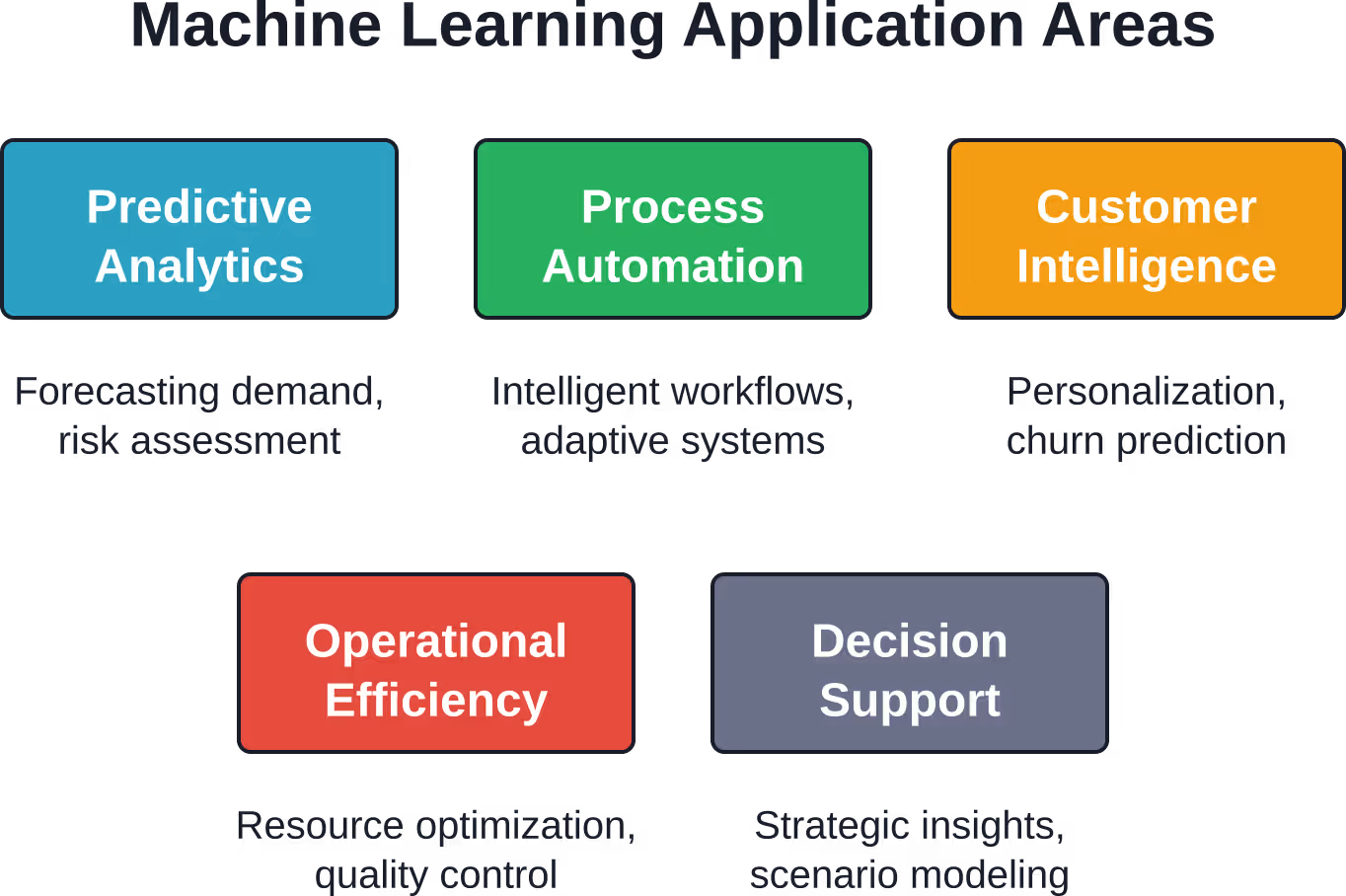
The Translation Challenge: From Business Problems to ML Solutions
Here’s where many transformation projects stumble. Identifying a business problem is straightforward. Translating it into a well-specified machine learning solution is not. Research analyzing 18 approaches spanning requirements engineering and machine learning development found significant gaps. 67% of approaches list strategic objectives among expected inputs. That’s a problem. Machine learning projects fail not because the algorithms don’t work, but because teams solve the wrong problem or build solutions that don’t align with business constraints.
Getting Specification Right
Successful ML implementations start with clear problem definitions. What outcome needs improvement? What data is available? What constraints exist—regulatory, ethical, technical? According to standards guidance from organizations like NIST, building trustworthy AI systems requires explicit risk management frameworks and stakeholder alignment from the start. Their AI Risk Management Framework emphasizes cultivating trust while promoting innovation. The technical capability exists. The challenge is organizational—ensuring business stakeholders, data scientists, and operations teams speak the same language and work toward aligned goals.
Implementation Considerations for Enterprise Systems
Machine learning doesn’t exist in isolation. It integrates into enterprise systems—ERP platforms, CRM databases, supply chain management tools. Technical standards organizations have published research on AI-enabled SAP enterprise systems, measuring ROI of AI implementation from a managerial perspective, and using generative AI for data conversion in ERP SaaS implementations. These aren’t theoretical exercises—they’re responses to real integration challenges. The technical debt from legacy systems, data quality issues, and organizational resistance create friction. Machine learning models are only as good as the data they consume and the systems they integrate with.
| Implementation Factor | Critical Considerations | Common Pitfalls |
|---|---|---|
| Data Quality | Accuracy, completeness, consistency across sources | Assuming existing data is ML-ready without validation |
| System Integration | API compatibility, latency requirements, fallback mechanisms | Treating ML as standalone rather than embedded component |
| Stakeholder Alignment | Cross-functional input, clear success metrics, ongoing feedback | Letting data scientists work in isolation from business units |
| Governance Framework | Model monitoring, bias detection, explainability protocols | Deploying without ongoing performance tracking |
Strategic Leadership in ML-Driven Transformation
Technology enables transformation. Leadership determines whether it succeeds. Research on strategic leadership in AI-driven digital transformation emphasizes ethical governance, innovation management, and sustainable practices. These aren’t soft concerns—they’re operational requirements. When ML systems make decisions that affect customers, employees, or partners, questions of fairness, transparency, and accountability become business-critical. Organizations need governance frameworks that address algorithmic bias, data privacy, and model explainability. And they need leaders who understand that ML transformation isn’t a one-time project. It’s an ongoing capability that requires investment in talent, infrastructure, and organizational change management.
The SME Advantage: Accessibility and Agility
Large enterprises have resources. But they also have bureaucracy, legacy systems, and risk-averse cultures. Small and medium-sized enterprises have a different advantage: agility. Research on leveraging AI as a strategic growth catalyst for SMEs indicates that 91% of SMEs using AI report that it directly boosts their revenue, and AI drives operational efficiencies with potential cost reductions up to 30% and time savings exceeding 20 hours monthly. Cloud-based ML platforms, pre-trained models, and low-code tools lower barriers to entry. SMEs can deploy customer sentiment analysis, demand forecasting, or dynamic pricing without building data science teams from scratch. The constraint isn’t technology—it’s strategic clarity. SMEs that identify specific business problems and match them to appropriate ML capabilities can move faster than larger competitors bogged down in approval processes.
Measuring Success Beyond Technical Metrics
Model accuracy matters. But business outcomes matter more. A customer churn prediction model with 95% accuracy is useless if retention teams don’t act on its insights. A fraud detection system that flags too many false positives creates operational burden rather than value. Research on measuring success of digital transformation initiatives highlights the gap between technical performance and business impact. Transformation success requires alignment between ML outputs and operational workflows, with clear measurement of downstream effects on revenue, costs, and customer satisfaction. The question isn’t “how accurate is the model?” It’s “how much better are business outcomes because of this model?”
Future Directions: Generative AI and Beyond
Machine learning continues evolving. Generative AI represents the latest shift—systems that don’t just classify or predict, but create. Standards research on digital twin supply chains explores how ML-powered digital twins revolutionize aerospace supply chains. Research on data conversion in ERP SaaS implementations examines how generative AI streamlines complex migration tasks. These capabilities move beyond optimization into generation—creating synthetic training data, generating code from natural language descriptions, designing product variants based on specifications. The transformation isn’t complete. It’s accelerating. Organizations that treat ML adoption as a learning process rather than a destination position themselves to absorb continuous capability improvements.
FAQ
What’s the difference between digital transformation and ML transformation?
Digital transformation digitizes processes and systems. ML transformation adds learning and adaptation—systems that improve themselves based on data and outcomes rather than just executing predefined workflows.
Do small businesses need machine learning for digital transformation?
Not every business needs ML immediately, but most will benefit from it eventually. Start by identifying specific pain points—forecasting errors, customer churn, manual data processing—where ML offers measurable improvement rather than implementing it broadly.
How long does ML implementation take?
Timelines vary widely based on problem complexity, data readiness, and organizational factors. Simple use cases like sentiment analysis might deploy in weeks. Complex systems involving multiple data sources and regulatory requirements can take months. Proper scoping and stakeholder alignment matter more than rushing deployment.
What data quality is required for machine learning?
ML models need accurate, consistent, and representative data. Common issues include missing values, inconsistent formatting, and biased training sets. Expect to spend significant effort on data preparation—often 60-80% of project time goes to cleaning and organizing data rather than building models.
How do you measure ROI on machine learning investments?
Focus on business metrics, not technical ones. Track changes in revenue, cost reduction, customer retention, or operational efficiency tied to ML deployments. Establish baseline measurements before implementation and monitor continuously after deployment to capture actual impact.
What organizational changes does ML transformation require?
Successful ML adoption requires cross-functional collaboration between business units, data teams, and IT operations. Organizations need governance frameworks for model monitoring, processes for continuous improvement, and cultural acceptance that ML systems will make mistakes and need refinement.
Is machine learning implementation secure?
Security depends on implementation quality. ML systems introduce new risk vectors—model poisoning, adversarial attacks, data leakage. Organizations need security frameworks specific to ML, including model access controls, input validation, and monitoring for anomalous predictions that might indicate compromise.
Moving Forward With ML-Powered Transformation
Machine learning isn’t future technology. It’s operational reality for organizations across industries and sizes. The competitive advantage doesn’t come from adopting ML first—it comes from adopting it effectively. That means starting with clear business problems, ensuring data and system readiness, aligning stakeholders around measurable outcomes, and treating implementation as an iterative learning process. The market trajectory tells you where capital is flowing. The research tells you where implementation challenges lie. The question is whether your organization will transform proactively or reactively. The systems learning from your data today will define your competitive position tomorrow. Make that learning intentional.