
Quick Summary: Machine learning is transforming fleet management by enabling predictive maintenance, optimizing routes in real-time, and reducing operational costs through data-driven insights. AI-powered systems can now predict vehicle failures with over 90% accuracy and reduce unplanned downtime by up to 47%, while processing telematics data from millions of vehicles simultaneously to detect patterns invisible to human analysts. The transportation industry is experiencing a fundamental shift. Fleet managers who once relied on manual tracking and reactive maintenance are now deploying machine learning systems that analyze millions of data points per second. And the results speak for themselves. But here’s the thing—not every fleet is ready to leverage these technologies effectively. The gap between traditional fleet management and AI-powered operations has never been wider. So what does it actually take to implement machine learning in fleet management? What are the real benefits, and where do the challenges lie? This guide breaks down everything fleet managers need to understand about machine learning applications in 2026, from predictive maintenance systems that catch failures before they happen to route optimization algorithms that save thousands in fuel costs.
What Machine Learning Brings to Fleet Management
Machine learning—a subset of artificial intelligence—enables systems to learn from data without explicit programming. For fleet management, this means software that gets smarter with every mile driven. Traditional fleet management relied on scheduled maintenance intervals, manual route planning, and historical averages. Machine learning changes the game entirely. The technology processes telematics data streams in real-time: engine diagnostics, tire pressure trends, brake wear patterns, driver behavior signals, fuel consumption rates, and location coordinates. From this flood of information, ML algorithms identify patterns that predict failures, optimize routes dynamically, and flag anomalies across entire fleets. 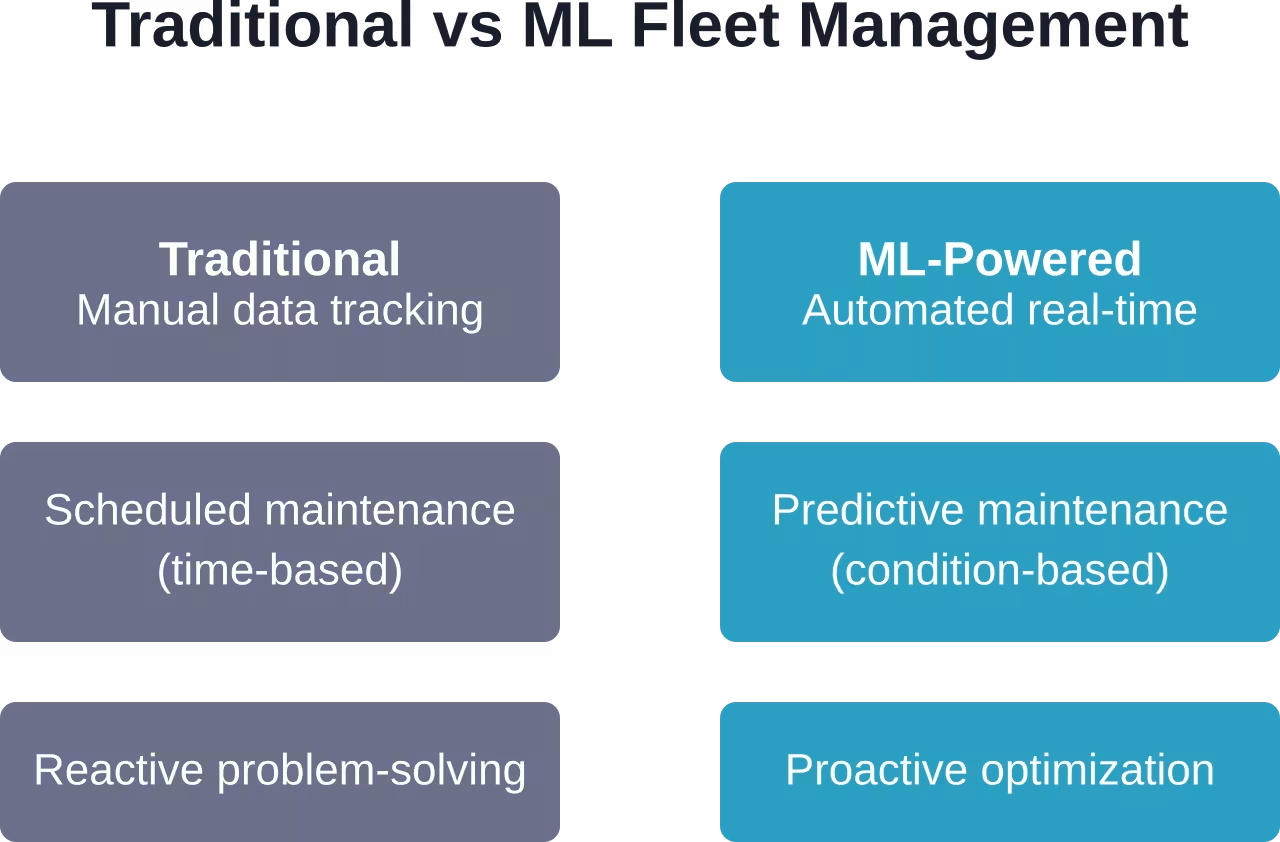 According to a recent global survey of 1,800 fleet managers across 15 countries by Webfleet, 56% of respondents said that integrating AI has enhanced driver protection, behavior analysis, and overall safety outcomes. Real talk: that’s a majority seeing measurable improvements in one of the most critical KPIs—driver safety.
Turn Fleet Data Into AI Software With AI Superior
AI Superior helps companies assess AI use cases and turn them into working software. Their services cover AI consulting, AI software development, R&D, training, and integration into existing workflows. For fleet management, this can support route analysis, maintenance prediction, fuel usage insights, driver performance review, risk alerts, or reporting automation.
Need Machine Learning for Fleet Workflows?
AI Superior can help with:
- assessing machine learning use cases
- building custom AI and ML tools
- developing forecasting and analytics models
- integrating AI into daily workflows
👉 Contact AI Superior to discuss your project.
Predictive Maintenance: The Killer Application
Predictive maintenance represents the most impactful application of machine learning in fleet management today. Here’s how it works: ML models analyze telematics data continuously, learning the baseline behavior of each vehicle component. When patterns deviate from normal—say, a slight temperature increase in a refrigeration unit or subtle vibration changes in an engine—the system flags it for inspection. The accuracy is remarkable. Industry benchmarking data from 2026 shows predictive maintenance systems achieving over 92% accuracy in confirming predicted failures within a 14-day window. That’s not just impressive—it’s transformative.
| Performance Metric | Target | Actual Achievement |
|---|---|---|
| Predictive Maintenance Accuracy | >90% | 92% |
| Failures Confirmed (14-day window) | — | 40% |
| Unplanned Downtime Reduction | >40% | 47% |
A 400-vehicle refrigerated logistics fleet deployed an AI-powered system in late 2025 that ingested telematics data from every truck in real-time—engine diagnostics, reefer unit temperatures, brake wear patterns, tire pressure trends, and driver behavior signals. Within the first 72 hours online, the system flagged a pattern no human analyst had spotted: three trucks on the same corridor were showing early-stage refrigerant leaks. Catching those failures before total breakdown prevented spoiled cargo, emergency roadside repairs, and customer delivery failures. The cost savings? Substantial. But more importantly, the system demonstrated something crucial: ML doesn’t just react faster than humans—it detects patterns humans can’t see at all.
From Preventative to Predictive
Traditional preventative maintenance schedules services based on time intervals or mileage thresholds. Change the oil every 5,000 miles. Inspect brakes every six months. Machine learning replaces this one-size-fits-all approach with condition-based scheduling. Vehicles operating in harsh conditions get earlier attention. Trucks with gentler usage cycles go longer between services. The result? Maintenance happens exactly when needed—not too early (wasting resources) and not too late (risking breakdowns).
Route Optimization and Intelligent Planning
Static route planning is dead. Machine learning algorithms now process real-time traffic data, weather conditions, delivery windows, vehicle capacity constraints, driver hours-of-service regulations, and fuel prices to generate optimal routes that adapt throughout the day. Sound familiar? That’s because consumer apps like Google Maps and Waze popularized dynamic routing. Fleet management systems take it several steps further, optimizing not just for one vehicle but for entire fleets simultaneously while balancing complex business constraints. The business impact is significant. Optimized routing reduces fuel consumption, cuts delivery times, improves on-time performance, and increases the number of stops each vehicle can complete per shift. According to industry reports, ML-driven route optimization can increase delivery capacity by approximately 15% without adding vehicles—purely through more efficient routing and scheduling.
Real-Time Anomaly Detection at Scale
Managing a small fleet? Pattern recognition is manageable for experienced human operators. But what about fleets with hundreds or thousands of vehicles? Technical research from IEEE has demonstrated real-time anomaly detection across million-vehicle fleets using quantum-inspired classical algorithms. These systems process massive data streams simultaneously, identifying unusual patterns that signal maintenance needs, safety risks, or operational inefficiencies. The key advantage: scalability. ML systems monitor every vehicle with the same level of attention, 24/7, without fatigue or oversight gaps.
Driver Safety and Behavior Analysis
Machine learning doesn’t just monitor vehicles—it monitors driving behavior too. Telematics systems track acceleration patterns, braking force, cornering speed, lane departures, following distance, and dozens of other behavioral indicators. ML algorithms establish baseline patterns for each driver and flag deviations that correlate with increased accident risk. The goal isn’t surveillance—it’s intervention before incidents occur. When a driver exhibits sudden changes in behavior (fatigue indicators, aggressive driving patterns, distraction signals), the system can trigger alerts for immediate supervisor follow-up or automated coaching interventions. The safety improvements are measurable. Fleet managers implementing AI-powered driver monitoring report fewer accidents, lower insurance premiums, and reduced liability exposure.
Operational Efficiency and Cost Reduction
The financial case for machine learning in fleet management is compelling. Cost reductions come from multiple sources: lower maintenance expenses through predictive scheduling, reduced fuel consumption via optimized routing, fewer accidents from safety monitoring, decreased downtime from proactive repairs, and better asset utilization through intelligent dispatch.
| Cost Category | Traditional Approach | ML-Powered Approach |
|---|---|---|
| Maintenance Strategy | Time/mileage-based schedules | Condition-based predictive |
| Route Planning | Static daily routes | Dynamic real-time optimization |
| Fuel Management | Manual tracking and reporting | Automated monitoring with alerts |
| Safety Monitoring | Reactive incident response | Proactive behavior intervention |
| Asset Utilization | Fixed schedules and assignments | AI-driven optimal dispatch |
Now, this is where it gets interesting. Machine learning systems don’t just optimize individual functions—they optimize across functions simultaneously. A route that’s theoretically faster might put excessive wear on a vehicle nearing maintenance. The ML system balances route efficiency against maintenance timing, driver availability, delivery urgency, and vehicle condition to find the truly optimal solution. That level of multi-variable optimization is impossible for human planners working with spreadsheets.
Implementation Challenges and Considerations
But wait. Before diving into machine learning deployment, fleet managers need to understand the challenges.
Data Quality and Integration
Machine learning is only as good as the data it learns from. Fleets with inconsistent telematics coverage, incomplete maintenance records, or siloed data systems will struggle to extract value. Successful implementations require clean, comprehensive data flowing from multiple sources: GPS trackers, engine computers, fuel cards, maintenance management systems, dispatch software, and driver apps. Getting all these systems talking to each other? That’s often the hardest part.
Security and Privacy Concerns
Connected fleets generate enormous amounts of data—location tracks, vehicle diagnostics, driver behavior metrics, customer delivery information. All of it is sensitive. All of it is vulnerable. Fleet managers implementing ML systems must address data security comprehensively: encrypted transmission, secure storage, access controls, regular security audits, and incident response plans. Driver privacy is equally critical. Monitoring systems must comply with labor regulations, respect driver rights, and maintain transparency about what data is collected and how it’s used.
Change Management and Training
Technology is the easy part. People are harder. Fleet managers, dispatchers, maintenance technicians, and drivers all need training on new ML-powered systems. Workflows change. Decision-making processes evolve. Some roles shift focus from manual analysis to system oversight. Organizations that invest in comprehensive training and change management see faster adoption and better ROI. Those that treat ML deployment as purely a technology project often struggle with user resistance and underutilization.
The Technology Stack Behind ML Fleet Management
What actually powers these systems? Modern ML fleet management platforms combine several technologies: IoT sensors and telematics hardware collect vehicle and driver data; cloud infrastructure provides scalable storage and computing power; machine learning frameworks process data and train models; API integrations connect to existing fleet management systems; mobile applications provide driver interfaces; and dashboards give fleet managers actionable insights. 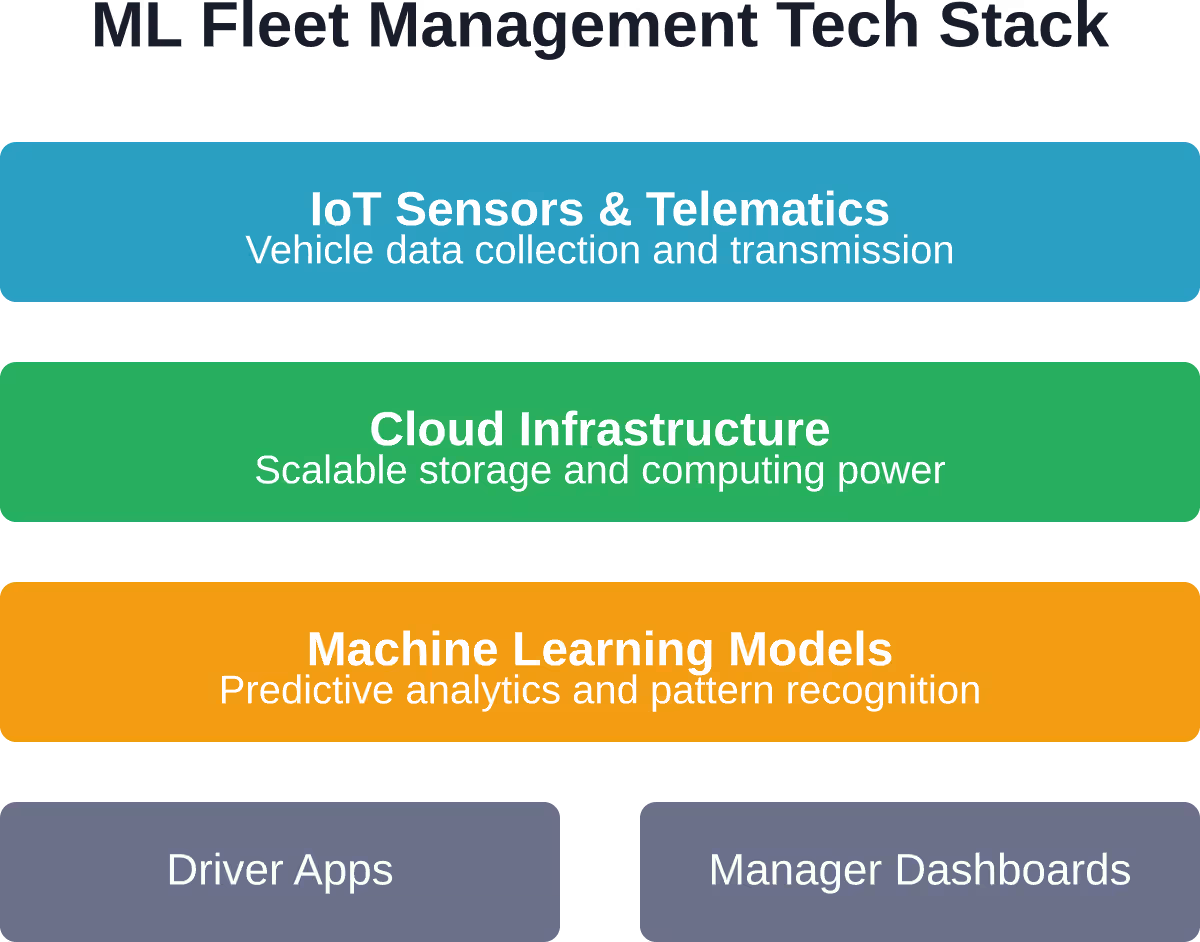 The shift to cloud-based systems is particularly important. On-premise solutions can’t scale to handle the computational demands of ML across large fleets. Cloud platforms provide the processing power to analyze millions of data points in real-time.
Integration with Blockchain and IoT
Some advanced implementations are exploring synergies between AI, machine learning, IoT, and blockchain technologies. Blockchain can provide tamper-proof maintenance records, verifiable driver logs, and transparent supply chain tracking. When combined with ML analytics, this creates auditable systems that satisfy regulatory requirements while optimizing operations. These multi-technology approaches are still emerging but show promise for industries with strict compliance requirements like pharmaceutical cold-chain logistics or hazardous materials transport.
Looking Forward: The Future of ML in Fleet Management
Where is this technology headed? Several trends are accelerating in 2026. Generative AI is beginning to augment ML systems, enabling natural language interfaces for fleet managers and automated report generation. Electric vehicle fleets are creating new ML applications around battery health prediction and charging optimization. Autonomous vehicle integration is pushing ML capabilities toward collaborative multi-vehicle coordination. The convergence of these technologies suggests fleet management will become increasingly automated over the next decade. Human managers won’t disappear—their role will shift toward strategic oversight and exception handling while ML systems handle routine optimization. That said, the core value proposition remains constant: better decisions through better data analysis.
Practical Steps for Getting Started
Ready to explore machine learning for fleet management? Start by assessing current data infrastructure. What telematics systems are already in place? How complete and accurate is the data? Where are the gaps? Next, identify the highest-value use cases for the specific fleet. Long-haul operations might prioritize route optimization. High-maintenance fleets might focus on predictive maintenance. Safety-critical operations might emphasize driver monitoring. Then pilot with a subset of vehicles before full deployment. This limited rollout reveals integration challenges, validates ROI projections, and builds organizational confidence in the technology. Finally, plan for continuous improvement. Machine learning systems get better over time as they accumulate more training data. The fleet in year two of ML deployment will outperform year one significantly.
Frequently Asked Questions
How accurate is machine learning for predicting vehicle maintenance needs?
Modern ML systems achieve over 92% accuracy in predicting maintenance failures within a 14-day window, according to industry benchmarking data from 2026. This represents a substantial improvement over traditional time-based maintenance schedules, which often service vehicles either too early or too late.
What’s the minimum fleet size needed to justify ML investment?
While there’s no absolute minimum, fleets with 25+ vehicles typically see clear ROI from ML systems. Smaller fleets can still benefit from ML-powered platforms offered as subscription services, where the development costs are shared across many customers rather than borne entirely by a single operation.
How long does it take to implement a machine learning fleet management system?
Implementation timelines vary based on fleet size and data infrastructure maturity. Pilot deployments can launch in 4-8 weeks. Full enterprise rollouts for large fleets typically take 3-6 months, with the majority of time spent on data integration and change management rather than ML configuration itself.
Can ML systems work with existing telematics hardware?
Most modern ML platforms integrate with popular telematics providers through APIs. Check compatibility before purchasing, but generally the ML software layer sits on top of existing hardware investments rather than requiring complete replacement.
What happens if the ML system makes incorrect predictions?
ML systems operate as decision-support tools, not autonomous controllers. Fleet managers review predictions and make final decisions. Over time, feedback from actual outcomes (whether predicted failures occurred, whether suggested routes performed as expected) trains the models to improve accuracy.
How does machine learning handle unusual situations not in the training data?
ML systems flag anomalies and out-of-distribution scenarios for human review rather than making confident predictions about situations they haven’t encountered. This is why human oversight remains critical—ML excels at pattern recognition within known parameters but requires human judgment for novel situations.
What data privacy regulations apply to driver monitoring systems?
Regulations vary by jurisdiction. In the EU, GDPR imposes strict requirements on employee monitoring and data processing. In the US, requirements vary by state but generally require disclosure to drivers about what data is collected and how it’s used. Consult legal counsel to ensure compliance with applicable regulations before implementing driver monitoring.
Conclusion: The Strategic Imperative
Machine learning isn’t a futuristic concept anymore—it’s a competitive necessity in fleet management. The fleets achieving 47% reductions in unplanned downtime, 15% improvements in delivery capacity, and substantial cost savings aren’t using magic. They’re using ML systems that turn data into actionable intelligence. The technology is mature. The ROI is proven. The competitive pressure is mounting. Fleet managers who delay ML adoption risk falling behind competitors who are already optimizing faster, operating more efficiently, and delivering better service. The question isn’t whether to implement machine learning in fleet management. The question is how quickly it can be done effectively, with proper attention to data quality, security, training, and continuous improvement. Start evaluating ML platforms today. Run pilots on high-value use cases. Build organizational capabilities for the data-driven future of fleet operations. Because in 2026, machine learning in fleet management isn’t emerging technology—it’s table stakes for competitive operations.