Quick Summary: Machine learning in HR uses algorithms to analyze workforce data, predict employee behavior, and automate recruitment processes. Studies show 83% of employers now use AI tools for hiring, with 30% reductions in cost-per-hire reported. ML transforms HR from reactive administration to strategic, data-driven decision-making. Human resources departments face mounting pressure. According to EEOC testimony, as many as 83% of employers and up to 99% of Fortune 500 companies use some form of automated tool to screen or rank candidates. That’s not a trend—it’s the new baseline. Machine learning fundamentally changes how HR teams operate. Instead of sorting through hundreds of resumes manually, algorithms identify patterns across thousands of data points in seconds. But the shift brings complexity alongside efficiency. The technology promises smarter hiring, lower costs, and better retention. Real talk: it also introduces new risks around bias, transparency, and legal compliance. Organizations that understand both sides position themselves to compete for talent while those that don’t fall behind.
What Machine Learning Actually Means for HR Teams
Machine learning is a subset of artificial intelligence focused on pattern recognition. Instead of following rigid rules, ML algorithms learn from data. Feed the system 10,000 employee records, and it identifies which characteristics correlate with high performance or early turnover. Three types of machine learning show up in HR applications:
- Supervised learning uses labeled historical data—like past employees marked as “retained” or “departed”—to predict outcomes for new candidates. This powers most recruitment screening tools.
- Unsupervised learning finds hidden patterns without pre-labeled categories. HR teams use this for employee segmentation, discovering natural groupings based on behavior, skills, or engagement levels.
- Reinforcement learning improves through trial and feedback. Some advanced systems adjust interview questions based on candidate responses, though this remains less common than the other approaches.
The distinction matters. Supervised models need clean historical data, which means past biases can embed themselves in predictions. Organizations that relied on biased hiring practices historically risk automating those same patterns.
Current Adoption Across Organizations
According to SHRM research, 62% of HR professionals work in organizations using AI somewhere in their operations. Break that down further:
- 39% have AI adopted specifically in HR functions
- 7% plan to launch HR-focused AI this year
- 23% use AI elsewhere but not yet in HR
- 31% have no plans to launch AI
Small businesses aren’t sitting on the sidelines either. True machine learning implementation, where systems improve predictions over time, remains concentrated among larger enterprises. 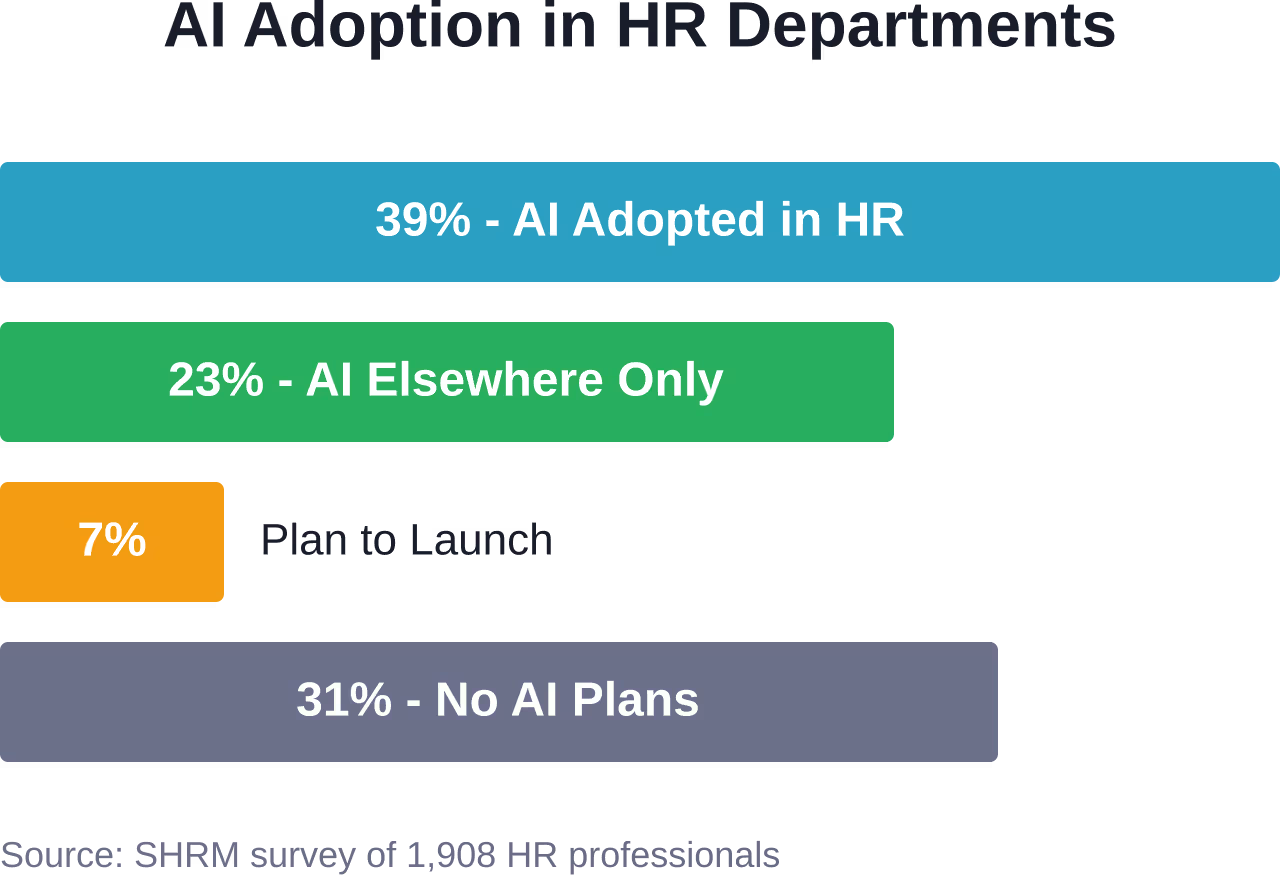 Here’s the thing though—adoption doesn’t equal sophistication. Many organizations use basic automation like resume parsing while calling it “AI.”
Core Applications Transforming HR Functions
Recruitment and Candidate Screening
This is where ML makes the biggest immediate impact. According to EEOC data from February 2022, 79% of employers use AI or automation for recruitment and hiring. Algorithms screen applications based on patterns from successful hires. They parse resumes, assess skills alignment, and rank candidates—all before a human reviews the pool. SHRM research shows AI recruitment reduces cost-per-hire by 30%, and 86.1% of recruiters using AI report accelerated hiring processes. The technology handles volume that would overwhelm manual processes. When a role attracts 500 applicants, ML systems narrow the pool to 20-30 top candidates in minutes rather than days. But wait. This efficiency comes with documented risks. Automated systems have screened out qualified candidates because algorithms learned from historical hiring patterns that excluded certain demographics. The Equal Employment Opportunity Commission launched a specific initiative in October 2021 to address algorithmic fairness in hiring.
Predictive Analytics for Retention
Machine learning models analyze employee data to predict who’s likely to leave. Variables include tenure, salary progression, performance ratings, engagement survey responses, and promotion history. One study using Random Forest Classification achieved 88% accuracy predicting attrition on the testing data based on factors like job satisfaction, work-life balance, and monthly income. When models flag high-risk employees, HR can intervene with targeted retention efforts. The approach shifts HR from reactive to proactive. Instead of conducting exit interviews after someone resigns, departments identify dissatisfaction signals months earlier.
Performance Management and Development
ML systems track performance metrics continuously rather than relying solely on annual reviews. They identify skill gaps, recommend training programs, and suggest career paths based on employee profiles similar to those who succeeded in specific roles. According to SHRM’s 2026 State of AI in HR report, AI’s organizational impact is 5.7 times more likely to shift job responsibilities and three times more likely to create new roles than to displace jobs entirely. Some platforms analyze communication patterns, project completion rates, and peer feedback to surface insights human managers might miss. Others match employees with mentors based on career trajectory data.
Workforce Planning and Resource Allocation
Predictive models forecast hiring needs based on business growth projections, seasonal patterns, and attrition rates. They optimize shift scheduling, identify skill shortages before they become critical, and model scenarios for organizational restructuring. Large-scale operations use ML to balance labor costs against demand fluctuations. The technology processes variables too complex for spreadsheet planning—location-specific attrition rates, skill certification expiration dates, competing employer activity in local markets. 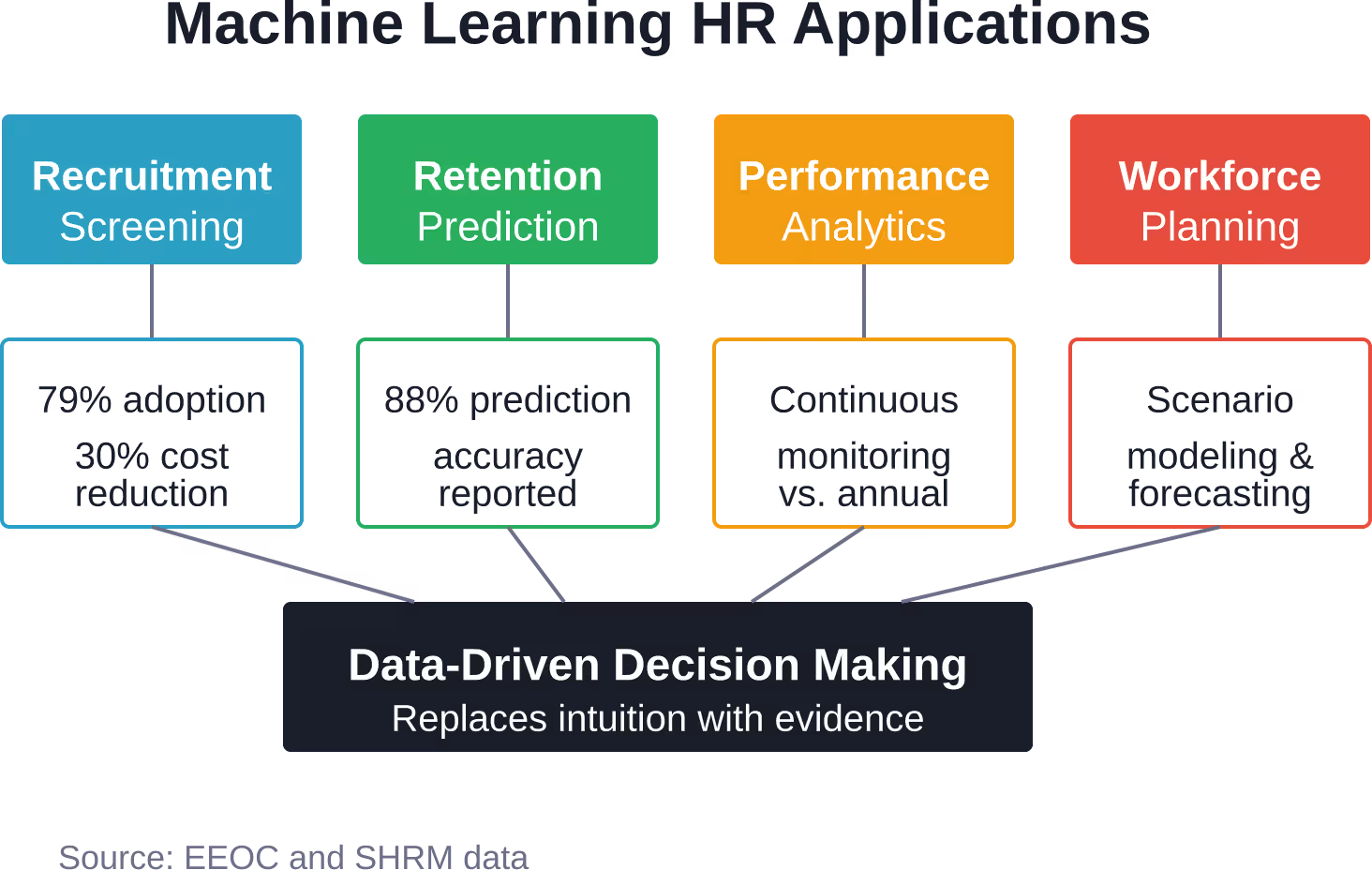

Build HR Machine Learning Tools With AI Superior
Machine learning in HR usually works best when the goal is specific - for example, prediction, classification, matching, or workflow support. AI Superior can help HR and people operations teams define the use case, review the data, and build a model that can be tested before full implementation. Their work covers AI consulting, data science, machine learning, NLP, AI software development, proof of concept development, and model evaluation. This fits HR projects where employee data, candidate data, documents, or internal workflows need careful handling. AI Superior can support HR teams with:
- Defining the HR ML use case and project scope
- Reviewing candidate, employee, performance, or document data
- Building proof of concept models
- Developing NLP or machine learning models
- Testing model accuracy, reliability, and practical use
- Planning integration with HR software or internal systems
- Supporting AI product development from prototype to deployment
For HR, this may apply to candidate matching, resume parsing, workforce analytics, attrition prediction, employee feedback analysis, and internal HR automation tools. Contact AI Superior to discuss the project.
Documented Benefits Driving Adoption
SHRM data shows 85% of employers using automation or AI report time savings and efficiency gains. That’s the table stakes. Deeper benefits emerge when examining specific metrics:
| Benefit Category | Measured Impact | Source |
|---|---|---|
| Cost Reduction | 30% lower cost-per-hire | SHRM |
| Speed to Hire | 86.1% report faster hiring | SHRM |
| Prediction Accuracy | 88% attrition prediction rate | Research study |
| Efficiency Gains | 85% report time savings | SHRM |
| Bad Hire Prevention | $17,000 average cost avoided | SHRM |
Organizations that deliver top employee experiences typically outperform on revenue growth by 31% compared to other firms. Machine learning enables that experience at scale—personalized development plans, proactive engagement, targeted retention strategies. The technology processes feedback loops humans can’t. When a training program correlates with 15% higher retention in one department but shows no effect in another, ML identifies the pattern and adjusts recommendations accordingly.
The Bias Problem Nobody Wants to Talk About
Now, this is where it gets uncomfortable. Machine learning doesn’t eliminate bias—it can amplify it. Testimony before the EEOC highlighted how algorithms trained on historical hiring data inherit past discrimination. One system learned to penalize resumes containing the word “women’s” because it appeared in phrases like “women’s chess club.” Another downranked candidates from certain universities because few historical hires came from those schools. The EEOC launched its Artificial Intelligence and Algorithmic Fairness initiative specifically because automated systems posed civil rights concerns. ReNika Moore’s testimony noted that early 20th-century employment ads segregated jobs by gender—administrative support for women, technical roles for men. Modern ML risks encoding similar patterns if training data reflects those historical biases. Three types of algorithmic discrimination emerge:
- Direct elimination: Systems automatically reject candidates based on protected characteristics or proxies. ZIP codes correlate with race; filtering by location can have discriminatory effects.
- Proxy variables: Algorithms identify correlations between seemingly neutral factors and protected categories. Name analysis, university affiliation, employment gaps—all can serve as proxies for race, gender, or disability status.
- Opacity: Most ML systems operate as black boxes. Candidates don’t know why they were rejected. Employers can’t explain algorithmic decisions, making discrimination hard to identify and challenge.
Legal frameworks are catching up slowly. Adam Klein’s testimony emphasized that cost-effectiveness can’t justify employment decision-making if it results in disparate impact on protected groups. The four-fifths rule from adverse impact analysis still applies—if a selection tool advances one demographic group at less than 80% the rate of the highest-performing group, it triggers scrutiny.
Implementation Strategies That Actually Work
Organizations succeeding with ML in HR follow specific patterns. They don’t buy a platform and hope for the best.
Audit Historical Data First
Before training any model, examine the dataset for embedded biases. If past hiring favored certain demographics, adjust for that imbalance or the algorithm will perpetuate it. Clean data beats sophisticated algorithms. Garbage in, garbage out remains true. One company discovered its “high performer” labels correlated with managers who inflated ratings, not actual performance. Training a retention model on that data would have optimized for the wrong outcomes.
Validate Predictions Against Protected Categories
Run regular adverse impact analyses. For recruitment tools, calculate selection rates by race, gender, age, and other protected categories. Compare the lowest rate to the highest—if the ratio falls below 80%, investigate immediately. This isn’t optional. It’s a legal requirement under Title VII of the Civil Rights Act, the Age Discrimination in Employment Act, and the Americans with Disabilities Act.
Maintain Human Oversight
ML should augment human decision-making, not replace it. Use algorithms to narrow candidate pools from 500 to 50, then apply human judgment to the shortlist. According to SHRM’s Chief Research Officer Ben Eubanks, “We can’t let the human stuff go in HR, recruiting, or hiring because that is where we’ll feel the loss the most.” The technology handles volume; humans assess cultural fit, communication skills, and intangibles that don’t quantify easily.
Document Everything
Keep records of algorithmic decision criteria, validation testing results, and impact analyses. If challenged legally, organizations need to demonstrate that automated systems don’t discriminate. The EEOC expects employers to know how their AI tools work. “We didn’t know” isn’t a defense. Vendor-provided systems still require in-house validation.
Train HR Teams on ML Fundamentals
HR professionals don’t need computer science degrees, but they do need basic literacy in how ML works. Understanding concepts like training data, overfitting, and correlation versus causation prevents naive adoption of flawed systems. The knowledge gap creates risk. Non-technical HR leaders might assume “AI” means objective and accurate when neither is guaranteed.
What the Research Actually Shows
Look—studies on ML in HR vary wildly in quality. But some patterns hold across reputable research: A 2022 SHRM study found that nearly 1 in 4 organizations report using automation or artificial intelligence (AI) to support HR-related activities. Two years later, that number climbed to 62% having AI somewhere in their organization. Recruitment specifically shows the strongest adoption. Between 35% and 45% of companies have now adopted AI in their hiring processes, with the AI recruitment sector projected to expand at a 6.17% compound annual growth rate from 2023 to 2030. Among Fortune 500 companies, as many as 99% use some form of automated tool to screen or rank candidates. Cost savings are real but vary by implementation. SHRM reports 30% reductions in cost-per-hire for AI recruitment. Given that companies lose an average of $17,000 on each bad hire, and the U.S. Department of Labor estimated that the cost could be as high as 30% of the employee’s first-year wages (potentially reaching $24,000 for someone with an $80,000 salary), better screening delivers measurable ROI. However, accuracy claims require scrutiny. One study reported 88% accuracy predicting employee attrition using Random Forest algorithms. That sounds impressive until considering the base rate. If 15% of employees leave annually, a model that always predicts “stay” would be 85% accurate without any intelligence whatsoever. The real question is whether ML beats naive baselines by enough to justify implementation costs.
Regulatory Landscape and Compliance Requirements
The EEOC isn’t sitting back watching. Their January 2023 meeting titled “Navigating Employment Discrimination in AI and Automated Systems: A New Civil Rights Frontier” signaled active enforcement intentions. Title VII of the Civil Rights Act applies to algorithmic hiring decisions just as it does to human ones. If an ML system produces disparate impact on protected groups, the employer faces liability—even if the bias was unintentional and embedded in vendor software. Gary D. Friedman’s testimony emphasized that employers can’t outsource responsibility. Using third-party AI tools doesn’t shield organizations from discrimination claims. The vendor might provide the technology, but the employer remains accountable for its effects. The four-fifths rule provides a practical test. Calculate selection rates for each demographic group. If any group’s rate is less than 80% of the highest group’s rate, adverse impact exists and requires justification. For example: if 100 white applicants result in 50 advancing (50% rate), and 100 Black applicants result in 30 advancing (30% rate), the ratio is 30/50 = 60%. That’s below the 80% threshold and triggers investigation. NIST released an AI Risk Management Framework providing voluntary guidelines for trustworthy AI development. While not legally binding, it offers a structure for organizations trying to implement ML responsibly.
Common Implementation Mistakes
Organizations trip over predictable obstacles:
- Buying before defining the problem: Vendors sell impressive-sounding platforms. But without clear objectives—“reduce time-to-hire by 40%” or “improve 12-month retention by 15%“—measuring success becomes impossible.
- Trusting vendor claims without validation: Marketing materials promise accuracy, fairness, and efficiency. Demand proof. Ask for adverse impact analyses on data similar to the organization’s demographic distribution.
- Insufficient training data: Small companies with 50 employees can’t train meaningful predictive models. ML needs volume—hundreds or thousands of examples. Organizations without sufficient data should focus on simpler automation rather than sophisticated learning algorithms.
- Ignoring data privacy: Employee data collected for one purpose (payroll) can’t necessarily be repurposed for ML prediction without consent and legal review. GDPR in Europe and various state laws in the U.S. impose restrictions.
- Set-it-and-forget-it deployment: ML models drift over time. A system trained on 2020 hiring data might make poor predictions in 2026 if job requirements, candidate pools, or business priorities shifted. Continuous retraining and validation are mandatory.
The Future Already Happening
According to SHRM’s 2026 State of AI in HR report, 46% of organizations expect to use AI in HR by 2026. More telling: 27% of CEOs identified attracting top talent as one of their top three priorities for the next 12 months, behind only adopting artificial intelligence. The overlap isn’t coincidental. Sophisticated applications are expanding beyond recruitment. Predictive analytics for promotion readiness, automated succession planning, sentiment analysis from employee communications, skills gap identification through work product analysis—all are moving from pilot projects to production systems. The technology will get better at what it does. Algorithms become more accurate, training datasets grow larger, and computing power increases. That makes thoughtful implementation more urgent, not less. The stakes rise when systems operate at scale.
Frequently Asked Questions
How accurate is machine learning for predicting employee turnover?
Studies report accuracy rates between 75-88%, but context matters enormously. In industries with 10-15% annual attrition, even simple models can achieve 85% accuracy by mostly predicting “stay.” The meaningful metric is whether ML beats simple heuristics (like flagging anyone with less than 2 years tenure) by enough margin to justify implementation costs. Well-designed systems targeting high-risk segments can identify 40-60% of future departures early enough for intervention.
Does AI recruitment actually reduce bias or just hide it?
Both outcomes are possible depending on implementation. ML trained on biased historical data amplifies those biases at scale. However, properly designed systems that explicitly test for adverse impact and adjust for demographic balance can reduce bias compared to unstructured human interviews. The key is continuous validation—measuring selection rates by protected categories and auditing for proxy variables that correlate with demographics. Transparency matters more than the technology itself.
What’s the minimum company size for ML in HR to make sense?
Recruitment automation tools work at any scale because they draw on external datasets. But predictive analytics for retention or performance require substantial internal data—typically 500+ employees with at least 2 years of historical records. Smaller organizations benefit more from basic automation (resume parsing, interview scheduling) rather than sophisticated machine learning that needs volume to generate reliable patterns.
Can employees challenge decisions made by algorithms?
Absolutely. Employment discrimination laws apply equally to algorithmic and human decisions. The challenge is that ML systems often operate as black boxes, making it harder to identify bias. The EEOC expects employers to be able to explain how their automated systems work and demonstrate they don’t produce discriminatory outcomes. Employees who believe they were unfairly rejected can file complaints, and employers must be able to justify their tools’ decisions with adverse impact analyses and validation studies.
What data should HR collect to support machine learning?
Start with structured data already being tracked: application dates, hire dates, performance ratings, promotion history, compensation changes, exit dates, and exit reasons. Add engagement survey scores, training completion, and internal mobility if available. Avoid collecting protected category data unless specifically needed for adverse impact testing, and never use it as a model input. Skills assessments, work samples, and productivity metrics strengthen predictive power when available. Quality beats quantity—clean, consistent data from 2-3 years outperforms messy records spanning a decade.
How often should ML models be retrained?
Quarterly at minimum, monthly for recruitment tools in fast-changing markets. Business conditions shift, candidate pools evolve, and model performance degrades over time. Schedule regular adverse impact analyses alongside retraining—if demographic selection rates change, investigate immediately. Some systems implement continuous learning that updates incrementally, but these still need periodic validation. Think of it like maintaining software: patch frequently, audit regularly, and rebuild when the foundation shows cracks.
What legal risks do employers face using AI in hiring?
The primary risk is disparate impact discrimination under Title VII, the Age Discrimination in Employment Act, and the Americans with Disabilities Act. If an ML system screens out protected groups at higher rates than others, employers face potential lawsuits and EEOC enforcement even if the discrimination was unintentional. Additional risks include privacy violations if employee data is mishandled, contract disputes if vendor tools underperform, and reputational damage if algorithmic bias becomes public. Using third-party vendors doesn’t eliminate liability—employers remain responsible for outcomes regardless of who built the technology.
Practical Next Steps
Starting with ML in HR doesn’t require massive investment or complete transformation. Begin with pilot projects targeting specific pain points: Organizations drowning in applications benefit most from automated screening. Those struggling with turnover should focus on retention prediction. Companies making poor hiring decisions need better candidate assessment. Partner with vendors transparent about how their algorithms work. Demand documentation on training data, validation methods, and adverse impact testing. If a vendor can’t explain their system clearly, walk away. Assemble a cross-functional team including HR, legal, IT, and diversity/inclusion stakeholders. ML implementation isn’t an HR-only project—it touches compliance, data governance, and risk management. Start collecting better data now even if immediate ML deployment isn’t planned. Structure exit interviews consistently, standardize performance documentation, and maintain clean records. Future algorithms will only be as good as the data they learn from. Most importantly, stay educated. The technology evolves rapidly, regulations are emerging, and best practices are still being established. Organizations that combine human judgment with machine intelligence—rather than replacing one with the other—position themselves to compete effectively for talent in an increasingly automated landscape. The shift toward machine learning in HR is irreversible. By 2026, the question isn’t whether to adopt these tools but how to implement them responsibly, effectively, and legally. Those who figure that out gain competitive advantage. Those who don’t risk both compliance failures and strategic disadvantages in talent markets where data-driven competitors are pulling ahead.