
Quick Summary: Machine learning is revolutionizing logistics by enabling predictive demand forecasting, autonomous route optimization, real-time inventory management, and risk assessment across supply chains. By analyzing vast datasets and identifying patterns, ML algorithms reduce operational costs, minimize delivery delays, and improve decision-making accuracy in warehouse operations, transportation networks, and supplier relationship management. The logistics industry faces mounting pressure from every direction. Global disruptions, fluctuating demand patterns, and razor-thin margins leave little room for error. Traditional approaches to supply chain planning can’t keep pace. Machine learning changes that equation entirely. By processing historical data, identifying hidden patterns, and generating predictions at scale, ML algorithms tackle challenges that have overwhelmed conventional systems for decades. But here’s the thing—implementation isn’t straightforward. According to MIT Sloan research, trucks in the U.S. are about 30% empty on average, wasting fuel and generating unnecessary carbon emissions. Companies that deployed algorithmic route optimization reduced that waste to between 10% and 15%. That’s the kind of tangible impact ML delivers when applied correctly.
Core Capabilities of Machine Learning in Logistics
Machine learning encompasses several algorithmic approaches that transform raw logistics data into actionable intelligence. These techniques range from supervised learning models that predict outcomes based on labeled historical data to unsupervised methods that discover patterns without predefined categories. The most valuable ML applications in logistics share three characteristics: they process large datasets faster than human analysts, they improve accuracy through iterative learning, and they adapt to changing conditions without complete reprogramming.
Demand Forecasting and Inventory Optimization
Predicting future demand represents one of the most mature ML applications in supply chain management. According to IEEE research on demand forecasting, ML algorithms analyze purchase histories, seasonal patterns, promotional calendars, and external factors like weather or economic indicators to generate predictions. These forecasts directly inform inventory decisions. Stock too much, and capital sits idle while storage costs accumulate. Stock too little, and lost sales damage customer relationships. ML models continuously refine their predictions as new data arrives, reducing both overstock and stockout scenarios. Real talk: the accuracy gains aren’t marginal. Companies implementing ML-based demand forecasting report significant reductions in forecast error compared to traditional statistical methods.
Route Optimization and Fleet Management
Transportation networks involve thousands of variables—traffic patterns, delivery windows, vehicle capacity, fuel costs, driver schedules, and customer locations. Traditional routing algorithms handle basic optimization, but they struggle with dynamic conditions. ML-powered route planning systems continuously learn from completed deliveries, identifying which routes actually perform best under various conditions. These systems also optimize for multiple objectives simultaneously: minimizing distance, reducing fuel consumption, meeting time windows, and balancing workload across drivers. PlusAI, an autonomous truck technology provider, demonstrates this capability in practice. Their multimodal sensor systems enable trucks to autonomously handle lane changes, stop-and-go traffic, and overtaking maneuvers. The system optimizes fuel usage, saving around 10% of energy costs according to industry reports. 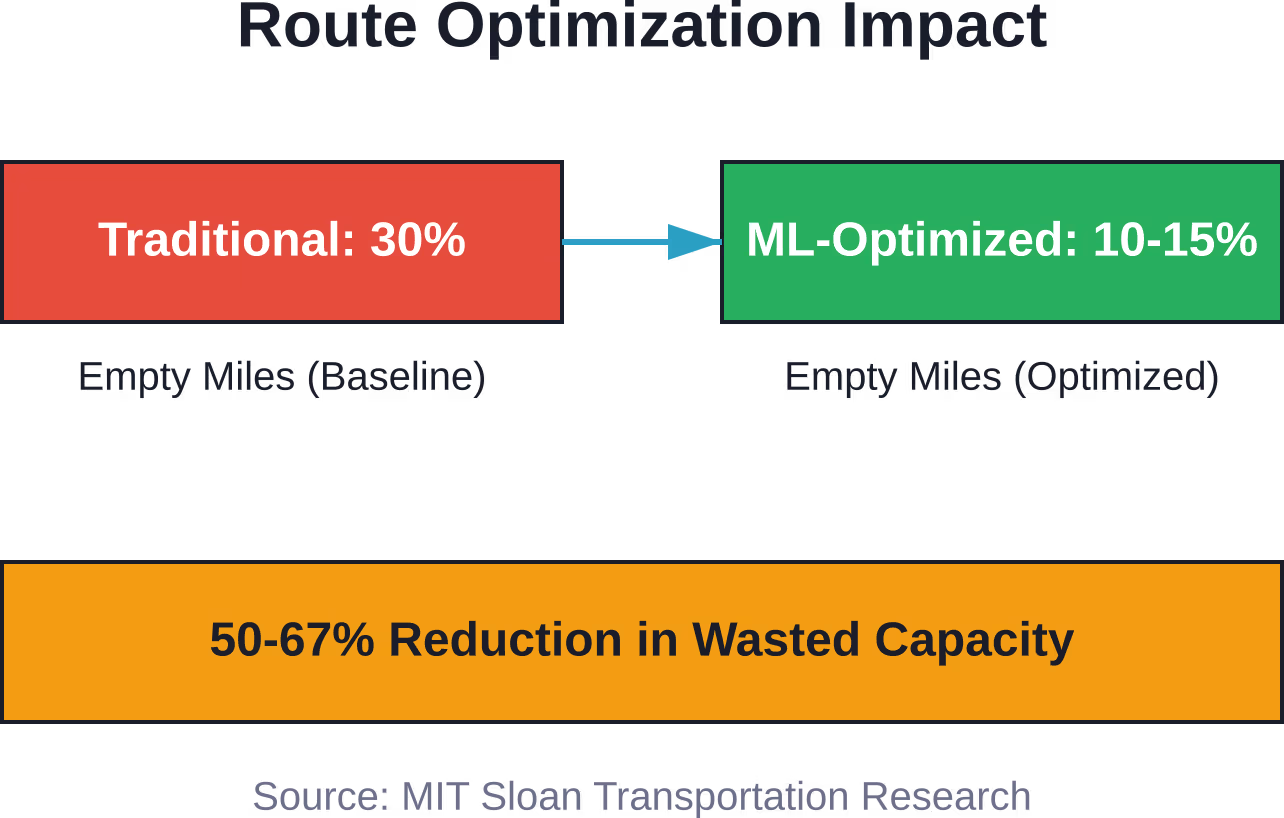
Supply Chain Risk Management and Predictive Analytics
Supply chains face constant disruption threats: supplier delays, geopolitical events, natural disasters, quality issues, and demand volatility. Identifying which risks matter most—and when they’ll materialize—separates resilient operations from vulnerable ones. Research published on arXiv examining supply chain risk assessment found that comprehensive three-stage SCRM techniques appear in only 3% of research studies (9 of 276 papers examined). Most approaches focus on model development rather than practical applicability.
Supplier Performance and Delay Prediction
A case study analyzed in arXiv research tracked orders delivered to three warehouse buyers from suppliers between 2015 and 2022. The dataset revealed significant on-time delivery challenges, with mean delay durations varying by buyer.
| Buyer | On-Time Rate | Delayed Rate | Mean Delay (Days) | Maximum Delay (Days) |
|---|---|---|---|---|
| Buyer B1 | 44% | 56% | 121.18 | 1,669 |
| Buyer B2 | 49% | 51% | 68.93 | 2,227 |
| Buyer B3 | 32% | 68% | 64.56 | 1,070 |
Machine learning models trained on this type of historical performance data predict which suppliers pose the highest delay risk for upcoming orders. Importantly, 26% of suppliers were shared across the three warehouses, allowing the algorithm to transfer learning between buyers and build more robust risk profiles. These predictions enable procurement teams to adjust order timing, diversify supplier portfolios, or negotiate buffer inventory for high-risk components before disruptions occur.
Warehouse Operations and Automation
Modern warehouses generate massive data streams: item locations, pick times, equipment utilization, worker productivity, order composition, and seasonal patterns. ML algorithms analyze these streams to optimize layout design, picking sequences, and labor allocation. Predictive maintenance represents another high-impact application. By monitoring equipment sensor data, ML models identify patterns that precede failures, scheduling maintenance during planned downtime rather than responding to emergency breakdowns. 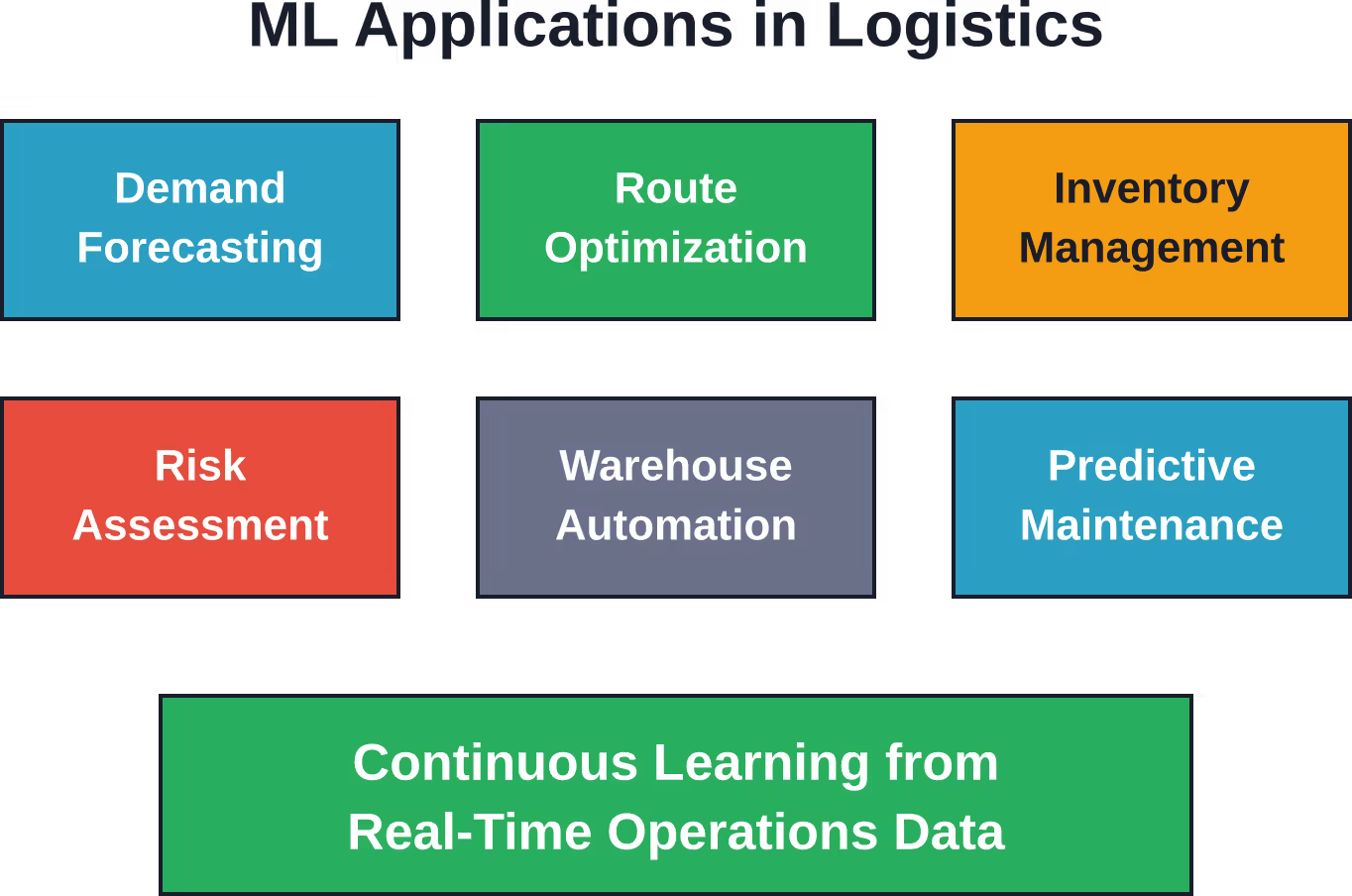

Deploy AI-Driven Machine Learning for Logistics Operations
Logistics businesses often rely on disconnected data sources, manual coordination, and reactive planning that slow down operations over time. AI Superior develops custom machine learning solutions that help companies work with real-time data, improve forecasting, and build more efficient operational processes.
Build Smarter Logistics Planning with AI Systems
AI Superior can support your team with:
- Predictive models for operational planning and forecasting
- Big data analytics for large logistics datasets
- Custom AI software tailored to internal business processes
👉Get in touch with AI Superior to explore machine learning systems for logistics planning, analytics, and operational efficiency.
Implementation Challenges and Practical Considerations
Deploying ML in logistics isn’t plug-and-play. Several obstacles trip up organizations attempting their first implementations.
Data Quality and Integration
Machine learning algorithms are only as good as their training data. Legacy systems often store information in incompatible formats, with inconsistent labeling and significant gaps. Before ML can deliver value, organizations need clean, integrated datasets spanning relevant operational dimensions. That integration work takes time and resources. Many companies underestimate the effort required to connect ERP systems, warehouse management platforms, transportation management software, and external data sources into a unified pipeline.
Choosing the Right Use Cases
Not every logistics problem needs machine learning. Some processes work fine with traditional rules-based automation. The highest-value ML applications share certain characteristics: large datasets, complex patterns that defy simple rules, and decisions repeated frequently enough that small improvements compound. According to Chris Caplice, executive director of the MIT Center for Transportation and Logistics, “AI is a moving target.” Organizations should start with focused pilot projects that demonstrate clear ROI before expanding to enterprise-wide deployments.
Key Technologies and Algorithm Types
Different ML techniques suit different logistics challenges. Supervised learning algorithms like random forests, gradient boosting, and neural networks excel at prediction tasks when historical labeled data exists—demand forecasting, delivery time estimation, and quality classification. Unsupervised learning methods including clustering and dimensionality reduction identify hidden patterns and segment data—grouping similar customer orders, detecting anomalous shipments, or discovering supplier performance categories. Reinforcement learning shows particular promise for sequential decision problems like dynamic pricing, real-time route adjustment, and warehouse robot coordination. These algorithms learn optimal strategies through trial and error, improving performance as they interact with their environment.
| ML Technique | Primary Logistics Application | Data Requirement |
|---|---|---|
| Supervised Learning | Demand forecasting, delay prediction | Labeled historical outcomes |
| Unsupervised Learning | Customer segmentation, anomaly detection | Unlabeled operational data |
| Reinforcement Learning | Dynamic routing, inventory control | Environment simulation or live data |
| Deep Learning | Image recognition, natural language processing | Very large labeled datasets |
Measuring Impact and ROI
Successful ML implementations require clear success metrics defined before deployment. These typically fall into several categories: cost reduction (lower fuel spend, reduced inventory carrying costs), service improvement (faster delivery times, higher fill rates), and risk mitigation (fewer stockouts, reduced delay frequency). The measurement horizon matters. Some benefits appear immediately—route optimization savings materialize within weeks. Other advantages like improved demand forecast accuracy compound over quarters as the models learn from more data. Organizations should track both leading indicators (model prediction accuracy, algorithm confidence scores) and lagging business outcomes (actual cost savings, customer satisfaction improvements). This dual-lens approach catches implementation problems early while validating long-term value.
Frequently Asked Questions
How does machine learning differ from traditional logistics software?
Traditional logistics software follows predetermined rules and formulas programmed by developers. Machine learning algorithms instead identify patterns directly from data, improving their performance as they process more examples. This means ML systems adapt to changing conditions and discover relationships that programmers didn’t explicitly code.
What’s the typical implementation timeline for ML in logistics?
Focused pilot projects typically run 3-6 months from data preparation through initial deployment. Enterprise-wide rollouts spanning multiple facilities and systems often require 12-18 months. The timeline depends heavily on data quality—organizations with clean, integrated datasets move faster than those needing extensive data engineering work.
Do companies need in-house data scientists to use ML in logistics?
Not necessarily. Many logistics technology vendors now offer ML-powered solutions as managed services or embedded features. These platforms handle the algorithmic complexity while logistics professionals focus on operational decisions. That said, organizations pursuing custom ML development or sophisticated applications benefit from dedicated data science expertise.
Which logistics area sees the fastest ROI from machine learning?
Route optimization and fleet management typically deliver measurable returns within months. The combination of frequent decisions (daily routing), clear metrics (fuel costs, delivery times), and mature algorithms makes this a natural starting point. Demand forecasting shows strong returns but takes longer as accuracy improvements compound over multiple planning cycles.
How much historical data do ML models need for logistics applications?
The requirement varies by problem complexity and algorithm type. Simple forecasting models might work with 12-24 months of historical data, while sophisticated risk assessment systems benefit from 3-5 years spanning various conditions. Data quality matters more than quantity—six months of clean, complete records often outperform three years of inconsistent data with gaps.
Can machine learning handle supply chain disruptions it hasn’t seen before?
Partially. ML models excel at recognizing patterns similar to their training data but struggle with truly unprecedented events. The most robust approaches combine ML predictions with human judgment and scenario planning. Some advanced techniques like transfer learning and causal inference help models generalize better to novel situations.
What are the main risks of implementing ML in logistics operations?
The biggest risks include over-reliance on flawed models, data privacy and security vulnerabilities, and integration failures with existing systems. Poor data quality can lead to biased or inaccurate predictions that degrade rather than improve operations. Organizations should maintain human oversight, especially during initial deployment phases, and implement robust testing before fully automated decision-making.
Looking Ahead: The Future of ML-Driven Logistics
Machine learning’s role in logistics will expand as algorithms improve and data sources proliferate. Integration with Internet of Things sensors, blockchain tracking systems, and digital twin simulations creates richer datasets that enable more sophisticated analysis. The industry is moving toward prescriptive analytics that don’t just predict outcomes but recommend specific actions. Advanced systems will suggest which supplier to use for a critical component, when to reroute a delayed shipment, or how to rebalance inventory across a network—all in real time. But technology alone won’t determine success. Organizations that combine ML capabilities with operational expertise, clean data infrastructure, and change management discipline will capture the most value. The logistics companies thriving five years from now won’t necessarily be those with the most sophisticated algorithms—they’ll be the ones that deployed practical ML solutions solving real problems while their competitors were still planning. Ready to explore ML for your logistics operations? Start with a focused pilot addressing a specific pain point. Measure results rigorously. Learn from both successes and failures. Then scale what works.