
Quick Summary: Machine learning is transforming mechanical engineering through predictive maintenance, generative design, and real-time optimization. Engineers leverage ML algorithms to analyze sensor data, reduce testing cycles and development time, and achieve command prediction accuracies of approximately 95%, reshaping traditional workflows from concept to manufacturing. Machine learning has moved from research labs into the core toolkit of mechanical engineering. What started as experimental applications in the early 2010s now powers everything from autonomous vehicle design to additive manufacturing process control. The discipline isn’t just adopting machine learning—it’s being fundamentally reshaped by it. Traditional engineering workflows relied on physics-based simulation and iterative prototyping. Today’s engineers complement that foundation with data-driven models that learn from sensor streams, testing results, and operational performance. According to the U.S. Bureau of Labor Statistics, the median annual wage for architecture and engineering occupations was $97,310 in May 2024. Engineers who understand both mechanical principles and machine learning techniques position themselves at the intersection of these opportunities. But does machine learning actually deliver on its promises? Let’s examine the evidence.
Core Machine Learning Concepts for Mechanical Engineers
Machine learning in mechanical engineering isn’t about replacing fundamental physics—it’s about augmenting engineering judgment with pattern recognition at scales humans can’t match.
Supervised Learning for Engineering Problems
Supervised learning dominates mechanical engineering applications. The algorithm learns from labeled data: input features mapped to known outputs. Common applications include:
- Material property prediction from composition and processing parameters
- Failure mode classification from vibration signatures
- Quality prediction in manufacturing processes
- Performance optimization for thermal systems
Northwestern University researchers demonstrated this approach with spinodal metamaterials, achieving prediction errors as low as 5 to 10 percent for complex mechanical behavior. The framework combined submicron 3D printing with electron microscopy testing, using deep learning to model nonlinear stress-strain responses. The accuracy matters because it enables inverse design—specifying desired properties and having the model generate suitable microstructures. Their system supports inverse design with prediction errors as low as 5 to 10 percent for targeted mechanical responses.
Unsupervised Learning and Anomaly Detection
Unsupervised algorithms find patterns without labeled examples. In mechanical engineering, this translates to anomaly detection in systems where failure modes haven’t been fully characterized. Clustering algorithms group similar operational states. When sensor readings fall outside established clusters, the system flags potential issues before catastrophic failure occurs. IEEE research on predictive maintenance emphasizes unsupervised methods for rotating machinery, where vibration patterns reveal bearing degradation, misalignment, and imbalance without requiring labeled failure data.
Reinforcement Learning for Control
Reinforcement learning trains algorithms through trial and error, maximizing cumulative reward. Robotics applications leverage this approach extensively. NIST hosted a workshop on July 12, 2020 focused on advancing machine learning for manufacturing robotics, addressing robust learning methods that handle real-world variability in production environments. The challenge? Mechanical systems operate in physical reality where failed experiments have real costs. Simulation environments let algorithms explore safely, then transfer learned policies to actual hardware. 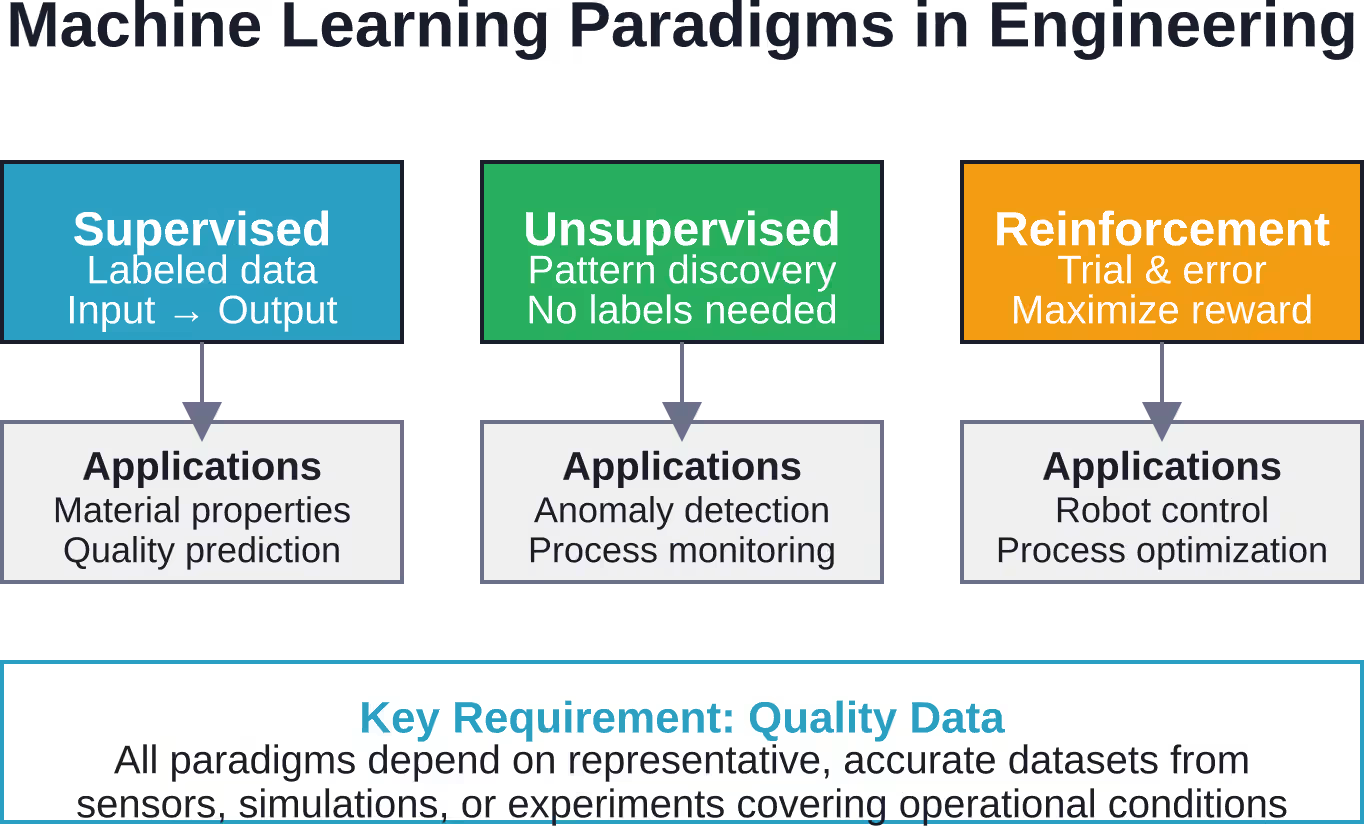
Real-World Applications Transforming Mechanical Engineering
Theory becomes valuable when it solves actual problems. Machine learning applications in mechanical engineering span the entire product lifecycle.
Predictive Maintenance in Industrial Systems
Predictive maintenance represents one of the most mature machine learning applications. Instead of scheduled maintenance (wasteful) or run-to-failure approaches (costly), algorithms predict component degradation based on operational data. IEEE published multiple reviews of machine learning algorithms for predictive maintenance in industrial applications. The research emphasizes rotating machinery—pumps, motors, compressors, turbines—where vibration analysis, thermal imaging, and lubricant monitoring generate continuous data streams. Machine learning models identify subtle patterns that precede failure. A bearing develops microscopic wear. Vibration signatures change slightly. Temperatures drift. Humans miss these early signals. Algorithms don’t. The business case? Unplanned downtime costs manufacturing facilities thousands per hour. Predictive maintenance schedules interventions during planned stops, extends component life, and prevents cascading failures.
Generative Design and Topology Optimization
Generative design flips traditional CAD workflows. Instead of an engineer sketching geometry and analyzing performance, the engineer specifies constraints and objectives. The algorithm generates candidate designs. According to ASME reporting on AI design tools, the algorithm can predict user commands with about 95 percent accuracy based on typical workflows. The system learns typical design sequences, suggesting next steps and accelerating repetitive tasks. But generative design goes deeper than command prediction. Topology optimization algorithms remove material from design spaces while maintaining structural requirements. Machine learning accelerates this process—training on thousands of optimization runs lets models propose near-optimal geometries instantly. The topology optimization workflow traditionally required:
- Define design space and constraints
- Run finite element analysis
- Adjust material distribution
- Iterate until convergence (hours to days)
Machine learning-augmented approaches complete preliminary designs in minutes. Engineers refine the AI-generated concepts, combining algorithmic efficiency with human engineering judgment.
Additive Manufacturing Process Control
Additive manufacturing—3D printing of metal, polymer, and composite parts—presents unique challenges. Layer-by-layer fabrication means defects can propagate through builds. Process parameters (laser power, scan speed, powder distribution) dramatically affect final properties. NIST leads research on advanced informatics and artificial intelligence for additive manufacturing, developing metrics, models, and best practices for implementing machine learning in design and process planning. Penn State researchers demonstrated machine learning-based process-structure-property linkages in Ti-6Al-4V additive manufacturing. Different processes and heat treatments yield unique grain structures. Machine learning models predict mechanical properties from process parameters, eliminating trial-and-error experimentation. Real-time monitoring adds another dimension. Cameras and sensors track melt pool characteristics during printing. Machine learning algorithms detect anomalies—porosity forming, layer adhesion failing, thermal gradients exceeding limits—and adjust parameters mid-build or flag parts for inspection.
Autonomous Vehicle Engineering
Autonomous vehicles represent perhaps the most complex integration of machine learning and mechanical engineering. The mechanical systems—powertrains, suspension, braking, steering—must respond to commands from perception and planning algorithms operating in real-time. Machine learning handles:
- Sensor fusion from cameras, lidar, radar, and GPS
- Object detection and classification
- Path planning and trajectory optimization
- Vehicle dynamics prediction and control
The mechanical engineering challenges? Designing actuators fast enough to execute planned maneuvers. Thermal management for compute systems generating kilowatts of heat. Packaging sensors and processors within automotive design constraints. Ensuring functional safety when algorithms make life-critical decisions. Research institutions and manufacturers collaborate on safe AI for autonomous systems, developing testing frameworks and validation methods that prove algorithm reliability before deployment. 
Apply ML to Mechanical Engineering With AI Superior
Mechanical engineering projects often rely on sensor data, simulations, production systems, and performance measurements that can benefit from machine learning analysis. AI Superior helps engineering teams structure AI projects around operational efficiency, predictive analysis, and process optimization. Their work includes AI consulting, machine learning engineering, data science, proof of concept development, and AI software implementation. AI Superior can help mechanical engineering projects with:
- Processing engineering and operational datasets
- Developing predictive and optimization models
- Building proof of concept analytical workflows
- Detecting irregularities in equipment behavior
- Testing model accuracy under operational conditions
- Supporting integration into engineering systems
For mechanical engineering applications, this may include predictive maintenance, equipment monitoring, simulation analysis, fault detection, and process optimization. 👉Contact AI Superior to explore the engineering workflow and next steps.
Benefits Machine Learning Brings to Mechanical Engineers
Machine learning doesn’t just automate existing tasks—it enables engineering approaches that were previously impossible.
Handling High-Dimensional Design Spaces
Traditional engineering optimization struggles when designs have dozens or hundreds of parameters. The combinatorial explosion makes exhaustive search infeasible. Physics-based simulation of every candidate exceeds computational budgets. Machine learning models trained on simulation data become surrogate models—fast approximations of expensive simulations. Engineers explore design spaces orders of magnitude larger, evaluating thousands of candidates in the time one high-fidelity simulation would require. A Bayesian machine learning framework developed at University at Buffalo SUNY demonstrates this for strain gradient plasticity multiscale models. The framework selects appropriate models across scales, handling uncertainty in model parameters and structure.
Learning from Limited Experimental Data
Experimental testing costs time and money. Mechanical testing destroys samples. Prototype fabrication has lead times. How do engineers build accurate models from scarce data? Transfer learning and physics-informed neural networks offer solutions. Transfer learning applies knowledge from related problems. A model trained on aluminum alloys can bootstrap learning for a new titanium alloy with fewer experiments. Physics-informed approaches embed known equations (conservation laws, constitutive relations) into neural network architectures. The model can’t violate physics, constraining its behavior even where data is sparse. Northwestern’s metamaterial research exemplifies this: high-quality but limited experimental data from electron microscopy testing trains models that generalize across design variations.
Real-Time Optimization and Adaptive Control
Static designs optimized for nominal conditions underperform when conditions change. Machine learning enables adaptive systems that optimize continuously. Manufacturing processes drift. Tool wear changes cutting forces. Ambient conditions affect thermal behavior. Traditional control responds to these changes reactively. Machine learning predicts degradation and adjusts proactively. The computational efficiency matters. Once trained, neural networks evaluate in milliseconds. Real-time control loops running at kilohertz frequencies can incorporate machine learning predictions without bottlenecks.
| Engineering Challenge | Traditional Approach | Machine Learning Approach | Key Advantage |
|---|---|---|---|
| Design optimization | Iterative simulation (hours-days) | Surrogate models (seconds-minutes) | Explore larger design spaces |
| Material selection | Database lookup, testing | Property prediction from composition | Discover novel combinations |
| Quality control | Sampling inspection | 100% automated inspection | Catch defects in real-time |
| Maintenance scheduling | Time-based or reactive | Condition-based prediction | Reduce downtime and costs |
| Process tuning | Design of experiments | Active learning optimization | Fewer experimental runs |
Machine Learning Algorithms Commonly Used
Mechanical engineers don’t need to become machine learning researchers, but understanding which algorithms suit which problems improves application success.
Regression Algorithms
When the goal is predicting continuous values—stress, temperature, efficiency, lifespan—regression algorithms fit the task. Linear regression and its variants (ridge, lasso) work surprisingly well for problems with linear or near-linear relationships. Polynomial features extend applicability to curved responses. Support vector regression handles nonlinear problems by projecting data into higher-dimensional spaces where linear relationships emerge. Gaussian process regression provides not just predictions but uncertainty estimates—critical for safety-critical applications.
Neural Networks and Deep Learning
Neural networks approximate arbitrary functions, making them powerful for complex engineering problems. Deep learning—networks with many layers—excels at extracting hierarchical features from raw data. Convolutional neural networks process images from cameras and microscopes, detecting defects, classifying materials, and measuring dimensions. Recurrent networks handle sequential data like vibration time series or process histories. The catch? Neural networks require substantial training data and computational resources. Transfer learning and data augmentation mitigate data requirements. Cloud computing and GPUs address computational demands.
Ensemble Methods
Random forests and gradient boosting combine multiple weak learners into strong predictors. These algorithms often win engineering competitions because they’re robust, handle mixed data types, and resist overfitting. Random forests train many decision trees on random data subsets, averaging their predictions. Gradient boosting builds trees sequentially, each correcting errors of its predecessors. Practitioners favor ensemble methods for their reliability and interpretability. Feature importance metrics reveal which inputs drive predictions—insight valuable when explaining model decisions to stakeholders.
Challenges and Limitations
Machine learning solves problems, but it creates new ones too. Engineers need a clear-eyed assessment of both capabilities and constraints.
Data Quality and Availability
Garbage in, garbage out. Machine learning models learn patterns in training data. If that data doesn’t represent actual operating conditions, models fail when deployed. Mechanical engineering data challenges include:
- Sensor noise and calibration drift
- Incomplete coverage of operating envelope
- Rare failure modes with few examples
- Proprietary data that can’t be shared
- Legacy systems without digital instrumentation
Data collection infrastructure requires investment. Sensors, data acquisition systems, storage, and processing don’t come free. Smaller manufacturers face particularly steep barriers, as NIST noted in research on AI adoption by smaller manufacturing operations.
Model Interpretability vs. Performance
Neural networks deliver impressive accuracy. They also function as black boxes—inputs go in, predictions come out, and the reasoning remains opaque. For many engineering applications, understanding why a model makes predictions matters as much as accuracy. Regulatory compliance, safety certification, and engineering judgment all require interpretability. Explainable AI methods address this gap. Feature importance analysis shows which inputs most influence predictions. SHAP values attribute predictions to specific input values. Attention mechanisms in neural networks highlight which data regions drove decisions. IEEE research on explainable predictive maintenance of rotating machines emphasizes balancing accuracy with interpretability, particularly in safety-critical systems where operators need to trust and verify model outputs.
Computational Requirements
Training deep learning models demands computational resources beyond typical engineering workstations. Graphics processing units (GPUs) accelerate training, but represent significant hardware investment. Cloud computing democratizes access—engineers rent GPU time rather than purchasing hardware. But cloud costs scale with usage, and proprietary data raises security concerns when processed externally. Edge deployment adds another challenge. Once trained, models must run on target hardware—often embedded systems with limited memory and processing power. Model compression techniques (quantization, pruning, distillation) reduce resource requirements while maintaining acceptable accuracy.
Integration with Traditional Engineering Tools
Engineers work within established toolchains: CAD systems, finite element solvers, manufacturing execution systems, product lifecycle management platforms. Machine learning adds value when it integrates smoothly with these tools. API development, data format translation, and workflow automation become critical. The best algorithm provides no value if engineers can’t actually use it within their existing processes.
Future Trends in Machine Learning for Mechanical Engineering
The field keeps evolving. Several trends promise to reshape how mechanical engineers apply machine learning over the coming years.
Physics-Informed Neural Networks
Pure data-driven models ignore physics knowledge accumulated over centuries. Physics-informed neural networks (PINNs) embed partial differential equations directly into network architectures. The network learns solutions that satisfy both data and governing equations. This hybrid approach requires less training data and generalizes better beyond training conditions. Conservation of mass, momentum, and energy aren’t learned from data—they’re enforced by construction. Research from technical universities demonstrates PINNs for complex dynamical systems, combining the flexibility of neural networks with the reliability of physics-based models.
Digital Twins and Real-Time Optimization
Digital twins—virtual replicas of physical systems updated with real-time sensor data—represent a convergence of simulation, machine learning, and IoT infrastructure. NIST’s research on digital twins for additive manufacturing demonstrates the concept: a computational model mirrors the actual printing process, predicting properties and detecting anomalies as builds progress. The vision extends beyond manufacturing. Wind turbines, aircraft engines, industrial robots, and entire production lines gain digital twins that enable predictive maintenance, performance optimization, and what-if analysis without disrupting operations.
Automated Machine Learning (AutoML)
Building effective machine learning models requires expertise in algorithm selection, hyperparameter tuning, feature engineering, and validation strategies. AutoML automates these tasks. Engineers specify the problem and provide data. AutoML tools search across algorithms and configurations, returning optimized models without requiring deep machine learning expertise. This democratization lets mechanical engineers apply machine learning without becoming data scientists. The tools handle technical details while engineers focus on problem formulation and results interpretation.
Federated Learning for Distributed Systems
Proprietary data limits model development. Companies won’t share sensitive manufacturing data. Equipment operators can’t disclose failure histories that might reveal competitive information. Federated learning trains models across distributed datasets without centralizing data. Local models train on private data, sharing only model updates (not raw data) with a central coordinator. The aggregated model benefits from all data while preserving privacy. This approach enables industry-wide collaboration on predictive maintenance, quality control, and process optimization while respecting competitive and privacy constraints.
Getting Started with Machine Learning in Mechanical Engineering
For mechanical engineers ready to apply machine learning, where should they begin?
Educational Pathways
Universities increasingly offer machine learning courses tailored for mechanical engineers. The University of Arkansas runs MEEG-44403/54403: Machine Learning for Mechanical Engineers, covering algorithms, implementation, and domain-specific applications. Online platforms provide accessible alternatives. Courses focusing on engineering applications—rather than general computer science—accelerate learning by connecting algorithms to familiar problems. MIT’s Department of Mechanical Engineering emphasizes combining thorough analysis with hands-on discovery, applying this philosophy to machine learning education that balances theory with practical implementation.
Tool Selection
Python dominates machine learning development, with libraries like scikit-learn (traditional algorithms), TensorFlow and PyTorch (deep learning), and Pandas (data manipulation) providing comprehensive toolkits. MATLAB offers machine learning toolboxes integrated with simulation and analysis tools familiar to mechanical engineers. The ecosystem advantage—seamless connection between simulation, data analysis, and machine learning—accelerates development. Commercial platforms like ANSYS and Altair embed machine learning capabilities directly into engineering simulation environments, reducing the barrier between traditional and ML-augmented workflows.
Starting with High-Impact Applications
First projects should deliver clear value without overwhelming complexity. Predictive maintenance offers excellent starting points—data collection infrastructure often exists, business cases are straightforward, and simple algorithms achieve useful results. Quality prediction in manufacturing provides another accessible entry point. Historical process parameters and quality measurements become training data. Models identify parameter combinations that maximize yield or minimize defects. Design space exploration with surrogate models suits engineers comfortable with simulation. Train a neural network on simulation results, then use the fast surrogate to explore thousands of design candidates.
Case Study: Material Property Prediction
Natural fiber composites exemplify machine learning’s impact on materials engineering. Traditional development cycles test numerous formulations, measuring mechanical properties through destructive testing. Research published in BioResources demonstrates machine learning approaches to natural fiber composites, optimizing reinforcement design and predicting properties from composition parameters. The methodology reduces experimental runs while identifying optimal formulations for specific applications. The workflow:
- Compile existing test data (composition, processing, properties)
- Train regression models predicting mechanical properties
- Use models to identify promising new formulations
- Validate predictions with targeted experiments
- Incorporate new data and retrain models
This iterative approach accelerates development while building institutional knowledge encoded in predictive models.
Frequently Asked Questions
Do mechanical engineers need programming skills for machine learning?
Basic programming competency helps significantly. Python skills enable engineers to implement and customize machine learning models. However, graphical tools and commercial software packages now provide no-code and low-code options that make machine learning accessible without extensive programming expertise. The critical skills are problem formulation, data understanding, and results interpretation—engineering skills, not purely programming ones.
How much data is needed to train effective models?
It depends entirely on problem complexity. Simple regression problems might need hundreds of samples. Deep learning for image analysis typically requires thousands. Transfer learning, physics-informed approaches, and data augmentation reduce requirements substantially. Quality matters more than quantity—clean, representative data beats large volumes of noisy, biased samples. Start with available data and expand systematically rather than waiting for “enough” data before beginning.
Can machine learning replace finite element analysis?
Not replace—complement. ML surrogate models trained on FEA results enable rapid design space exploration, but they interpolate within training data. Novel designs outside that space still require physics-based validation. The powerful combination uses FEA to generate training data and validate final designs, while ML accelerates the exploration and optimization between those validation points. Physics simulation remains the foundation; machine learning builds on it.
What’s the difference between AI and machine learning in engineering contexts?
Machine learning is a subset of artificial intelligence focused on algorithms that learn from data. AI encompasses broader capabilities including expert systems, optimization algorithms, and symbolic reasoning. In mechanical engineering, “AI” often refers to the entire toolkit of computational intelligence methods, while “machine learning” specifically describes data-driven approaches that improve through experience. The distinction matters less than understanding which specific techniques solve which engineering problems.
How do you validate machine learning models for safety-critical applications?
Validation for safety-critical systems requires rigorous approaches beyond standard train-test splits. Hold-out datasets that span the full operating envelope verify generalization. Adversarial testing probes edge cases and failure modes. Comparison against physics-based models checks physical plausibility. Uncertainty quantification identifies when models operate outside reliable regions. Regulatory frameworks for autonomous vehicles and medical devices provide templates that mechanical engineers adapt for their specific applications.
What prevents overfitting in small engineering datasets?
Several strategies combat overfitting when data is limited. Regularization (L1, L2, dropout) penalizes model complexity. Cross-validation assesses performance across multiple data splits. Early stopping halts training before overfitting occurs. Ensemble methods average multiple models to reduce variance. Physics-informed constraints embed domain knowledge that prevents unphysical predictions. Transfer learning leverages knowledge from related problems. Feature selection focuses models on truly relevant inputs rather than spurious correlations.
How long does it take to implement machine learning solutions?
Timelines vary dramatically. Proof-of-concept projects demonstrating feasibility on existing data might take weeks. Production-ready systems integrated into engineering workflows typically require months. Data collection infrastructure, model development, validation, integration, and deployment all consume time. Organizations see fastest results when they start simple, demonstrate value quickly, then expand scope based on lessons learned. Attempting comprehensive solutions immediately often leads to extended timelines without intermediate value delivery.
Conclusion
Machine learning has moved from experimental curiosity to essential capability in mechanical engineering. The algorithms analyze sensor streams, predict failures, generate designs, and optimize processes at scales and speeds humans can’t match. But the technology serves engineering goals—it doesn’t replace engineering judgment. The most successful applications combine machine learning’s pattern recognition with mechanical engineers’ physical intuition, domain expertise, and systems thinking. Data quality determines success. Models trained on representative, accurate data deliver reliable predictions. Garbage data produces garbage models, regardless of algorithmic sophistication. The field continues evolving rapidly. Physics-informed approaches, digital twins, AutoML tools, and federated learning promise to make machine learning more accessible, reliable, and valuable for mechanical engineers. Real talk: you don’t need to become a machine learning researcher to benefit from these methods. Understanding core concepts, recognizing suitable applications, and knowing when to collaborate with specialists takes engineers a long way. Start with focused projects addressing specific pain points. Learn from results. Build expertise incrementally. The engineering problems keep getting more complex. Machine learning gives mechanical engineers powerful new tools to tackle them. Time to add these capabilities to your toolkit.