Quick Summary: Machine learning is transforming neuroscience by enabling researchers to analyze massive neural datasets, decode brain activity patterns, and build predictive models of cognitive functions. Techniques like deep learning and artificial neural networks now help detect diseases earlier, map brain connectivity, and uncover mechanisms of learning and memory at scales previously impossible. Neuroscience generates more data than ever before. High-resolution brain imaging, dense electrode arrays, and genetic sequencing produce terabytes of information from single experiments. The challenge isn’t collecting data anymore—it’s making sense of it. That’s where machine learning steps in. These algorithms excel at finding patterns in complex datasets that would take human researchers decades to uncover manually. The partnership between machine learning and neuroscience isn’t new, but it’s accelerating at an unprecedented pace.
The Shared History of Two Fields
Here’s the thing though—machine learning and neuroscience have been intertwined since the beginning. Artificial neural networks, the foundation of modern deep learning, were directly inspired by biological neural networks in animal nervous systems. Even the terminology reflects this connection: artificial neurons, synaptic weights, neural architectures. Warren McCulloch, one of AI’s pioneers, trained in neuroscience. This cross-pollination continues today, with each field borrowing insights from the other. Neuroscientists use machine learning tools to analyze brain data, while AI researchers look to neuroscience for architectural inspiration.
Key Applications Transforming Brain Research
Machine learning tackles several critical challenges in neuroscience today. The applications span from basic research to clinical diagnostics.
Neural Decoding and Brain-Computer Interfaces
Decoding what the brain is doing from its electrical or metabolic signals requires sophisticated pattern recognition. Machine learning algorithms can now translate neural activity into intended movements, decoded speech, or visual imagery. These techniques power brain-computer interfaces that help paralyzed patients control prosthetic limbs or communicate. The algorithms learn mappings between neural firing patterns and external actions, improving accuracy with more training data.
Disease Detection and Mental Health Monitoring
According to research, machine learning systems can detect stress from behavioral data with impressive accuracy. In validation studies with 108 participants across three longitudinal experiments, the StressMon system achieved a 96% True Positive Rate and 80% True Negative Rate for stress detection with a 6-day prediction window, reaching 0.97 AUC overall. These results demonstrate how passive sensing combined with machine learning can identify mental health issues before they become severe.
| Condition | True Positive Rate | True Negative Rate | AUC | Prediction Window |
|---|---|---|---|---|
| Stress | 96% | 80% | 0.97 | 6 days |
Neuroimaging Analysis
Deep learning revolutionizes how researchers process brain scans. Convolutional neural networks can segment brain structures, identify tumors, detect stroke damage, and measure disease progression from MRI or CT images—often faster and more consistently than human radiologists. This automation frees clinicians to focus on treatment decisions rather than spending hours manually tracing anatomical boundaries. 
Explore Neuroscience ML Research With AI Superior
Neuroscience projects often involve large datasets from imaging systems, brain activity measurements, laboratory experiments, and behavioral studies. AI Superior can help research teams apply machine learning methods to organize, analyze, and model complex neuroscience data. AI Superior can support neuroscience-related ML work through:
- Development of predictive and classification models
- Building proof of concept research workflows
- Pattern detection in imaging and behavioral data
- Validation of model performance and analytical accuracy
- Integration planning for research and analysis environments
For neuroscience applications, this may apply to signal analysis, imaging interpretation, cognitive research support, behavioral pattern analysis, and experimental data processing. 👉Talk with AI Superior about the research direction and technical goals.
Methodological Approaches
Different machine learning paradigms serve different neuroscience needs. The choice depends on the research question and available data.
Supervised Learning
When researchers have labeled data—brain scans marked as healthy or diseased, neural recordings paired with known stimuli—supervised learning shines. The algorithm learns to predict labels from features, enabling classification and regression tasks. Applications include predicting treatment outcomes in psychiatric disorders, identifying disease biomarkers, and decoding sensory information from neural activity patterns.
Unsupervised Learning
Much neuroscience data lacks clear labels. Unsupervised methods find structure without them: clustering neurons by firing patterns, reducing high-dimensional neural activity to interpretable components, or discovering hidden brain states. These exploratory techniques often reveal organizational principles that weren’t obvious from experimental design alone.
Deep Learning
Artificial neural networks with multiple layers excel at learning hierarchical representations. In neuroscience, deep networks model sensory processing pathways, generate synthetic brain data for testing hypotheses, and extract complex features from raw recordings. The trade-off? Deep learning requires substantial data and computational resources, plus the resulting models can be difficult to interpret biologically. 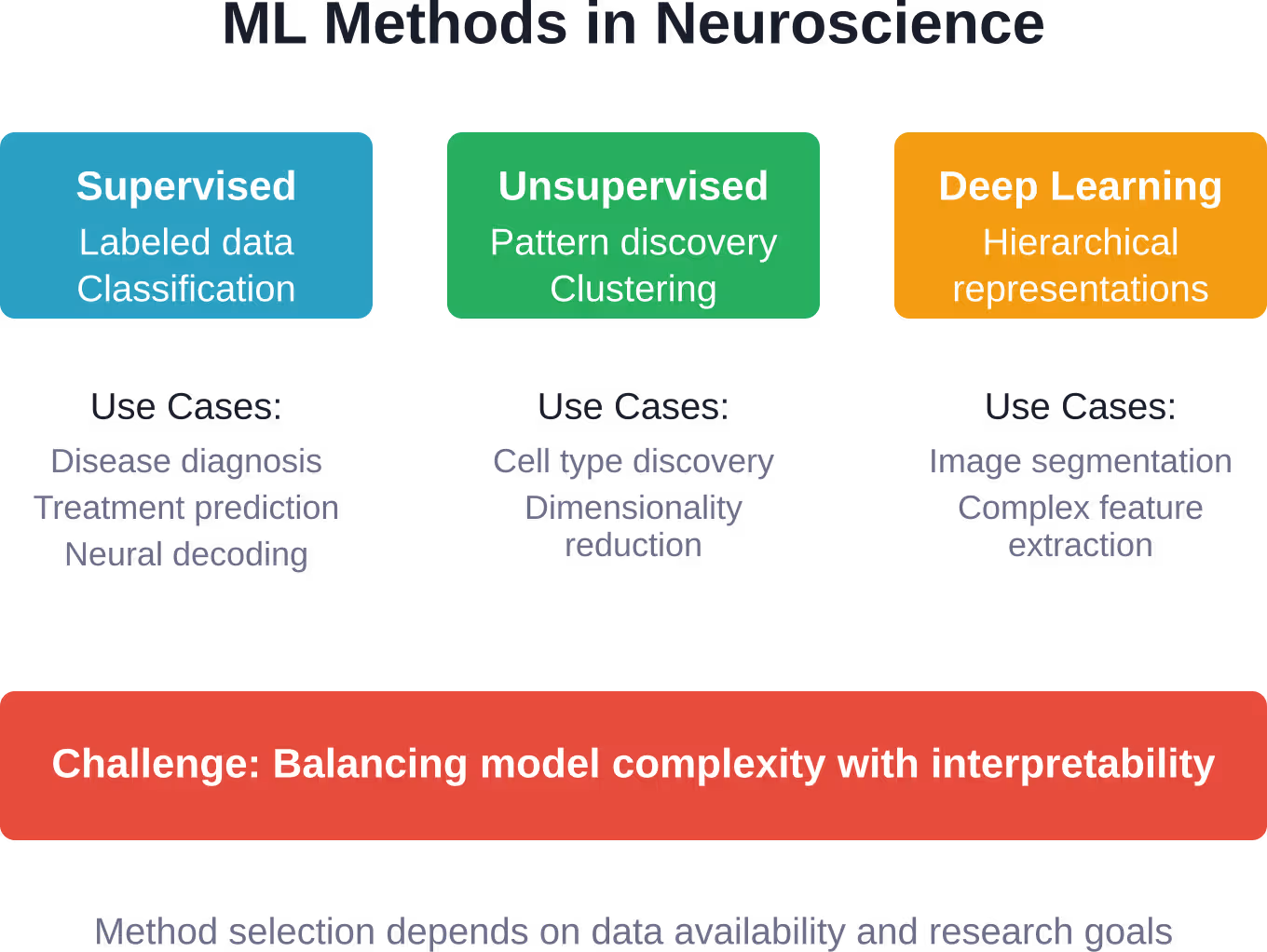
Challenges and Limitations
Real talk: machine learning isn’t a magic solution. Several obstacles complicate its application in neuroscience. Data quality matters enormously. Neural recordings contain noise, artifacts, and variability across subjects. Models trained on poor data produce unreliable results. Preprocessing and quality control remain critical steps that can’t be automated away. Sample sizes in neuroscience often lag behind what machine learning ideally needs. Brain imaging studies might include dozens or hundreds of subjects, while deep learning typically wants thousands or millions of examples. Researchers must carefully validate results to avoid overfitting. Interpretability poses another challenge. A model that accurately predicts seizures but operates as a black box doesn’t advance scientific understanding of epilepsy mechanisms. Neuroscientists increasingly demand explainable AI that reveals which features drive predictions.
The Road Ahead
The convergence of machine learning and neuroscience will only deepen. As recording technologies improve and datasets grow, algorithms will uncover patterns currently invisible to human analysis. Emerging directions include multi-modal integration—combining imaging, genetics, behavior, and physiology into unified models. Reinforcement learning offers new frameworks for understanding decision-making and reward processing. Transfer learning may allow models trained on one species or brain region to generalize to others. But the goal isn’t replacing neuroscientists with algorithms. It’s augmenting human insight with computational power, letting researchers ask bigger questions and test more complex hypotheses than ever before.
Frequently Asked Questions
What is machine learning in neuroscience?
Machine learning in neuroscience refers to computational methods that automatically identify patterns in brain data without explicit programming. These algorithms analyze neural recordings, brain images, and behavioral data to decode brain activity, predict diseases, and model cognitive processes.
How does deep learning differ from traditional machine learning in brain research?
Deep learning uses multi-layered artificial neural networks to learn hierarchical representations of data, making it particularly effective for complex tasks like image segmentation and feature extraction from raw neural recordings. Traditional machine learning often requires manual feature engineering, while deep learning discovers relevant features automatically.
Can machine learning predict neurological diseases?
Yes. Studies demonstrate machine learning systems detecting conditions like Alzheimer’s, Parkinson’s, and mental health disorders from imaging, genetic, and behavioral data. For example, research showed 96% True Positive Rate detecting stress using passive sensing data with a 6-day prediction window.
What are the main challenges applying AI to neuroscience?
Key challenges include limited sample sizes compared to typical machine learning needs, noisy and variable neural data, difficulty interpreting black-box models biologically, and ensuring results generalize across subjects and experimental conditions.
Do I need programming skills to use machine learning for neuroscience research?
Basic programming knowledge helps, particularly in Python or MATLAB. However, many user-friendly tools and software packages now provide graphical interfaces for common analyses. Collaboration between neuroscientists and machine learning experts often produces the best results.
How is machine learning changing neuroimaging?
Machine learning automates time-consuming tasks like brain structure segmentation, detects subtle patterns human observers miss, enables predictive modeling of disease progression, and processes multi-modal imaging data simultaneously. This accelerates research and improves diagnostic accuracy.
What’s the relationship between artificial neural networks and biological neurons?
Artificial neural networks were originally inspired by biological neural networks, borrowing concepts like weighted connections and activation functions. However, modern deep learning architectures have diverged significantly from biological realism, prioritizing performance over biological accuracy. Some researchers now work to close this gap.
Conclusion
Machine learning has become indispensable for neuroscience research. The volume and complexity of modern brain data simply can’t be analyzed effectively without algorithmic assistance. From decoding neural activity to predicting disease onset, these tools extend what researchers can discover about how brains work. The partnership works both ways—neuroscience continues inspiring new machine learning architectures while benefiting from computational analysis. As methods mature and datasets expand, expect this synergy to accelerate breakthroughs in understanding cognition, treating neurological disorders, and building more intelligent artificial systems. Ready to explore how machine learning can advance your neuroscience research? Start by identifying your specific analytical challenge, then investigate which methods best address that question. Collaboration between domain experts and computational specialists typically yields the most impactful results.