
Quick Summary: Machine learning in product development leverages algorithms and data analysis to accelerate design cycles, predict performance, optimize prototypes, and reduce development costs by 20–30%. ML models enable engineers to analyze massive datasets, automate testing, forecast market trends, and personalize products at scale—transforming traditional sequential processes into intelligent, data-driven workflows that deliver better products faster. Product development teams today face brutal constraints. Shrinking timelines, escalating complexity, and relentless cost pressure create what many engineers call a perfect storm. Traditional sequential design—sketch, prototype, test, revise—simply can’t keep pace anymore. Machine learning changes that equation fundamentally. It doesn’t just speed up existing workflows. ML algorithms enable entirely new approaches to design, testing, and optimization that weren’t feasible before. Around 40% of new products fail after launch. Development cycles that drag on too long burn capital and miss market windows. That’s where machine learning delivers measurable impact—reducing time to market by 20–40% while cutting development costs by 20–30%, according to corroborated industry analyses. But here’s the thing: machine learning isn’t generative AI. While ChatGPT-3.5 was released in November 2022, traditional machine learning remains the workhorse for many product development challenges. According to MIT Sloan research published in a 2024 survey, less than five years ago machine learning was the predominant form of AI businesses used across industries—and it still excels at specific tasks generative models can’t handle effectively.
What Machine Learning Actually Does in Product Development
Machine learning in product development refers to algorithms that learn patterns from data to make predictions, optimize designs, and automate analysis across the product lifecycle. Unlike rule-based systems that follow explicit instructions, ML models improve through exposure to data. The distinction matters. Rule-based automation handles known scenarios. Machine learning tackles uncertainty—predicting how untested materials will perform, identifying subtle design flaws humans miss, forecasting which features customers will value most.
Core ML Capabilities Engineers Rely On
Predictive modeling sits at the foundation. ML algorithms analyze historical performance data to forecast how new designs will behave under stress, heat, load, or real-world usage patterns. This eliminates countless physical prototype iterations. Pattern recognition identifies correlations across massive datasets that would take human analysts months to spot. When product teams have testing data from thousands of previous designs, ML models surface which variables actually drive performance outcomes. Optimization algorithms explore design spaces far larger than manual methods allow. An ML system can evaluate millions of potential configurations to find optimal solutions—balancing competing requirements like cost, weight, durability, and manufacturability simultaneously. Anomaly detection flags unusual patterns in testing data, manufacturing processes, or field performance that signal emerging problems before they become costly failures. 
Create ML Tools for Product Data With AI Superior
AI Superior develops AI-based applications and custom software products using machine learning models and algorithms. Their work can include predictive analytics, computer vision, NLP, BI tools, and big data analytics. For product development teams, this can support concept testing, customer insight analysis, feature prioritization, demand signals, or tools that help teams work with product data more clearly.
Need AI Built Around Product Decisions?
AI Superior can help with:
- building custom AI and ML tools
- creating predictive and data analysis models
- testing product ideas through PoC or MVP work
- integrating AI into product workflows
👉 Contact AI Superior to discuss your project.
Machine Learning Across the Product Lifecycle
ML applications span every development stage, though the specific algorithms and data requirements vary significantly.
Concept and Ideation Phase
Market intelligence models analyze customer feedback, social media conversations, support tickets, and purchase patterns to surface unmet needs. Natural language processing—a subset of ML—identifies themes and sentiment at scale that manual analysis would miss. Trend forecasting algorithms predict which product categories, features, or aesthetics will gain traction. Fashion and consumer electronics companies lean heavily on these models to time product launches. Competitive analysis tools use ML to track competitor product releases, pricing changes, and feature evolution across markets—alerting teams to emerging threats or opportunities.
Design and Engineering Phase
This is where machine learning delivers the most dramatic time savings. Generative design algorithms explore thousands of design alternatives based on specified constraints—load requirements, material costs, manufacturing methods, weight targets. Simulation acceleration uses ML models trained on physics simulation data to predict performance without running full computational fluid dynamics or finite element analysis. What used to take hours of compute time now happens in seconds. Materials selection models recommend optimal materials based on performance requirements, cost constraints, sustainability goals, and supply chain availability. These systems learn from vast databases of material properties and real-world performance data. Computer-aided engineering tools increasingly embed ML to automate mesh generation, suggest design improvements, and flag potential failure modes during CAD work.
Prototyping and Testing Phase
Test optimization algorithms determine the minimum number of prototype iterations needed to validate performance, dramatically reducing physical testing costs. Quality prediction models analyze early prototype test results to forecast whether a design will meet specifications—allowing teams to pivot earlier when problems surface. Failure analysis tools use ML to identify root causes when prototypes fail, correlating failure modes with specific design parameters or manufacturing variables.
Manufacturing and Scale-Up Phase
Process optimization models tune manufacturing parameters—temperature, pressure, speed, material flow—to maximize yield and minimize defects. Predictive maintenance algorithms monitor equipment sensor data to forecast failures before they happen, reducing downtime during production ramp. Quality control systems use computer vision and ML to inspect products at speeds and accuracy levels human inspectors can’t match. Defect detection rates improve while false positive rates drop.
Real-World Impact: When Machine Learning Actually Delivers
Abstract capabilities don’t mean much without measurable outcomes. Here’s where the data gets interesting. Michelin, the tire manufacturer, provides one of the most thoroughly documented cases. According to MIT Sloan Review, Michelin has received considerable benefits from generative AI and machine learning projects, including document processing in the tax department, social listening in marketing, and root cause analysis in manufacturing, with that return growing 30% to 40% annually over three years. The company deployed ML across multiple areas: document processing in tax operations, social listening in marketing, and—most relevant for product development—root cause analysis in manufacturing. These weren’t moonshot projects. They focused on practical applications that delivered near-term value. Sound familiar? That pattern repeats across industries. The highest-ROI ML projects solve specific, well-defined problems rather than attempting wholesale transformation.
Software Development: A Controlled Study
MIT researchers studied how machine learning tools affect developer workflows in a controlled setting. The findings reveal important patterns about ML’s impact on knowledge work. According to MIT research on generative AI’s impact on software developers, those with access to generative AI tools did more core coding work and fewer non-coding tasks That shift matters. It suggests ML tools don’t just speed up existing work—they change how professionals allocate time across different task types. Developers spent more time on the creative, technical work they’re trained for and less on coordination overhead. The research also noted these changes persisted long-term, indicating genuine workflow transformation rather than temporary novelty effects.
The Infrastructure Reality Check
But implementation isn’t trivial. Research published in Management Review Quarterly found that only 9% of organizations reported that establishing the infrastructure for ML-based business intelligence required low effort. In contrast, over 50% reported the effort was high or very high. That’s the gap between machine learning’s promise and its practice. The algorithms work. Integrating them into existing product development processes, data pipelines, and organizational workflows—that’s where teams struggle.
| ML Application Area | Primary Benefit | Implementation Complexity | Typical Time to Value |
|---|---|---|---|
| Predictive Performance Modeling | Reduce prototype iterations | High (requires historical data) | 6–12 months |
| Design Optimization | Explore larger design spaces | Medium (needs clear constraints) | 3–6 months |
| Quality Defect Detection | Improve manufacturing yield | Medium (computer vision setup) | 3–9 months |
| Market Trend Forecasting | Better product-market fit | Low to Medium (data availability varies) | 2–4 months |
| Test Result Analysis | Faster failure root cause ID | Medium (domain expertise needed) | 4–8 months |
Machine Learning vs. Generative AI: Choosing the Right Tool
Since ChatGPT’s release in late 2022, many organizations shifted attention to generative AI. That makes sense for content creation, code generation, and conversational interfaces. But for product development, traditional machine learning often remains the better choice. Here’s why: generative AI creates new content—text, images, code—based on patterns in training data. Machine learning predicts outcomes, classifies data, optimizes parameters, and identifies patterns in structured data. Need to analyze sensor data from 10,000 product tests to identify which variables drive failure rates? That’s a supervised learning problem, not a generative AI task. Want to optimize a design for minimum weight while meeting strength requirements? That’s an optimization algorithm, not something generative models handle well. According to MIT Sloan research, businesses need to understand when to deploy each AI approach. Generative AI excels at unstructured content tasks. Traditional machine learning handles structured prediction, classification, and optimization problems that dominate product engineering. The distinction isn’t just academic. Teams that try to force generative AI into roles better suited for traditional ML waste time and money. The reverse is equally true—using traditional ML for tasks generative models handle better leads to poor results.
When to Use Traditional Machine Learning
Structured data analysis tasks—predicting numerical outcomes, classifying items into categories, detecting anomalies in sensor streams, optimizing multi-variable systems. These are machine learning’s sweet spot. Performance prediction from test data. Quality control and defect detection. Process optimization in manufacturing. Demand forecasting. Equipment maintenance scheduling. All of these rely on traditional ML algorithms.
When Generative AI Makes More Sense
Generating design variations from text descriptions. Creating marketing copy or documentation. Summarizing customer feedback. Assisting with code generation. Converting natural language requirements into structured specifications. Generative models also help with early-stage ideation—producing concept sketches, suggesting feature combinations, or drafting multiple design alternatives quickly. The practical approach? Most product development teams need both, applied to different problems.
Implementation: Where Teams Actually Get Stuck
The technical barriers to machine learning have dropped dramatically. Cloud platforms offer pre-built ML services. Open-source frameworks make algorithm implementation straightforward. Computing power is cheap and abundant. So why do over 50% of organizations report high implementation effort? Data infrastructure problems top the list. ML models need clean, labeled, accessible data. Most product development organizations have data scattered across disconnected systems—CAD files in one place, test results in another, manufacturing data in a third system, customer feedback in a fourth. Integrating these data sources isn’t a technical problem anymore. It’s an organizational one. Different departments own different systems. Data formats vary. Access controls prevent sharing. Nobody has clear responsibility for data quality across silos.
The Skills Gap Reality
Product engineers understand engineering. Data scientists understand machine learning. The overlap between these skill sets remains frustratingly small. Engineers know which problems need solving and what constraints matter. Data scientists know which algorithms apply and how to train models effectively. Getting these groups to communicate effectively—that’s where projects stall. The most successful implementations create hybrid roles or small cross-functional teams where engineers and data scientists work together daily rather than tossing requirements back and forth.
Integration With Existing Tools
CAD systems, PLM platforms, simulation software, testing equipment—product development teams already use dozens of specialized tools. ML models need to integrate with these existing workflows rather than requiring engineers to adopt entirely new systems. That integration work takes time. APIs need to be developed or leveraged. Data flows need to be established. User interfaces need to be designed so engineers can interact with ML predictions without becoming data scientists themselves.
Trust and Validation
Engineers won’t rely on ML predictions they don’t understand or trust. Black-box models that output recommendations without explanation don’t work in high-stakes engineering contexts. Explainable AI—techniques that help users understand why a model made a particular prediction—becomes critical. So does rigorous validation. ML models need to prove their predictions are reliable before teams will make expensive decisions based on them. That validation process takes time and domain expertise. Data scientists can verify that a model performs well statistically. Only experienced engineers can judge whether its predictions make physical sense.
Cost-Benefit Analysis: Is Machine Learning Worth It?
The 20–30% development cost reduction statistic sounds compelling. But implementation requires upfront investment—infrastructure, talent, integration work, training. Does the math actually work out? For large-scale product development organizations with high prototype costs and long development cycles, the ROI case is usually straightforward. Reducing even a few prototype iterations or shortening the development timeline by weeks pays for the ML investment quickly. For smaller teams or products with short development cycles and low prototype costs, the calculation gets trickier. The fixed costs of ML infrastructure don’t scale down proportionally.
Where ROI Shows Up Fastest
High-volume manufacturing where even small quality improvements or yield increases generate large savings. A 1% reduction in defect rates can mean millions in savings annually for high-volume production. Complex products with expensive physical prototypes—automotive, aerospace, industrial equipment. Reducing prototype iterations from ten to seven saves enormous amounts of time and money. Products with rich performance data from previous generations. ML models trained on historical data deliver value faster than projects starting from scratch. Regulatory-intensive industries where testing costs are extremely high—medical devices, pharmaceuticals. ML models that predict test outcomes help prioritize which candidates to test physically.
Where ROI Takes Longer
Custom or one-off products where the ML model won’t be reused. The upfront investment may exceed the savings on a single product. Organizations without existing data infrastructure or culture. Building data pipelines and changing workflows adds substantial cost and timeline. Teams without in-house ML expertise that need to hire or contract out. Talent costs remain high, especially for niche domain combinations.
| Factor | Positive ROI Indicators | Negative ROI Indicators |
|---|---|---|
| Product Complexity | High complexity, many variables | Simple products, few design parameters |
| Development Volume | Multiple products per year | One-off or rare developments |
| Prototype Costs | Expensive physical prototypes | Low-cost or virtual prototyping |
| Data Availability | Rich historical performance data | Limited or no historical data |
| Organizational Readiness | Existing data infrastructure, ML skills | Starting from scratch on infrastructure |
Getting Started: A Practical Approach
Most successful ML implementations in product development start small and focused rather than attempting enterprise-wide transformation.
Identify a Narrow, High-Value Problem
Pick one specific pain point where ML could deliver measurable value. Not “optimize our entire product development process.” Instead, something like “reduce testing iterations for thermal performance” or “predict manufacturing defects from design parameters.” The problem should be important enough to matter but narrow enough to show results within 3–6 months.
Verify Data Availability
Before committing resources, confirm the necessary data exists and is accessible. ML projects fail most often due to data problems, not algorithm problems. Run a data audit. How much historical data exists? What format is it in? How clean is it? How much labeling or preprocessing will be required? If the data doesn’t exist yet, consider whether collecting it for 6–12 months before starting the ML project makes sense, or whether a different initial problem would be better.
Build a Cross-Functional Team
Three roles matter most: domain experts who understand the problem deeply, data scientists or ML engineers who can build and train models, and IT or data engineering support to handle infrastructure. These people need to work together closely, not hand off work sequentially. Co-location or at minimum daily collaboration makes a huge difference.
Plan for Integration From Day One
How will engineers actually use the ML model? Through their existing CAD system? Via a standalone application? As an API that other tools call? Designing the user experience and integration points early prevents building models that work technically but don’t fit into actual workflows.
Validate Rigorously Before Scaling
Run the ML model in parallel with existing processes initially. Compare its predictions against reality. Have domain experts review outputs and flag problems. Only after the model proves reliable in this validation phase should it move into production use where decisions depend on its output.
The Human-AI Partnership Model
Machine learning doesn’t replace engineering judgment. It augments it. The most effective implementations position ML as a tool that handles data-intensive analysis, pattern recognition, and optimization—freeing engineers to focus on creative problem-solving, contextual judgment, and decisions that require deep domain expertise. That software developer study mentioned earlier showed this pattern clearly. When developers gained access to ML coding tools, they spent more time on actual development work and less on routine project management tasks. The AI didn’t replace developers—it let them spend their time on higher-value activities. The same dynamic plays out in product development. ML models can evaluate thousands of design variations overnight. But engineers still need to define the problem, set constraints that reflect real-world requirements, interpret results, and make final decisions. Research from the MIT Initiative on the Digital Economy notes that while companies are deploying increasingly autonomous AI agents for various tasks, understanding of how to optimize human-AI collaboration remains nascent. Getting this partnership right—determining which decisions to delegate to algorithms and which require human judgment—separates successful implementations from failed ones.
Security and Governance Considerations
As ML becomes more embedded in product development, security and governance become critical concerns. Models trained on proprietary design data represent valuable intellectual property. Compromised models could leak sensitive information or produce subtly flawed outputs. NIST released a concept paper and proposed action plan in August 2025 for developing NIST SP 800-53 Control Overlays for Securing AI Systems, recognizing that AI security intersects with but extends beyond traditional IT security. Model integrity, data provenance, adversarial robustness—these concerns require specific attention in ML implementations. Product development teams need clear policies around data access, model versioning, output validation, and accountability. When an ML model recommends a design change that later causes a product failure, who’s responsible? The engineer who accepted the recommendation? The data scientist who trained the model? The organization that deployed it? These questions don’t have simple answers, but they need explicit consideration before problems arise.
Looking Ahead: What’s Changing
The boundary between traditional machine learning and generative AI continues to blur. Newer architectures combine predictive capabilities with generative features. Foundation models trained on massive datasets can be fine-tuned for specific product development tasks with relatively small amounts of domain data. Agentic AI—systems that can act autonomously rather than just providing recommendations—represents the next frontier. These agents could negotiate design trade-offs, explore solution spaces, run simulations, and iterate toward optimal solutions with minimal human oversight. Research from MIT on agentic AI notes that companies are deploying these autonomous systems across a vast array of tasks, but understanding of how to work with AI agents to maximize productivity remains limited. Early results show promise, but also reveal new challenges around trust, control, and accountability. Real talk: some predictions about AI’s impact have proven wildly overoptimistic. But machine learning’s value in product development rests on solid ground. The core capabilities—pattern recognition, prediction, optimization—solve real problems teams face daily. The trajectory seems clear. ML integration will deepen. Tools will improve. Barriers will fall. But the fundamental value proposition—using algorithms to handle data-intensive analysis so humans can focus on judgment and creativity—that’s not changing.
Common Implementation Pitfalls to Avoid
Learning from others’ mistakes saves time and money. These pitfalls appear repeatedly in ML product development projects.
- Starting too big. Attempting to transform the entire product development process at once almost always fails. Narrow, focused pilots deliver better results and learning.
- Underestimating data requirements. ML models are only as good as their training data. Poor data quality, insufficient quantity, or lack of representative examples doom projects before algorithms even matter.
- Ignoring change management. Engineers need to understand how and when to use ML tools. Without proper training and cultural buy-in, even technically successful systems sit unused.
- Treating ML as a black box. When users can’t understand or verify model outputs, they won’t trust them enough to make important decisions based on them.
- Neglecting ongoing maintenance. ML models degrade over time as conditions change. Models trained on last generation’s products may not apply well to new designs with different characteristics.
- Overlooking infrastructure costs. Computing resources, data storage, model versioning, monitoring systems—the infrastructure costs add up and need explicit planning.
Measuring Success: Key Metrics
How do teams know whether ML implementations actually deliver value? These metrics help track impact.
- Development cycle time reduction. Are products getting to market faster? By how much? Which phases show the most improvement?
- Prototype iteration reduction. How many fewer physical prototypes are needed? What’s the cost savings?
- Defect rate changes. Are quality issues declining? Are they caught earlier in the process?
- Cost per product developed. Is the total cost per product launch decreasing after accounting for ML infrastructure costs?
- Engineer productivity. Are engineers able to evaluate more design alternatives, run more analyses, or complete more projects in the same timeframe?
- Model adoption rate. What percentage of relevant decisions actually use ML model outputs? Low adoption suggests integration or trust problems.
- Prediction accuracy. How well do model predictions match actual outcomes? This metric matters most for validation but remains important in production.
Frequently Asked Questions
What’s the difference between machine learning and AI in product development?
Artificial intelligence is the broad umbrella term for systems that exhibit intelligent behavior. Machine learning is a specific subset of AI focused on algorithms that learn from data to make predictions or decisions. In product development, most practical AI applications use machine learning techniques—training models on historical design data, test results, or manufacturing parameters to predict outcomes or optimize new designs. Other AI approaches like rule-based expert systems exist but are less common now.
How much historical data do we need before machine learning becomes useful?
The answer varies by problem complexity and algorithm type. Simple predictive models might produce useful results with a few hundred data points. Complex problems with many variables may require thousands or tens of thousands of examples. Generally speaking, teams should aim for at least 500–1,000 quality data points to start seeing value, but more is better. Data quality matters more than quantity—1,000 clean, well-labeled examples beat 10,000 messy, inconsistent ones. If historical data is limited, consider whether 6–12 months of data collection makes sense before implementing ML models.
Can small product development teams benefit from machine learning, or is it only for large enterprises?
Small teams can benefit, but the ROI calculation is trickier. ML implementation has fixed costs that don’t scale down proportionally. Small teams should focus on cloud-based ML services rather than building infrastructure, use pre-trained models where possible, and target problems with extremely high value relative to team size—like reducing expensive prototype iterations or avoiding costly design failures. Starting with vendor solutions that embed ML rather than building custom models often makes more sense for smaller organizations.
What happens when a product based on ML predictions fails? Who’s responsible?
This remains a complex legal and ethical question without settled answers. Currently, most organizations treat ML systems as decision-support tools rather than autonomous decision-makers. The engineer or product manager who accepts an ML recommendation and acts on it typically retains responsibility for that decision. Organizations need clear policies defining when ML outputs require human review, what validation processes apply, and how accountability flows. Documentation becomes critical—recording which ML model version produced a recommendation, what data it used, and what human review occurred helps clarify responsibility if problems arise later.
How do we prevent machine learning models from perpetuating biases in our product development?
ML models learn patterns from training data—including biases present in that data. If historical design decisions reflected unstated assumptions, resource constraints, or limited perspectives, models trained on that data may reinforce those patterns. Mitigation strategies include: auditing training data for representation gaps, involving diverse stakeholders in defining problem constraints and success metrics, testing model outputs across different scenarios and user populations, maintaining human oversight for decisions with significant equity implications, and regularly retraining models as organizational understanding evolves. Transparency about model limitations matters too—documenting what assumptions the model makes helps users apply appropriate skepticism.
Should we build machine learning capabilities in-house or use external vendors?
The build-versus-buy decision depends on several factors. In-house development makes sense when the problem is unique to your organization, when proprietary data or processes are involved, when ML will be a core competitive advantage, or when you have existing ML talent. Vendor solutions work better for common problems with established solutions, when speed to value matters more than customization, when ML expertise is limited internally, or for initial pilots to prove value before committing to infrastructure. Many organizations use a hybrid approach—vendor solutions for generic capabilities, custom development for proprietary applications that differentiate their products.
How quickly can we expect to see ROI from machine learning in product development?
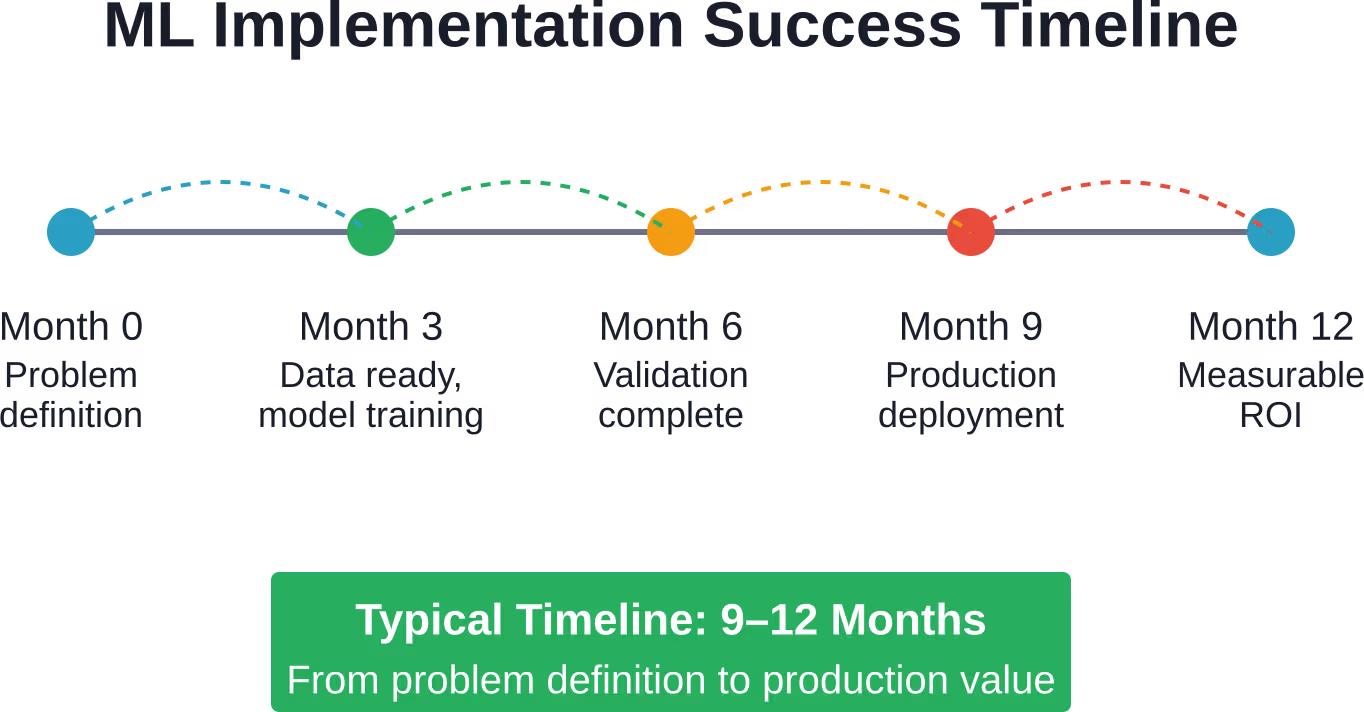
Based on corroborated analyses, most implementations show measurable value within 9–15 months from project start. That breaks down roughly as: 2–3 months for problem definition and data preparation, 2–4 months for model development and training, 2–3 months for validation and integration, and 3–6 months in production before benefits accumulate enough to measure clearly. Development cost reductions of 20–30% are achievable but typically require multiple product cycles to realize fully. Faster ROI appears in high-volume manufacturing contexts where even small improvements generate large savings quickly. Slower ROI is typical for complex custom products or when significant infrastructure investment is needed first.
Conclusion: The Pragmatic Path Forward
Machine learning in product development isn’t hype anymore. It’s proven technology delivering measurable results—20–30% cost reductions, faster development cycles, better products. But success requires realistic expectations. ML doesn’t replace engineering expertise. It augments it. The organizations seeing the best results treat ML as a tool that handles data-intensive analysis, freeing human experts to focus on creativity, judgment, and decisions that require deep contextual understanding. Start small. Pick one specific, high-value problem. Verify the data exists. Build a cross-functional team. Validate rigorously. Scale after proving value. That approach works far better than attempting wholesale transformation. The technology will keep improving. Models will get more capable. Integration will get easier. Costs will drop. But the fundamental value proposition remains constant: use algorithms to find patterns and optimize solutions in ways manual analysis can’t match, so engineering teams can build better products faster. The question isn’t whether to adopt machine learning in product development anymore. It’s how quickly your organization can implement it effectively while competitors do the same.