
Quick Summary: Machine learning is revolutionizing real estate through automated property valuations, predictive analytics, and market trend forecasting. ML algorithms analyze vast datasets to deliver accuracy rates of up to 98% for on-market properties, helping investors, agents, and buyers make faster, data-driven decisions while reducing manual workload and operational costs. The real estate industry is sitting on a goldmine of data. Property records, transaction histories, market trends, demographic shifts—it’s all there. But here’s the thing: extracting actionable insights from millions of data points manually? That’s an impossible task. Machine learning changes the game entirely. These algorithms can process vast datasets in hours, spotting patterns that would take analysts months to identify. The result? Faster decisions, more accurate valuations, and a competitive edge that traditional methods simply can’t match. The technology isn’t futuristic speculation anymore. Real estate companies are already deploying ML systems for property appraisals, investment analysis, and customer targeting. Some automated valuation models now achieve accuracy rates of up to 98% for on-market homes and 93% for off-market properties.
Understanding Machine Learning in Real Estate Context
Machine learning refers to algorithms that improve through experience without explicit programming. Feed them data, and they identify patterns, make predictions, and refine their accuracy over time. In real estate, that means training models on historical transaction data, property characteristics, economic indicators, and market trends. The algorithm learns which factors drive property values, predict buyer behavior, or signal market shifts. The distinction between traditional statistics and machine learning matters here. Linear regression models—the old standard—assume relationships between variables follow predictable patterns. ML models handle complexity better, capturing non-linear relationships and interactions between dozens of variables simultaneously. Research compared traditional linear regression against ML models for predicting commercial real estate returns. ML models showed significantly enhanced predictive accuracy, with one model reducing forecasting error by 68% over baseline approaches and 26% over enhanced statistical methods, particularly over intermediate and long-term forecast horizons. That’s not a marginal improvement. That’s the difference between making informed investment decisions and shooting in the dark. 
Enhance Real Estate Operations with Machine Learning
Real estate businesses face challenges with large datasets, including market trends, property valuations, and transaction management. AI Superior helps companies leverage machine learning to streamline data analysis, predict trends, and automate critical business processes.
Unlock the Real Estate Data Potential with AI
AI Superior offers:
- Predictive models for property value assessment and market analysis
- Custom machine learning solutions tailored to real estate data
- Big data analytics for large-scale property and transaction datasets
- Seamless AI integration into existing real estate platforms
👉Reach out to AI Superior to explore how machine learning can transform your real estate operations and enhance decision-making.
Automated Property Valuation: The Cornerstone Application
Property valuation represents the most mature use case for machine learning in real estate. Automated Valuation Models (AVMs) analyze comparable sales, property features, location data, and market conditions to estimate values. The technology processes variables traditional appraisers consider—square footage, bedrooms, bathrooms, lot size—plus hundreds of additional factors. Proximity to schools, crime rates, walkability scores, recent renovations, neighborhood trends, even seasonal patterns all feed into the calculation. IEEE research comparing ML models for real estate price prediction found that sophisticated algorithms consistently outperform traditional methods. The studies examined models across urban markets, testing their ability to handle complex pricing dynamics. The practical benefits extend beyond accuracy. AVMs deliver instant valuations, eliminating the weeks-long wait for traditional appraisals. That speed matters for time-sensitive transactions, portfolio rebalancing, or market analysis. Advanced AVM systems process valuations for large property portfolios across multiple markets, maintaining high accuracy rates while handling massive volume.
Multimodal Approaches for Enhanced Accuracy
The latest evolution in property valuation combines multiple data types—structured numerical data, geospatial information, images, and text descriptions. Research from institutions worldwide demonstrates that multimodal machine learning models outperform single-source approaches. Image analysis adds significant value here. ML models trained on property photos can assess condition, identify renovations, estimate quality of finishes, and flag discrepancies between listing descriptions and visual evidence. Geospatial embedding—encoding location data as mathematical representations—captures neighborhood effects, accessibility, and environmental factors traditional models miss. Properties two blocks apart might show vastly different value trajectories based on hyperlocal trends only visible through spatial analysis.
Predictive Analytics for Investment Decisions
Predicting commercial real estate returns challenges even experienced investors. Multiple variables interact in complex ways—economic cycles, interest rates, demographic shifts, development patterns, regulatory changes. Machine learning approaches this problem by testing models against traditional approaches for forecasting real estate returns across different time horizons. The results? ML models significantly enhanced predictive accuracy, particularly over intermediate and long-term horizons. For 4-quarter forecasts and beyond, the improvement proved substantial enough to influence investment strategy. Here’s why that matters: commercial real estate decisions often involve holding periods of 5-10 years or more. Better long-term forecasting directly impacts portfolio performance and risk management. The research highlights a critical insight: machine learning doesn’t just incrementally improve predictions—it makes previously unreliable long-term forecasts actually usable for decision-making. Institutional investors and asset managers are taking notice. Research from Altus’ 2021 CRE Innovation Report found that 25% of CRE senior executives were using machine learning in a significant way. That percentage has only grown since.
Market Trend Analysis and Forecasting
Real estate markets move in patterns, but identifying those patterns early enough to act on them? That’s where machine learning excels. ML algorithms process massive datasets—transaction records, listing activity, economic indicators, demographic data, search trends, social media signals—to detect emerging market shifts before they become obvious. The technique works particularly well for identifying micro-market trends. While traditional analysis might track city-level or neighborhood-level changes, machine learning can identify block-by-block variations in pricing momentum, inventory levels, or buyer demand. Graph-based deep learning models represent a particularly promising approach. These models treat properties as nodes in a network, with connections representing spatial relationships, comparable sales, or shared characteristics. The structure allows algorithms to capture how value changes propagate through markets. Research on graph-based property valuation demonstrates improved scalability and accuracy compared to traditional methods. The approach handles complex urban markets where properties influence each other’s values in non-linear ways.
Nowcasting Real Estate Markets
Nowcasting—estimating current conditions using real-time data—addresses a fundamental problem in real estate: official statistics lag reality by weeks or months. Machine learning models trained on high-frequency data sources can estimate current market conditions before official reports are published. Online listing activity, search volume, pricing changes, time-on-market metrics all provide signals about market momentum. Research applying machine learning to housing markets demonstrated enhanced nowcasting accuracy by leveraging rich, geolocated datasets, with significant improvements reported through high-frequency data sources.
Customer Targeting and Lead Generation
Real estate marketing traditionally relies on broad demographic targeting and geographic segmentation. Machine learning enables far more precise identification of potential buyers or tenants. ML models analyze behavioral data—search patterns, website interactions, email engagement, property views—to score leads based on conversion probability. The system learns which signals indicate serious intent versus casual browsing. The technology also powers predictive targeting for outbound marketing. By analyzing characteristics of past customers and current market participants, algorithms identify lookalike audiences most likely to engage. Some real estate platforms report significant improvements in marketing efficiency through ML-powered targeting. The systems allocate ad spend toward high-probability prospects while filtering out unlikely converters. 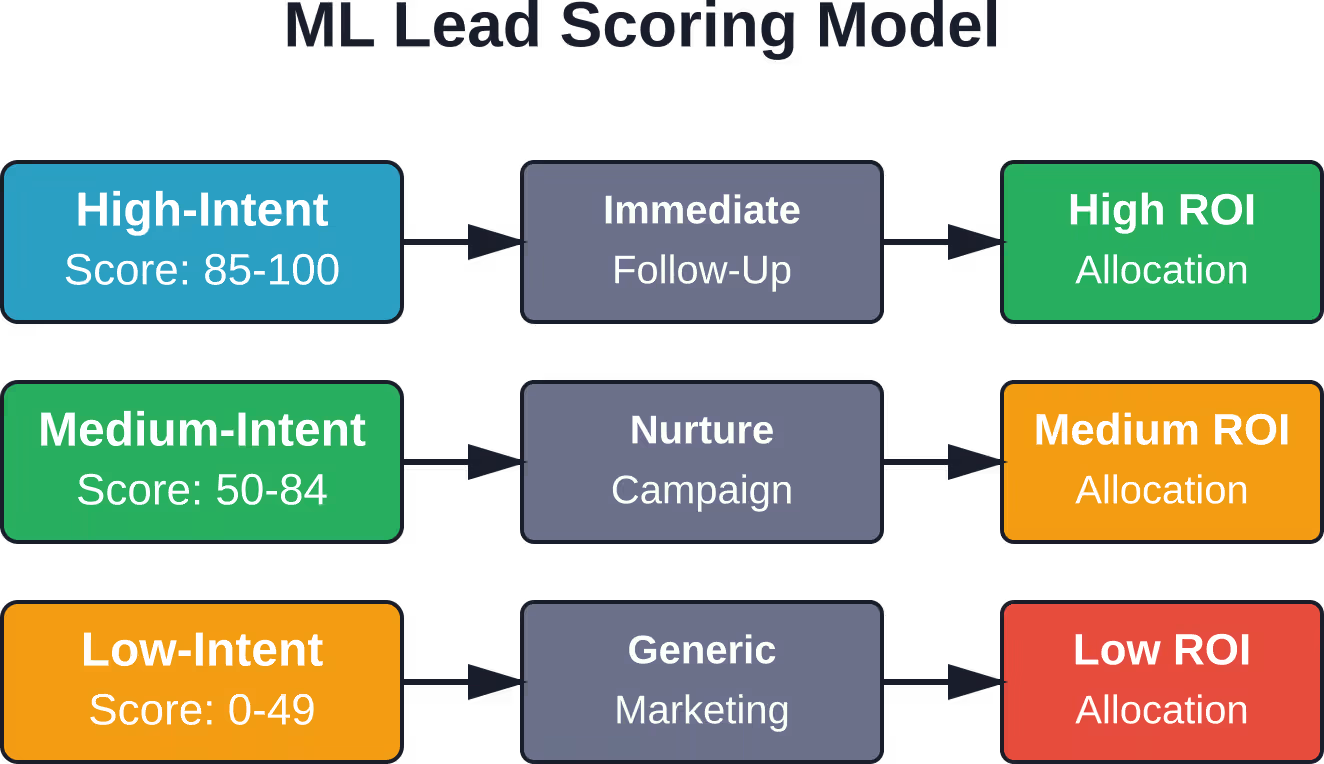
Financial Operations and Risk Assessment
Machine learning streamlines financial processes throughout the real estate transaction lifecycle. From initial underwriting through ongoing portfolio management, ML systems reduce manual workload while improving accuracy. Mortgage lending represents a prime application area. ML models assess credit risk, detect fraud, predict default probability, and optimize loan pricing. The systems process applicant data, property information, and market conditions to make faster, more consistent lending decisions. For commercial properties, machine learning assists with cash flow forecasting, tenant credit analysis, and lease renewal predictions. These models help property managers anticipate vacancy, optimize rental rates, and identify at-risk tenants before problems escalate. HUD policies recognize automated inspection and verification processes for certain transactions. Reimbursable costs for property inspections are defined in HUD guidelines, reflecting acceptance of systematic property evaluation methods.
Implementation Challenges and Considerations
Machine learning delivers impressive results, but implementation isn’t trivial. Real estate companies face several obstacles when adopting these technologies.
Data Quality and Availability
ML models are only as good as their training data. Real estate data presents unique challenges—inconsistent formats, missing information, outdated records, and fragmented sources across multiple jurisdictions. Cleaning and normalizing property data requires significant effort. Square footage measurements might vary between tax records and listings. Property features may be described inconsistently. Historical transaction data might have gaps or errors. Research applying ML to real estate markets typically spends substantial effort on data preprocessing. Studies examining property datasets report excluding significant portions of appraisal data due to quality filters, with some research noting exclusions based on ratio validation, transaction range limits, and transaction frequency criteria. That level of data curation takes time and expertise. Companies need processes for acquiring, validating, and maintaining high-quality datasets before ML models can deliver value.
Model Interpretability
Real estate decisions often require explanation and justification. Regulatory requirements, client expectations, and professional standards demand transparency in valuation and risk assessment. Some ML models—particularly deep neural networks—operate as black boxes. They produce accurate predictions but don’t explain their reasoning in human-understandable terms. This creates tension between accuracy and interpretability. Simpler models may be easier to explain but less accurate. Complex models might deliver better performance but resist clear interpretation. The solution often involves hybrid approaches—using interpretable models for regulated contexts while leveraging more complex algorithms for internal analysis. Techniques like SHAP values and LIME can help explain black-box model predictions after the fact.
Technical Expertise Requirements
Building and deploying machine learning systems requires specialized skills—data science, software engineering, cloud infrastructure, and domain expertise in real estate. Many real estate firms lack in-house ML talent. Hiring data scientists with real estate knowledge proves challenging, and training real estate professionals in machine learning takes time. Options include building internal teams, partnering with technology vendors, or adopting third-party platforms that package ML capabilities for real estate applications. Each approach involves trade-offs between cost, control, and customization.
The Path Forward: ML Adoption Roadmap
Successfully implementing machine learning in real estate requires a structured approach. Organizations that jump directly to advanced applications without foundational work often struggle:
- Start with high-value, well-defined problems where ML clearly outperforms existing methods: Property valuation, lead scoring, and market analysis represent good entry points with measurable ROI.
- Invest in data infrastructure before deploying models: Establish processes for data collection, storage, validation, and updating. Build pipelines that automatically feed clean data to ML systems.
- Begin with pilot projects that demonstrate value without requiring enterprise-wide transformation: Test ML approaches on specific geographies, property types, or business processes. Measure results, refine approaches, then scale successful implementations.
- Build or acquire the necessary technical capabilities: Whether through hiring, training, or partnerships, organizations need access to data science expertise and appropriate technology platforms.
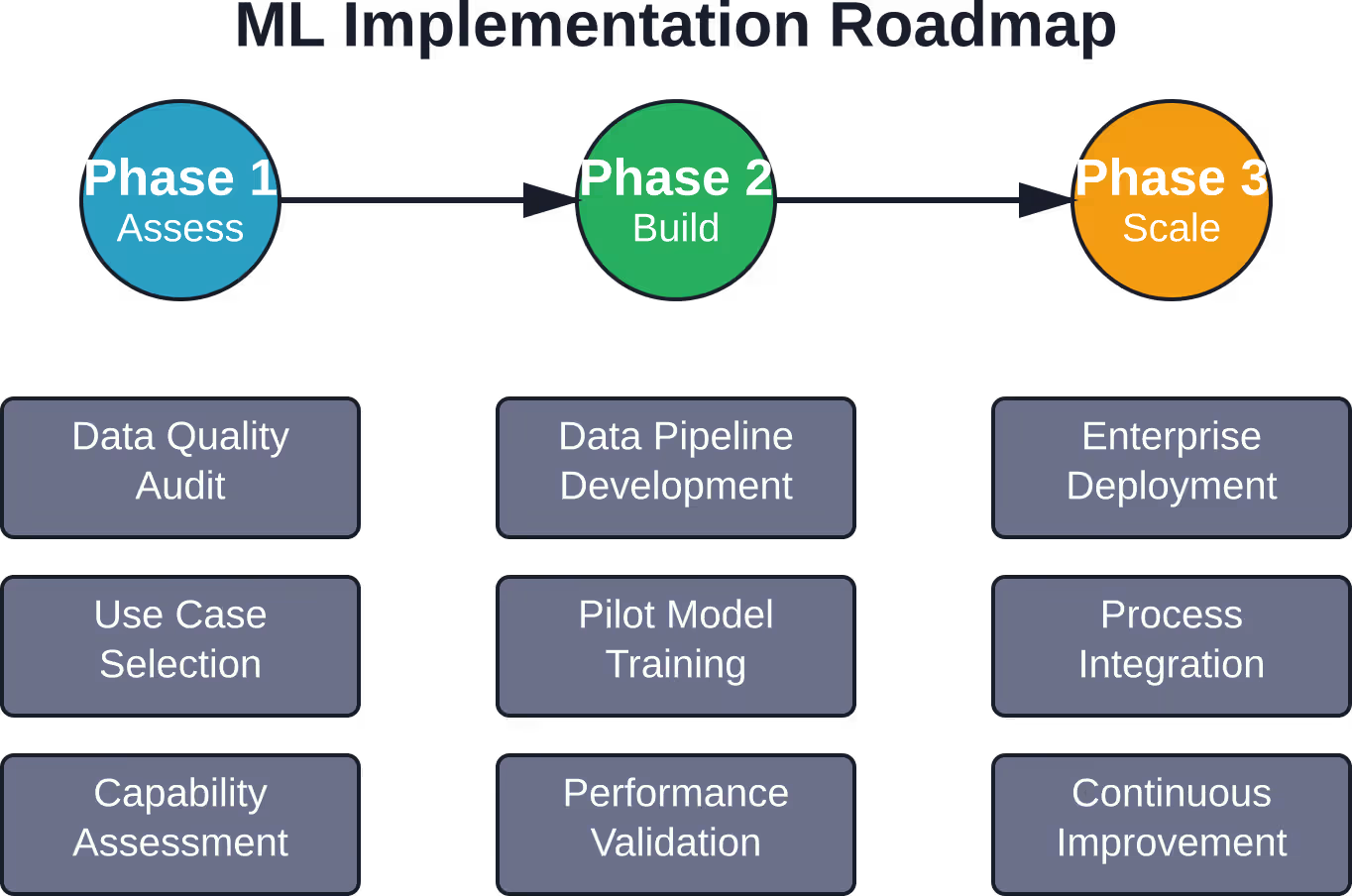 Establish feedback loops for continuous improvement. ML models degrade over time as markets change. Regular retraining with fresh data maintains accuracy and adapts to evolving conditions.
Future Directions in Real Estate ML
The field continues evolving rapidly. Several trends will shape how machine learning transforms real estate over the next several years:
- Large language models and generative AI will enhance property descriptions, automate customer communications, and synthesize market intelligence from unstructured text sources. These technologies complement traditional ML approaches focused on numerical prediction.
- Graph neural networks and spatial analytics will improve modeling of location effects and market interconnections. These approaches capture how properties influence each other’s values in ways traditional models miss.
- Multimodal learning—combining images, text, structured data, and geospatial information—will become standard for property valuation and analysis. Research demonstrates clear accuracy improvements from integrating diverse data types.
- Real-time data integration will enable more responsive market analysis and dynamic pricing. As transaction data, listing activity, and economic indicators become available with minimal lag, ML systems will deliver increasingly current insights.
The global real estate market represents substantial economic value with projections in the hundreds of trillions of dollars. Even marginal efficiency improvements from machine learning translate to substantial value creation.
Frequently Asked Questions
What’s the difference between AI and machine learning in real estate?
Machine learning represents a subset of artificial intelligence focused specifically on systems that learn from data. In real estate, ML typically refers to algorithms that predict prices, classify properties, or identify patterns, while broader AI includes technologies like natural language processing for chatbots or computer vision for property image analysis. Most practical real estate applications today use ML techniques rather than general AI.
How accurate are machine learning property valuations?
Accuracy varies based on property type, market conditions, and data availability. For on-market residential properties in major markets, ML-based AVMs achieve accuracy rates of up to 98%, with 93% accuracy for off-market properties. Commercial property valuations show more variation but still outperform traditional statistical methods by substantial margins—research shows 68% error reduction compared to basic models.
Can small real estate companies benefit from machine learning?
Yes, though the approach differs from enterprise implementations. Small firms can leverage third-party platforms that package ML capabilities without requiring in-house data science teams. Cloud-based AVMs, predictive analytics services, and ML-powered marketing platforms offer subscription access to sophisticated algorithms. The key is selecting high-impact applications and partnering with vendors who understand real estate operations.
What data is needed to train real estate ML models?
Core requirements include historical transaction data (prices, dates, property characteristics), location information (addresses, coordinates, neighborhood classifications), property features (size, bedrooms, bathrooms, age, condition), and market context (comparable sales, economic indicators, demographic data). Advanced models also incorporate images, text descriptions, geospatial data, and time-series information. Data quality matters more than quantity—clean, consistent datasets produce better results than massive but messy collections.
How long does it take to implement machine learning in real estate?
Timeline depends on scope and organizational readiness. A focused pilot project—testing ML for property valuation in a specific market—might take 3-6 months including data preparation, model development, and validation. Enterprise-wide deployment of ML across multiple processes typically requires 12-24 months, with ongoing refinement thereafter. Data infrastructure work often consumes the majority of initial implementation time.
Does machine learning replace real estate professionals?
No, it augments their capabilities rather than replacing them. ML handles data-intensive tasks—processing comparables, analyzing market trends, scoring leads—freeing professionals to focus on relationship management, negotiation, and complex decision-making that requires human judgment. Appraisers use AVMs to accelerate routine valuations while applying expertise to unique properties. Agents leverage predictive analytics for better targeting while still building client relationships.
What are the main challenges in adopting ML for real estate?
Data quality represents the primary obstacle—real estate data is often fragmented, inconsistent, and incomplete. Technical expertise requirements present another barrier, as building ML systems requires specialized skills many firms lack. Model interpretability creates challenges in regulated contexts where decisions must be explainable. Integration with existing systems and workflows requires careful planning. Finally, measuring ROI and demonstrating value to stakeholders who may not understand the technology demands clear communication and well-defined success metrics.
Taking Action: Next Steps for Real Estate Organizations
Machine learning isn’t a distant future technology—it’s reshaping real estate operations right now. Organizations that delay adoption risk falling behind competitors who are already leveraging these capabilities. Start by identifying specific business problems where ML can deliver measurable value. Property valuation, investment analysis, and marketing optimization represent proven applications with clear ROI. Assess current data assets and infrastructure. What information does the organization already collect? How is it stored and maintained? Where are the gaps? Building strong data foundations enables successful ML deployment. Explore available solutions—both build and buy options. For organizations with technical resources, developing custom models offers maximum control and customization. For most firms, partnering with specialized vendors or adopting platform solutions provides faster time-to-value. Begin small with pilot projects that test concepts and build organizational capability. Success with focused applications creates momentum for broader adoption while minimizing risk. The competitive advantage from machine learning grows as algorithms learn from more data and organizations develop expertise in applying these tools. Early movers compound their advantage over time. The question isn’t whether to adopt ML in real estate—it’s how quickly organizations can implement these capabilities effectively. The real estate industry sits at an inflection point. Massive datasets, powerful algorithms, and cloud computing infrastructure have converged to make sophisticated analytics accessible at scale. Organizations that embrace this transformation will define the future of real estate decision-making.