
Quick Summary: Machine learning is revolutionizing software testing by automating test generation, reducing maintenance overhead, and improving defect detection accuracy. ML algorithms analyze historical test data, code changes, and execution patterns to intelligently prioritize tests, predict failure-prone areas, and generate more effective test cases—delivering faster, more reliable quality assurance with significantly less manual effort. Software testing faces a fundamental challenge: applications grow increasingly complex while release cycles accelerate. Traditional manual testing can’t keep pace. Machine learning offers a solution. By analyzing patterns in code, test execution history, and defect data, ML algorithms make testing smarter, faster, and more thorough. The technology isn’t replacing human testers—it’s augmenting their capabilities in ways that weren’t possible before. The stakes are high. The 1996 Ariane V rocket failure cost $500,000,000 in uninsured losses due to inadequate exception handling. More recently, a trading algorithm malfunction at Knights Capital Group resulted in a $440,000,000 loss in 2012. These incidents underscore why intelligent, data-driven testing matters.
What Machine Learning Brings to Software Testing
Machine learning transforms software testing from a reactive, labor-intensive process into a proactive, intelligence-driven practice. The technology excels at pattern recognition—exactly what’s needed when analyzing thousands of test results, code changes, and execution traces. Traditional testing relies on predetermined scripts and rules. ML-based testing adapts and learns. When a test suite runs repeatedly, ML algorithms identify which tests catch real bugs versus which ones produce false positives. They detect patterns in code changes that historically correlate with defects. They predict which areas of an application are most likely to fail based on complexity metrics and past behavior. This isn’t theoretical. Facebook developed Sapienz, an automated testing tool using machine learning to identify and prioritize test cases. The tool reduced crashes in Facebook’s Android app by 80%, demonstrating measurable impact in production environments. 
Develop AI Tools for Software Testing With AI Superior
AI Superior builds AI and machine learning solutions for data analysis, predictive analytics, NLP, BI, big data analytics, and custom software development. Their work can help teams turn testing data, logs, reports, and product behavior into tools that support clearer decisions. For software testing, this can support defect prediction, test result analysis, issue classification, QA reporting, or smarter review of large testing datasets.
Need AI Connected to Testing Data?
AI Superior can help with:
- creating machine learning models
- building analytics and classification tools
- testing AI ideas through PoC or MVP work
- connecting AI tools with existing platforms
👉 Contact AI Superior to discuss your project.
Core Applications of ML in Testing
Machine learning enhances several critical areas of software testing. Each application addresses specific pain points that manual approaches struggle to solve at scale.
Automated Test Case Generation
ML algorithms analyze application behavior, code structure, and usage patterns to generate relevant test cases automatically. Instead of manually writing hundreds of test scenarios, developers train models on existing tests and application specifications. The algorithms learn which input combinations expose edge cases and boundary conditions. They identify untested code paths and generate scenarios to cover them. Research from arXiv shows that LLM-generated tests achieved 79% line coverage and 76% branch coverage on unmodified programs, with an average of 13.1 tests generated per program. But here’s the thing—context matters tremendously. Test oracle accuracy with CUT-level (Class Under Test) context reached 53.64%, significantly outperforming MUT-level context at 40.74% and test prefix only at 40.38%. 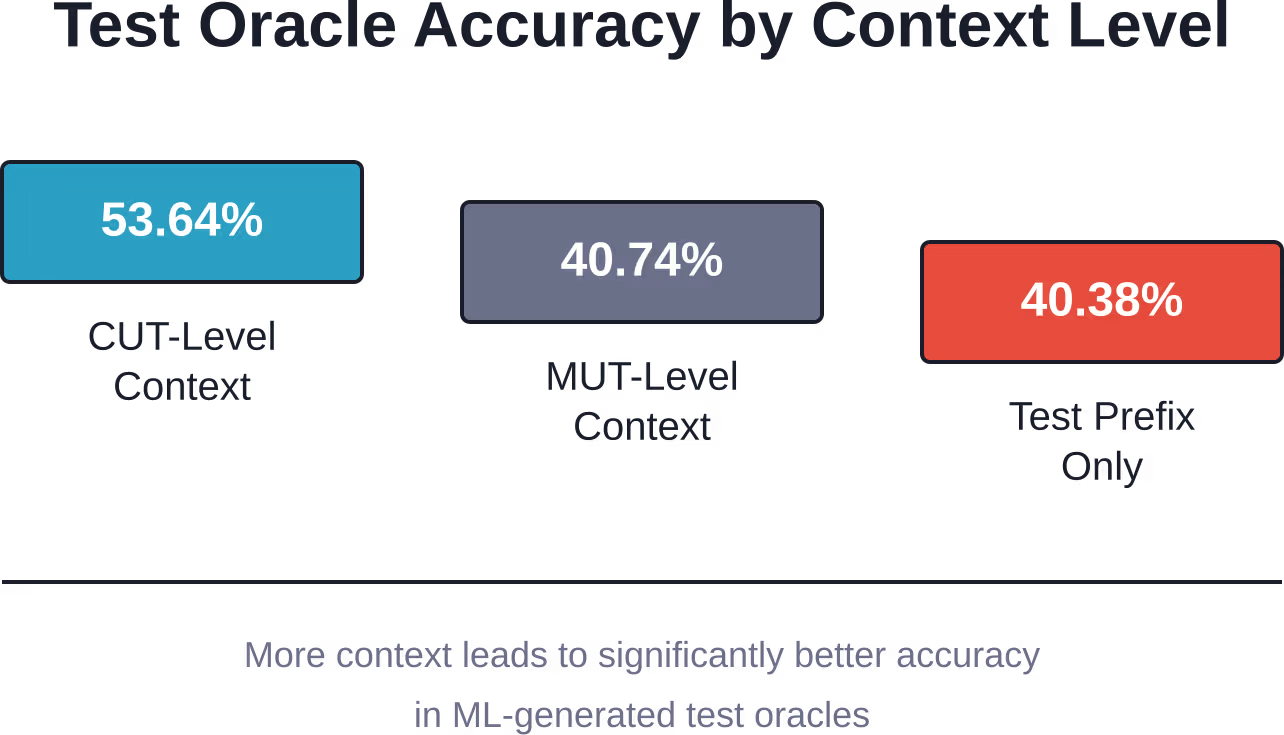
Intelligent Test Prioritization
Not all tests are equally valuable. Some catch bugs frequently; others haven’t failed in months. ML algorithms analyze test execution history, code coverage data, and recent changes to rank tests by their likelihood of detecting defects. Risk-based test prioritization uses ML to examine past defect patterns, code complexity metrics, and change histories. When developers commit code, the system predicts which tests are most likely to fail and runs those first. This approach dramatically reduces feedback time. Instead of waiting hours for an entire suite to complete, developers get critical results in minutes.
Defect Prediction
ML models trained on historical defect data can identify code areas prone to bugs before testing even begins. The algorithms consider factors like code complexity, developer experience, recent change frequency, and dependency relationships. These predictions guide testing efforts toward high-risk components. Teams allocate more thorough testing resources where they’ll have the greatest impact.
Test Maintenance and Flakiness Detection
Flaky tests—those that pass and fail inconsistently—plague automation efforts. They erode confidence and waste time investigating non-issues. ML algorithms identify flaky tests by analyzing execution patterns across multiple runs and environments. The models distinguish between legitimate failures indicating real bugs and spurious failures caused by timing issues, environmental factors, or poorly designed tests. This classification helps teams clean up their test suites systematically.
Machine Learning Algorithms Used in Testing
Different ML techniques suit different testing challenges. The most common algorithms in software testing include:
| Algorithm Type | Primary Use Case | Key Advantage |
|---|---|---|
| Neural Networks | Test case generation, defect prediction | Handles complex, non-linear patterns in code behavior |
| Decision Trees | Test prioritization, classification | Interpretable rules for decision-making |
| Random Forests | Defect prediction, risk assessment | Robust against overfitting with high accuracy |
| Support Vector Machines | Anomaly detection, classification | Effective with high-dimensional data |
| Clustering Algorithms | Test suite optimization, redundancy removal | Identifies similar tests without labeled data |
Large Language Models represent the latest development. Recent research evaluated 22,374 program variants from the Project CodeNet dataset, finding that LLM-generated tests maintained a 66.5% pass rate under Single Abstract Changes (code modifications that preserve functionality). However, more than 99% of failing SAC tests passed on the original program, indicating the tests aligned with original rather than modified behavior.
Real-World Implementation Challenges
Deploying ML in testing isn’t plug-and-play. Several obstacles require careful consideration.
Data Quality and Quantity
ML models need substantial training data. Small projects with limited test history don’t provide enough signal for effective learning. The data must also be clean—messy test results with inconsistent labeling confuse models and produce unreliable predictions.
Model Interpretability
When an ML model flags code as high-risk or deprioritizes certain tests, teams need to understand why. Black-box models that can’t explain their reasoning are difficult to trust in critical quality decisions. This is where simpler algorithms like decision trees offer advantages despite potentially lower accuracy. Their transparent logic builds confidence.
Integration Complexity
ML-powered testing tools must integrate with existing CI/CD pipelines, version control systems, and test frameworks. The integration overhead can be significant, particularly for organizations with legacy systems or complex toolchains.
Evolution and Maintenance
Software changes constantly. ML models trained on last year’s codebase may not generalize well to this year’s architecture. Continuous retraining and model updates require ongoing investment. Research shows that LLM test pass rates dropped under Semantics-Preserving Changes despite unchanged functionality—with test pass rates falling to 79% and branch coverage falling to 69%. This demonstrates how sensitive ML models are to code evolution. 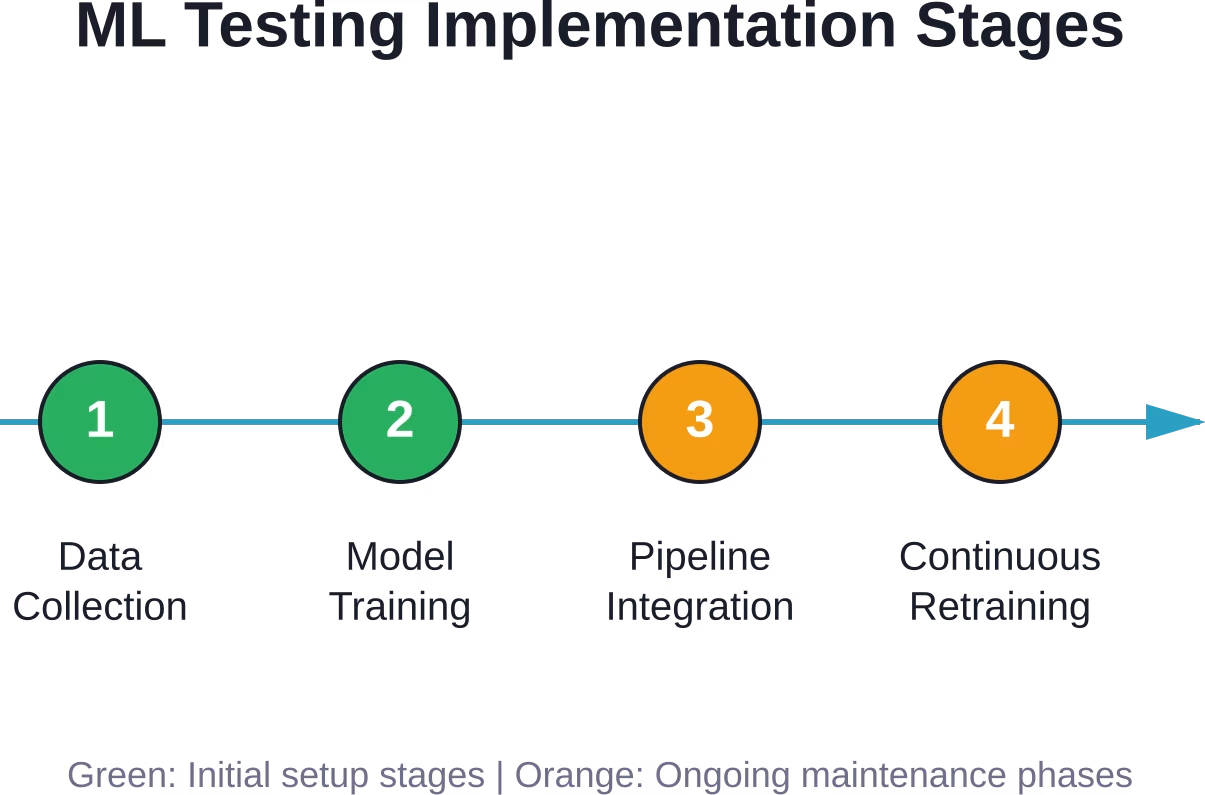
Best Practices for Adopting ML in Testing
Organizations implementing ML-powered testing should follow these guidelines:
- Start Small: Begin with one specific problem—test prioritization or flaky test detection—rather than attempting comprehensive transformation immediately. Prove value in a limited scope before expanding.
- Invest in Data Infrastructure: Clean, well-structured test execution data is essential. Implement proper logging, tagging, and storage before training models. Garbage in, garbage out applies completely to ML testing.
- Maintain Human Oversight: ML recommendations should augment, not replace, human judgment. Testers need the ability to override automated decisions and provide feedback that improves models.
- Monitor Model Performance: Track ML model accuracy, precision, and recall over time. Set up alerts for when performance degrades, indicating the need for retraining or adjustment.
- Document and Explain: Maintain clear documentation of which ML models run where, what data they use, and how they make decisions. This transparency builds trust and facilitates debugging when issues arise.
The Future of ML in Software Testing
The technology continues evolving rapidly. Several trends will shape the next phase: Large Language Models are already generating functional tests from natural language specifications. As these models improve, the gap between requirement and executable test will narrow further. Self-healing tests represent another frontier. When application changes break existing tests, ML systems will automatically update locators, assertions, and test logic to match the new implementation—reducing maintenance burden dramatically. The ISTQB released their Certified Tester AI Testing (CT-AI) Syllabus Version 2.0 in April 2026, reflecting how AI and ML testing have matured from experimental techniques into standardized professional practices. Cross-application learning will enable models trained on one codebase to transfer knowledge to another. Instead of starting from scratch, organizations will leverage pre-trained models that understand common software patterns and testing strategies.
Frequently Asked Questions
What’s the difference between AI and ML in software testing?
Machine learning is a subset of artificial intelligence. ML specifically refers to algorithms that learn patterns from data, while AI encompasses broader concepts including expert systems, natural language processing, and reasoning. In testing contexts, ML handles pattern-based tasks like prediction and classification, while AI might include rule-based systems and knowledge representation.
Do ML testing tools replace manual testers?
No. ML tools augment human testers by automating repetitive analysis and prediction tasks. Testers still design test strategies, interpret results, understand business requirements, and make judgment calls that algorithms can’t. The technology shifts focus from mechanical execution to strategic thinking.
How much historical data is needed to train ML testing models?
It varies by application. Test prioritization models might produce useful results with a few hundred test executions per test case. Defect prediction typically requires data from multiple release cycles. Generally speaking, more data improves model accuracy, but practical benefits often appear with months rather than years of history.
Can ML testing work for small development teams?
Small teams face challenges because they generate less training data and may lack ML expertise. However, cloud-based testing platforms with built-in ML capabilities make the technology accessible without requiring in-house data science teams. The key is choosing tools that work well with limited data or leverage transfer learning from other projects.
What testing types benefit most from machine learning?
Regression testing sees substantial benefits because ML excels at analyzing repetitive test execution patterns. Performance testing benefits from anomaly detection algorithms that identify unusual behavior. UI testing gains from visual comparison algorithms that detect rendering issues. Unit test generation shows promise with LLM-based approaches.
How do you measure ROI on ML testing investments?
Track metrics like test execution time reduction, defect detection rate improvements, test maintenance hours saved, and production escape rate changes. Compare these against implementation and operation costs. Typical benefits include 30-50% reduction in test execution time through intelligent selection and 20-40% decrease in maintenance effort through automated updates and flaky test identification.
What happens when ML models make wrong predictions?
Wrong predictions are inevitable—no ML model achieves perfect accuracy. The impact depends on the error type. False negatives (missing defects) are more serious than false positives (flagging non-issues). Proper implementation includes fallback mechanisms, confidence thresholds, and human review for critical decisions. Continuous monitoring catches degrading performance before it causes serious problems.
Conclusion
Machine learning fundamentally changes how software testing operates. By learning from execution history, code patterns, and defect data, ML algorithms make testing faster, smarter, and more thorough. The technology addresses real pain points: endless test maintenance, unpredictable execution times, flaky tests, and difficulty prioritizing limited testing resources. Organizations already see measurable improvements in defect detection, test efficiency, and overall software quality. Implementation requires investment—in data infrastructure, tool integration, and ongoing model maintenance. But the returns justify the effort for teams serious about quality and velocity. Start exploring ML-powered testing tools today. Identify your biggest testing challenge—whether that’s slow feedback cycles, maintenance overhead, or inadequate coverage—and find an ML solution that addresses it specifically. The future of software quality is intelligent, adaptive, and data-driven.