
Quick Summary: Machine learning is transforming transportation through intelligent systems that predict traffic patterns, optimize logistics routes, enhance vehicle safety, and improve overall efficiency. From autonomous vehicles to real-time congestion management, ML algorithms process vast amounts of data to make transportation smarter, safer, and more sustainable across public transit, freight, and urban mobility systems. Transportation networks worldwide face mounting pressure. Growing urban populations, increasing vehicle counts, and environmental concerns demand solutions that traditional engineering alone can’t deliver. That’s where machine learning enters the picture. Machine learning algorithms process massive transportation datasets—traffic sensors, GPS traces, weather patterns, accident records—to uncover patterns invisible to human analysts. These patterns translate directly into safer roads, shorter commutes, and more efficient freight delivery. The technology isn’t futuristic speculation anymore. Research institutions and transportation agencies worldwide are deploying ML-based systems that predict traffic congestion before it forms, route delivery vehicles around emerging delays, and identify accident-prone locations before crashes occur. This guide examines how machine learning actually works within transportation systems, which applications deliver measurable results, and what challenges engineers face when implementing these technologies.
Understanding Machine Learning in Transportation Context
Machine learning represents a subset of artificial intelligence focused on pattern recognition and prediction from data. Unlike traditional transportation models that rely on predetermined rules and equations, ML algorithms learn relationships directly from observed data. Here’s the thing though—transportation generates data at unprecedented scales. Every vehicle with GPS tracking, every traffic camera, every transit card swipe creates data points. A single urban traffic network might generate millions of observations daily. Traditional statistical methods struggle with this volume and complexity. Machine learning thrives on it.
Core ML Techniques Used in Transportation
Transportation applications typically employ several machine learning approaches, each suited to different problem types:
- Deep neural networks excel at processing sequential data like traffic flow patterns. Research from MIT’s Transit Lab demonstrates how deep neural networks can predict individual trip-making decisions and detect changes in travel behavior patterns more effectively than traditional discrete choice models.
- Ensemble methods combine multiple algorithms to improve prediction accuracy. Recent comparative studies show that while attention mechanisms and Transformer frameworks effectively capture long-range dependencies in traffic sequences, ensemble learning approaches become more valuable as forecasting horizons extend beyond immediate predictions.
- Recurrent neural networks handle time-series data particularly well. Traffic forecasting research indicates that naive RNN architectures can outperform more complex models when using time embedding for 30-day-ahead traffic predictions, highlighting how simpler approaches sometimes deliver better results for extended horizons.
- Autoencoders reduce data dimensionality while preserving essential information. Studies on traffic accident prediction demonstrate that deep autoencoder models can achieve promising accuracy when predicting accident severity levels, even when processing datasets with 49 features.
How Transportation Differs from Other ML Domains
Transportation presents unique challenges that distinguish it from other machine learning applications. Temporal dependencies matter enormously. Traffic conditions at 8:00 AM directly influence conditions at 8:15 AM. The weather from yesterday affects road conditions today. Algorithms must capture these time-based relationships. Spatial relationships add another layer. Congestion on Highway 101 affects parallel routes. An accident downtown impacts traffic patterns kilometers away. Effective models incorporate geographic connectivity. Safety criticality raises the stakes. Entertainment recommendation errors annoy users. Transportation prediction errors can endanger lives. This demands different validation standards and safety thresholds. Data quality varies widely across sources. Professional traffic sensors provide reliable measurements. Crowdsourced GPS data contains gaps and noise. Models must handle this heterogeneity gracefully. 
Build Transportation ML Workflows With AI Superior
Transportation systems often involve large-scale operational data, routing information, sensor inputs, and logistics workflows. AI Superior can help organizations apply machine learning to transportation analysis, optimization, and monitoring projects. AI Superior can help transportation projects through:
- Structuring logistics and operational datasets
- Developing predictive and optimization models
- Building proof of concept transportation workflows
- Detecting patterns in traffic and operational data
- Evaluating model performance in real-world conditions
- Supporting integration into transportation software systems
Reach out to AI Superior to discuss the workflow and technical requirements.
Traffic Prediction and Management Applications
Traffic prediction represents one of the most mature machine learning applications in transportation. The goal sounds straightforward—forecast how many vehicles will use specific road segments at future time intervals. But the execution involves considerable complexity.
Traffic Flow Prediction
Traffic flow prediction estimates vehicle counts passing through road segments within fixed future intervals, typically ranging from 10 minutes to several hours ahead. These predictions enable proactive traffic management rather than reactive responses to congestion already underway. Machine learning approaches significantly outperform traditional statistical methods for this task. Deep neural networks can identify non-linear patterns in flow data that linear regression models miss entirely. The prediction accuracy depends heavily on the forecast horizon. Short-term predictions (10-30 minutes ahead) generally achieve higher accuracy than long-term forecasts (several hours or days ahead). Research demonstrates that prediction strategies must shift as horizons extend—temporal dependency modeling works well for immediate forecasts, while periodicity patterns become more important for extended predictions.
Congestion Prediction and Prevention
Predicting where congestion will form before it materializes allows transportation agencies to implement preventive measures. Variable speed limits, ramp metering, and route guidance can divert traffic away from emerging bottlenecks. Machine learning models for congestion prediction typically classify road segments into congestion levels rather than predicting exact vehicle counts. This classification approach often proves more actionable for traffic management operators who need to make binary decisions about interventions. Real-world implementations combine prediction models with automated response systems. When models forecast high congestion probability, systems automatically adjust traffic signals, update digital highway signs, or send alerts to navigation apps.
Speed Prediction
Accurate speed prediction enables better travel time estimates for route planning. Navigation applications rely heavily on these predictions to recommend optimal routes and provide arrival time estimates. Speed prediction faces challenges that flow prediction doesn’t encounter. Speed can vary dramatically within a single road segment—the front of a traffic queue moves slowly while vehicles entering from behind travel at free-flow speeds. Spatial granularity becomes critical. Map-enhanced prediction approaches that incorporate road geometry, intersection characteristics, and historical speed patterns for specific segments demonstrate superior performance compared to models that treat all road segments as equivalent.
| Application Type | Prediction Target | Typical Horizon | Primary Use Case |
|---|---|---|---|
| Traffic Flow | Vehicle counts | 10 min - 2 hours | Traffic management planning |
| Congestion | Congestion level classification | 15 min - 1 hour | Preventive interventions |
| Speed | Average segment speed | 5 min - 30 min | Route optimization, ETAs |
| Travel Time | Origin to destination duration | Current - 1 hour | Navigation, trip planning |
Safety Enhancement Through Machine Learning
Transportation safety applications leverage machine learning to predict accidents, identify hazardous locations, and assess crash severity. These applications directly save lives when implemented effectively.
Accident Prediction and Prevention
Accident prediction models analyze historical crash data, road characteristics, weather conditions, and traffic patterns to identify high-risk scenarios. The goal isn’t predicting individual crashes—that remains impractical—but rather identifying conditions and locations where crash probability increases significantly. Research on traffic accident severity prediction reveals interesting patterns in crash data distribution. In one comprehensive dataset with 49 features, severity levels showed highly imbalanced distribution: 0.3% severity level one, 71.0% severity level two, 27.2% severity level three, and 1.4% severity level four incidents. This imbalance creates modeling challenges. Standard algorithms tend to over-predict common severity levels while missing rare but critical severe crashes. Techniques like synthetic minority oversampling and weighted loss functions help address this imbalance. Deep autoencoder approaches have demonstrated promising accuracy for severity prediction tasks when addressing imbalanced accident severity data.
Identifying Hazardous Locations
Rather than waiting for multiple crashes to designate a location as hazardous, machine learning models can identify risky road segments proactively based on geometric characteristics, sight distance limitations, traffic volume patterns, and historical near-miss events. These predictive hotspot models enable agencies to prioritize safety improvements where they’ll deliver maximum impact. Intersection redesigns, sight line clearing, and additional signage can prevent crashes rather than simply responding after they occur.
Real-Time Risk Assessment
Advanced systems assess crash risk in real-time based on current conditions. When heavy rain reduces visibility while traffic volume remains high on a curve with historical crash problems, risk scores increase. Agencies can respond with speed limit reductions, enhanced warning signs, or increased enforcement presence. Community discussions around transportation safety often emphasize the value of these proactive approaches compared to traditional reactive safety programs that only address locations after crash patterns emerge.
Autonomous Vehicles and Advanced Driver Assistance
Autonomous vehicles represent perhaps the most visible application of machine learning in transportation. These systems must perceive their environment, predict other road user behavior, and execute safe driving decisions—all tasks where machine learning plays central roles.
Perception and Environment Understanding
Autonomous vehicles rely on machine learning to interpret sensor data from cameras, lidar, radar, and ultrasonic sensors. Deep learning models identify pedestrians, vehicles, cyclists, traffic signs, lane markings, and obstacles from raw sensor inputs. This perception challenge differs fundamentally from traditional computer vision tasks. Autonomous vehicles must achieve near-perfect accuracy because perception failures directly cause safety incidents. A 95% accurate pedestrian detector—excellent by many ML standards—would miss one pedestrian in twenty, an unacceptable safety risk. The difficulty of testing life-critical software in autonomous systems significantly exceeds challenges in traditional software domains. Modified condition/decision coverage (MCDC) testing, the key method for testing life-critical software in aviation and some other fields, requires that every decision within code takes every possible outcome, each condition within each decision takes every possible outcome, and every condition independently affects decision outcomes. According to research on combinatorial methods for trust and assurance in autonomous systems, MCDC testing represents a critical but resource-intensive validation approach for life-critical software. For autonomous vehicles with millions of lines of code and countless edge cases, comprehensive testing presents extraordinary challenges. Testing approaches for autonomous systems can generate substantially more distinct critical test scenarios compared to baseline methods, helping identify edge cases that simpler testing strategies miss.
Behavior Prediction
Autonomous vehicles must predict how other road users will behave. Will that pedestrian step into the crosswalk? Will the vehicle in the adjacent lane merge? Machine learning models process observed behavior patterns to generate these predictions. The multi-agent nature of traffic creates complexity. Each vehicle’s behavior influences others, creating interdependencies that models must capture. Research on machine learning in multiagent systems addresses these challenges through approaches like inverse reinforcement learning and game-theoretic modeling.
Decision Making and Control
Once an autonomous vehicle perceives its environment and predicts other users’ behavior, it must decide how to act. Machine learning contributes to these decisions, though many systems combine learned models with rule-based safety constraints to ensure predictable behavior in critical situations. The path from research to deployment remains long. Testing requirements, regulatory frameworks, and liability questions continue evolving. But the underlying machine learning capabilities continue advancing steadily. 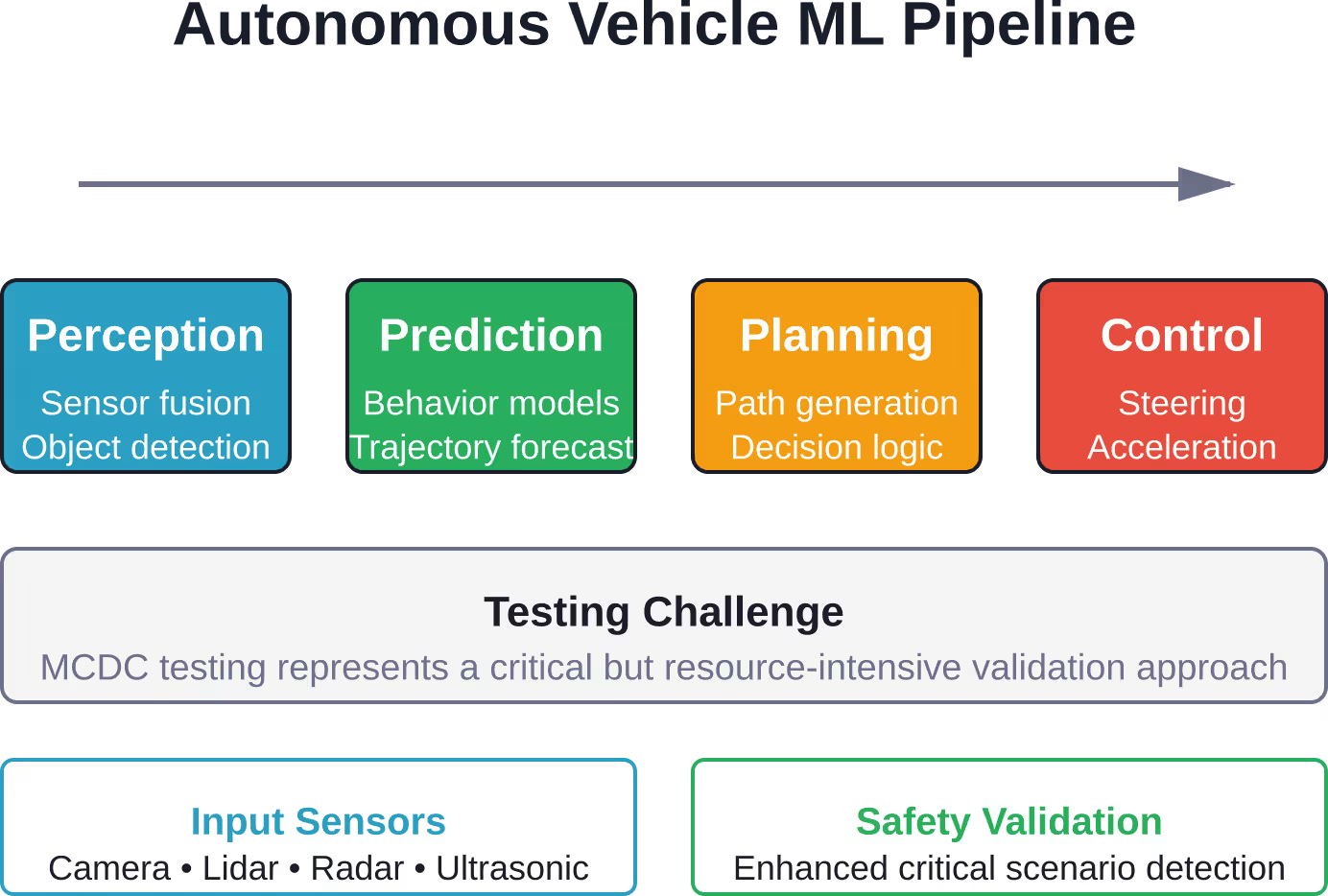
Logistics and Freight Optimization
Logistics operations generate enormous costs and environmental impacts. Machine learning optimization can reduce both significantly through better routing, demand forecasting, and resource allocation.
Route Optimization
Traditional route optimization uses algorithms like Dijkstra’s shortest path or vehicle routing problem solvers. These work well when travel times remain constant, but real-world transportation involves dynamic conditions. Machine learning enhances route optimization by predicting time-dependent travel times. A route optimal at 6:00 AM might perform poorly at 8:00 AM due to rush hour congestion. ML models trained on historical GPS traces can forecast these variations and recommend routes that minimize expected total travel time. Research on last-mile delivery operations demonstrates that machine learning approaches can significantly outperform traditional optimization-based methods and other machine learning architectures for delivery route planning.
Demand Forecasting
Logistics companies must position vehicles and drivers to meet anticipated demand. Too few resources means missed deliveries and dissatisfied customers. Too many resources means unnecessary costs. Machine learning models forecast demand patterns based on historical delivery data, seasonal trends, weather forecasts, local events, and economic indicators. These predictions enable better resource allocation decisions. Demand forecasting becomes particularly valuable for shared mobility services where demand fluctuates dramatically across time and location. Positioning vehicles in high-demand areas before requests arrive reduces wait times and improves service quality.
Inventory and Fleet Management
Machine learning assists with inventory positioning decisions—determining which distribution centers should stock which products in what quantities. Models forecast regional demand patterns and optimize inventory placement to minimize transportation costs while maintaining service levels. Fleet management applications predict maintenance needs before failures occur, schedule vehicle servicing to minimize operational disruption, and optimize fleet composition based on demand patterns.
Public Transit Applications
Public transit systems face unique challenges where machine learning delivers substantial value. Unlike private vehicles, transit operates on fixed schedules that must accommodate varying demand while maintaining efficiency.
Ridership Prediction
Accurate ridership forecasting enables transit agencies to adjust service levels appropriately. Running extra buses during predicted high-demand periods improves passenger experience while avoiding unnecessary service during low-demand periods controls costs. Machine learning models for transit ridership prediction incorporate factors like day of week, time of day, weather conditions, local events, school calendars, and historical ridership patterns. Deep learning approaches can capture complex interaction effects between these variables that simpler models miss.
Travel Time Estimation
Bus travel times vary significantly based on traffic conditions, passenger boarding volumes, and signal timing. Providing passengers with accurate arrival predictions improves user experience substantially compared to static schedule information. Map-enhanced route travel time prediction using deep neural networks has demonstrated strong performance for this application. These models incorporate road network topology, historical speed patterns, and current conditions to generate accurate predictions even for routes and times with limited historical data.
Activity Pattern Generation
Transportation demand modeling relies on understanding human activity patterns—when people travel, where they go, and which modes they choose. Traditional activity-based models use rule-based approaches to generate synthetic populations with realistic activity patterns. Novel approaches incorporating deep learning for transport demand models show promise for generating more realistic activity patterns. These models can learn complex patterns from observed travel survey data and generate synthetic populations that better match real-world behavior diversity.
Multimodal Transportation Integration
Modern transportation involves multiple modes—walking, cycling, buses, trains, ride-sharing, personal vehicles. Optimizing across these modes requires understanding how people choose between options and how to coordinate different systems.
Mode Choice Prediction
Understanding which transportation mode individuals will select for specific trips helps agencies plan infrastructure investments and service levels. Machine learning models can predict mode choice based on trip characteristics, available options, individual preferences, and contextual factors. Hybrid transport mode selection approaches combining machine learning with multi-criteria decision making (MCDM) methods show particular promise. These approaches leverage ML’s pattern recognition capabilities while incorporating the structured decision frameworks that MCDM provides.
Mobility-as-a-Service Integration
Mobility-as-a-Service (MaaS) platforms integrate multiple transportation modes into unified services. Users can plan, book, and pay for multimodal trips through single applications. Machine learning powers these platforms’ recommendation engines, predicting which mode combinations will best meet users’ needs based on preferences, context, and real-time conditions. The algorithms must balance multiple objectives—minimizing travel time, reducing costs, improving reliability, and reducing environmental impact.
Implementation Challenges and Considerations
Despite promising capabilities, implementing machine learning in transportation systems presents substantial challenges that organizations must navigate carefully.
Data Quality and Availability
Machine learning models require large quantities of high-quality training data. Transportation data often suffers from gaps, inconsistencies, and errors. Sensor malfunctions create missing values. GPS noise generates location inaccuracies. Manual data collection introduces human error. Organizations must invest in data cleaning, validation, and quality assurance processes before model development can even begin. This preparatory work often consumes more time and resources than the actual modeling. Data availability varies dramatically across locations. Major urban areas with extensive sensor networks provide rich datasets. Smaller cities and rural areas often lack the infrastructure to generate comparable data, limiting ML application feasibility.
Model Interpretability Requirements
Transportation decisions often require justification and transparency. An agency implementing a traffic signal timing change based on ML predictions must explain the reasoning to stakeholders and the public. Deep learning models that deliver strong predictive performance often function as black boxes, making interpretability challenging. This creates tension between model accuracy and explainability requirements. Approaches that enhance interpretability—feature importance analysis, attention visualization, surrogate model explanation—help bridge this gap but don’t fully resolve the fundamental trade-off between model complexity and transparency.
Computational Requirements
Training sophisticated machine learning models demands substantial computational resources. Large traffic networks with millions of data points require powerful hardware and extended training times. Real-time applications face particularly stringent computational constraints. A traffic prediction model that takes five minutes to generate a ten-minute forecast provides little value. Deployment requires careful optimization to ensure models run fast enough for operational use.
Integration with Existing Systems
Transportation agencies operate legacy systems built over decades. Integrating new machine learning capabilities with existing traffic management systems, transit operations platforms, and data infrastructure presents technical challenges. These integration projects require expertise spanning machine learning, transportation engineering, and systems integration—a combination rarely found in single individuals or even single organizations. 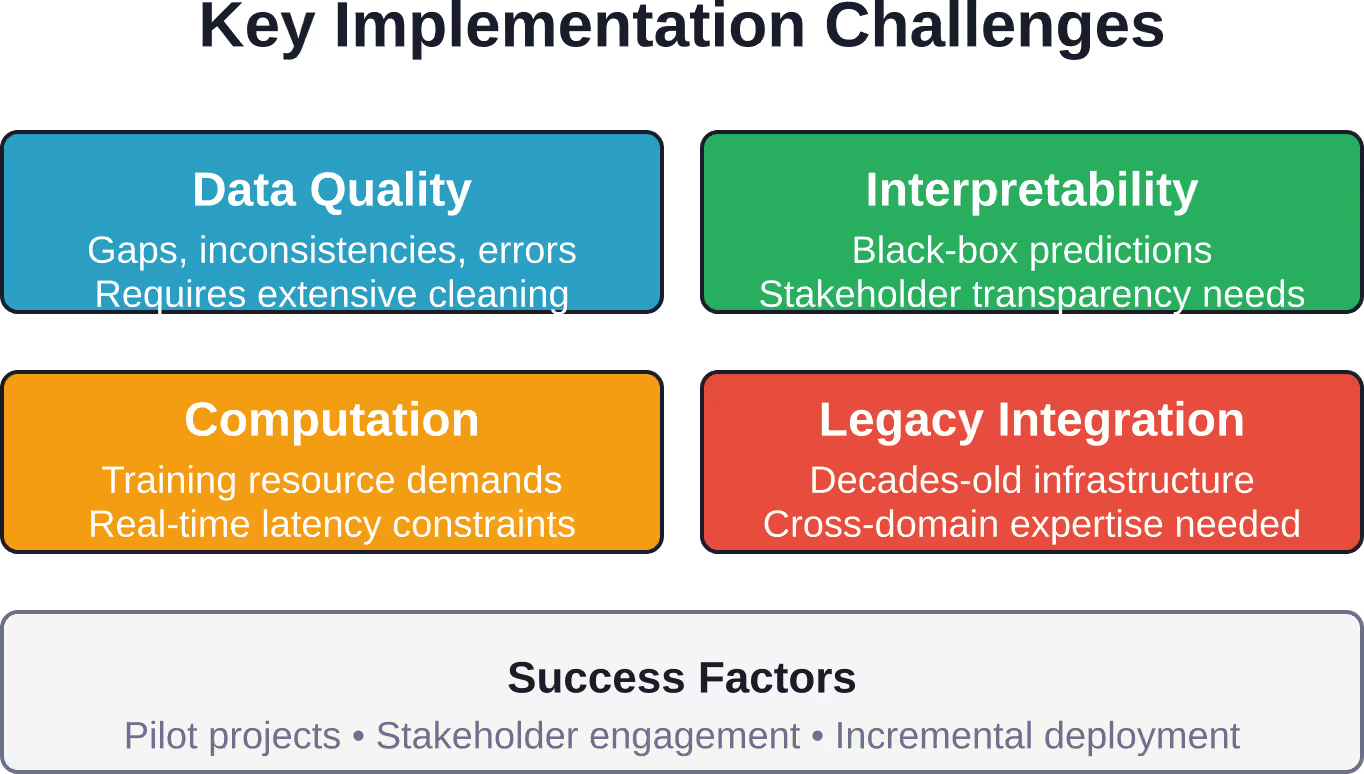
Emerging Trends and Future Directions
Machine learning in transportation continues evolving rapidly. Several emerging trends promise to reshape how these technologies get applied over coming years.
Edge Computing and Distributed Learning
Traditional ML approaches process data in centralized cloud servers. Edge computing pushes processing closer to data sources—traffic cameras with onboard processing, vehicles with local compute capabilities, intersection controllers with embedded ML models. This distributed approach reduces latency, improves privacy, and enables operation during connectivity disruptions. Federated learning techniques allow models to train across distributed devices without centralizing sensitive data.
Transfer Learning Across Cities
Training ML models from scratch requires extensive local data. Transfer learning enables models trained in one city to provide starting points for other locations, requiring less local data to achieve good performance. A traffic prediction model trained on New York data might transfer effectively to Philadelphia with relatively modest local fine-tuning. This capability could democratize ML access for smaller cities that can’t generate training datasets comparable to major metropolitan areas.
Reinforcement Learning for Control
Most current transportation ML applications focus on prediction. Reinforcement learning enables systems to learn optimal control policies through trial and error—how to time traffic signals, when to dispatch transit vehicles, and how to price ride-sharing to balance supply and demand. Simulation environments allow reinforcement learning agents to train on millions of virtual scenarios before deployment in real systems, addressing safety concerns that make pure trial-and-error learning impractical in live transportation networks.
Multi-Agent Coordination
Transportation inherently involves multiple interacting agents—vehicles, pedestrians, transit systems, logistics fleets. Multi-agent reinforcement learning and game-theoretic approaches can optimize system-level outcomes rather than just individual agent objectives. These approaches remain largely in research phases but show promise for addressing coordination challenges that single-agent optimization can’t solve effectively.
Best Practices for Organizations
Organizations implementing machine learning in transportation should follow practices that increase success probability while managing risks.
Start with Well-Defined Problems
Machine learning works best when applied to specific, well-defined problems with clear success metrics. “Improve traffic flow” is too vague. “Reduce average travel time on Route 50 during evening peak by 10%” provides clear direction and measurable outcomes. Organizations should identify high-value problems where data availability, stakeholder support, and technical feasibility align. These become ideal starting points for initial ML projects.
Build Data Infrastructure First
Attempting machine learning without solid data infrastructure leads to frustration. Organizations should invest in data collection, storage, cleaning, and management capabilities before diving into model development. This infrastructure pays dividends beyond ML applications—better data improves traditional analysis, reporting, and decision-making across organizations.
Pursue Pilot Projects
Large-scale systemwide ML deployments carry substantial risk. Pilot projects on limited scopes allow organizations to learn, validate capabilities, and demonstrate value before major commitments. Successful pilots build organizational confidence and stakeholder support for broader implementation. Failed pilots provide learning opportunities at limited cost.
Invest in Talent and Training
Machine learning requires expertise that traditional transportation agencies often lack internally. Organizations must either hire data scientists with transportation domain knowledge or train transportation professionals in ML techniques—ideally both. Partnerships with universities, consulting firms, and technology companies can supplement internal capabilities, but successful long-term ML programs require internal expertise to maintain and evolve systems.
Maintain Human Oversight
Machine learning should augment human decision-making, not replace it entirely—especially in safety-critical applications. Systems should present ML predictions and recommendations to human operators who retain final decision authority. This human-in-the-loop approach maintains accountability while leveraging ML’s pattern recognition capabilities to enhance decision quality.
Frequently Asked Questions
How accurate are machine learning traffic predictions?
Accuracy varies substantially based on prediction horizon, data quality, and model sophistication. Short-term predictions (10-30 minutes ahead) can achieve 85-95% accuracy in well-instrumented urban networks. Accuracy decreases for longer horizons—extended forecasts several days ahead typically show lower accuracy. Research demonstrates that naive RNN models can outperform more complex architectures for extended horizons like 30-day-ahead forecasts, showing that model selection matters significantly. Real-world accuracy also depends heavily on local data quality and how well training data represents current conditions.
What data do transportation machine learning systems require?
Requirements vary by application, but common data sources include traffic sensor measurements (loop detectors, cameras, radar), GPS traces from probe vehicles, transit smart card transactions, weather observations, road network topology, traffic signal timing, accident reports, and special event calendars. High-quality training typically requires months to years of historical data covering diverse conditions. Some applications can work with weeks of data when using transfer learning from models trained elsewhere. Data cleaning and validation often consume more effort than the actual modeling work.
Can small cities implement machine learning transportation systems?
Smaller cities face challenges compared to major metropolitan areas—less available data, smaller budgets, and limited technical staff. However, cloud-based platforms, transfer learning techniques, and vendor-provided solutions increasingly make ML accessible to organizations of varying sizes. Starting with focused applications that leverage readily available data works better than attempting comprehensive system implementations. Partnerships with universities or regional transportation agencies can provide expertise and resources that individual small cities can’t maintain independently. The key is selecting appropriate scope and not attempting to replicate what only large cities with extensive resources can achieve.
How do autonomous vehicles handle situations not in their training data?
This represents one of autonomous vehicle development’s most challenging problems. Approaches include extensive simulation to generate rare scenarios artificially, careful system design that degrades gracefully when encountering unfamiliar situations, conservative decision-making that prioritizes safety when uncertainty is high, and continuous learning systems that improve based on fleet-wide experiences. However, the fundamental challenge remains—testing approaches can generate substantially more distinct critical scenarios than baseline methods, but truly comprehensive coverage of all possible situations remains impractical. This is why human oversight and conservative safety margins remain essential as the technology continues developing.
What’s the difference between machine learning and traditional transportation models?
Traditional transportation models use predetermined mathematical relationships derived from transportation theory—traffic flow follows specific equations, travelers choose routes based on defined utility functions. These models require transportation engineers to specify all relationships explicitly. Machine learning models instead learn patterns directly from observed data without requiring engineers to specify exact mathematical forms. ML can capture complex non-linear relationships that traditional models miss, but often function as black boxes with limited interpretability. In practice, hybrid approaches combining traditional modeling structure with machine learning flexibility often deliver the best balance of accuracy, interpretability, and reliability.
How much does implementing ML transportation systems cost?
Costs vary enormously based on scope, existing infrastructure, and implementation approach. Organizations might spend anywhere from tens of thousands of dollars for focused pilot projects using cloud platforms and vendor solutions, to millions for comprehensive systems requiring custom development and extensive sensor deployment. Data infrastructure typically represents a major cost component—installing and maintaining sensors, building data pipelines, and establishing storage systems. Ongoing costs for cloud computing, model maintenance, and staff expertise continue indefinitely. Many organizations start with small pilot projects to demonstrate value before committing to larger investments. Vendor-provided software-as-a-service options can reduce upfront costs while increasing ongoing subscription expenses.
How do privacy concerns affect transportation machine learning?
Transportation data often contains sensitive information about individual movements and behaviors. GPS traces can reveal home and work locations, daily routines, and visited destinations. Privacy regulations like GDPR in Europe and various state laws in the US impose requirements for data collection, storage, and use. Best practices include data anonymization, aggregation to remove individual identifiability, secure storage with access controls, clear policies about data usage and retention, and transparency with the public about what data gets collected and how it’s used. Edge computing and federated learning approaches that process data locally rather than centralizing it can reduce privacy risks while still enabling ML applications. Organizations must balance ML capabilities with legitimate privacy protections.
Conclusion
Machine learning has moved from experimental research to operational reality in transportation systems worldwide. Traffic prediction models guide daily commutes. Autonomous vehicles navigate city streets. Logistics algorithms optimize delivery routes. Transit systems forecast ridership and estimate arrival times. The technology isn’t perfect. Implementation challenges around data quality, computational requirements, and legacy system integration require careful navigation. Testing life-critical autonomous systems demands resources that represent significant development budgets. Model interpretability remains a persistent challenge when stakeholders require transparency. But the trajectory is clear. As data infrastructure expands, algorithms improve, and organizational expertise grows, machine learning applications in transportation will become increasingly sophisticated and widespread. The most successful implementations start focused—identifying specific problems where ML can deliver measurable value, building necessary data infrastructure, executing pilot projects, and expanding gradually based on demonstrated results. Organizations that invest now in developing ML capabilities position themselves to benefit from these technologies as they mature. Those that wait risk falling behind competitors and peer agencies already leveraging these tools. The question isn’t whether machine learning will transform transportation—it already has. The question is how quickly organizations will adapt to harness these capabilities effectively. Ready to explore how machine learning could improve your transportation operations? Start by identifying high-value problems, assessing your data readiness, and connecting with experts who can help translate ML capabilities into operational improvements.