
Quick Summary: A Master’s in Predictive Analytics equips professionals with advanced skills in statistical modeling, machine learning, and data-driven decision-making. According to the National Science Foundation, master’s enrollment in science, engineering, and health fields increased 22.1% between 2020 and 2024, reflecting strong demand. Graduates enter roles like data scientist (median salary $112,590 in 2024 per BLS) and management analyst, with the data scientist field projected to grow 34% through 2034. The explosion of big data has created unprecedented demand for professionals who can transform raw information into strategic insights. Organizations across every sector—from healthcare to finance, insurance to tech—need experts who can build predictive models, forecast trends, and drive data-informed decisions. A Master’s in Predictive Analytics addresses exactly that need. It’s an interdisciplinary program that blends statistics, computer science, machine learning, and business strategy. But does it actually deliver career results? And what separates these programs from adjacent degrees in data science or business analytics? Let’s break down what these programs offer, who they’re built for, and what career trajectories actually look like.
What Is a Master’s in Predictive Analytics?
Predictive analytics uses historical data, statistical algorithms, and machine learning techniques to forecast future outcomes. The discipline goes beyond describing what happened—it answers “what’s likely to happen next?” A master’s program in this field typically covers:
- Statistical modeling and regression analysis
- Machine learning algorithms (supervised and unsupervised)
- Data mining and pattern recognition
- Data visualization and communication
- Risk management and decision theory
- Programming languages like Python, R, and SQL
Programs generally require 30-36 credit hours and can be completed in 12-24 months full-time, or up to 3 years part-time. Many institutions offer hybrid or fully online formats designed for working professionals.
How It Differs from Data Science and Business Analytics
Here’s the thing though—these degree titles overlap considerably. Many programs use the terms interchangeably, and hiring managers often don’t distinguish sharply between them. That said, some general patterns exist:
| Degree Focus | Primary Emphasis | Typical Curriculum Weight |
|---|---|---|
| Predictive Analytics | Forecasting, modeling, risk assessment | Heavy statistics, moderate programming |
| Data Science | Broad data lifecycle, engineering, ML | Heavy programming, moderate statistics |
| Business Analytics | Business strategy, operational decisions | Business context, moderate technical depth |
In practice, curriculum matters more than the degree name. Look at required courses, capstone projects, and faculty research areas to gauge what skills the program actually develops. 
Build Practical Predictive Analytics Skills with AI Superior
AI Superior provides training and consulting focused on real-world AI and predictive analytics use cases. The approach is based on working with actual data and systems, helping teams understand how models are built and applied in practice.
Looking to Develop Predictive Analytics Skills?
AI Superior can help with:
- training teams on AI and predictive analytics
- working with real datasets and use cases
- explaining modeling and implementation steps
- supporting practical skill development
👉 Contact AI Superior to discuss training and implementation needs
Enrollment Trends and Program Growth
Graduate education in data-focused fields has seen remarkable expansion. According to the National Center for Science and Engineering Statistics, master’s enrollment in science, engineering, and health fields increased 22.1% between 2020 and 2024. Between 2023 and 2024 specifically, master’s enrollment in science grew 1.2%, though engineering saw a slight decline of 0.9%. From 2021 to 2023, enrollment of temporary visa holders consistently increased in science, engineering, and health master’s degree programs, but from 2023 to 2024, enrollment slowed or declined for this group. This growth reflects employer demand. The Bureau of Labor Statistics reports that data scientist employment stood at 245,900 in 2024, with projected growth of 34% through 2034—far exceeding the average for all occupations.
Career Outcomes and Salary Expectations
So what do graduates actually do? Career paths span multiple industries and job titles.
Common Job Titles
- Data Scientist
- Predictive Analyst
- Machine Learning Engineer
- Business Intelligence Analyst
- Risk Analyst
- Quantitative Analyst
- Analytics Manager
The Bureau of Labor Statistics reports that data scientists earned a median annual wage of $112,590 in May 2024. Computer systems design and related services employed 11% of data scientists, while insurance carriers and related activities accounted for 10% of the workforce. Management analysts—another common destination for predictive analytics graduates—held about 1.1 million jobs in 2024 with a median salary of $101,190. Computer systems analysts earned $103,790 median annual wage in May 2024. Real talk: entry-level positions often start $10,000-$20,000 below these medians, particularly for recent graduates without prior industry experience. But mid-career professionals with 5-7 years of experience frequently exceed median figures, especially in tech hubs and financial centers.
Industries Hiring Predictive Analytics Graduates
Demand spans sectors:
- Financial services (fraud detection, credit risk, algorithmic trading)
- Healthcare (patient outcomes, resource optimization, epidemic modeling)
- Insurance (underwriting, claims prediction, actuarial modeling)
- Retail and e-commerce (demand forecasting, personalization, inventory optimization)
- Technology (product recommendations, user behavior, growth analytics)
- Manufacturing (predictive maintenance, supply chain optimization)
Program Formats and Admission Requirements
Most programs offer flexible formats to accommodate working professionals. Options include on-campus full-time (1-1.5 years), part-time evening/weekend (2-3 years), and fully online synchronous or asynchronous formats.
Typical Admission Requirements
| Requirement | Details |
|---|---|
| Undergraduate GPA | Typically 3.0 minimum, competitive programs 3.5+ |
| Prerequisite Coursework | Calculus, linear algebra, statistics; programming helpful |
| Standardized Tests | GRE often optional or waived for experienced professionals |
| Work Experience | Not required but strengthens application; 2-5 years common |
| Letters of Recommendation | 2-3 academic or professional references |
| Statement of Purpose | Articulating career goals and program fit |
Many programs accept students from diverse undergraduate backgrounds—economics, engineering, business, mathematics, computer science, even physics or social sciences. What matters most is quantitative aptitude and genuine interest in working with data.
Cost and Return on Investment
Program costs vary widely. Public in-state programs might run $20,000-$40,000 total, while private institutions and out-of-state tuition can reach $60,000-$100,000+. But wait. Does that investment pay off? For career switchers and early-career professionals, the answer is generally yes—especially when comparing entry-level salaries in unrelated fields ($45,000-$60,000) to data scientist roles (typically $75,000-$95,000 range based on recent market data). The salary differential can recoup tuition in 2-3 years. For mid-career professionals already earning $80,000+, the calculus depends on whether the degree unlocks senior roles (analytics manager, director of data science) that wouldn’t be accessible otherwise.
Skills Employers Actually Want
Degree programs teach technical foundations, but hiring managers look for specific applied competencies.
Technical Skills
- Statistical modeling (regression, time series, Bayesian methods)
- Machine learning (random forests, gradient boosting, neural networks)
- Programming (Python and R for analytics; SQL for databases)
- Data visualization (Tableau, Power BI, or Python libraries like matplotlib)
- Big data tools (Hadoop, Spark) for large-scale processing
Non-Technical Skills
Here’s where many technically proficient graduates struggle. Employers consistently cite these gaps:
- Business acumen—understanding how analytics drive revenue, reduce costs, or mitigate risk
- Communication—explaining complex models to non-technical stakeholders
- Problem framing—identifying which business questions analytics can answer
- Ethical judgment—recognizing bias, privacy concerns, and fairness issues
The best programs integrate these through capstone projects with real organizational partners, case studies, and cross-functional team assignments.
Choosing the Right Program
Not all Master’s in Predictive Analytics programs are created equal. Consider these factors:
Curriculum Depth
Look for programs requiring at least 3-4 courses each in statistics and machine learning, plus hands-on programming. Elective offerings signal breadth—can students specialize in healthcare analytics, financial modeling, or marketing analytics?
Faculty Expertise
Are faculty actively publishing research? Do they consult with industry? Faculty credentials matter less than whether they’re engaged with current methodologies and real-world applications.
Industry Connections
Programs with corporate partnerships, practicum requirements, or active alumni networks provide recruitment pipelines. Ask about career services, employer site visits, and job placement rates.
Capstone or Thesis Options
Applied capstone projects (solving a real organizational problem) generally deliver more immediate career value than theoretical thesis work—unless doctoral study is the goal. 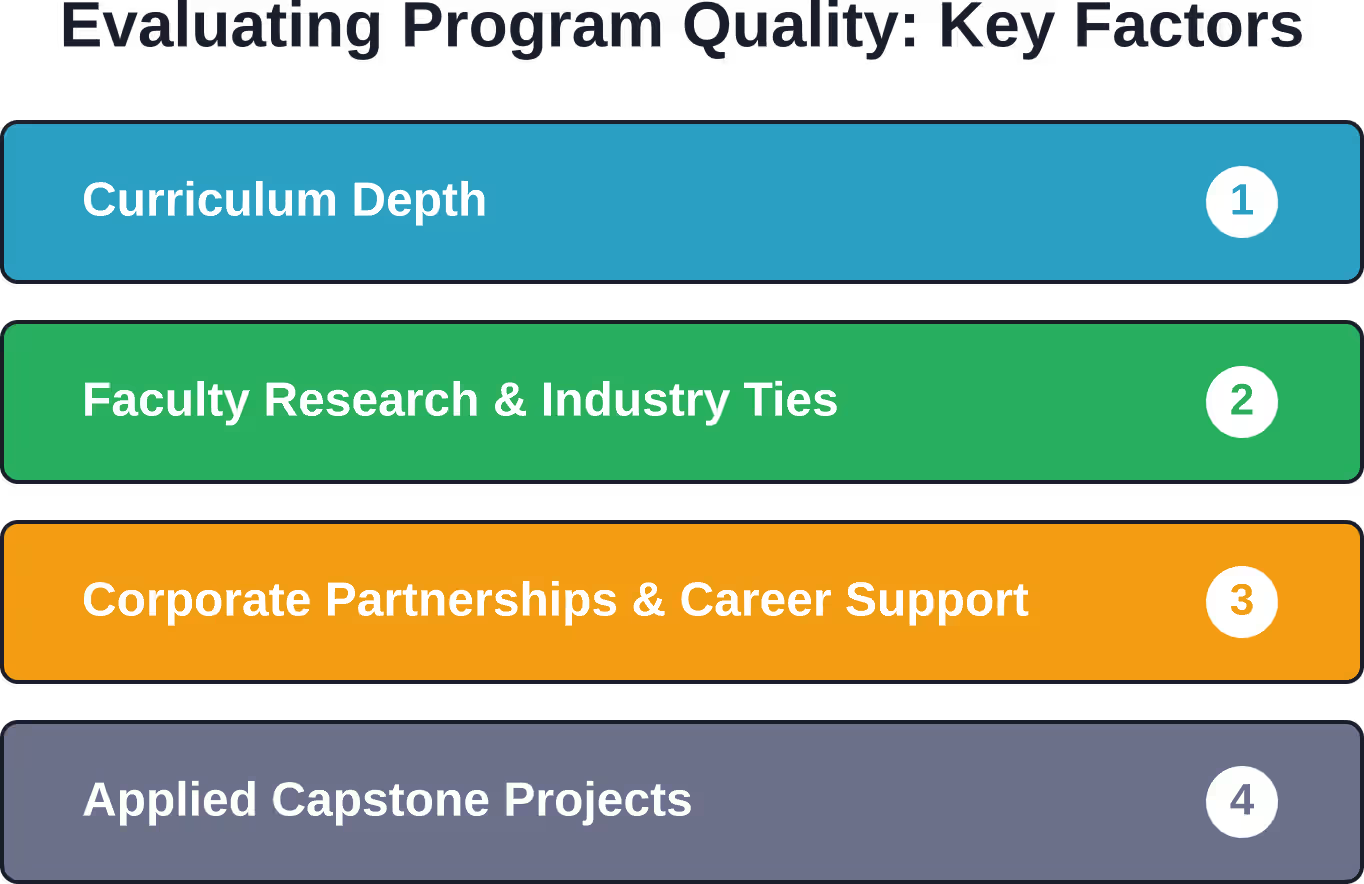
Is a Master’s in Predictive Analytics Right for You?
This degree makes sense for:
- Professionals with 0-5 years of experience seeking structured skill development
- Career changers from quantitative fields (finance, engineering, sciences) moving into analytics
- Analysts or business intelligence professionals wanting to advance into modeling roles
- Technical professionals (developers, DBAs) seeking formal statistical training
It might not be the best fit for:
- Senior professionals with 10+ years in analytics—specialized certificates or executive programs may suffice
- Those primarily interested in data engineering or software development (consider CS degrees instead)
- Individuals seeking research careers (PhD programs offer better preparation)
The short answer? If current work involves Excel analysis and the goal is building production machine learning models, a master’s delivers that transition. If already building models and the goal is managing teams, industry experience and leadership training matter more.
Frequently Asked Questions
How long does a Master’s in Predictive Analytics take?
Full-time programs typically require 12-18 months (3-4 semesters), while part-time formats extend to 24-36 months. Accelerated options exist at some institutions, compressing coursework into 10-12 months, though these demand significant time commitment.
Can I get a Master’s in Predictive Analytics online?
Yes, many accredited programs offer fully online or hybrid formats. Online programs provide identical curricula and degrees as on-campus versions. Look for synchronous (scheduled class times) versus asynchronous (self-paced) formats depending on work schedule flexibility.
What’s the difference between predictive analytics and data science master’s programs?
The distinction is often minimal. Predictive analytics programs emphasize statistical modeling and forecasting, while data science programs may include more software engineering, data infrastructure, and broader ML applications. Check specific curricula—course requirements matter more than degree titles.
Do I need programming experience before applying?
Most programs don’t require prior programming but expect students to learn quickly. Familiarity with Python, R, or SQL strengthens applications. Many programs offer bridge courses or pre-program boot camps for students without coding backgrounds.
What undergraduate majors prepare someone for this degree?
Common backgrounds include mathematics, statistics, computer science, economics, engineering, business, and physical sciences. Programs typically require calculus, linear algebra, and introductory statistics as prerequisites. Some accept students from non-quantitative fields who complete prerequisite courses.
How much can I earn after graduating?
According to the Bureau of Labor Statistics, data scientists earned a median of $112,590 in May 2024. Entry-level roles typically start $75,000-$90,000, while senior positions reach $130,000-$180,000+. Geography, industry, and prior experience significantly impact compensation.
Is a master’s degree required to become a data scientist?
Not universally, but increasingly common. Many employers prefer master’s-level candidates, especially for roles involving complex modeling. Entry-level positions sometimes accept bachelor’s degrees with strong portfolios, but advancement often requires graduate education or equivalent experience.
Final Thoughts
A Master’s in Predictive Analytics opens doors to one of the fastest-growing, highest-paying career fields. With data scientist employment projected to grow 34% through 2034 and median salaries exceeding $112,000, the market fundamentals remain strong. But success requires more than the degree itself. The most valuable programs combine rigorous technical training with business context, communication skill development, and real-world application through capstones or internships. For professionals ready to commit 1-2 years and $30,000-$80,000 to structured learning, the investment generally pays dividends—particularly when transitioning from lower-paying fields or advancing from descriptive analytics into predictive modeling roles. Sound like the right move? Research programs carefully, talk to alumni about actual outcomes, and ensure the curriculum matches career goals. The field needs skilled practitioners who can not just build models, but translate data insights into strategic action.