
The AI coding space is getting crowded, and two names keep popping up in every developer forum: OpenClaw and Claude Code. But here’s the thing—they’re not really competitors. They’re completely different tools that people keep comparing because they both involve AI writing code.
I’ve spent weeks testing both, and the confusion is understandable. One’s an official Anthropic product with enterprise backing. The other’s an open-source project that’s equal parts exciting and terrifying.
Let’s break down what each actually does, where they excel, and which one you should be using (if any).
What Is Claude Code?
According to Anthropic’s official documentation, Claude Code is an agentic coding tool that reads your codebase, edits files, runs commands, and integrates with your development tools. It’s available in your terminal, IDE, desktop app, and browser.
Think of it as a highly capable coding assistant that waits for your instructions. You give it a task—”refactor this component to use TypeScript” or “add error handling to these API calls”—and it executes. Then it stops and waits for your next instruction.
The key word here? Instruction. Claude Code is reactive by design.
Claude Code’s Approach to Memory.
Claude Code uses conversation memory that operates within your current session. As community discussions note, this memory operates on a session basis, which means each new coding session starts relatively fresh.
For most developers, that’s actually a feature, not a bug. You don’t want your AI assistant carrying context from last week’s experiment into today’s production work.
What Is OpenClaw?
OpenClaw is harder to define because it’s fundamentally different. It’s a personal assistant agent that runs continuously, making autonomous decisions based on heartbeats or scheduled tasks.
According to community documentation and GitHub repositories, OpenClaw has evolved into a skills-based system where users can extend its capabilities.
But wait—there’s a catch. Actually, several catches.
The OpenClaw Security Problem
Real talk: OpenClaw requires admin-level system access to function as intended. Community discussions reveal significant concerns about “giving an LLM admin rights,” with multiple users calling it problematic from a security perspective.
One developer stated concerns about security implications, while another warned that OpenClaw lacks the corporate safety guardrails present in Claude Code. These aren’t theoretical risks—they’re practical concerns from people who understand what unrestricted AI access means.
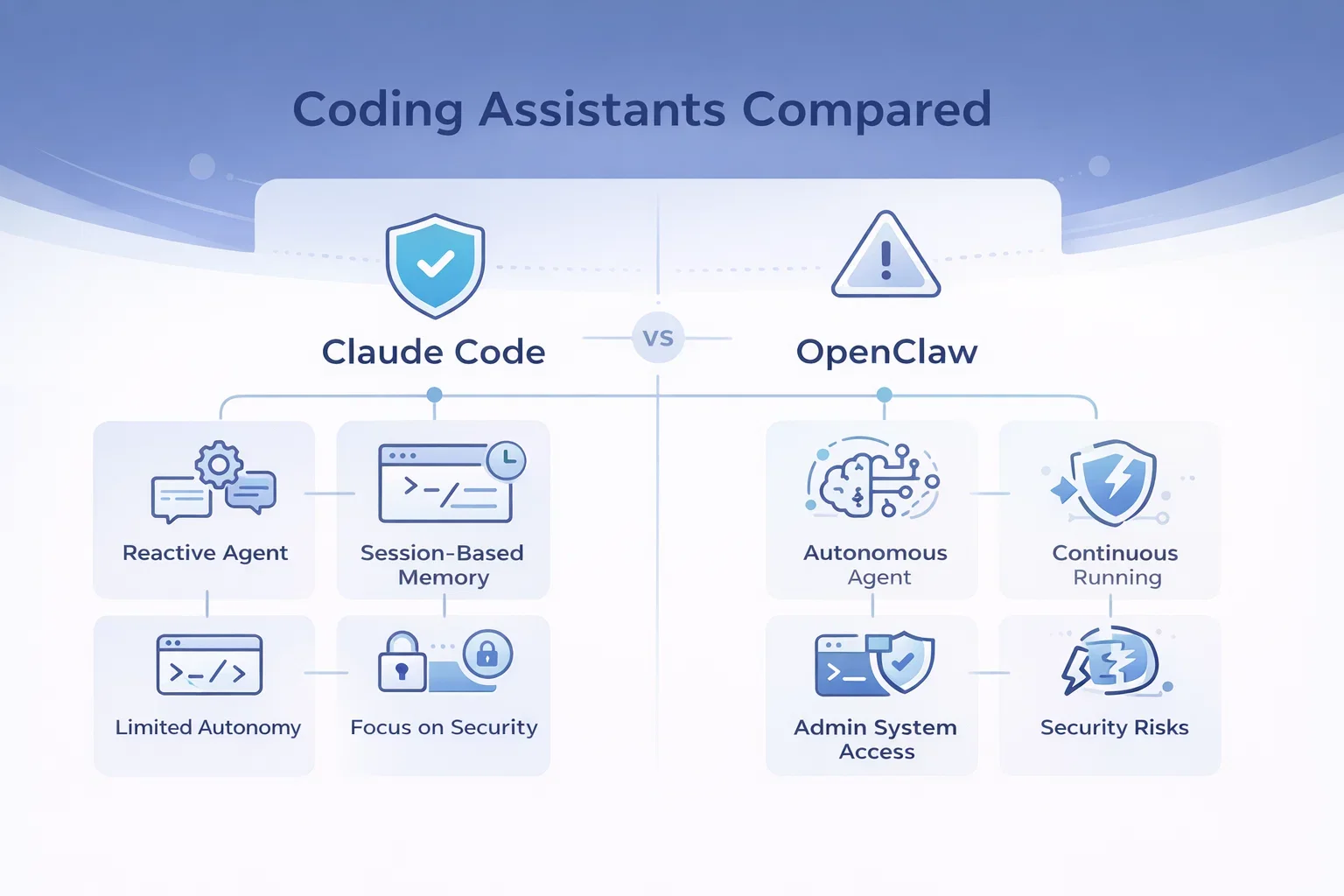
Key architectural differences between Claude Code and OpenClaw affecting security and control.
The Token Usage Disaster
Community discussions reveal concerns about OpenClaw’s token usage patterns. Developers noted significant disparities in token consumption between OpenClaw users and Claude Code users.
The reason appears to be OpenClaw’s autonomous nature—it runs continuously, checking and executing tasks even when not actively being used. Community members noted that the creator reportedly did not prioritize token efficiency in the design.
Multiple users reported concerns about account restrictions related to usage patterns. The consensus from community discussions is that OpenClaw’s token consumption presents a significant cost concern compared to Claude Code’s task-based approach.
Memory Architecture: The Real Difference
Community discussions comparing memory approaches revealed important architectural differences: OpenClaw uses hierarchical memory with persistent storage across sessions, while Claude Code uses conversation memory that resets between sessions.
This hierarchical memory is one of OpenClaw’s interesting technical features. It attempts to maintain context across long-running tasks and multiple sessions.
But does that matter for most developers? Not really. Most coding tasks don’t benefit from persistent memory across days or weeks. You want fresh context for fresh work.
What About Local LLMs for OpenClaw?
Some developers tried running OpenClaw with local models through Ollama to avoid token costs. Community discussions reported mixed results.
Users noted that local models created quality degradation compared to Claude’s commercial models. The consensus in community discussions was that local models introduce reliability concerns that make OpenClaw significantly less effective.
| Feature | Claude Code | OpenClaw
|
|---|---|---|
| Execution Model | Reactive (waits for instructions) | Autonomous (runs continuously) |
| System Access | Limited, controlled permissions | Admin-level access required |
| Memory Approach | Session-based, resets between uses | Hierarchical, persistent across sessions |
| Token Usage | Task-based, efficient | Continuous, often excessive |
| Security Guardrails | Built-in protections | Minimal restrictions |
| Official Support | Full Anthropic documentation | Community-driven, experimental |
| Best For | Professional development work | Personal experimentation (with caution) |
Which Should You Actually Use?
Look, this isn’t a fair fight. Claude Code is a production-ready tool backed by Anthropic’s resources and documentation. OpenClaw is an experimental project that the community itself views with caution.
Community consensus emphasizes the different design philosophies: Claude Code requires instruction-based task execution, while OpenClaw’s autonomous design enables different capabilities with corresponding trade-offs in security and cost.
That autonomous capability sounds appealing until you realize it means giving an AI unrestricted access to your system. And as multiple community members note, this raises security implications.
For Professional Development: Claude Code
If you’re building software professionally, Claude Code is the recommended choice. It integrates with existing tools, respects security boundaries, and offers predictable token costs compared to OpenClaw’s continuous operation model.
According to Anthropic’s best practices documentation, you can configure Claude Code to work efficiently across sessions while maintaining appropriate security controls.
For Experimentation: Maybe Neither
If you want to experiment with autonomous agents, consider whether you actually need that capability. Community discussions suggest most use cases people imagine for OpenClaw can be handled effectively by Claude Code with appropriate prompting.
Developers have questioned whether the autonomous capabilities of OpenClaw actually provide tangible benefits for typical coding workflows.
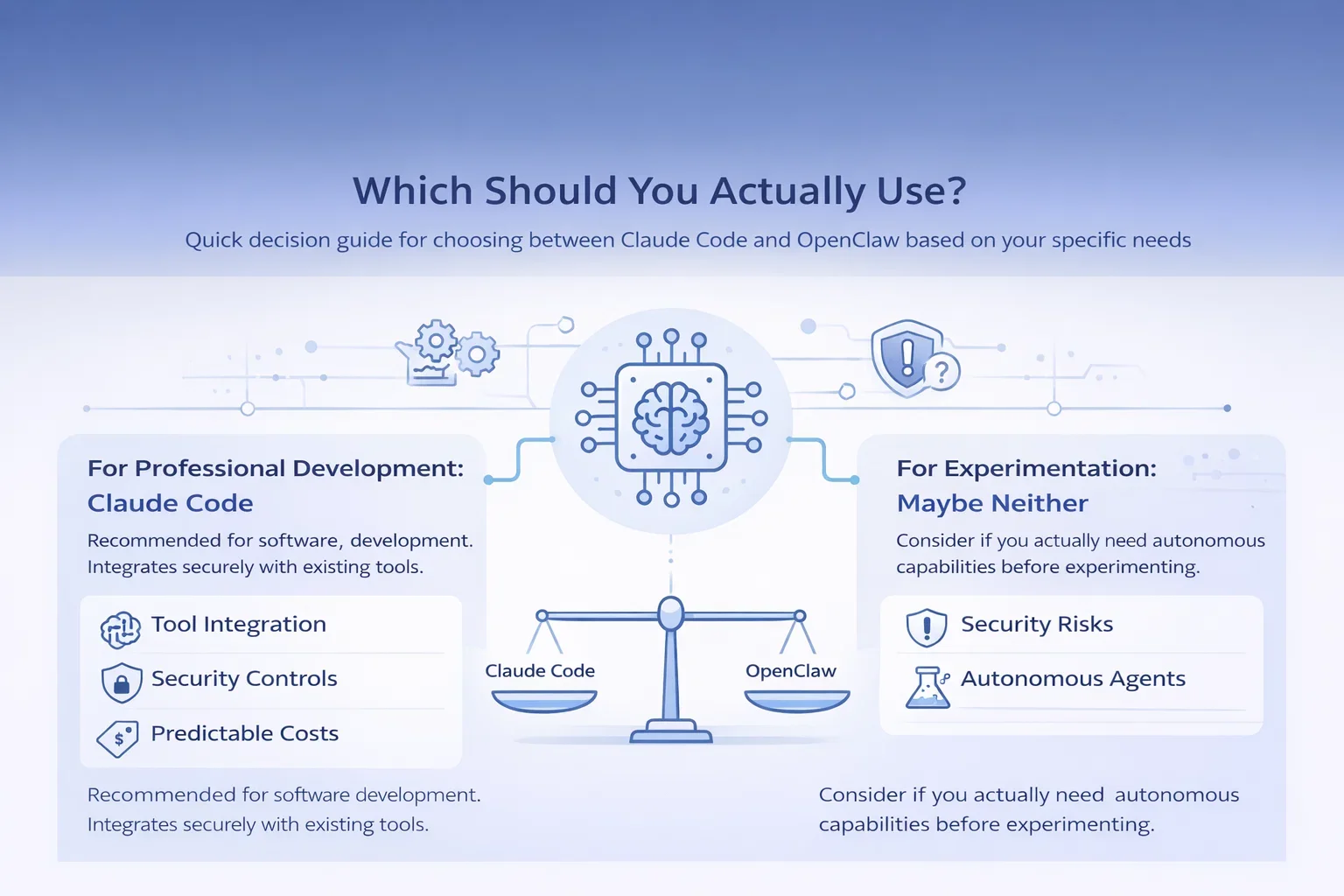
Quick decision guide for choosing between Claude Code and OpenClaw based on your specific needs.

Implementing Professional AI Agents with AI Superior
While the debate between reactive tools like Claude Code and autonomous agents like OpenClaw highlights the exciting future of development, navigating the security risks and architectural complexities of these technologies requires more than just an API key. For businesses that need the efficiency of agentic workflows without the admin-level security vulnerabilities or unpredictable token costs, professional guidance is essential. Our team at AI Superior specializes in bridging this gap by developing customized, end-to-end AI-driven software solutions that prioritize corporate safety and operational reliability.
We understand that for most professional organizations, “experimental” is a synonym for “risk.” That is why our Ph.D.-level Data Scientists and Software Engineers follow a rigorous, systematic process—from initial discovery and MVP testing to full-scale integration—ensuring that any autonomous capability we build is transparent and secure. Whether you are looking to implement sophisticated Natural Language Processing or want to build a private, hosted version of a coding assistant tailored to your proprietary codebase, we provide the technical expertise to turn advanced AI concepts into stable, high-value business assets.
The Bottom Line
Claude Code and OpenClaw aren’t really competitors. They represent different philosophies about how AI should assist with coding.
Claude Code is the professional’s choice: secure, documented, and designed for real work. OpenClaw is the experimenter’s playground: powerful, risky, and fascinating to understand from an AI agent design perspective.
Community consensus emphasizes that OpenClaw’s token consumption model and security profile present significant challenges for production use. Claude Code remains the recommended approach for professional development work.
Frequently Asked Questions
Is OpenClaw the same as Claude Code?
No, they’re fundamentally different. Claude Code is an official Anthropic tool that executes tasks based on your instructions. OpenClaw is an open-source autonomous agent that runs continuously and makes its own decisions. As community discussions note, OpenClaw is built on Anthropic’s Claude APIs but operates as a separate autonomous system.
Why does OpenClaw use so many tokens?
OpenClaw’s autonomous nature means it runs continuously, checking conditions and executing tasks even when you’re not actively working. This leads to significantly higher token usage compared to Claude Code’s task-based approach. Community discussions indicate the creator did not prioritize token efficiency in the design.
Is OpenClaw safe to use?
Community discussions reveal significant security concerns. OpenClaw requires admin-level system access and lacks the safety guardrails built into Claude Code. Developers advise against using it on systems with sensitive data or in production environments.
Can I use local LLMs with OpenClaw to save money?
Yes, but users report quality degradation. Community testing indicated that local models result in reduced reliability compared to Claude’s commercial models.
Which is better for learning to code?
Claude Code is better for learning because it responds to specific instructions and waits for your input, creating a collaborative learning experience. OpenClaw’s autonomous behavior can make it harder to understand what’s happening and why.
Does Claude Code have persistent memory like OpenClaw?
No, Claude Code uses session-based memory that resets between uses. OpenClaw uses hierarchical memory that persists across sessions. However, for most development tasks, fresh context is actually preferable to accumulated historical context.
 English
  German
  Arabic
  French
  Dutch
Dutch  Spanish