
Viral reports claim an automated trading bot generated $115,000 in a single week on Polymarket, while another trader claimed 1,560% ROI. These headlines have flooded crypto Twitter, sparking both excitement and skepticism about OpenClaw bots trading on prediction markets.
But here’s what nobody’s really talking about: most of these bots are cobbled together from open-source GitHub repositories with questionable security practices, and community discussions reveal that only 30% of Polymarket wallets are actually profitable.
So what’s the real story? I’ve spent the last month digging through GitHub repos, analyzing bot architectures, and tracking community sentiment. Here’s everything you need to know about OpenClaw Polymarket bots—the good, the sketchy, and the downright risky.
What Exactly Is OpenClaw?
OpenClaw is an AI agent framework that’s had more identity crises than a teenager. Originally called Clawdbot, then rebranded to Moltbot, and now landing on OpenClaw—this rapid-fire rebranding happened so fast that community discussions reference all three names interchangeably.
The core concept? An AI agent that can execute real-world actions through “skills”—modular capabilities like trading crypto, interacting with DeFi protocols, or placing bets on prediction markets. According to the VoltAgent/awesome-openclaw-skills GitHub repository, which has garnered 15,400 stars and 1,600 forks, the platform supports everything from Polymarket trading to automated DeFi operations.
But let’s be real: the virality feels manufactured. One community member noted, “Steinberger, the dev is famous for using guerilla marketing tactics that is exactly how this software became famous. Most openclaw conversations in the news were fake made by him or marketing people.”
The Polymarket Connection: Why Prediction Markets?
Polymarket is a decentralized prediction market platform where users bet on real-world outcomes—everything from political elections to cryptocurrency price movements. Think of it as a betting platform where the “house” is replaced by peer-to-peer trading and blockchain settlement.
Why are bots gravitating toward Polymarket specifically?
Three reasons:
- Market inefficiencies: Prediction markets often have pricing discrepancies compared to traditional markets, creating arbitrage opportunities
- Liquidity provision rewards: Users who provide liquidity earn fees, similar to automated market makers in DeFi
- 24/7 operation: Unlike traditional markets, prediction markets never close—perfect for automated bots
According to academic research from Wharton on prediction markets, the platform supports mechanisms that create incentives for market participation and information discovery. However, that same incentive structure creates opportunities for algorithmic exploitation.
The GitHub Ecosystem: Building Blocks for Polymarket Bots
The OpenClaw Polymarket bot ecosystem isn’t a single product—it’s a collection of open-source repositories. Here are the key players:
| Repository | Stars | Forks | Primary Function
|
|---|---|---|---|
| VoltAgent/awesome-openclaw-skills | 18,700 | 1,900 | Comprehensive skill library collection |
| BankrBot/openclaw-skills | 897 | 260 | Polymarket, crypto trading, DeFi operations |
| chainstacklabs/polyclaw | 118 | 25 | Trading-enabled Polymarket skill with position tracking |
| 0xrsydn/polymarket-crypto-toolkit | 39 | 12 | Python toolkit for algorithmic trading strategies |
The chainstacklabs/polyclaw repository is particularly noteworthy—it’s described as a “Trading-enabled Polymarket skill for OpenClaw” that can browse markets, execute trades, track positions, and discover hedges. This is the foundation most traders use when building Polymarket automation.
Meanwhile, the 0xrsydn/polymarket-crypto-toolkit focuses specifically on exploiting mean reversion in Polymarket’s BTC 5-minute markets. It’s a composable Python toolkit with plugin-based strategies, indicators, backtesting capabilities, and multi-source data feeds.
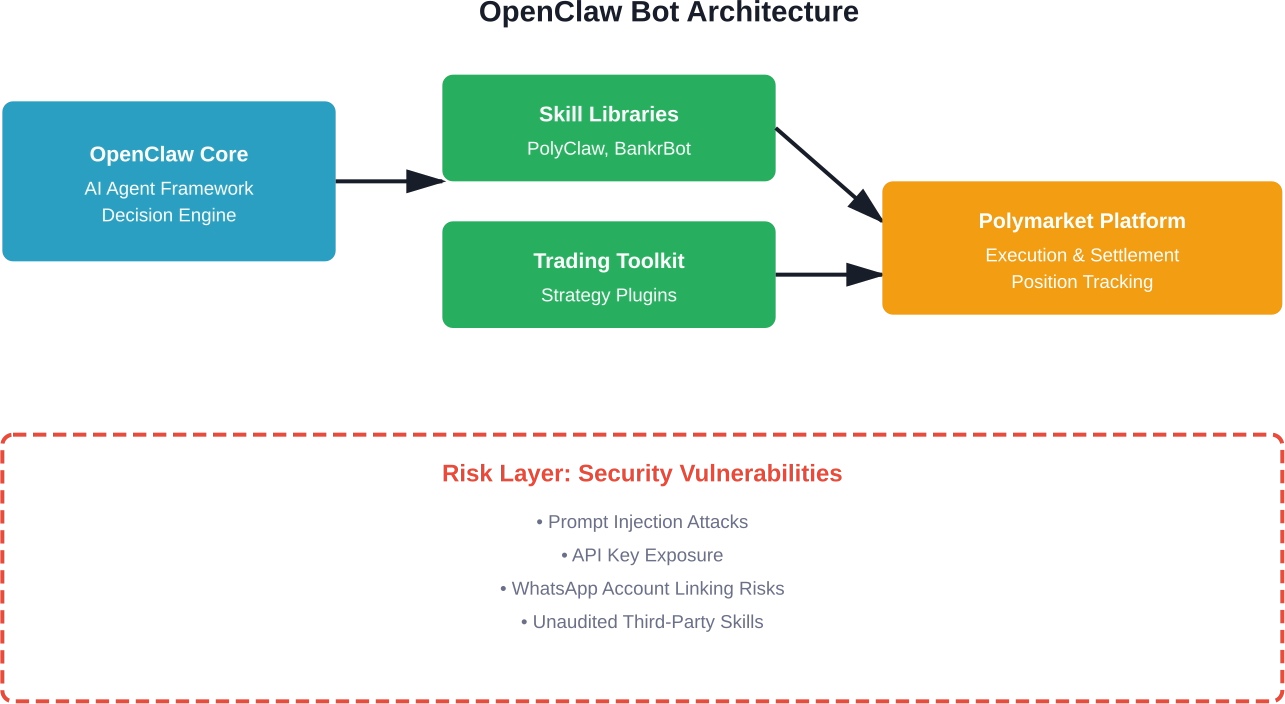
How OpenClaw bots connect to Polymarket through modular skill libraries—with an inherent security risk layer
How OpenClaw Polymarket Bots Actually Work
The operational flow is straightforward but technically complex. Here’s the breakdown:
- Market Scanning: The bot continuously monitors Polymarket for opportunities—price discrepancies, arbitrage windows, or liquidity provision needs.
- Strategy Execution: Based on pre-programmed strategies (mean reversion, arbitrage, market making), the bot decides whether to enter positions.
- Trade Execution: Using the PolyClaw skill, the bot places trades directly on Polymarket through API connections.
- Position Management: The bot tracks open positions, monitors profit/loss, and executes exit strategies when conditions are met.
- Risk Management: Better implementations include stop-losses, position sizing rules, and exposure limits—though many amateur bots skip this entirely.
The 0xrsydn toolkit specifically targets BTC 5-minute prediction markets, exploiting mean reversion patterns. When Bitcoin’s price moves sharply in one direction over a 5-minute window, the bot bets on a correction in the next window. Backtesting capabilities let traders optimize strategies before risking real capital.
The $115K Week: What Really Happened
Multiple sources reference an OpenClaw bot generating $115,000 to $116,280 in profit within a week (or a day, depending on the source) through automated liquidity provision on Polymarket. That’s a compelling headline.
But let’s look at what’s missing from these reports:
- No verified wallet addresses or on-chain transaction history
- No disclosure of initial capital deployed
- No mention of risk exposure or maximum drawdown
- No long-term performance data beyond the cherry-picked timeframe
Community discussions paint a different picture. One Reddit user noted that only 17% of Polymarket wallets are profitable. Another commented, “Please, just stop even thinking about money falling from the sky… 0 effort = 0 success… or even negative success.”
The reality? Some sophisticated traders are absolutely making money with automated strategies. But the viral success stories conveniently omit the losses, the capital requirements, and the technical expertise needed to avoid catastrophic failures.
Real User Experiences: The Good and The Ugly
Community discussions on Reddit reveal a stark divide between marketing claims and reality.
When asked if anyone was actually using OpenClaw, one user responded: “I played with it on an isolated system, it was very clearly vibe coded in how shitty the configuration is.” Another noted: “I actually installed and tried it on my macbook but it nowhere near as special as peopel make it up to be. Just connects a whole lot of APIs and MCP servers and that’s kind of it.”
The security concerns are particularly alarming. Community discussions reveal that linking WhatsApp accounts to OpenClaw exposes users to prompt injection attacks that could forward verification codes for bank accounts, investment platforms, or crypto exchanges. A user warned: “Imagine a prompt injection to tell it to forward a verification code for one of your accounts… bank, Schwab, or Coinbase, or Gmail.”
And then there’s this gem from a discussion thread: “You missed the best part – the number one skill on OpenClaw marketplace is almost surely malware that provides remote prompt / code execution capabilities.”
Real talk: the risk-to-reward ratio here is way off for most users.
Strategies Traders Actually Use
According to the polymarket-crypto-toolkit repository and community discussions, here are the primary strategies deployed:
| Strategy | Complexity | Risk Level | Typical Use Case
|
|---|---|---|---|
| Arbitrage | Medium | Low-Medium | Price discrepancies between Polymarket and other platforms |
| Market Making | High | Medium | Providing liquidity and collecting spreads |
| Mean Reversion | Medium | Medium-High | BTC 5-minute markets, crypto volatility |
| Liquidity Provision | Low-Medium | Medium | Earning fees from providing liquidity pools |
| Directional Betting | Low | High | Taking positions on specific outcomes |
But here’s the catch: most traders are actually using these bots for “arbitrage farming” and airdrop farming—not genuine directional trading. They’re avoiding actual risk by hedging positions across multiple platforms or outcomes, essentially gaming the system for potential future rewards rather than making genuine predictions.
The Security Nightmare Nobody’s Addressing
This is where things get genuinely concerning. Research from academic institutions on AI agents and cryptocurrency access highlights the emerging security risks when AI systems gain access to financial infrastructure.
The core vulnerabilities include:
- Prompt Injection Attacks: An attacker can manipulate the AI agent’s behavior by injecting malicious prompts that override original instructions. This could lead to unauthorized fund transfers or exposure of sensitive credentials.
- Third-Party Skill Malware: The skill marketplace operates on an open contribution model. Anyone can submit a “skill,” and as community members noted, the most popular skills may contain remote execution capabilities.
- API Key Exposure: Many implementations require users to store API keys and private keys in configuration files—a security practice that would make any InfoSec professional cringe.
- Account Takeover Risks: Users who integrate messaging platforms like WhatsApp create pathways for verification code interception, potentially compromising linked financial accounts.
Community consensus on AI safety concerns is strong, with multiple users noting the security liabilities of associating commercial brands with these systems.
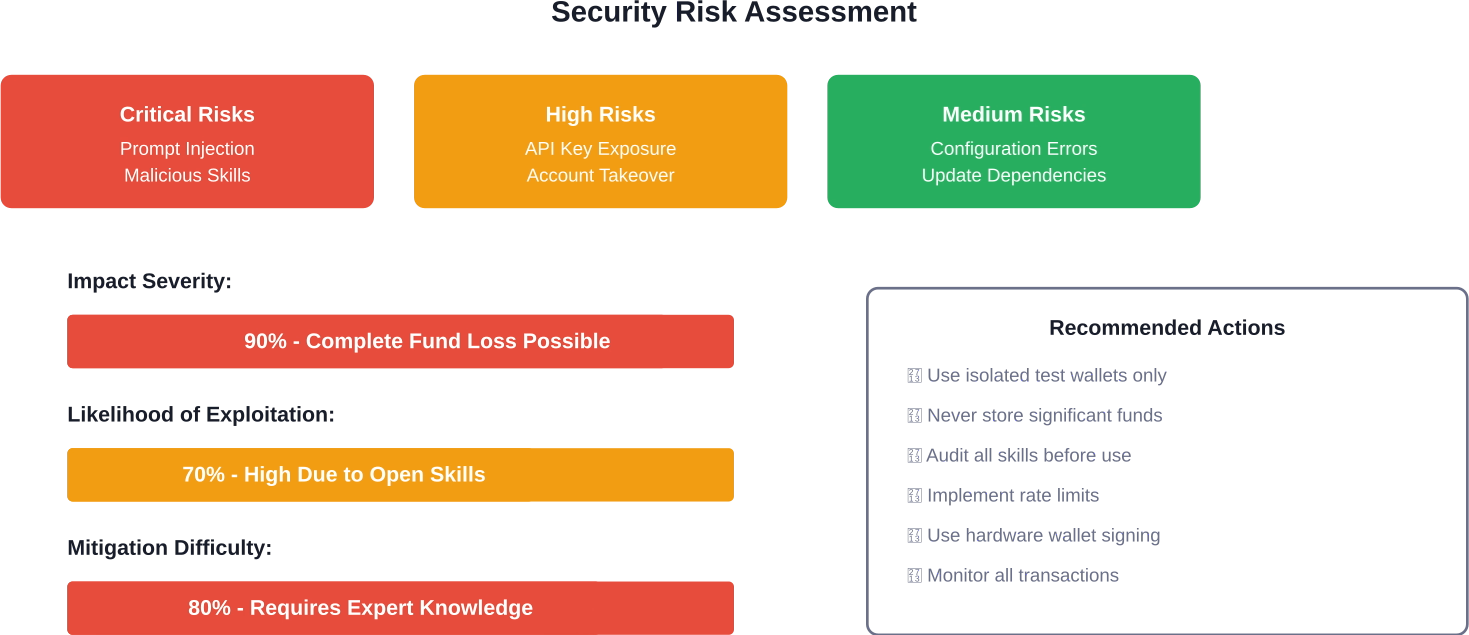
Comprehensive security risk analysis for OpenClaw Polymarket bots based on documented vulnerabilities
Should You Actually Use an OpenClaw Polymarket Bot?
Let’s be brutally honest about who this is—and isn’t—for.
This might work for you if:
- You have significant technical expertise in blockchain, Python, and security best practices
- You can audit open-source code before running it
- You’re willing to use isolated test environments with small amounts of capital
- You understand algorithmic trading strategies and their failure modes
- You have time to actively monitor bot performance and intervene when needed
This absolutely isn’t for you if:
- You’re looking for passive income with minimal effort
- You can’t afford to lose your entire investment
- You don’t understand prompt injection or API security
- You trust viral Twitter threads about guaranteed returns
- You’re planning to link sensitive accounts (email, banking, exchanges)
The BlockRunAI/awesome-OpenClaw-Money-Maker repository describes itself as a “Curated list of ways to make money with OpenClaw,” but community sentiment suggests most of these are speculative at best. One user summed it up perfectly: “Be honest: it’s all gambling.”
Alternatives and Safer Approaches
If you’re interested in automated Polymarket trading but want to minimize risk, consider these alternatives:
- Build Custom Solutions: Instead of using pre-built OpenClaw skills, develop your own trading scripts with explicit security controls and limited permissions.
- Use Established Platforms: Some crypto exchanges and prediction market platforms offer official API access with better security infrastructure and legal protections.
- Paper Trading First: The polymarket-crypto-toolkit includes backtesting capabilities. Test strategies extensively with simulated capital before risking real funds.
- Manual Trading with Alerts: Set up monitoring and alerting systems that notify you of opportunities, but require manual approval before executing trades.
Chainstack has developed infrastructure support for OpenClaw bots, providing more reliable node access—but that doesn’t address the fundamental security concerns.

Professional AI Development with AI Superior
While the allure of automated profits on prediction markets is strong, the documented security vulnerabilities and “vibe-coded” nature of many open-source frameworks present a significant barrier to entry for serious participants. Our team at AI Superior believes that financial automation requires more than just connecting a few APIs; it demands a foundation of rigorous data science and robust software architecture. As a German-based leader in custom AI services, we specialize in moving beyond experimental scripts to build secure, end-to-end AI applications tailored to the specific risk profiles and strategic goals of our clients.
Whether you are looking to deploy sophisticated predictive analytics or navigate complex DeFi environments, we provide the Ph.D.-level expertise necessary to ensure your algorithms are both profitable and resilient. We follow a systematic development process—from discovery and MVP testing to full-scale integration—ensuring that every solution we build is audited for security and optimized for real-world performance. Instead of risking your capital on unverified GitHub repositories, we help you leverage cutting-edge machine learning to transform raw market data into actionable, secure, and highly competitive trading advantages.
The Legal and Ethical Gray Zone
Here’s something most articles skip: the legal implications of automated prediction market trading aren’t entirely clear.
Polymarket operates in a regulatory gray area. Automated trading that exploits information asymmetries or platform inefficiencies may face future regulatory scrutiny. And if your bot is farming airdrops or gaming incentive structures rather than making genuine predictions, you’re potentially violating platform terms of service.
Academic research on prediction markets emphasizes their value for market efficiency and information discovery. Bots that simply extract value without contributing genuine predictive information undermine the core premise of these markets.
What’s Next for OpenClaw and Polymarket?
The OpenClaw ecosystem continues evolving rapidly. Competitors have emerged, while Olas has launched their own bot solutions for Polymarket. This fragmentation creates both opportunities and additional risks as standards and security practices vary across implementations.
Meanwhile, Polymarket itself is likely developing countermeasures against bot exploitation. As platforms mature, they typically implement rate limits, KYC requirements, and bot detection systems that can render current automated strategies obsolete.
The fundamental tension remains: AI agents with cryptocurrency access create powerful automation capabilities but introduce new attack vectors that we’re only beginning to understand.
Final Thoughts: Is the Juice Worth the Squeeze?
OpenClaw Polymarket bots represent a fascinating intersection of AI agents, decentralized prediction markets, and algorithmic trading. The technical capabilities are genuinely impressive—autonomous agents that can scan markets, execute strategies, and manage positions without human intervention.
But the gap between marketing hype and reality is enormous. Most users aren’t generating six-figure weekly returns. They’re wrestling with security vulnerabilities, configuration nightmares, and the harsh reality that only 17% of Polymarket participants are profitable at all.
If you’re a sophisticated developer with security expertise and a high risk tolerance, experimenting with OpenClaw bots on Polymarket might offer learning opportunities and potential profits. Start small, audit everything, and treat it as a high-risk experiment rather than a passive income stream.
For everyone else? The security risks, technical complexity, and capital requirements make this a hard pass. Wait for more mature solutions with proper security audits, insurance mechanisms, and regulatory clarity.
The future of AI-powered trading agents is genuinely exciting. But we’re still in the wild west phase where the outlaws outnumber the sheriffs. Proceed with extreme caution—or better yet, just watch from the sidelines until the dust settles.
Ready to explore safer ways to engage with prediction markets? Focus on developing your own market analysis skills, understanding the fundamentals of prediction market mechanics, and building technical knowledge through paper trading before risking real capital on automated systems with known security vulnerabilities.
Frequently Asked Questions
Can OpenClaw bots really make $115K per week on Polymarket?
While viral reports claim bots generated $115K in a week through automated liquidity provision, these figures lack verification through wallet addresses or transaction history. Community data suggests only 17% of Polymarket wallets are profitable overall. Exceptional returns are possible with sophisticated strategies and substantial capital, but they’re far from guaranteed and come with significant risk exposure.
Is it safe to use OpenClaw for Polymarket trading?
No, security experts have identified critical vulnerabilities including prompt injection attacks, malicious third-party skills, and API key exposure risks. If you choose to use it, only deploy isolated test wallets with minimal funds, audit all code thoroughly, and never link sensitive accounts.
What’s the difference between PolyClaw and OpenClaw?
OpenClaw is the AI agent framework (formerly Clawdbot and Moltbot), while PolyClaw is a specific skill library developed by Chainstack Labs that enables Polymarket trading functionality. PolyClaw is one of many skills that can be added to OpenClaw to give it trading capabilities for browsing markets, executing trades, tracking positions, and discovering hedges.
Do I need programming skills to run a Polymarket bot?
Yes, absolutely. Successfully deploying and maintaining an OpenClaw Polymarket bot requires knowledge of Python, blockchain fundamentals, API integration, security best practices, and algorithmic trading concepts. Users without technical expertise face significantly higher risks of misconfiguration, security breaches, and financial losses. This isn’t a plug-and-play solution despite marketing claims.
What strategies do OpenClaw Polymarket bots use?
Common strategies include arbitrage (exploiting price discrepancies across platforms), market making (providing liquidity for spread profits), mean reversion (betting on price corrections in volatile markets like BTC 5-minute windows), and liquidity provision (earning fees). According to community discussions, many traders use bots for arbitrage farming and airdrop farming rather than genuine directional betting.
Where can I find OpenClaw Polymarket bot code?
Primary repositories include chainstacklabs/polyclaw (118 stars) for trading-enabled Polymarket skills, BankrBot/openclaw-skills (897 stars) for comprehensive skill libraries, and 0xrsydn/polymarket-crypto-toolkit (39 stars) for Python algorithmic trading tools. The VoltAgent/awesome-openclaw-skills repository (18,700 stars) aggregates resources, though community members warn that popular skills may contain malware.
Has Polymarket banned automated trading bots?
As of the time of writing, Polymarket hasn’t implemented blanket bans on automated trading, but this may change as bot activity increases. Platforms typically develop countermeasures including rate limiting, bot detection algorithms, and enhanced KYC requirements. Additionally, using bots to farm airdrops or game incentive structures may violate terms of service even if direct trading automation is permitted.
 English
  German
  Arabic
  French
  Dutch
Dutch  Spanish