
The AI agent war is heating up. On one side, you’ve got OpenClaw—the viral open-source framework that lets Claude control your entire computer. On the other, Manus AI, the cloud-based autonomous agent that Meta quietly acquired for an estimated $2 billion in late 2025.
But here’s the thing: these aren’t just different products. They’re different philosophies about what AI agents should be and who should control them.
According to Northeastern University’s analysis, OpenClaw is a “privacy nightmare” that gives AI full access to your computer. Meanwhile, research from the United Nations University describes Manus as “leading the charge in autonomous AI” with its fully autonomous capabilities. Both descriptions are accurate. Both are also terrifying in their own ways.
So which one should you actually use? Let’s break down what each agent does, what they cost, and when you’d choose one over the other. Real talk: this decision matters more than you think.
What Is OpenClaw? The Open-Source Agent Everyone’s Talking About
OpenClaw is an open-source AI agent framework that runs locally on your computer. It quickly became one of the fastest-growing open-source projects in GitHub history, with significant community adoption.
The GitHub community has built around OpenClaw with active development. According to GitHub data provided in source materials, there are multiple repositories dedicated to OpenClaw skills and extensions, with the ecosystem growing and developers creating custom “skills” that extend what OpenClaw can do.
The Security Problem Nobody Wants to Talk About
But wait. There’s a massive elephant in the room.
According to reporting from authoritative sources, there are significant security concerns with OpenClaw’s architecture. Gartner and Forrester have both raised security concerns about unrestricted AI agent access to computer systems.
One Reddit user put it bluntly: “Hype + No safeguards is all the current pack of brain atrophied yololets need to allow Claude to hold the wheel in every aspect of their lives.” This reflects community skepticism about the default security posture.
OpenClaw’s default configuration is notoriously insecure. The very design that makes it powerful—unrestricted access—is what makes it dangerous.
What Is Manus AI? Meta’s $2 Billion Bet on Autonomous Agents
Manus AI takes a completely different approach. Instead of running locally, everything happens in the cloud. You control Manus through Telegram (and soon WhatsApp) using simple text messages. No installation. No configuration. No giving an AI the keys to your local machine.
According to research from the United Nations University, Manus “has emerged as a significant player in the AI landscape, thanks to its advanced capabilities and impressive performance metrics.” Harvard Business School published a case study in January 2026 examining Manus AI’s market impact.
What sets Manus apart is its autonomous planning capability. You don’t just chat with it—you assign tasks, and it figures out how to complete them. It can break down complex projects, execute sub-tasks, and even coordinate multiple specialized sub-agents working together.
Researchers have tested Manus by assigning it complex tasks, demonstrating planning capabilities that go beyond simple automation.
The Cost Problem: Credit Systems and Unpredictability
Here’s where Manus gets controversial: the pricing model.
Manus uses a credit system that can impact your budget. Reddit users have expressed concerns about costs: “Manus AI is expensive as fuck. Impossible to work with it.” Another echoed: “Manus feels like the most non config instantly useable agent but expensive as hell.”
The challenge is that you don’t know how many credits a task will consume until it’s done. Complex research tasks or coding projects can rack up costs quickly. It’s the opposite of OpenClaw’s model, where you pay for your own API keys and know exactly what you’re spending.
That said, for users working from mobile devices, Manus offers something OpenClaw can’t. As one user noted: “I work off of my iPhone so no desktop for open claw.” The cloud-based architecture means you can run sophisticated AI agents from anywhere, on any device.
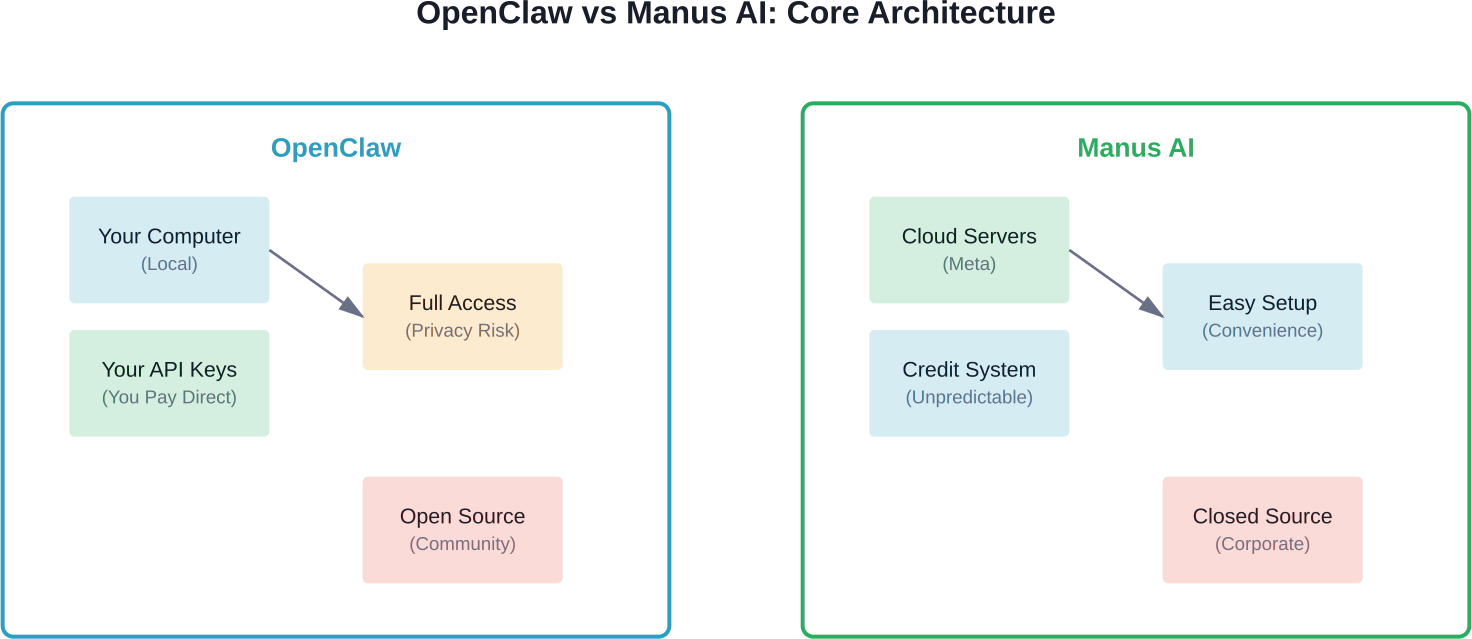
Architectural comparison showing OpenClaw’s local execution model versus Manus AI’s cloud-based approach
Head-to-Head: OpenClaw vs Manus AI Feature Comparison
Let’s get tactical. Here’s how these two agents stack up across the dimensions that actually matter.
| Feature | OpenClaw | Manus AI
|
|---|---|---|
| Execution Environment | Local (your computer) | Cloud (Meta servers) |
| Setup Complexity | High (technical setup required) | Low (Telegram message to start) |
| Pricing Model | Your own API costs (predictable) | Credit system (unpredictable) |
| Privacy Level | High (local execution, if secured) | Lower (data sent to cloud) |
| Security Risk | Very high (full computer access) | Moderate (sandboxed cloud) |
| Source Code | Open source | Closed source (proprietary) |
| Mobile Support | No (requires desktop) | Yes (works from any device) |
| Customization | Extensive (community skills) | Limited (preset capabilities) |
| Coding Capabilities | Excellent (direct file access) | Excellent (cloud-based coding) |
The Two Philosophies of AI Agents
What’s really interesting here isn’t just the features. It’s the underlying philosophy.
- OpenClaw represents the “raw power” approach. Give the AI unrestricted access and let it do anything. No guardrails, no sandboxing, no corporate oversight. It’s the WordPress of AI agents—massively powerful but also massively risky if you don’t know what you’re doing.
- Manus represents the “managed service” approach. Let the AI be autonomous, but within a controlled environment that a major corporation manages. You trade some privacy and control for convenience and (theoretically) safety.
Industry analysis suggests that open-architecture AI agents represent a strategic shift in how companies approach autonomous agent frameworks, with major technology firms competing on different platforms.
According to research on enterprise AI adoption, agentic AI represents a significant emerging segment in enterprise computing, with substantial projected spending growth in coming years.
Pricing Breakdown: What You Actually Pay
Let’s talk money, because this is where things get interesting.
With OpenClaw, you’re paying for your own API keys. If you’re using Claude 3.5 Sonnet (the most common choice), typical costs vary based on usage patterns. For typical automation tasks, costs depend on usage levels.
The advantage? Predictability. You can monitor your API usage in real-time and set spending limits. One Reddit user noted: “I’m doing all this stuff better already” with their own API setup.
Manus AI uses a subscription plus credits model. Manus AI offers official pricing plans: a Free Plan with limited credits and a Pro Plan starting from $20/month (or $200/month for high-usage tiers). One user described it as “impossible to work with” due to costs. Another said: “Manus is great at coding for my company (promoted by ChatGPT and reviewed by Claude). I work off of my iPhone so no desktop for open claw.”
The challenge is that complex tasks can consume credits unpredictably. Research tasks, extensive coding projects, or multi-step automations might burn through your monthly allocation quickly. There’s no way to set a hard spending limit before a task starts.
The Privacy Trade-Off: Local vs Cloud
This is the big one. According to Northeastern University’s research, OpenClaw presents privacy considerations because it requires full computer access. But here’s the nuance: that’s only true if you don’t lock it down properly.
OpenClaw running locally means your data never leaves your machine (unless the AI explicitly sends something to the cloud via API calls). If you’re working with sensitive client data, confidential business information, or personal files, local execution is theoretically more private.
But—and this is critical—OpenClaw’s default security posture requires careful configuration. Community discussion reflects concerns about its security model. Reddit users have noted the risks associated with its architecture.
Manus sends everything to Meta’s cloud servers. Your prompts, your task descriptions, potentially your data. For many use cases, this is fine. For others, it’s a dealbreaker.
The cloud advantage is that Manus runs in a sandboxed environment with professional security management. The disadvantage is you’re trusting Meta with your data. Pick your poison.
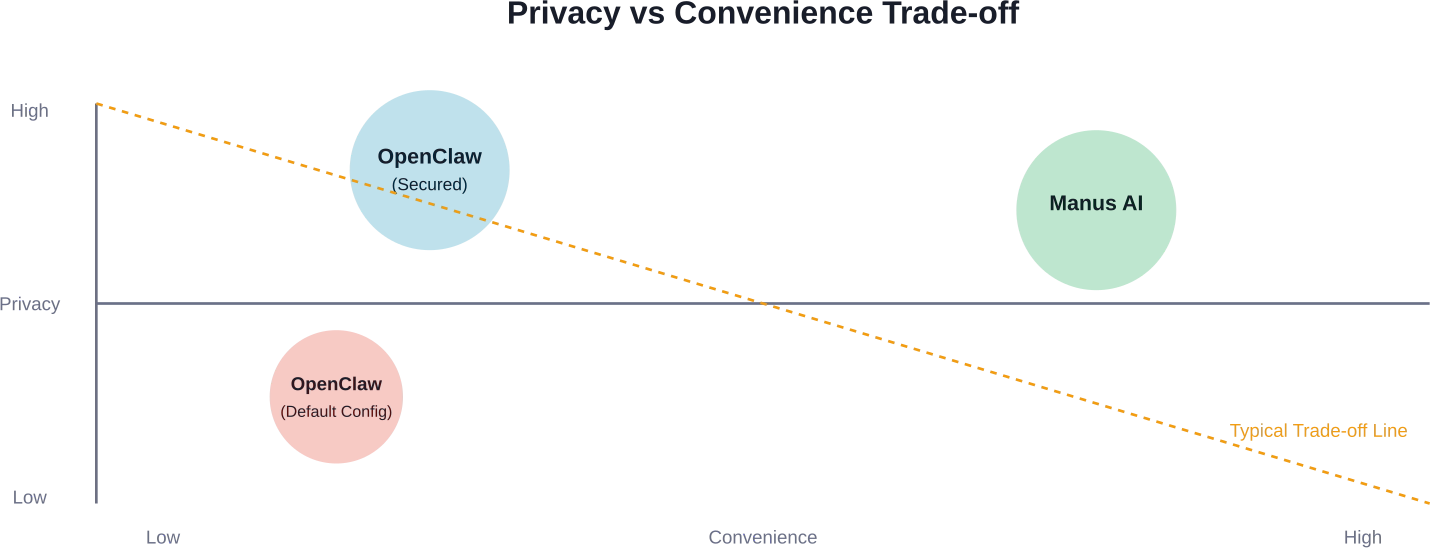
Privacy versus convenience positioning for OpenClaw and Manus AI, showing how default configurations affect security
When to Choose OpenClaw vs Manus AI
Okay, so which one should you actually use? Here’s my take based on real-world use cases.
Choose OpenClaw If:
- You’re comfortable with technical setup and configuration
- You need full control over your AI agent’s behavior
- You want predictable costs (your own API keys)
- You’re working with sensitive data that can’t leave your machine
- You want to customize and extend functionality with community skills
- You have the time and expertise to properly secure the installation
- You need desktop automation with direct file system access
Choose Manus AI If:
- You want something that works immediately with zero setup
- You primarily work from mobile devices (iPhone/Android)
- You’re willing to pay premium pricing for convenience
- You don’t have technical background or time for configuration
- You need autonomous agents that can plan and execute complex tasks
- You’re comfortable with your data being processed in the cloud
- You want Meta’s infrastructure and security management
The short answer? Most people will find OpenClaw too complex and risky. Most developers will prefer OpenClaw’s flexibility and control. There’s a reason both approaches exist.
Cloud Services Race: OpenClaw-as-a-Service
Here’s where things get really interesting. According to reporting from The Register, major cloud providers are developing managed OpenClaw offerings despite security considerations.
What does this mean? It means you might soon be able to run OpenClaw in a managed cloud environment—getting the power of OpenClaw with the convenience of Manus. Best of both worlds? Maybe. Or maybe the worst of both worlds if the security isn’t handled properly.
The cloud providers see the demand and they’re racing to meet it. But security researchers warn that this creates scenarios where AI agents have significant access levels.
Real User Experiences: What Reddit Actually Says
Let’s cut through the marketing and look at what actual users are saying in community discussions.
On OpenClaw, the sentiment is mixed. One user asked: “What exactly is the shift here? Is it UX, architecture, control layer, distribution?” The responses revealed different perspectives on the technology.
Community members have discussed the tradeoffs between power and security in OpenClaw’s architecture.
On Manus, users consistently praise the instant usability but complain about costs. “Manus is great at coding for my company” wrote one user, but added the caveat about expense. Another noted challenges with alternative approaches to AI agents.
The consensus? Both tools are powerful but flawed in different ways. OpenClaw is too complex and risky for most users. Manus is too expensive and closed for many developers. We need something in between, as some community discussions have explicitly stated.

Scaling Enterprise Agents with AI Superior
The tug-of-war between OpenClaw’s risky transparency and Manus AI’s expensive opacity highlights a critical gap for businesses: the need for agentic tools that are both secure and cost-effective. At AI Superior, we believe you shouldn’t have to compromise on data sovereignty or budget predictability. Our team of PhD-level Data Scientists and Software Engineers specializes in the customized development of AI-driven software tailored to your specific operational guardrails. By building bespoke frameworks, we help organizations bypass the “privacy nightmares” of open-source scripts while avoiding the unpredictable credit systems of consumer-grade cloud agents.
Transitioning from experimentation to production requires more than just a chat interface; it requires a robust architecture that fits your existing infrastructure. We provide comprehensive Artificial Intelligence Consulting to help your team identify high-value automation areas and then execute the R&D necessary to bring those agents to life. Whether you need computer vision integration or secure Natural Language Processing, our German-based team ensures your AI journey is grounded in reliability and technical excellence.
The Verdict: Transparency Wins, But At What Cost?
Look, here’s my honest take after diving deep into both platforms.
OpenClaw is the more transparent option. It’s open source, runs locally, and gives you complete control. But that transparency comes with massive responsibility. You’re responsible for security, configuration, and understanding what you’re allowing the AI to do. Most people don’t have the technical expertise to use it safely.
Manus AI is the more convenient option. It works immediately, requires no technical knowledge, and runs on any device. But that convenience comes with opacity. You don’t know exactly what it’s doing, how much tasks will cost, or what Meta is doing with your data.
The brutal truth? Neither option is ready for mainstream enterprise use. Research on enterprise AI adoption suggests agentic AI will become increasingly important, but the security, pricing, and control issues need solving first.
For individual users and developers experimenting with AI agents in 2026, the choice comes down to this: Do you want control or convenience? Privacy or portability? Predictable costs or instant setup?
Answer those questions honestly, and you’ll know which agent is right for you.
Ready to experiment with AI agents? Start with Manus if you’re new to AI automation and want quick wins. Try OpenClaw if you’re technical, security-conscious, and willing to invest time in proper setup. Either way, proceed carefully—these tools are powerful enough to be genuinely transformative and genuinely dangerous.
Frequently Asked Questions
Is OpenClaw actually better than Manus AI?
It depends on your needs. OpenClaw offers more control, customization, and predictable costs through your own API keys. Manus AI provides easier setup, mobile access, and cloud-based execution. OpenClaw is better for technical users who need privacy and customization. Manus is better for non-technical users who prioritize convenience over control.
How much does Manus AI actually cost?
Manus uses a credit system with subscription pricing that varies based on usage. Community reports indicate costs can become significant for complex tasks, with some users noting expense concerns. OpenClaw uses your own API keys with costs depending on your usage volume.
Is OpenClaw safe to use?
OpenClaw requires full computer access and has significant security considerations in its default configuration. Security researchers have raised concerns about unrestricted AI agent access to computer systems. If you use OpenClaw, you must carefully configure security settings, limit access, and understand the risks. Many security professionals recommend cautious evaluation before using it in production environments.
Can I use Manus AI on my phone?
Yes, Manus AI works through Telegram (and soon WhatsApp) messaging, making it accessible from any device including iPhones and Android phones. This is a major advantage over OpenClaw, which requires a desktop computer. Several users specifically cited mobile access as their reason for choosing Manus over OpenClaw.
Did Meta really acquire Manus for $2 billion?
Meta’s acquisition of Manus AI for approximately $2 billion in late 2025 is referenced in multiple sources including academic case studies. The acquisition signals Meta’s investment in autonomous agent technology.
What’s the difference between OpenClaw and Claude?
Claude is an AI language model from Anthropic. OpenClaw is an agent framework that lets Claude (or other AI models) control your computer. Think of Claude as the brain and OpenClaw as the body that lets the brain interact with your computer’s keyboard, mouse, files, and applications. OpenClaw uses Claude’s API but adds computer control capabilities.
Which AI agent is best for coding projects?
Both OpenClaw and Manus excel at coding tasks. OpenClaw has direct file system access making it powerful for local development. Manus has strong coding capabilities with cloud-based execution and can coordinate multiple sub-agents for complex projects. Users report success with both platforms for coding work.
 English
  German
  Arabic
  French
  Dutch
Dutch  Spanish