
Quick Summary: Predictive analytics in customer experience leverages machine learning and historical data to forecast customer behavior, anticipate needs, and proactively resolve issues before they arise. Organizations using these tools can reduce churn, personalize interactions at scale, and shift from reactive support to strategic relationship-building. With predictive models achieving 81.9–90% accuracy in forecasting customer loyalty and churn, businesses gain the foresight needed to optimize every touchpoint along the customer journey. Customer experience isn’t what it used to be. Static surveys and post-interaction feedback tell businesses what already happened—but prediction tells them what’s about to happen. That’s the fundamental shift predictive analytics brings to CX. Traditional customer service operates in reaction mode. Someone complains, teams scramble to fix it, damage control begins. Predictive analytics flips that model on its head. By analyzing patterns in historical data, machine learning algorithms forecast customer behaviors and issues before they surface. The result? Organizations can intervene early, personalize proactively, and build loyalty instead of constantly repairing it. Here’s the thing though—predictive analytics isn’t magic. It’s structured data science applied to customer interactions, purchase history, support tickets, and engagement metrics. When done right, it transforms CX from a cost center into a strategic differentiator.
How Predictive Analytics Reshapes Customer Experience
Predictive analytics uses statistical algorithms and machine learning techniques to identify the likelihood of future outcomes based on historical data. In customer experience contexts, that means analyzing every touchpoint—website visits, support interactions, purchase patterns, product usage telemetry, social media sentiment—to build models that forecast what customers will do next. The process starts with data collection. Organizations aggregate structured data (transaction records, CRM entries, service logs) and unstructured data (emails, chat transcripts, voice recordings). Machine learning models then identify patterns invisible to human analysis: subtle signals that a customer is about to churn, behavioral triggers that predict upsell readiness, or issue clusters that indicate an emerging product defect. Academic research demonstrated that Random Forest models achieved 81.9% accuracy in predicting customer churn for subscription services, while ensemble classification approaches (combining C5.0, KNN, and Neural Network techniques) reached 90% overall accuracy and 90% AUC ROC thresholds for customer loyalty prediction. These aren’t theoretical benchmarks—they represent real-world performance in operational environments. But accuracy alone doesn’t drive business outcomes. The value emerges when predictions trigger action: routing a high-risk customer to retention specialists, offering personalized incentives before a competitor does, or deploying proactive support before frustration escalates.
Key Predictive Analytics Capabilities for CX Teams
Not all predictive tools serve the same purpose. Organizations building predictive CX capabilities typically focus on several core functions.
Churn Prediction and Retention
Churn prediction models analyze engagement decay, support ticket sentiment, product usage decline, and competitive signals to identify customers at risk of leaving. Early identification enables targeted retention efforts—personalized outreach, loyalty incentives, account reviews—before the customer decides to switch. The subscription economy makes this especially critical. When customers can cancel with a click, the window for intervention is narrow. Predictive models flag risk early enough that retention teams can act while goodwill still exists.
Personalization at Scale
Traditional segmentation groups customers into broad categories. Predictive personalization creates individual profiles that forecast preferences, content affinity, optimal contact timing, and channel preferences for each customer. Machine learning models continuously refine these profiles as new interaction data flows in. This allows organizations to personalize without manual effort. Recommendation engines, dynamic content systems, and automated nurture campaigns all operate on predictive inputs, delivering relevance at scale that human teams couldn’t manually coordinate.
Proactive Issue Resolution
Predictive analytics doesn’t just forecast customer actions—it predicts operational issues. By analyzing support ticket patterns, product telemetry, and usage anomalies, systems can identify problems before customers report them. Organizations can then fix issues proactively, notify affected users, or deploy preventive solutions. This shifts the customer experience from reactive (“submit a ticket and wait”) to proactive (“we noticed an issue with your account and already fixed it”). The latter builds trust in ways reactive support never can.
Demand Forecasting and Resource Optimization
Contact centers use predictive analytics to forecast volume by channel, topic, and time. This enables staffing optimization, skill-based routing, and capacity planning that matches supply to predicted demand. The result is shorter wait times, better first-contact resolution, and lower operational costs. Seasonal patterns, campaign impacts, product launches, and external events all feed into these models. Accurate forecasts prevent both understaffing (which degrades experience) and overstaffing (which wastes resources). 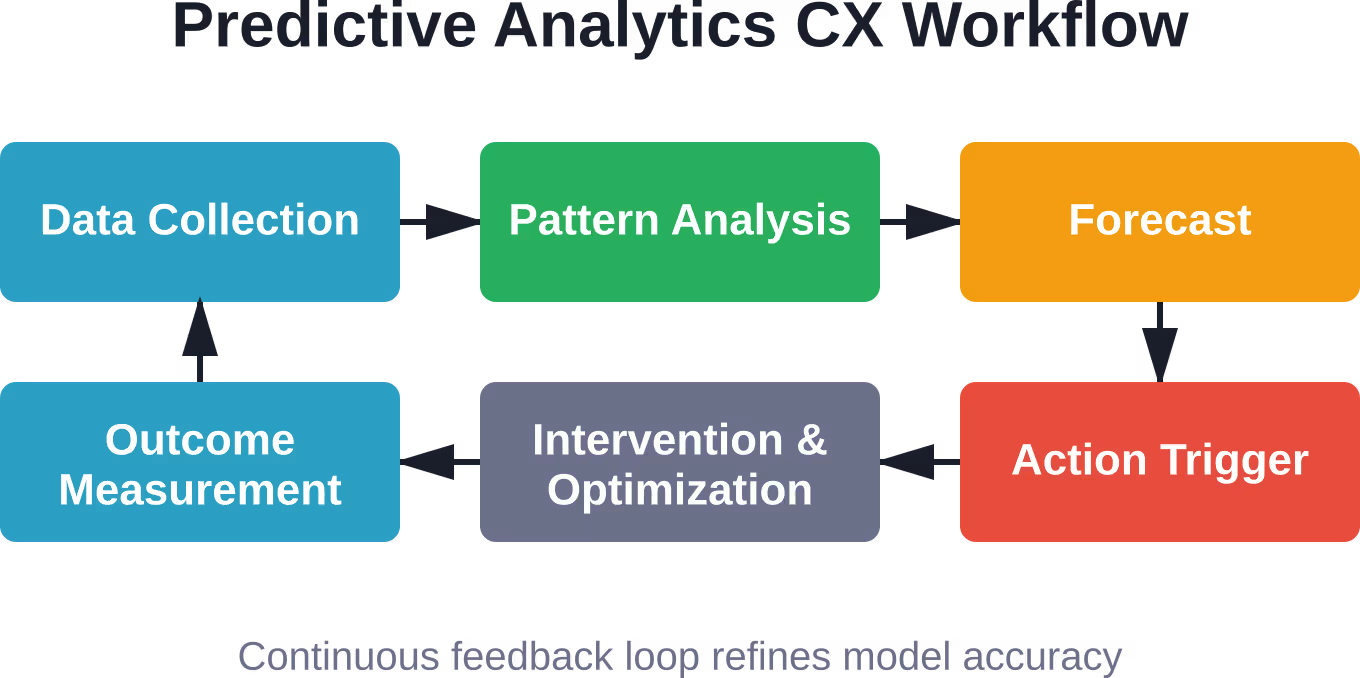
Real-World Applications Driving Business Results
Theory matters less than execution. Organizations across industries deploy predictive analytics to solve concrete CX challenges.
Retail and E-Commerce
Online retailers use predictive models to forecast product interest, personalize recommendations, and optimize inventory positioning. Behavioral signals—browsing patterns, cart abandonment, price sensitivity—feed algorithms that predict purchase likelihood and optimal promotional timing. When a customer shows churn signals (declining visit frequency, engagement with competitor content, support dissatisfaction), retention workflows activate automatically. Personalized incentives, win-back campaigns, and account manager outreach all deploy based on predicted risk scores.
Financial Services
Banks and fintech companies use predictive analytics to identify fraud risk, forecast loan default, and personalize product recommendations. CX applications include predicting when customers will need support (tax season, major life events, account changes) and proactively offering guidance before they request it. Academic research on AI-driven customer experience highlights that financial services firms face particular challenges around the personalization-privacy paradox—customers want personalized service but resist data collection. Predictive systems must balance utility with transparency, ensuring customers understand how their data creates value.
Telecommunications
Telecom providers operate in highly competitive markets with low switching costs. Predictive churn models are mission-critical. These systems analyze network usage patterns, billing disputes, service interruptions, and competitive offer exposure to identify at-risk accounts. Network performance data also feeds predictive maintenance models. When congestion patterns or equipment degradation signals emerge, proactive communication prevents service complaints before customers notice issues.
SaaS and Subscription Services
Software providers track product usage telemetry to predict renewal likelihood, expansion opportunities, and support needs. Usage decline, feature adoption stagnation, and administrative inactivity all signal churn risk. Customer success teams use these signals to prioritize outreach and intervention. Predictive models also identify upsell readiness—when usage patterns indicate a customer has outgrown their current tier or would benefit from additional features. Timing these conversations based on usage data (rather than arbitrary sales cycles) dramatically improves conversion rates.
Airlines and Hospitality
IEEE research on predictive analytics for passenger satisfaction in the airline industry demonstrates how operational data (flight delays, baggage performance, gate changes) combined with customer history enables proactive service recovery. Airlines can offer compensation, rebooking options, or lounge access before passengers reach the complaint stage. Hotels use similar models to predict guest preferences, optimize room assignments, and personalize amenities based on past behavior and reservation context.
Building Predictive CX Capabilities: Practical Implementation
Organizations don’t become predictive overnight. Implementation follows a maturity path from basic analytics to sophisticated forecasting.
Start with Data Infrastructure
Predictive models require clean, integrated data. Customer identities must resolve across channels (web, mobile, support, purchase). Interaction history, behavioral telemetry, and outcome data all need structured collection and storage. Many organizations discover their data is siloed—marketing platforms don’t talk to support systems, e-commerce transactions don’t link to CRM records, product usage lives in separate databases. Integration precedes prediction.
Define Clear Use Cases
Don’t build predictive models because competitors do. Identify specific CX problems where foresight creates value: reducing churn, personalizing content, optimizing staffing, preventing issues. Each use case requires different data inputs, model architectures, and action workflows. Start small. Pilot with a single high-impact use case, prove ROI, then expand. Early wins build organizational confidence and budget support for broader initiatives.
Choose Appropriate Model Complexity
Not every problem requires deep learning. Simpler models—logistic regression, decision trees, Random Forest algorithms—often deliver strong performance with less data, faster training, and easier interpretability. IEEE research confirms that ensemble methods combining multiple simpler classifiers frequently outperform individual complex models. Model selection depends on data volume, prediction latency requirements, and explainability needs. Regulated industries (finance, healthcare) often require interpretable models where decision logic can be audited. Consumer applications may tolerate black-box neural networks if accuracy justifies the opacity.
Establish Feedback Loops
Predictive models degrade without continuous learning. Customer behavior shifts, market conditions change, competitive dynamics evolve. Models trained on historical data become less accurate over time unless new outcome data retrains them. Build feedback systems that capture actual outcomes (did the customer churn? did the upsell succeed? was the issue resolved proactively?) and feed those results back into model training. This creates continuous improvement cycles that maintain accuracy.
Address Ethical and Privacy Considerations
Predictive analytics raises legitimate privacy concerns. Customers may not realize their behavior is being scored and predicted. Transparency about data use, clear opt-out mechanisms, and adherence to privacy regulations (GDPR, CCPA) aren’t optional—they’re foundational to sustainable predictive CX programs. The FTC has scrutinized surveillance pricing and algorithmic decision-making practices. Organizations must ensure predictive systems don’t create discriminatory outcomes or exploit vulnerable populations. Regular bias audits and fairness assessments should be standard practice.
| Implementation Phase | Key Activities | Common Challenges |
|---|---|---|
| Data Foundation | Integrate data sources, resolve customer identity, establish governance | Siloed systems, data quality issues, privacy compliance |
| Pilot Use Case | Define business problem, build initial model, test with limited scope | Scope creep, unrealistic accuracy expectations, insufficient action workflows |
| Production Deployment | Automate scoring, integrate with CRM/support tools, train teams | System integration complexity, change management, model latency |
| Scale and Optimize | Expand to new use cases, refine models, measure business impact | Resource constraints, model drift, maintaining interpretability |

Use Proven Predictive Analytics to Retain More Customers
Customer experience doesn’t usually break in obvious ways. It fades – slower responses, less engagement, fewer returns. By the time it becomes visible, retention is already affected. AI Superior develops custom AI software where predictive analytics is used with customer data to identify patterns and support earlier responses based on those signals. This includes working with behavioral data, interaction data, and other customer-related information.
Bring Predictive Models Into Customer Workflows
AI Superior focuses on applying predictive analytics where customer-related decisions are made:
- Use behavioral data to assess churn risk
- Identify changes in customer activity patterns
- Work with structured and unstructured customer data
- Integrate models into existing systems
- Update models as customer data changes
If retention issues are still addressed after they become visible, (/contact/) and start working with predictive analytics earlier.
Measuring Predictive Analytics Impact on CX
Predictive initiatives must demonstrate ROI. Measurement frameworks should connect model performance (accuracy, precision, recall) to business outcomes (churn reduction, lifetime value increase, cost savings). Track both leading indicators (prediction accuracy, intervention rates, model coverage) and lagging indicators (customer retention, satisfaction scores, revenue impact). A model with 90% accuracy that doesn’t change business outcomes has failed regardless of technical performance. Recent MIT Sloan research emphasizes that organizations should focus CX measurement on metrics that yield the deepest insights rather than collecting exhaustive data rather than collecting exhaustive data. Predictive analytics should inform which metrics matter most—the ones that actually forecast future customer value and satisfaction. Common CX metrics enhanced by predictive analytics include:
- Customer Lifetime Value (CLV): Predictive models forecast future value based on current behavior, enabling investment prioritization
- Net Promoter Score (NPS) Prediction: Behavioral signals predict survey responses before customers complete them, allowing proactive intervention
- First Contact Resolution (FCR): Predictive routing matches customers to agents most likely to resolve their specific issue type
- Time to Resolution: Issue complexity prediction enables realistic SLA commitments and resource allocation
- Retention Rate: Churn prediction models measure success by retention improvement in at-risk cohorts
Emerging Trends Shaping Predictive CX
Predictive analytics continues to evolve as technology advances and customer expectations shift.
Real-Time Prediction and Action
Early predictive systems operated in batch mode—scoring customers daily or weekly. Modern architectures enable real-time prediction during active sessions. A customer browsing support documentation triggers instant risk assessment; if churn signals appear, live chat proactively offers assistance. Real-time systems require streaming data architectures, low-latency model serving, and automated action workflows. The technical complexity is higher, but the CX impact is substantially greater.
Conversational AI Integration
Chatbots and voice assistants increasingly incorporate predictive context. Instead of treating each conversation as isolated, AI agents access predicted customer intent, forecasted needs, and risk scores. This enables more natural, anticipatory interactions that feel less scripted. When a high-value customer at churn risk initiates a support chat, the system can route them to human specialists immediately rather than forcing bot interactions that may increase frustration.
Emotion and Sentiment Prediction
Text and voice analytics now predict emotional state during interactions. Frustration signals trigger escalation protocols before customers explicitly request supervisors. Satisfaction cues identify coaching opportunities for agents. This emotional intelligence layer makes predictive systems more human-responsive, preventing process-driven interactions that ignore customer sentiment.
Causal Inference Beyond Correlation
Traditional predictive models identify correlations—usage decline correlates with churn. Newer causal inference techniques attempt to understand why, identifying which interventions actually change outcomes versus which simply correlate with them. This matters because correlation-based predictions can recommend ineffective actions. Causal models help organizations invest in interventions that genuinely influence customer behavior rather than those that merely predict inevitable outcomes. 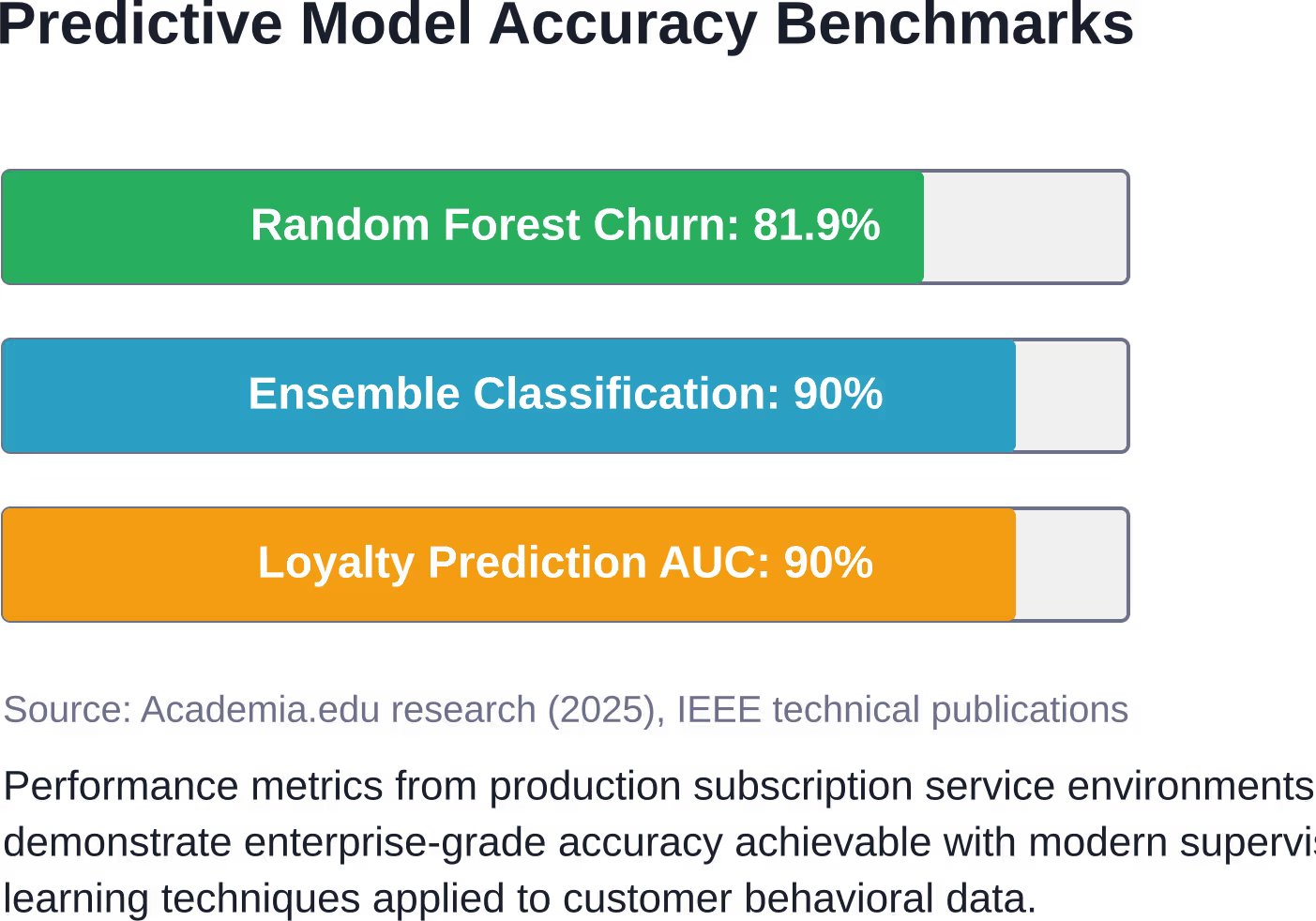
Overcoming Common Implementation Challenges
Predictive CX programs fail for predictable reasons. Awareness helps organizations avoid common pitfalls.
Data Quality and Availability
Models trained on incomplete or inaccurate data produce unreliable predictions. Organizations often discover that critical data points aren’t captured, historical records contain gaps, or data definitions vary across systems. Address data quality before model building. Invest in data cleaning, normalization, and validation. Establish ongoing governance that maintains quality as new data flows in.
Organizational Resistance
Customer-facing teams may resist algorithm-driven recommendations, especially when predictions contradict their intuition. Early surveys indicated organizational hesitation around AI adoption, reflecting hesitation that persists in some organizations today. Change management matters as much as technology. Involve frontline teams early, demonstrate model value with pilots, and position predictions as decision support rather than replacement. Humans should remain in the loop for high-stakes decisions.
Model Interpretability
Complex models become black boxes. When an agent sees “this customer has a 73% churn risk,” they need to understand why to take appropriate action. Interpretability techniques (SHAP values, LIME, attention mechanisms) help explain individual predictions. For regulated industries or high-impact decisions, interpretability isn’t optional. Customers and regulators increasingly demand explanations for algorithmic decisions that affect them.
Integration Complexity
Predictive scores don’t create value sitting in data science notebooks. They must integrate with CRM systems, support platforms, marketing automation tools, and agent desktops. API development, system compatibility, and workflow automation all require engineering effort beyond model development. Plan integration architecture from the start. Involve IT and platform teams early to ensure predictions can actually flow into operational systems.
The Strategic Advantage of Predictive CX
Organizations that master predictive analytics fundamentally change their customer relationships. Instead of waiting for problems to surface, they anticipate and prevent them. Instead of generic experiences, they deliver personalized interactions at scale. Instead of reactive cost centers, CX teams become strategic drivers of retention and growth. The competitive advantage compounds over time. Better predictions enable better actions. Better actions generate better outcomes. Better outcomes produce better training data. The cycle creates a moat that competitors struggle to replicate. But this advantage isn’t automatic. It requires sustained investment in data infrastructure, analytical talent, technology platforms, and organizational change. Companies that treat predictive analytics as a one-time project rather than continuous capability-building will see limited results. Real talk: most organizations remain in early stages of predictive CX maturity. The opportunity for differentiation remains wide open. Companies that build these capabilities now—while competitors still rely on reactive approaches—will establish positions that become increasingly difficult to challenge.
Frequently Asked Questions
What data sources are essential for predictive customer experience analytics?
Core data sources include CRM transaction history, support ticket records, product usage telemetry, website/app behavioral data, purchase history, and customer communication logs. Integrating these disparate sources into unified customer profiles is critical—predictive models need comprehensive behavioral signals across all touchpoints to generate accurate forecasts. Unstructured data like email content, chat transcripts, and voice recordings add valuable context when processed through natural language techniques.
How accurate are predictive models for customer churn?
Academic research demonstrates that Random Forest algorithms achieve 81.9% accuracy for subscription service churn prediction, while ensemble classification approaches (combining multiple model types) reach 90% overall accuracy and 90% AUC ROC performance. Accuracy varies by industry, data quality, and model sophistication. Organizations should expect 70-85% accuracy ranges initially, with improvement as models refine through continuous learning from actual outcomes.
What’s the difference between predictive analytics and traditional CX metrics?
Traditional CX metrics (NPS, CSAT, CES) measure past performance—they tell you what customers thought after an interaction concluded. Predictive analytics forecasts future behavior and outcomes before they occur. Instead of learning a customer was dissatisfied after they churn, predictive models identify risk signals weeks or months earlier when intervention can still prevent attrition. The shift is from reactive measurement to proactive forecasting.
How do organizations act on predictive insights without seeming intrusive?
Transparency and value exchange are key. Frame proactive outreach around helping customers rather than revealing surveillance: “We noticed your usage pattern changed—can we help optimize your setup?” rather than “Our algorithm flagged you as a churn risk.” Offer genuine value through recommendations, issue prevention, or personalized assistance. Always provide opt-out mechanisms and explain how data improves their experience. Customers accept personalization when it demonstrably benefits them and respects their privacy preferences.
What technologies are required to implement predictive CX?
Essential components include data warehousing or lake infrastructure for historical storage, ETL/integration tools to unify customer data across sources, machine learning platforms for model development and training, real-time scoring engines for operational predictions, and integration APIs to push predictions into CRM, support, and marketing systems. Cloud platforms (AWS, Azure, Google Cloud) offer managed services that reduce infrastructure complexity. Organizations don’t need to build everything from scratch—many vendors offer predictive CX platforms with pre-built models and integrations.
How long does it take to see ROI from predictive analytics investments?
Pilot implementations typically show measurable impact within 3-6 months if focused on high-value use cases like churn reduction in at-risk segments. Full-scale deployment across multiple use cases usually requires 12-18 months to achieve substantial ROI. The timeline depends on data infrastructure maturity, organizational readiness, and use case complexity. Organizations with clean, integrated data and executive sponsorship move faster than those needing foundational data work. Early wins from targeted pilots help justify broader investment.
Can small businesses benefit from predictive CX, or is it only for large enterprises?
Small and medium businesses can absolutely leverage predictive analytics, though approaches differ from enterprise deployments. SaaS platforms now offer accessible predictive tools without requiring data science teams—CRM systems, marketing automation platforms, and customer support software increasingly embed predictive features. SMBs should focus on narrow, high-impact use cases (churn prediction for top accounts, demand forecasting for staffing) rather than trying to build comprehensive capabilities. Cloud-based solutions and managed services make predictive CX financially viable for organizations of all sizes.
Moving Forward: Building Your Predictive CX Roadmap
Predictive analytics isn’t a distant future concept—it’s an operational reality transforming customer experience today. Organizations across industries use these tools to reduce churn, personalize at scale, and shift from reactive support to proactive relationship-building. The question isn’t whether to adopt predictive CX, but how quickly and strategically to build the capability. Competitors aren’t waiting. Customer expectations continue rising. The gap between reactive and predictive organizations will only widen. Start with your data foundation. Identify one high-value use case. Build a pilot. Measure results. Scale what works. The journey from reactive to predictive doesn’t happen overnight, but every organization can begin today. The organizations that win won’t have the most sophisticated algorithms. They’ll have the clearest strategies, the cleanest data, and the strongest commitment to acting on predictions. Technology enables predictive CX—but strategy, execution, and organizational alignment make it successful. Ready to transform your customer experience from reactive to predictive? Start by auditing your current data infrastructure, identifying your highest-impact use case, and building the cross-functional team that will turn predictions into action. The competitive advantage of foresight is waiting.