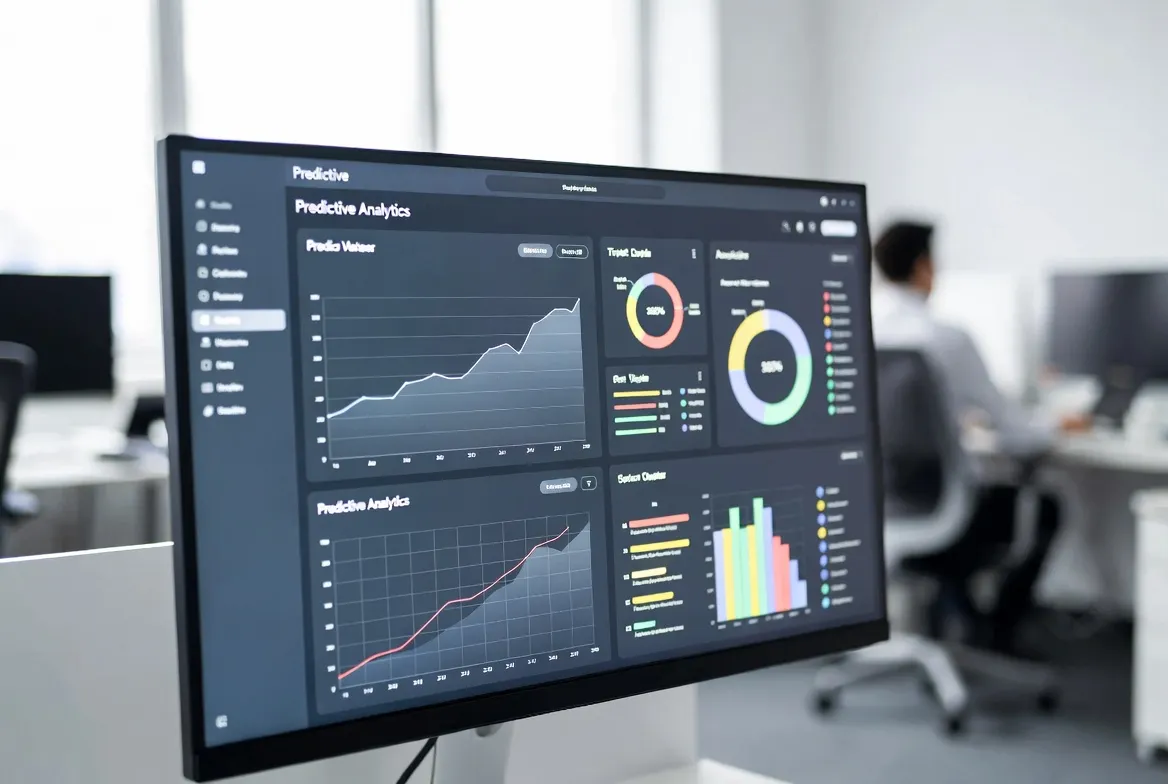
Quick Summary: Predictive analytics in insurance leverages historical data, machine learning, and real-time information to forecast future outcomes, enabling insurers to price policies more accurately, detect fraud, streamline claims processing, and personalize customer experiences. The technology adoption is growing rapidly across life, health, and property-casualty insurance sectors, transforming underwriting, risk assessment, and operational efficiency. As the industry generates massive data volumes, predictive analytics has become essential for competitive advantage and profitability. The insurance industry has traditionally relied on backward-looking data and educated guesses. That approach doesn’t cut it anymore. Predictive analytics is reshaping how insurers assess risk, price policies, and interact with customers. According to the Society of Actuaries, predictive analytics adoption among health care organizations is growing, with many executives implementing or planning to implement these technologies. But here’s the thing—predictive analytics isn’t just about crunching numbers. It’s about turning data into actionable insights that drive profitability, reduce losses, and improve customer satisfaction.
What Is Predictive Analytics in Insurance?
Predictive analytics uses historical data, statistical algorithms, and machine learning techniques to identify the likelihood of future outcomes. For insurers, that means forecasting everything from claim frequency to customer churn. The process integrates multiple data sources—policy information, claims history, external databases, telematics, social determinants of health, and real-time streaming data. Actuaries and data scientists build models that detect patterns humans would miss. Health care generates as much as 30% of the world’s data, and new technologies are changing how life insurers analyze consumer information. Actuaries are uniquely positioned to harness these complexities because they understand both data modeling and business application.
Why Insurers Can’t Ignore Predictive Analytics
Competitive pressures are mounting. According to the Willis Towers Watson Life Predictive Analytics Survey Report from September 2018, life insurance companies rated these factors as highly important:
- Competitive pressures in product development and pricing (78% of respondents)
- Customer relationship management (67%)
- Earnings and profitability pressures (64%)
- Technology innovation (cited as a driver by most respondents)
The short answer? Predictive analytics is no longer optional—it’s the engine behind growth, efficiency, and competitive advantage. Research indicates that insurers implementing well-designed customer experience strategies can achieve meaningful improvements in customer satisfaction and revenue growth.
Key Use Cases for Predictive Analytics in Insurance
Predictive analytics touches nearly every operational area. Here are the most impactful applications.
Risk Assessment and Underwriting
Traditional underwriting relies on broad demographic categories and historical averages. Predictive models dig deeper. Machine learning algorithms analyze hundreds of variables simultaneously—credit scores, health records, lifestyle factors, geographic data, even social determinants of health. The result? More accurate risk segmentation and pricing that reflects individual circumstances rather than crude generalizations. According to the Society of Actuaries, insurers are exploring whether real-time fully underwritten decisions are an achievable goal. The technology is getting there.
Fraud Detection and Prevention
Insurance fraud costs the industry dearly. According to the Coalition Against Insurance Fraud, an estimated $308.6 billion is lost annually to fraudulent claims in the United States. In fact, fraud accounts for 5–10% of total claims costs for insurers. Predictive models flag suspicious patterns in real time. Anomalies in claim timing, medical billing codes, provider networks, or claimant behavior trigger alerts for investigation. Machine learning improves over time. As models process more claims, they become better at distinguishing legitimate from fraudulent activity. The result? Faster detection, reduced losses, and deterrence effects as fraudsters realize their schemes won’t work.
Claims Processing and Management
Claims processing has historically been slow and labor-intensive. Predictive analytics streamlines the entire workflow. Models can estimate claim severity within hours of an incident report. They identify which claims require detailed investigation versus which can be fast-tracked. They predict settlement costs, helping adjusters negotiate more effectively. Automation handles routine claims end-to-end. Complex cases get routed to experienced adjusters with the right expertise. The efficiency gains are substantial—lower operational costs and faster payouts that improve customer satisfaction.
Customer Personalization and Retention
Predictive analytics enables mass customization. Insurers can tailor policy recommendations, pricing, and communication based on individual customer profiles. Churn prediction models identify customers at risk of switching carriers. Targeted retention campaigns—policy adjustments, loyalty incentives, proactive outreach—keep high-value customers from walking away. Usage-based insurance programs rely on predictive analytics. Telematics data from vehicles or wearables from health monitoring devices feed models that adjust premiums based on actual behavior, not assumptions.
| Use Case | Primary Benefit | Data Sources |
|---|---|---|
| Risk Assessment | Accurate pricing, reduced adverse selection | Demographics, claims history, external databases |
| Fraud Detection | Prevent $80B annual losses | Claims patterns, provider networks, anomaly detection |
| Claims Processing | Faster settlements, lower costs | Incident reports, historical claims, severity models |
| Customer Retention | Meaningful satisfaction improvement | Behavioral data, policy interactions, churn signals |
| Product Development | Market-driven innovation | Competitive analysis, customer feedback, trend data |
Predictive Analytics Across Insurance Sectors
Life Insurance
Life insurers use predictive analytics for mortality modeling, lapse prediction, and policy persistence forecasting. Industry surveys indicate growing adoption of predictive models across group life and individual life insurance segments. Underwriting acceleration is a major focus. Models assess applicant risk using non-medical data, reducing the need for lengthy exams and blood tests. The Society of Actuaries notes that real-time fully underwritten decisions are on the horizon.
Health Insurance
Health insurers apply predictive analytics to population health management, medical cost forecasting, and utilization management. Social determinants of health—factors like housing stability, education, and access to transportation—are increasingly integrated into risk scoring. Provider network optimization relies on predictive models that forecast patient outcomes by provider, enabling insurers to steer members toward high-quality, cost-effective care.
Property and Casualty Insurance
P&C insurers use predictive analytics for catastrophe modeling, claims forecasting, and pricing optimization. According to the National Flood Insurance Program (cited by the Insurance Information Institute), 90 percent of all natural disasters in the United States involve flooding. Telematics in auto insurance allows real-time risk assessment. Models analyze driving behavior—speed, braking patterns, mileage—and adjust premiums accordingly. The feedback loop encourages safer driving. 
Get Predictive Models for Insurance Risk, Pricing, and Claims
Insurance teams already have the inputs – claims history, policy data, customer profiles. The challenge is turning that data into decisions that support underwriting, pricing, and fraud detection. AI Superior develops custom AI software that includes predictive models and applies them to real insurance data and processes, helping insurers use machine learning in core operations.
Apply Predictive Analytics Across Core Insurance Operations
Instead of treating analytics as a separate layer, AI Superior focuses on practical use:
- Apply machine learning to policy and claims data
- Support underwriting and risk evaluation with predictive models
- Identify patterns relevant to fraud detection
- Integrate models into existing systems and processes
- Monitor and update models as data changes
If underwriting and claims decisions still rely on historical data alone, (/contact/) and explore how predictive models can support your operations.
Tools and Technologies Powering Predictive Analytics
Modern predictive analytics platforms combine multiple technologies:
- Machine Learning Frameworks: TensorFlow, PyTorch, and scikit-learn provide the foundation for building and training models. These frameworks handle everything from linear regression to deep neural networks.
- Data Streaming Platforms: Real-time data processing requires tools like Apache Kafka or Confluent. These platforms ingest data from telematics, IoT devices, claims systems, and external APIs, feeding predictive models with up-to-the-second information.
- Cloud Infrastructure: AWS, Azure, and Google Cloud offer scalable computing resources. Insurers can process massive datasets without maintaining expensive on-premises hardware.
- Generative AI: Newer applications incorporate large language models for natural language processing—analyzing unstructured data like claim notes, medical records, or customer service transcripts to extract insights traditional models would miss.
Challenges and Considerations
Now, this is where it gets tricky. Predictive analytics isn’t plug-and-play:
- Data Quality: Models are only as good as their inputs. Incomplete, outdated, or biased data produces unreliable predictions. Data governance—standardization, validation, lineage tracking—is foundational.
- Regulatory Compliance: Insurance is heavily regulated. Predictive models must comply with fair lending laws, anti-discrimination statutes, and privacy regulations. Explainability matters—regulators want to understand how models make decisions.
- Talent Gaps: Building and maintaining predictive analytics systems requires specialized skills. Actuaries, data scientists, and machine learning engineers are in high demand and short supply.
- Integration Complexity: Legacy systems weren’t designed for real-time data flows. Integrating predictive models with existing policy administration, claims management, and billing systems requires significant IT investment.
The Future of Predictive Analytics in Insurance
Where is this headed? Real-time underwriting will become standard. Applicants will receive instant quotes based on comprehensive risk assessments that consider hundreds of variables. Continuous risk monitoring will replace annual policy renewals. Models will adjust premiums dynamically as customer circumstances change—a new job, a move to a different neighborhood, improved health metrics. Ecosystem integration will expand. Insurers will partner with healthcare providers, auto manufacturers, smart home companies, and wearable device makers to access richer data streams. Ethical AI frameworks will mature. Industry standards for model transparency, bias detection, and fairness will emerge, balancing innovation with consumer protection. According to the Society of Actuaries, actuaries will continue to play a central role—they understand both the technical complexities of predictive modeling and the business realities of insurance operations.
Frequently Asked Questions
What is predictive analytics in insurance?
Predictive analytics in insurance uses historical data, statistical algorithms, and machine learning to forecast future events like claim likelihood, fraud risk, customer churn, and policy lapses. It enables insurers to make data-driven decisions about pricing, underwriting, and customer engagement.
How does predictive analytics improve underwriting?
Predictive models analyze hundreds of variables simultaneously—health records, credit scores, lifestyle factors, geographic data—to assess individual risk more accurately than traditional demographic-based methods. This leads to better pricing, reduced adverse selection, and faster underwriting decisions.
Can predictive analytics really detect insurance fraud?
Yes. Machine learning models identify suspicious patterns in claim timing, billing codes, provider networks, and claimant behavior. Fraud accounts for 5–10% of total claims costs, and predictive analytics significantly reduces these losses by flagging anomalies for investigation in real time.
What data sources do insurers use for predictive analytics?
Insurers integrate policy information, claims history, external credit bureaus, telematics from vehicles, wearable health devices, social determinants of health, weather data, public records, and real-time streaming data from IoT devices. Data quality and governance are critical for model accuracy.
Is predictive analytics widely adopted in insurance?
Predictive analytics adoption among insurance organizations is growing rapidly. According to the Society of Actuaries, adoption rates are expanding across life, health, and property-casualty sectors, with many executives implementing or planning to implement these technologies.
What are the main challenges of implementing predictive analytics?
Key challenges include data quality issues, regulatory compliance requirements, talent shortages for data scientists and actuaries, integration complexity with legacy systems, and the need for model explainability to satisfy regulators and customers.
How will predictive analytics change insurance in the future?
Expect real-time underwriting with instant decisions, continuous risk monitoring that adjusts premiums dynamically, deeper ecosystem integration with healthcare and IoT providers, and more sophisticated ethical AI frameworks that balance innovation with consumer protection.
Making Predictive Analytics Work
Predictive analytics isn’t just a technology investment—it’s a strategic imperative. Insurers who master data-driven decision-making will outperform competitors on profitability, customer satisfaction, and operational efficiency. But success requires more than buying software. It demands organizational commitment—executive sponsorship, cross-functional collaboration between IT, underwriting, claims, and actuarial teams, and a culture that values experimentation and continuous improvement. The data is already there. Health care generates 30% of the world’s data. Telematics devices track driving behavior. Wearables monitor health metrics. The question isn’t whether to use predictive analytics. The question is how quickly an organization can turn that data into competitive advantage.