
Quick Summary: Predictive analytics in shipping uses AI and machine learning to analyze massive datasets—weather patterns, port congestion, fuel prices, demand trends—and forecast outcomes before they happen. This technology helps carriers and freight forwarders optimize routes, predict delays, reduce costs, and manage risks in real time, transforming reactive supply chains into proactive, data-driven operations. The shipping industry has relied on the same foundational processes for decades—route planning, carrier selection, cargo management. But the tools powering those processes? They’re changing fast. Predictive analytics is rewriting the playbook. Instead of reacting to delays, port congestion, or demand spikes after they happen, shipping companies can now see them coming and adjust course. According to the Brookings Institution, small businesses using digital platforms like eBay saw a 97% export rate compared to just 4% for offline peers. Here’s the thing though—predictive analytics isn’t just about forecasting weather or fuel costs. It’s about connecting billions of data points across the entire shipping lifecycle and turning that information into actionable decisions.
What Predictive Analytics Actually Means for Shipping
Predictive intelligence in the maritime industry uses artificial intelligence methods and advanced analytics to track billions of data points. These systems identify maritime trends and forecast future events—delays, route disruptions, demand shifts, compliance risks. Real talk: this isn’t just theoretical. Industry analyses indicate that approximately 55-65% of ships arrived at ports later than expected, leading to losses ranging between $5 and $10 billion. Predictive analytics tackles this head-on by analyzing historical and real-time data to spot patterns that signal trouble before it escalates. The technology works by layering multiple data streams:
- Weather conditions and forecasts
- Port congestion and berth availability
- Traffic patterns and vessel movements
- Fuel prices and consumption rates
- Historical delay patterns
- Demand signals from freight bookings
Machine learning algorithms process this data continuously, updating predictions as conditions change. That means shipping companies can adjust routes mid-voyage, reroute cargo before a port shuts down, or staff warehouses ahead of demand surges. 
Use Predictive Analytics with AI Superior
AI Superior works with logistics and operational data to build predictive models that support planning, tracking, and optimization. The focus is on integrating models into existing systems so predictions can support day-to-day operations.
Looking to Apply Predictive Analytics in Shipping?
AI Superior can help with:
- evaluating logistics and operational data
- building predictive models
- integrating models into existing systems
- improving performance based on results
👉 Contact AI Superior to discuss your project, data, and implementation approach
Route Optimization: Cutting Costs and Carbon
AI-powered predictive analytics is changing how shipping routes are planned and managed. Analyzing real-time data—weather, traffic, port conditions—helps ships take the most efficient paths. Traditional route planning relied on static charts and historical averages. AI-driven systems update constantly. If a storm develops mid-Pacific, the system recalculates and suggests an alternate route that adds fewer hours than waiting out the weather. If port congestion spikes in Los Angeles, cargo gets rerouted to Oakland before the vessel even arrives. This improves fuel efficiency, reduces transit times, and lowers emissions. And look—fuel is one of the biggest operating expenses for carriers. Shaving even 5% off fuel consumption per voyage translates to millions in annual savings for large fleets.
| Aspect | Traditional Route Planning | AI-Driven Predictive Analytics |
|---|---|---|
| Data Usage | Limited, static historical data | Real-time, dynamic multi-source data |
| Flexibility | Low, reactive to events | High, proactive adjustments |
| Decision Speed | Slower, manual review required | Faster, automated recommendations |
| Efficiency Gains | Moderate, incremental | Significant, compounding over time |
| Environmental Impact | Higher fuel consumption | Reduced emissions through optimization |
The International Maritime Organization has taken action to create a comprehensive strategy that harnesses emerging technologies to improve efficiency, safety, and sustainability in the shipping industry. Predictive analytics sits at the center of that vision.
Demand Forecasting: Matching Capacity to Need
Predicting demand is critical for freight forwarders and logistics companies. Too much capacity means wasted resources. Too little means missed revenue and unhappy customers. Predictive analytics enables logistics companies to forecast demand and better mitigate risks. The systems analyze historical booking patterns, economic indicators, seasonal trends, and even geopolitical signals to anticipate cargo volumes weeks or months ahead. For example, if analytics detect early signs of retail inventory buildup in China ahead of the holiday season, freight forwarders can allocate container space and negotiate carrier contracts before rates spike. Conversely, if demand signals weaken, they can scale back and avoid committing to unused capacity.
Delay Prediction and Risk Management
Delays, even minor ones, result in substantial fees and unforeseen expenses. Access to advanced maritime analytics helps organizations stay ahead of disruptions. Predictive intelligence systems track vessel movements, port congestion, labor strikes, customs delays, and equipment shortages. When multiple risk factors align—say, a vessel running behind schedule approaching a port with known berth shortages—the system flags the delay risk hours or days in advance. That early warning gives logistics teams time to reroute cargo, notify customers, adjust warehouse staffing, or rebook connecting transport. It’s the difference between reacting to a crisis and managing a known variable. 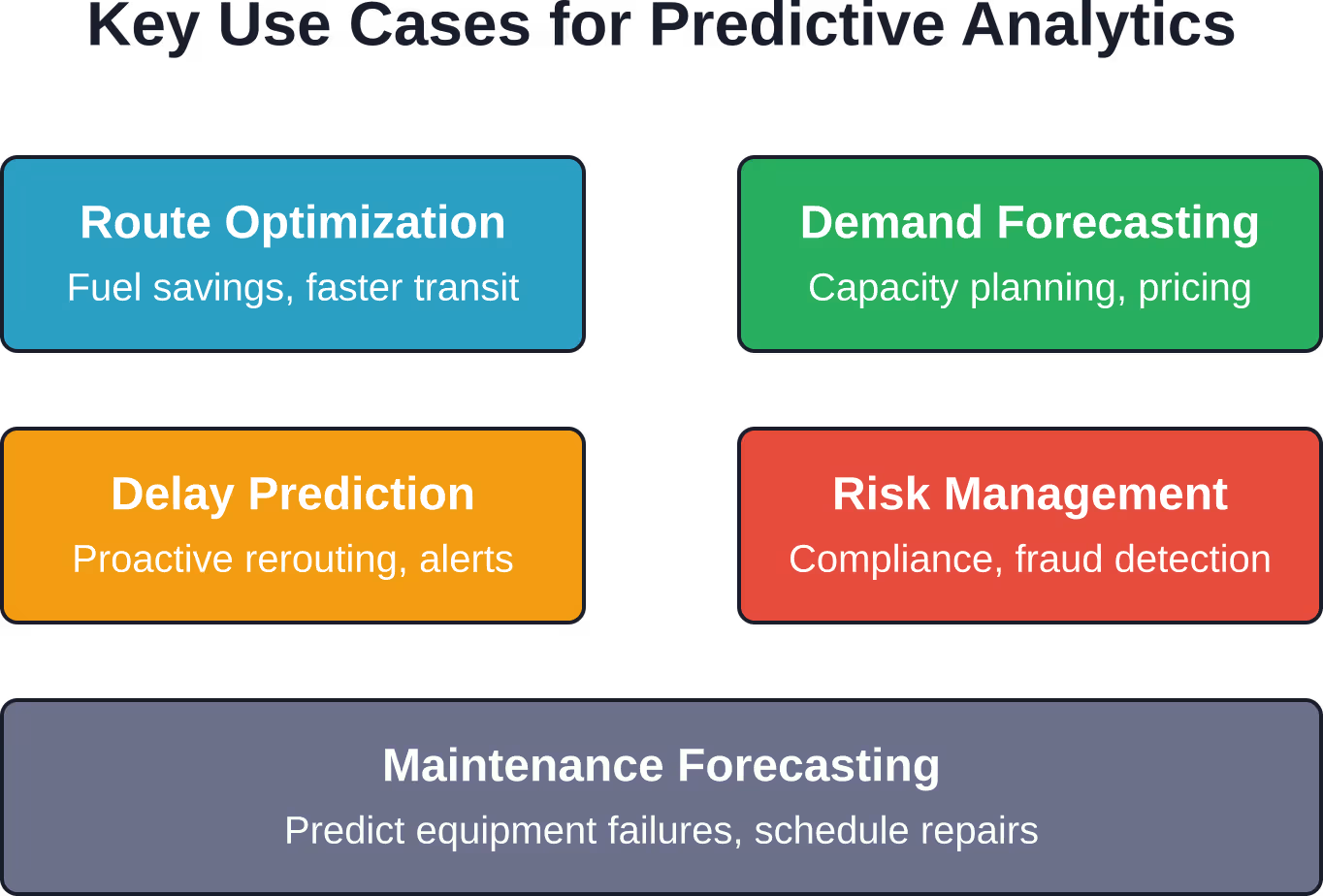
Compliance and Security Applications
Regulatory compliance is a growing concern for maritime companies. Sanctions lists change frequently, vessel registrations can be deceptive, and cargo declarations don’t always match reality. Predictive intelligence systems help organizations maintain compliance by cross-referencing vessel data against sanctions lists (like OFAC), tracking ownership changes, and flagging suspicious behavior patterns—vessels that go dark by turning off transponders, frequent port visits to high-risk regions, or rapid ownership transfers. For commodity trading firms and security teams, this visibility reduces the risk of inadvertently doing business with sanctioned entities or financing illicit activities. It’s not just about avoiding fines—it’s about protecting brand reputation and maintaining customer trust.
How Shipping Companies Integrate Predictive Analytics
Implementing predictive analytics doesn’t mean ripping out existing systems. Most shipping companies integrate these tools into their transportation management systems (TMS) or use standalone platforms that pull data from multiple sources. The integration typically works like this:
- Data feeds from vessel tracking systems, port authorities, weather services, and internal booking systems flow into the analytics platform.
- Machine learning models process the data, identifying patterns and generating forecasts.
- Insights are pushed back into the TMS or delivered via dashboards, alerts, and reports.
- Logistics teams act on recommendations—rerouting shipments, adjusting staffing, notifying customers.
The reliability of AI and predictive analytics depends on data quality. Garbage in, garbage out. Shipping companies that invest in clean, standardized data inputs see faster, more accurate predictions. Those with fragmented or inconsistent data struggle to realize the full value.
Challenges and Limitations
Predictive analytics isn’t a magic bullet. The technology has limitations. First, it requires substantial data infrastructure. Smaller carriers or freight forwarders without digital systems can’t feed the algorithms the data they need. Second, predictions are probabilistic, not certain. A system might forecast a 70% chance of delay—but that still leaves a 30% chance everything goes smoothly. Decision-makers need to understand that predictive analytics reduces risk; it doesn’t eliminate it. Third, there’s the human factor. If logistics teams don’t trust the predictions or lack the authority to act on them, the technology sits idle. Change management and training are just as important as the software itself. And finally, costs. Enterprise-grade predictive analytics platforms require investment—licensing fees, data integration, training, ongoing maintenance. For large carriers and freight forwarders, the ROI is clear. For smaller operators, the business case can be harder to justify.
The Competitive Edge Predictive Analytics Provides
Here’s the thing: predictive analytics is becoming table stakes. The companies adopting it now are pulling ahead—lower costs, faster delivery times, happier customers. Those waiting risk falling behind competitors who can offer more reliable service at better prices. According to research on Supply Chain Trends for 2025, artificial intelligence is transforming logistics with predictive analytics, real-time tracking, automation, and autonomous trucking. The trend is accelerating, not slowing down. Supply chain data works harder when it’s fed into predictive models. Instead of sitting in silos—vessel positions in one system, booking data in another, port schedules in a third—analytics platforms connect those dots and surface insights no single dataset could reveal. That competitive edge compounds over time. Better predictions lead to better decisions. Better decisions lead to lower costs and higher service levels. Higher service levels attract more customers. More customers generate more data, which improves predictions further. It’s a virtuous cycle.
Looking Ahead: What’s Next for Predictive Analytics in Shipping
The technology is evolving fast. Expect to see deeper integration with autonomous systems—predictive analytics guiding autonomous vessels, automated port equipment, and drone-based inspections. Blockchain integration could provide tamper-proof data feeds, improving prediction accuracy and compliance tracking. Georgia Tech research on predicting the future of supply chains emphasizes learning from the past to navigate uncertainty. As predictive models ingest more historical disruption data—pandemics, trade wars, natural disasters—they’ll get better at anticipating black swan events and suggesting contingency plans. And as computing power grows cheaper and AI models become more accessible, predictive analytics will trickle down to smaller operators. Cloud-based platforms with pay-as-you-go pricing are already emerging, democratizing access to tools that were once only available to the largest carriers.
Frequently Asked Questions
What is predictive analytics in the shipping industry?
Predictive analytics in shipping uses artificial intelligence and machine learning to analyze vast datasets—weather, port congestion, fuel prices, demand trends—and forecast future outcomes. This helps carriers and freight forwarders optimize routes, predict delays, manage risks, and make data-driven decisions in real time.
How does predictive analytics reduce shipping costs?
Predictive analytics reduces costs by optimizing routes to save fuel, forecasting demand to match capacity efficiently, predicting delays to avoid penalties and fees, and identifying maintenance needs before equipment failures occur. These improvements compound over time, delivering significant savings for carriers and logistics companies.
What data sources do predictive analytics systems use?
Predictive analytics platforms pull data from vessel tracking systems, weather forecasts, port authorities, historical shipping records, freight booking platforms, fuel price feeds, economic indicators, and compliance databases. The more diverse and high-quality the data, the more accurate the predictions.
Can small shipping companies benefit from predictive analytics?
Yes, though the business case depends on scale and digital maturity. Cloud-based predictive analytics platforms with flexible pricing are making the technology more accessible to smaller operators. However, companies need clean, standardized data inputs to see value—fragmented or inconsistent data limits prediction accuracy.
Is predictive analytics the same as predictive intelligence?
The terms are often used interchangeably in the maritime industry. Predictive intelligence typically refers to the broader application of AI methods and advanced analytics to track billions of data points and forecast maritime events. Predictive analytics is the technical discipline underlying those capabilities.
How accurate are predictive analytics forecasts in shipping?
Accuracy varies based on data quality, model sophistication, and the specific use case. Delay predictions and route optimizations can be highly accurate when fed real-time, clean data. Demand forecasting is less precise due to external variables like economic shifts and geopolitical events. No system is 100% accurate—predictions are probabilistic, not certain.
What’s the biggest challenge in implementing predictive analytics?
Data quality and integration are the biggest hurdles. Predictive analytics requires clean, standardized data from multiple sources. Many shipping companies have fragmented systems that don’t talk to each other. Integrating those systems, ensuring data consistency, and training teams to act on insights require time, investment, and organizational change.
Conclusion
Predictive analytics is transforming the shipping industry from a reactive, best-guess operation into a proactive, data-driven machine. The technology isn’t futuristic—it’s here, it’s working, and companies that adopt it are already seeing measurable results in cost savings, service reliability, and risk management. But success requires more than buying software. It demands clean data, organizational buy-in, and a willingness to trust the models enough to act on their recommendations. For shipping companies ready to make that leap, the competitive advantage is real and growing. Start by auditing existing data infrastructure. Identify gaps. Pilot a predictive analytics tool on a single use case—route optimization or delay prediction—and measure results. Then scale what works. The future of shipping is predictable. The question is whether organizations will use that predictability to get ahead or let competitors take the lead.