
Quick Summary: AI will not completely replace attorneys, but it will fundamentally transform how legal work gets done. While AI excels at automating repetitive tasks like document review and legal research, the profession’s core elements—strategic judgment, client relationships, ethical decision-making, and courtroom advocacy—remain uniquely human. Lawyers who embrace AI as a productivity tool will thrive, while those who resist adaptation may find themselves left behind. Artificial intelligence has sparked intense debate across professional fields, and the legal profession stands at the center of this technological storm. Every week brings new headlines about AI tools that can draft contracts, analyze case law, or predict litigation outcomes. This raises an urgent question for current and aspiring attorneys: will artificial intelligence make lawyers obsolete? The short answer? No—but that doesn’t mean business as usual. According to the Brookings Institution, more than 30% of all workers could see at least 50% of their occupation’s tasks disrupted by generative AI. The legal profession isn’t immune to this transformation. Yet the reality is more nuanced than simple replacement scenarios suggest. State bar associations have escalated their work on ethical issues raised by artificial intelligence, recognizing that regulation must keep pace with innovation. The promise of AI technologies captured the imagination of the legal community in a big way in 2023 and continues to reshape practices in 2026. Let’s examine what’s actually happening in legal practice, what the data shows, and where human attorneys remain irreplaceable.
The Current State of AI in Legal Practice
AI isn’t a future threat—it’s already embedded in daily legal work. Law firms use machine learning algorithms for e-discovery, contract analysis, and legal research. These tools process documents at speeds no human team could match. But here’s the thing: processing speed and actual legal judgment aren’t the same skill set. Generative AI tools like ChatGPT entered mainstream legal awareness in 2023, creating both excitement and cautionary tales. One notorious case illustrates the current limitations perfectly. A New York attorney used ChatGPT to supplement legal research, and the AI provided completely fabricated cases. When the court asked for verification, the attorney went back to ChatGPT, which “complied by inventing a much longer text.” This incident wasn’t an isolated glitch. It revealed fundamental constraints in how current AI systems operate—they generate plausible-sounding content without genuine understanding or verification capabilities.
How Law Firms Actually Use AI Today
In practice, legal AI applications focus on specific, well-defined tasks:
- Document review and discovery, analyzing thousands of pages for relevant information
- Legal research assistance, finding potentially relevant cases and statutes
- Contract analysis, identifying standard clauses and flagging anomalies
- Predictive analytics for case outcomes based on historical data
- Routine document drafting using templates and form generation
- Billing and practice management automation
These applications augment attorney capabilities rather than replace them. The technology handles volume and repetition, freeing lawyers to focus on strategy, interpretation, and client service. The New Jersey State Bar Association task force warned that AI tools “could significantly disrupt the industry’s traditional hourly billing model.” When technology makes work more efficient, billing practices built on billable hours face pressure. This represents a business model challenge, not job elimination. 
AI Systems Development With AI Superior
AI Superior works on building AI systems that can be applied within existing business environments. The process usually involves reviewing the problem, working with available data, and developing models that can be tested and scaled over time.
Considering AI for Your Business Processes?
AI Superior can help with:
- developing AI systems tailored to operational needs
- assessing feasibility based on available data
- integrating AI into current platforms and workflows
👉 Contact AI Superior to discuss your project, data, and implementation approach
What Employment Data Reveals About AI and Legal Jobs
The Bureau of Labor Statistics has incorporated AI impacts into employment projections, offering data-driven insights beyond speculation. Over the 2023–33 projections period, AI is expected to primarily affect occupations whose core tasks can be most easily replicated by generative AI in its current form. Legal occupations present a mixed picture. According to BLS analysis, technology may disrupt occupations without necessarily killing jobs. Historical patterns show that automation typically transforms work rather than eliminating entire professions. Consider photography: digital cameras replaced film cameras, devastating employment for photographic process workers. But the photography profession adapted and evolved. Similarly, legal professionals face transformation, not extinction. Research on growth trends for occupations considered at risk from automation shows a consistent pattern: concerns about technological unemployment have appeared repeatedly throughout history—in the 1950s and 1960s regarding computers and industrial automation, and earlier with mechanical technology. Each time, the predicted massive job losses failed to materialize. That doesn’t mean individual workers never face displacement. It means professions adapt, specializations shift, and new roles emerge alongside technological change.
Where AI Falls Short: The Irreplaceable Human Elements
Several core aspects of legal practice resist automation, not because the technology will never improve, but because clients fundamentally value human attributes in their legal representatives.
Strategic Judgment and Creative Problem-Solving
AI excels at pattern recognition within existing data. Legal strategy often requires recognizing when established patterns don’t apply, when to argue for exceptions, or when to develop novel legal theories. A machine can identify relevant precedents. Deciding which precedents to emphasize, which to distinguish, and how to craft a compelling narrative around them requires judgment that emerges from experience, intuition, and strategic thinking. Complex litigation involves countless micro-decisions: which witnesses to call, how to sequence evidence, when to settle versus pushing to trial. These decisions depend on reading subtle cues, understanding human psychology, and making probabilistic judgments under uncertainty.
Client Relationships and Emotional Intelligence
Legal matters typically arrive during stressful life circumstances—divorces, business disputes, criminal charges, estate planning after loss. Clients need someone who can understand their situation, manage their anxiety, and guide them through unfamiliar territory. This relational dimension can’t be automated. Trust develops through human connection, not algorithmic efficiency. A client facing criminal charges doesn’t want a chatbot—they want an advocate who believes in their case and will fight for them. The ability to read a room, sense when a client isn’t telling the whole truth, or recognize when opposing counsel is bluffing—these skills require emotional intelligence that remains distinctly human.
Ethical Decision-Making in Gray Areas
Legal ethics involve navigating situations where rules conflict, where obligations to clients clash with duties to the court, or where the right course of action isn’t obvious. State bar associations have escalated work on ethical issues raised by artificial intelligence precisely because technology creates new dilemmas that existing rules didn’t anticipate. Who is responsible when AI makes an error? How should billing work when AI does the task? What constitutes adequate supervision of AI tools? These questions require human judgment grounded in professional responsibility. An AI can’t shoulder ethical accountability because accountability requires agency and moral reasoning.
Courtroom Advocacy and Persuasion
Trial advocacy combines preparation with real-time adaptation. Effective cross-examination requires listening to answers and adjusting follow-up questions based on subtle cues. Oral arguments before appellate courts demand responding to judges’ concerns and reading which arguments are landing. No AI system can replicate the dynamic, improvisational nature of courtroom practice. The technology might help prepare, but the performance requires human presence and adaptability.
The Transformation of Legal Work: What’s Actually Changing
Rather than replacement, the legal profession is experiencing a restructuring of how work gets done and who does which tasks.
Shifting Task Allocation
Historically, junior associates spent years on document review and basic research—tasks that built skills but also generated billable hours. AI now handles much of this work faster and cheaper. This shift creates both challenges and opportunities. New attorneys may lose traditional training grounds, requiring law firms to develop new mentorship and skill-building approaches. But it also frees lawyers from tedious work to focus on higher-value activities. The structure of legal teams may evolve. Firms might need fewer junior associates for document work but more specialists in legal technology, data analysis, and AI oversight.
Business Model Disruption
The New Jersey State Bar Association identified a critical tension: AI efficiency “may conflict with current billing practices.” When software completes in minutes what previously took hours, billing by the hour becomes problematic. This pressure accelerates movement toward alternative fee arrangements—flat fees, contingency fees, subscription models. The shift affects firm economics and may ultimately benefit clients through lower costs and greater predictability. Law firms that adapt their business models to leverage AI efficiency will gain competitive advantages. Those clinging to billable-hour models may struggle.
Access to Justice Improvements
One promising dimension: AI could expand legal services access for populations currently underserved. Automated document preparation, chatbots for basic legal information, and AI-assisted self-help tools can reach people who can’t afford traditional legal representation. This doesn’t replace attorneys for complex matters, but it potentially addresses the vast middle ground where people need legal help but lack resources for full-service representation.
| Legal Task Category | AI Capability Level | Human Attorney Role | Impact on Profession |
|---|---|---|---|
| Document Review | High automation | Oversight and exceptions | Reduced junior associate hours |
| Legal Research | Strong assistance | Analysis and application | Faster research, deeper analysis |
| Contract Drafting | Template-based automation | Customization and negotiation | Shift from drafting to reviewing |
| Case Strategy | Data insights only | Decision-making authority | Enhanced by data, still human-led |
| Client Counseling | Minimal | Primary responsibility | Remains core attorney function |
| Courtroom Advocacy | None | Complete human control | No automation foreseeable |
| Ethical Judgment | None | Full accountability | Increased complexity from AI use |
Real Risks: Where Attorneys Face Genuine Disruption
Dismissing AI concerns entirely would be naïve. Certain practice areas and attorney roles face genuine pressure.
Document-Heavy Practice Areas
Attorneys whose work consists primarily of high-volume, standardized document production face the most direct competition from AI. This includes some consumer bankruptcy practices, simple real estate closings, basic estate planning with standard forms, and routine contract work. These practice areas aren’t disappearing, but they’re being commoditized. Attorneys competing primarily on price for standardized services will struggle against AI-powered alternatives.
Junior Associate Training Gaps
When AI handles document review that previously trained new lawyers, how do junior attorneys develop foundational skills? This creates a potential skills pipeline problem for the profession. Law firms must intentionally create new training pathways. Simply assuming junior lawyers will learn the same way partners did won’t work when the work structure has fundamentally changed.
Solo and Small Firm Competition
Large firms can invest in expensive AI tools and dedicated legal technology staff. Solo practitioners and small firms may lack resources for comparable investments, creating a competitive disadvantage. However, the market is developing more accessible AI tools, and smaller firms often have advantages in client relationships and responsiveness that technology can’t replicate.
What Legal Education Is Doing About AI
Law schools recognize they must prepare students for an AI-integrated profession. Penn Carey Law is leading this transformation with a focus on technological fluency and ethical practices. As of early 2026, the University of Pennsylvania Carey Law School has committed to supporting the next generation of legal professionals through innovative interdisciplinary legal education that incorporates AI literacy. Similarly, St. Mary’s Law decided to tackle artificial intelligence head-on, recognizing that “artificial intelligence is significantly impacting law schools in numerous ways, requiring them to adapt to this rapidly evolving technology to prepare future lawyers effectively.” Legal education reforms focus on several areas:
- Teaching students how to effectively use AI research tools while understanding their limitations
- Developing curriculum around AI ethics and professional responsibility
- Training in technology project management and legal operations
- Emphasizing skills AI can’t replicate—negotiation, client counseling, strategic thinking
- Creating awareness of how technology changes legal business models
Arizona State University Law notes that artificial intelligence is rapidly reshaping the legal field, from how lawyers practice to how societies regulate technology. At the same time, law will determine how AI evolves, creating reciprocal influence. 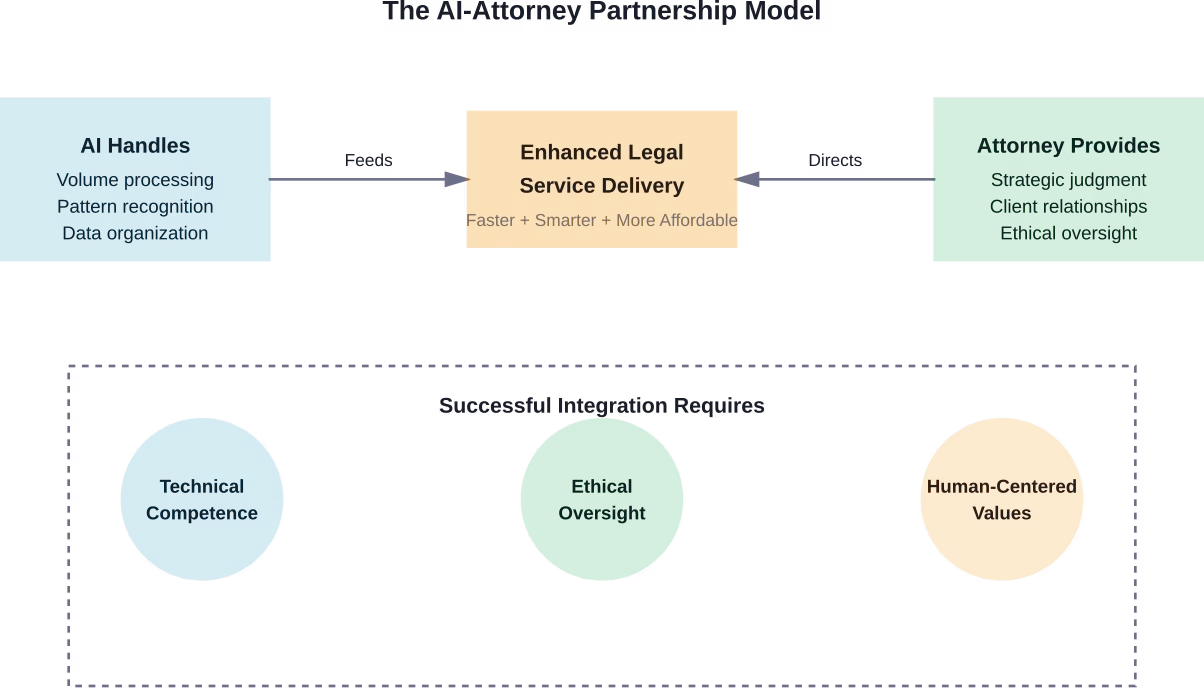
Expert Perspectives on AI and the Legal Future
Legal technology experts and bar association leaders offer nuanced views that reject both technological panic and complacent dismissal. The consensus among informed observers: AI won’t replace lawyers, but lawyers who use AI will replace lawyers who don’t. This framing shifts the question from whether automation threatens attorneys to how attorneys can leverage automation effectively. Community discussions among practicing attorneys reveal practical concerns about implementation. Many lawyers report that AI tools save significant time on routine tasks but require careful oversight to catch errors and ensure accuracy. The experience aligns with what the Brookings Institution found regarding exposure versus actual displacement. Having a job that’s exposed to AI disruption doesn’t mean the job disappears—it means the work changes.
The Skills That Matter More Now
As AI handles technical tasks more efficiently, distinctly human skills become more valuable:
- Relationship building and maintaining client trust
- Strategic thinking and creative problem-solving
- Cross-disciplinary knowledge connecting law to business, technology, and social contexts
- Communication skills for persuasion and negotiation
- Emotional intelligence for reading situations and people
- Ethical judgment in complex situations
- Technology fluency to effectively direct AI tools
Law schools that trained students to be legal research robots created lawyers vulnerable to automation. Those emphasizing judgment, communication, and strategic thinking prepare graduates for an AI-integrated profession.
Regulatory and Ethical Frameworks Emerging
Bar associations haven’t stood idle as AI transforms legal practice. Regulatory bodies are developing frameworks to govern AI use while maintaining professional standards. State bar associations have escalated work on ethical issues raised by artificial intelligence, focusing on several key areas:
Competence Requirements
Attorneys must understand the technology they use well enough to ensure competent representation. This doesn’t require coding skills, but it does demand awareness of how AI tools work, their limitations, and potential failure modes. Using AI without understanding it violates competence obligations. The ChatGPT fabricated cases incident demonstrated this perfectly—the attorney failed to verify AI output, producing incompetent work.
Supervision and Accountability
Who bears responsibility when AI makes errors? Existing ethics rules place accountability squarely on the attorney. AI tools don’t have bar licenses—lawyers do. This means attorneys can’t blindly rely on AI output. They must review, verify, and take responsibility for all work product, regardless of whether a human or algorithm generated the initial draft.
Billing Ethics
The New Jersey State Bar Association specifically addressed billing practices in its AI guidance. When AI completes work in minutes that previously took hours, billing as if human hours were spent raises ethical problems. Attorneys must bill honestly for the value delivered and time actually spent, not inflate bills based on pre-AI timeframes. This ethical requirement accelerates pressure on hourly billing models.
Confidentiality Concerns
Using cloud-based AI tools with client information raises confidentiality questions. Where is data stored? Who can access it? Is it used to train AI models? Attorneys must ensure AI tools comply with confidentiality obligations, which may require specific contractual protections or using on-premise rather than cloud-based solutions for sensitive matters.
How Attorneys Can Prepare for an AI-Integrated Future
Rather than fearing replacement, attorneys can take practical steps to thrive alongside AI technology.
Develop Technology Fluency
Understanding AI capabilities and limitations should become part of basic professional competence. This doesn’t mean learning to code, but it does mean staying informed about available tools and how they work. Experiment with AI tools in low-stakes contexts. Many platforms offer free trials that allow exploration without risk. Hands-on experience builds intuition about what AI does well and where it fails.
Double Down on Human Skills
As AI handles technical tasks, human relationship skills become more valuable, not less. Invest in developing communication abilities, emotional intelligence, and strategic thinking. Clients increasingly have access to automated legal information. What they can’t automate is having someone who genuinely understands their situation, advocates for their interests, and guides them through difficult decisions.
Specialize Strategically
General practice in highly standardized areas faces the most AI competition. Developing specialized expertise in complex or emerging fields creates defensibility against automation. Areas involving novel legal questions, cross-border complexity, or high-stakes strategic decisions remain heavily human-dependent. Technology expertise itself—helping clients navigate AI regulation, intellectual property, or cybersecurity—creates opportunities.
Rethink Business Models
If hourly billing faces pressure from AI efficiency, what alternatives work better? Subscription models, flat fees, and value-based pricing may align better with AI-assisted delivery. Law firms that innovate on business models while leveraging technology for efficiency can simultaneously improve profitability and reduce client costs—a rare win-win.
Maintain Ethical Vigilance
AI creates new ethical dilemmas without clear precedents. Maintaining strong ethical practices requires active attention as technology evolves. When in doubt about AI use, consult ethics counsel or bar association guidance. Being proactive about ethical compliance prevents the kind of catastrophic mistakes that damage careers and client interests.
| Attorney Type | AI Threat Level | Primary Risk Factors | Adaptation Strategy |
|---|---|---|---|
| BigLaw Associates | Moderate | Document review automation | Pivot to complex analysis and strategy |
| Document-Heavy Solo Practice | High | Commoditization of routine work | Add specialized services or personal touch |
| Litigation Specialists | Low | Research efficiency changes | Leverage AI for faster case preparation |
| Transactional Attorneys | Moderate | Contract automation | Focus on negotiation and deal strategy |
| Trial Lawyers | Very Low | Minimal courtroom AI application | Use AI for preparation, compete on advocacy |
| Legal Educators | Low | Curriculum adaptation pressure | Integrate AI literacy into teaching |
| In-House Counsel | Low-Moderate | Efficiency expectations increase | Become AI-savvy business partners |
The Broader Context: AI Impact Across Professions
Attorneys aren’t alone in facing AI-driven transformation. Looking at broader employment patterns provides perspective. According to Brookings Institution research, more than 30% of all workers could see at least 50% of their occupation’s tasks disrupted by generative AI. The greatest impacts appear concentrated in middle- to higher-paid occupations, clerical roles, and positions held disproportionately by women. This pattern differs from previous automation waves that primarily affected manufacturing and blue-collar work. Generative AI’s strength with language and information processing means knowledge workers face disruption too. However, exposure doesn’t equal elimination. The Bureau of Labor Statistics notes that AI may support demand for some computer occupations, as software developers are needed to develop AI-based business solutions and database administrators must maintain more complex data infrastructure. Similarly, legal professionals may find new roles emerging—legal technologists, AI compliance specialists, legal data analysts—even as some traditional tasks automate.
Lessons from Other Industries
The Hollywood writers’ strike in 2023 provided insights into how creative professionals can protect livelihoods from generative AI. Writers negotiated contractual protections ensuring AI serves as a tool writers can use, not a replacement for human creativity. According to Bureau of Labor Statistics data, writers and authors in the motion picture and video industry earned an average annual wage of $136,690 in 2022. The strike demonstrated that even in well-compensated creative fields, workers recognize AI as requiring proactive response. Legal professionals might similarly negotiate how AI gets deployed in their workplaces, ensuring technology augments rather than replaces human judgment.
What Clients Actually Want
Amid discussions of what AI can do, it’s worth considering what clients actually value in legal representation. Clients certainly appreciate efficiency and cost savings that AI can enable. But research consistently shows that trust, communication, and perceived advocacy matter enormously in client satisfaction. A client facing a lawsuit doesn’t just want legal research—they want an attorney who makes them feel heard, explains complex issues clearly, and fights for their interests. A business needs a lawyer who understands their industry, anticipates problems, and provides strategic guidance beyond legal technicalities. These relationship elements can’t be automated because they’re inherently interpersonal. An algorithm can draft a motion, but it can’t look a nervous client in the eye and provide reassurance grounded in genuine expertise and commitment. In fact, as legal services become more technology-mediated in routine aspects, the human relationship dimensions may become more valuable as differentiators. Clients with access to AI-powered document services will pay premium fees for attorneys who offer genuine partnership and strategic counsel.
The Next Decade: Reasonable Predictions
What should attorneys realistically expect over the next ten years? AI capabilities will continue advancing, but several constraints will limit replacement scenarios:
Technical Constraints
Current AI systems lack genuine understanding, common sense reasoning, and ability to handle truly novel situations. These aren’t minor bugs—they’re fundamental limitations of how machine learning works. While AI will improve at pattern recognition and generating plausible text, the leap to genuine legal reasoning remains distant. Legal work involves applying general principles to unique factual circumstances, recognizing analogies, and making judgment calls in ambiguous situations.
Regulatory Barriers
The unauthorized practice of law remains illegal. AI tools can’t hold bar licenses, appear in court, or sign legal documents. These aren’t arbitrary restrictions—they exist because legal representation involves fiduciary duties and accountability. Regulatory frameworks will evolve, but they’re unlikely to permit fully automated legal representation for anything beyond the most routine matters. The stakes are too high and the potential for harm too great.
Market Dynamics
Some legal work will commoditize through AI, but that creates market segmentation rather than profession elimination. Budget options will use more automation, while premium services emphasize human expertise and relationships. This mirrors other professional services. Tax preparation saw significant automation, yet CPAs remain in demand for complex tax planning. Similarly, legal services will likely bifurcate between automated routine work and high-touch professional services.
Integration Challenges
According to RAND research, while most C-suite leaders believe the responsibility gap with AI is a serious challenge, 72 percent admit they don’t have an AI policy in place to guide responsible use. Organizations struggle to integrate AI effectively even when they recognize its importance. Technical capability runs ahead of organizational readiness, slowing practical deployment. Law firms face similar integration challenges—changing workflows, training staff, addressing ethical concerns, and revising business models all take time. The transformation will unfold gradually, not overnight.
Frequently Asked Questions
Will AI completely replace lawyers in the future?
No, AI will not completely replace lawyers. While AI excels at automating specific tasks like document review and basic research, core legal functions require human judgment, ethical reasoning, client relationships, and courtroom advocacy that AI cannot replicate. The profession will transform rather than disappear, with attorneys working alongside AI tools rather than being replaced by them.
What legal tasks are most at risk from AI automation?
High-volume, repetitive tasks face the greatest automation risk, including document review for e-discovery, basic legal research, template-based contract drafting, and routine form completion. Practice areas consisting primarily of standardized document work—some consumer bankruptcy, simple real estate closings, and basic estate planning—face commoditization pressure from AI-powered alternatives.
Can AI provide legal advice or represent clients in court?
No, AI cannot legally provide advice or represent clients. This constitutes unauthorized practice of law. AI tools can assist attorneys with research and document preparation, but licensed human attorneys must provide actual legal advice, make strategic decisions, and appear in court. Regulatory barriers and ethical accountability requirements prevent AI from replacing attorney representation.
How should law students prepare for an AI-integrated legal profession?
Law students should develop both technology fluency and distinctly human skills. This includes understanding AI capabilities and limitations, practicing with legal technology tools, and developing strong communication, negotiation, and strategic thinking abilities. Focus on skills AI can’t replicate—relationship building, creative problem-solving, and ethical judgment—while becoming competent with technology that enhances efficiency.
What ethical issues do lawyers face when using AI tools?
Key ethical concerns include maintaining competence when using technology, ensuring adequate supervision of AI-generated work, billing honestly when AI increases efficiency, protecting client confidentiality with cloud-based tools, and taking accountability for errors in AI-assisted work product. State bar associations have developed guidance emphasizing that attorneys remain fully responsible for work quality regardless of whether AI was used.
Will AI make legal services more affordable for average people?
AI has potential to improve access to justice by reducing costs for routine legal work and enabling automated document preparation for simple matters. This could help people who currently can’t afford legal services. However, complex matters requiring strategic judgment and personalized representation will likely remain premium services. The market may bifurcate between low-cost automated options and high-touch professional services.
How are law firms adapting their business models for AI?
Law firms face pressure to move away from hourly billing as AI completes tasks faster than human timekeeping suggests. Many are exploring alternative fee arrangements including flat fees, subscription models, and value-based pricing. Firms are also investing in legal technology staff, reimagining junior associate training, and developing new service delivery models that leverage AI efficiency while maintaining quality and ethical standards.
Conclusion: Partnership, Not Replacement
The question “will AI replace attorneys” frames the situation incorrectly. The real question is how attorneys and AI will work together to deliver better, faster, more accessible legal services. Technology has always transformed legal practice—from typewriters to computers to legal research databases. Each innovation changed how lawyers worked without eliminating the profession. AI represents another significant shift, but one that follows historical patterns of adaptation rather than replacement. Attorneys bring judgment, relationships, strategic thinking, and ethical accountability that AI cannot replicate. Clients value these human elements and will continue paying for them. Meanwhile, AI handles volume, processes data efficiently, and automates repetitive work that humans find tedious. This complementary relationship creates opportunities for those who embrace it. Lawyers who develop technology fluency while doubling down on distinctly human skills will thrive in an AI-integrated legal landscape. Those who resist change or try to compete with AI on tasks it does better will struggle. The legal profession faces transformation, not extinction. Bar associations are developing ethical frameworks. Law schools are adapting curriculum. Practitioners are learning new tools. This active adaptation positions the profession to harness AI’s benefits while preserving the human judgment and advocacy that clients need. For attorneys wondering about their future in an AI age, the path forward is clear: embrace technology as a powerful tool, invest in skills that machines can’t match, maintain ethical vigilance, and remember that legal practice ultimately serves human needs that require human understanding. The attorneys who will succeed aren’t those who can do what AI does—they’re those who can do what AI can’t. Focus there, and the future looks bright. Ready to future-proof your legal career? Start exploring AI tools available to attorneys today, develop your understanding of how they work, and identify where technology can enhance rather than replace your unique professional value. The transformation is happening now—positioning yourself strategically makes all the difference.