
Quick Summary: AI will not fully replace bookkeepers but will transform their role significantly. While AI automates routine tasks like data entry and transaction categorization, bookkeepers who develop strategic, advisory, and relationship management skills will remain essential. The future belongs to bookkeepers who embrace AI as a tool to enhance their value rather than compete against it. The question keeps surfacing in accounting forums, LinkedIn discussions, and professional circles: will AI replace bookkeepers? With tools like Claude Co-Work and automation platforms becoming more sophisticated, the concern feels legitimate. Here’s the thing though—this isn’t the first time technology has threatened accounting jobs. Spreadsheets replaced ledger books. QuickBooks replaced manual accounting. Cloud platforms replaced desktop software. And bookkeepers adapted every single time. But AI feels different. It’s faster, smarter, and seemingly capable of learning tasks that once required years of training. So what’s actually happening in 2026? Real talk: the bookkeeping profession is transforming, not disappearing.
The Current State of AI in Bookkeeping
Artificial intelligence has made remarkable progress in handling specific bookkeeping tasks. Modern AI tools can categorize transactions, reconcile bank statements, and identify duplicate entries with impressive accuracy. According to research from Brookings, more than 30% of all workers could see at least 50% of their occupation’s tasks disrupted by generative AI. Bookkeepers fall squarely within this category, particularly for routine data processing tasks. But exposure doesn’t mean elimination. The same Brookings research emphasizes that among workers in the top quartile of occupational AI exposure, 26.5 million also have above-median adaptive capacity. Translation? Workers best positioned to make job transitions if displacement occurs—but more importantly, workers who can evolve their roles rather than lose them entirely. Current AI bookkeeping tools excel at:
- Automated data entry from receipts and invoices
- Transaction categorization based on historical patterns
- Bank reconciliation matching
- Duplicate detection and flagging
- Basic financial report generation
- Invoice processing and payment tracking
These capabilities are substantial. They’re also why the conversation about AI replacing bookkeepers gained momentum in the first place. 
AI Solutions Built for Real Use With AI Superior
AI Superior develops AI systems designed to operate within existing business setups. Instead of isolated tools, the focus is on solutions that can process data, support decisions, and fit into ongoing operations.
Planning to Introduce AI Into Your Workflow?
AI Superior can help with:
- creating AI systems tailored to specific tasks
- assessing use cases and data availability
- integrating AI into current infrastructure
👉 Contact AI Superior to discuss your project, data, and implementation approach
What AI Can’t Do (And Won’t Anytime Soon)
Now, this is where it gets interesting. AI performs impressively on defined processes with clear parameters. Give it a system to follow, and it executes efficiently. But who creates that system? According to discussions among bookkeeping professionals, the highest value in bookkeeping comes from initial client onboarding and setup—talking to clients, understanding their business model, and figuring out all the pieces that need integration:
- Payroll reports from multiple providers
- Third-party POS systems with unique configurations
- CRM data requiring custom mapping
- Multiple lines of credit and loan structures
- Various bank accounts and credit cards
- Shared spreadsheets with non-standard formats
- Email correspondence requiring context
- Receipt management across different platforms
Creating a cohesive, profitable, and efficient system from these disparate elements requires human judgment. It demands understanding business context, asking clarifying questions, and making judgment calls when information is incomplete or contradictory. AI struggles with ambiguity. It can’t read between the lines when a client says their “sales are complicated” or intuit why certain transactions need special handling based on industry-specific regulations.
The Relationship Factor
Bookkeeping isn’t purely technical work. Business owners develop trust relationships with their bookkeepers, relying on them for financial guidance during critical decisions. That trust gets built through conversations, reassurance during tax season stress, and the comfort of knowing someone understands the business’s financial story. AI can process numbers. It can’t provide the human reassurance that everything will be okay when cash flow tightens. According to AICPA research, hindsight reporting through descriptive and diagnostic methods still makes up 65% of a finance team’s report outputs. But finance leaders want transformation from cost centres to value centres—shifting toward predictive and prescriptive analytics, which are only being used by 25% of finance teams. This transformation requires human strategic thinking, not just computational power.
Complex Problem-Solving
When transactions don’t fit standard patterns—and they frequently don’t—bookkeepers investigate. They contact vendors, review contracts, consult with business owners, and apply professional judgment to resolve discrepancies. AI can flag anomalies. Humans determine whether those anomalies represent errors, fraud, legitimate business changes, or data entry mistakes requiring specific handling. 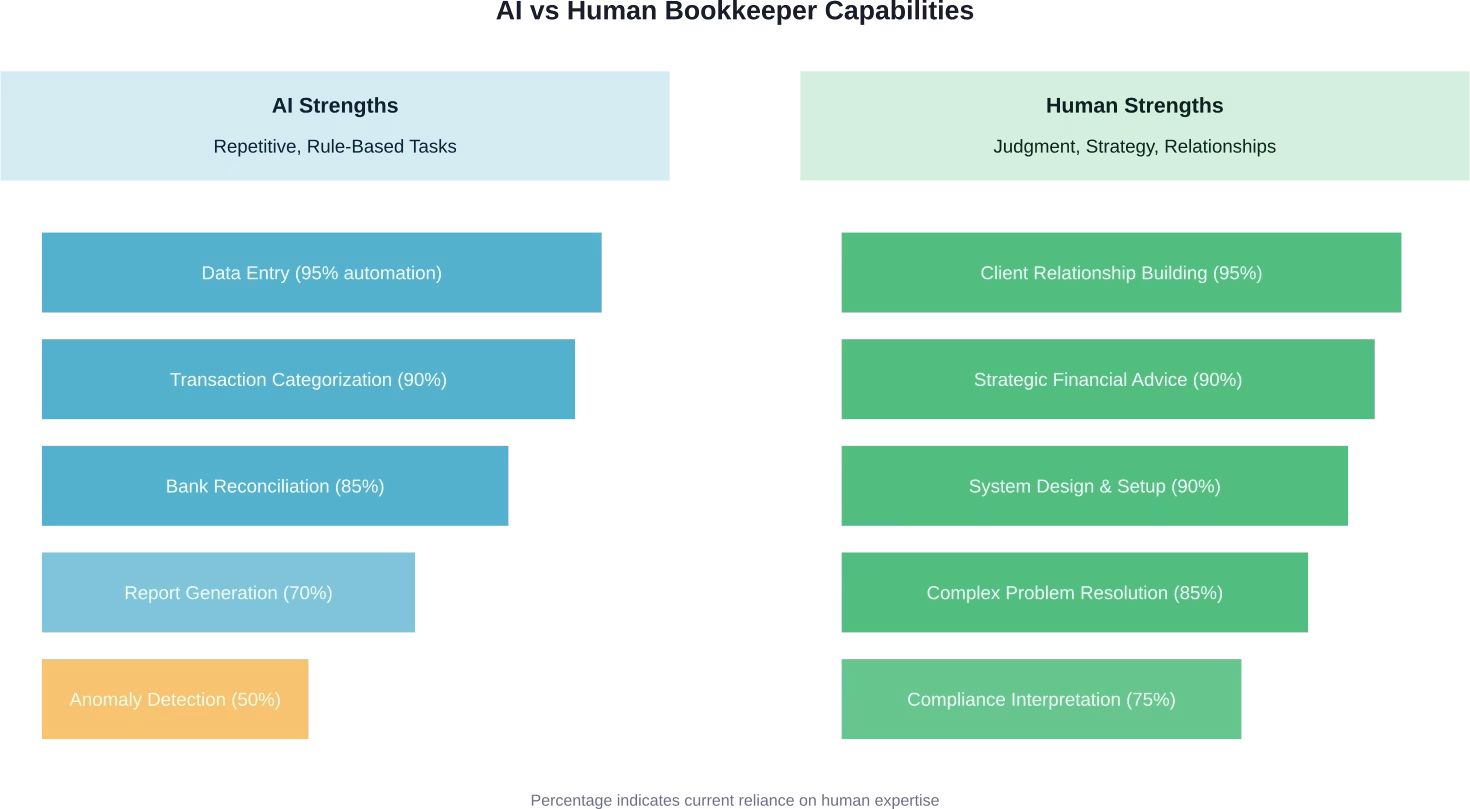
How Bookkeeping Jobs Are Actually Changing
Rather than replacement, the profession is experiencing role evolution. Bookkeepers who adapt are shifting from data processors to financial advisors. This mirrors historical patterns documented by the Bureau of Labor Statistics. Research on occupations considered at risk from automation shows that technology disrupts occupations without eliminating jobs entirely. Congressional hearings in the 1950s and 1960s raised similar concerns about computers and industrial automation leading to massive job losses—concerns that didn’t materialize as predicted. Sound familiar?
The Shift Toward Advisory Services
Automation creates capacity. When bookkeepers spend less time on data entry, they gain time for higher-value activities:
- Cash flow forecasting and planning
- Financial strategy recommendations
- Process optimization consulting
- Tax planning throughout the year (not just at filing time)
- Financial analysis for business decisions
- Custom reporting for specific business needs
These advisory services command higher billing rates than transaction processing. That’s the opportunity embedded in automation—moving upstream to more valuable, less commoditized work.
The Employee Versus Entrepreneur Dynamic
Professional discussions highlight a critical distinction: bookkeepers who operate as business owners face different AI impacts than employees performing standardized tasks. Business-owner bookkeepers create systems, manage client relationships, and customize processes—activities AI supplements rather than replaces. They use AI to execute their designed systems more efficiently. Employee bookkeepers performing repetitive tasks face higher displacement risk. But that risk creates urgency to develop specialized skills, deepen client relationships, or transition toward entrepreneurial models.
Which Bookkeeping Tasks Are Being Automated
Understanding specific automation helps bookkeepers position themselves strategically. Here’s what’s currently happening:
| Task Category | Automation Level | Human Role Remaining |
|---|---|---|
| Receipt scanning and data extraction | High (85-95%) | Verification, exception handling |
| Transaction categorization | High (80-90%) | Custom rules, unusual items |
| Bank reconciliation | Medium-High (70-85%) | Discrepancy investigation |
| Payroll processing | High (85-95%) | Setup, compliance monitoring |
| Accounts payable/receivable | Medium (60-75%) | Vendor relations, payment decisions |
| Financial reporting | Medium (50-70%) | Analysis, customization, presentation |
| Tax preparation | Medium (40-60%) | Strategy, complex situations, filing |
| Advisory services | Low (10-20%) | Strategy, recommendations, planning |
The pattern is clear: routine execution gets automated while judgment-based work remains human.
Skills Bookkeepers Need for the AI Era
The short answer? Different skills than five years ago. Technical bookkeeping knowledge remains foundational, but it’s no longer sufficient. The profession now demands hybrid capabilities combining traditional accounting expertise with modern business skills.
Technology Proficiency
Bookkeepers must become comfortable with AI-enhanced tools. This doesn’t mean coding or machine learning expertise—it means understanding how to configure, supervise, and optimize automated systems. Those who resist automation will find themselves competing on price with AI-powered services. Those who embrace it can deliver faster results at better margins.
Communication and Advisory Skills
Explaining financial information clearly to non-financial business owners becomes increasingly valuable. So does translating business needs into bookkeeping systems. These communication skills separate order-takers from trusted advisors.
Industry Specialization
Generalist bookkeepers face more AI competition than specialists who understand industry-specific requirements. Construction bookkeeping differs substantially from e-commerce bookkeeping, which differs from medical practice bookkeeping. Deep industry knowledge creates defensible competitive advantages that AI can’t easily replicate.
Business Acumen
Understanding how businesses operate—not just how to record their transactions—enables bookkeepers to provide strategic value. Recognizing what financial metrics matter for specific business models, identifying concerning trends before they become crises, and recommending operational improvements all require business understanding beyond accounting mechanics.
The Employment Outlook for Bookkeepers
Bureau of Labor Statistics projections show nuanced employment trends for financial industry occupations. While some routine processing roles face contraction, specialized accounting positions show continued demand. The key factor? Value delivered relative to cost. Bookkeepers who deliver pure transaction processing compete directly with software subscriptions costing $50-200 monthly. That’s unsustainable competition. Bookkeepers who deliver customized financial systems, strategic advice, and business partnership command $1,000-5,000+ monthly fees. AI doesn’t threaten that value proposition—it enables delivering it more efficiently. Research on AI labor displacement and worker retraining from Brookings highlights that just under half of training program participants across the U.S. participate in classroom training, with participation ranging from 14% to 96% across states. This creates opportunities for proactive bookkeepers who self-educate rather than waiting for formal retraining programs.
What Accounting Firms Are Doing
Forward-thinking accounting firms aren’t replacing bookkeepers with AI—they’re restructuring their service delivery models. Firms use automation to handle routine tasks more profitably while redeploying staff toward client-facing advisory work. The economics work well: automation reduces labor costs for commodity services while premium advisory services expand margins. According to the AICPA, finance teams need to shift from hindsight reporting to predictive and prescriptive analytics. This shift requires human judgment enhanced by technology, not technology alone. Firms that execute this transition successfully improve profitability while enhancing client satisfaction. Clients prefer strategic partners over data processors.
Practical Steps for Bookkeepers
So what should bookkeepers actually do? Waiting isn’t a strategy. Start by auditing current skills against future needs. Which tasks performed daily could be automated? Which require irreplaceable human judgment? Then deliberately develop capabilities in the judgment-required categories:
- Take on more complex clients requiring customization
- Develop expertise in specific industries
- Learn advisory skills through courses or mentorship
- Practice explaining financial concepts to non-financial audiences
- Master AI-enhanced bookkeeping tools
- Build systems and processes that can be scaled
Consider the entrepreneurial path seriously. Business-owner bookkeepers control their positioning, pricing, and service delivery in ways employees cannot.
Embrace AI as a Tool
The most important mindset shift: viewing AI as a capability enhancer rather than a competitor. Doctors didn’t disappear when X-rays were invented—they became more effective diagnosticians. Lawyers didn’t vanish when legal databases emerged—they became more efficient researchers. Bookkeepers won’t be replaced by AI—they’ll become more productive strategists who happen to use automated tools.
The Bigger Picture on Work and AI
Brookings research on generative AI and the American worker provides important context beyond bookkeeping specifically. More than 30% of all workers could see at least half their tasks exposed to AI, with greatest impacts on middle- to higher-paid occupations, clerical roles, and women. But exposure isn’t elimination. Research emphasizes that of the 37.1 million highly AI-exposed workers, 26.5 million have above-median adaptive capacity, while approximately 6.1 million workers lack adaptive capacity due to limited savings, advanced age, scarce local opportunities, and/or narrow skill sets. Bookkeepers who actively develop complementary skills fall squarely in this category. Research on career pathways indicates there are over 15 million workers without four-year degrees in jobs highly exposed to AI, with nearly 11 million in ‘Gateway’ occupations that historically enable transitions to higher-wage roles. Gateway occupations that offer immediate wage gains while building skills for higher-wage transitions become more accessible when automation handles routine prerequisites. The future of work involves continuous adaptation, not one-time career choices. That’s challenging but also liberating—bookkeepers aren’t locked into competing with AI on transaction processing forever.
Frequently Asked Questions
Will AI completely replace bookkeepers by 2030?
No. AI will automate specific bookkeeping tasks like data entry and transaction categorization, but bookkeepers who provide advisory services, client relationships, and strategic guidance will remain essential. The role is transforming rather than disappearing.
What bookkeeping tasks can AI already do?
AI currently handles receipt scanning, transaction categorization, bank reconciliation, duplicate detection, basic report generation, and invoice processing. These tasks follow defined rules that AI executes efficiently once properly configured.
What bookkeeping tasks can’t AI do?
AI struggles with client relationship building, creating customized accounting systems, resolving ambiguous situations, providing strategic financial advice, interpreting complex compliance requirements, and making judgment calls when information is incomplete or contradictory. These require human insight and context understanding.
Should bookkeepers learn AI skills?
Absolutely. Bookkeepers should become proficient with AI-enhanced tools to remain competitive. This doesn’t require technical programming knowledge—just comfort configuring and supervising automated systems. Bookkeepers who embrace AI deliver faster, more accurate results.
Are bookkeeping jobs declining because of AI?
Transaction-processing roles face pressure, but specialized bookkeeping positions remain in demand. The Bureau of Labor Statistics shows nuanced trends—routine processing contracts while advisory-focused positions grow. Overall bookkeeping employment is transforming in composition rather than simply declining.
How much do bookkeepers make compared to AI tools?
Basic accounting software costs $50-200 monthly, creating pricing pressure for commodity bookkeeping. However, specialized bookkeepers delivering customized systems and advisory services command $1,000-5,000+ monthly, far exceeding software costs because they provide strategic value software cannot.
Can I future-proof my bookkeeping career?
Develop skills AI can’t replicate: industry specialization, client communication, strategic advising, and business acumen. Consider entrepreneurial paths where relationship management and system design create defensible competitive advantages. Continuously adapt rather than protecting outdated workflows.
Conclusion: Transformation, Not Replacement
Will AI replace bookkeepers? The evidence points clearly toward transformation rather than elimination. AI automates specific tasks—data entry, categorization, routine reconciliation—freeing bookkeepers from time-consuming but low-value work. That creates capacity for higher-value activities that AI cannot replicate: building client relationships, designing customized financial systems, providing strategic guidance, and applying professional judgment to complex situations. Bookkeepers who resist this shift and cling to transaction processing will struggle. Those who embrace AI as a tool while developing irreplaceable human skills will thrive. The profession isn’t dying. It’s evolving—as it has with every previous technological advancement. The bookkeepers who recognize this pattern and adapt accordingly won’t just survive the AI era. They’ll lead it. Ready to future-proof your bookkeeping career? Start by identifying which of your current tasks could be automated, then deliberately develop the advisory and strategic skills that will define successful bookkeepers in 2026 and beyond.