Quick Summary: AI will not replace coders in 2026 or the foreseeable future. According to the Bureau of Labor Statistics, while AI affects certain programming tasks, it simultaneously increases demand for software developers needed to build and maintain AI systems. Developers who adapt by using AI tools to automate routine work while focusing on complex problem-solving, architecture, and human-centered design will remain highly valuable. The question keeps popping up in developer forums, LinkedIn threads, and coding bootcamp discussions: will AI replace coders? It’s not paranoia. Generative AI tools have gotten scary good at writing code. GitHub Copilot autocompletes entire functions. ChatGPT churns out working scripts in seconds. And newer models handle increasingly complex programming tasks that used to take experienced developers hours. But here’s what the actual data shows—not speculation, not hype, but government employment projections and real-world industry trends.
What the Bureau of Labor Statistics Actually Says About AI and Programmers
The U.S. Bureau of Labor Statistics doesn’t sugarcoat technological disruption. They’ve studied AI impacts across occupations, and their findings might surprise anyone convinced coding jobs are doomed. According to BLS employment projections covering 2023-2033, AI primarily affects occupations whose core tasks can be easily replicated by generative AI in its current form. Programming does involve some automatable tasks—but not all of them. Here’s the twist: AI may actually support demand for computer occupations. Software developers are needed to develop AI-based business solutions and maintain AI systems. Database administrators and architects are expected to handle increasingly complex data infrastructure that AI requires. According to the U.S. Bureau of Labor Statistics, the median annual wage for software developers was $133,080 in May 2024. That’s not the salary trajectory of a dying profession. BLS projects total employment to grow from 170.0 million in 2024 to 175.2 million in 2034—a 3.1 percent increase. Software development remains part of that growth, not the contraction.
Why AI Tools Aren’t the Job-Killer Headlines Suggest
History offers useful context here. Repeating periodic concerns raised earlier regarding mechanical technology, some observers in the 1950s and 1960s argued computers and industrial automation could lead to massive job losses. Didn’t happen. Technology changed what workers did, not whether jobs existed. Digital cameras replaced film cameras. BLS projected employment declines for photographic process workers based on technological maturation—not because cameras eliminated photography, but because the technology shifted the work. Programming faces a similar shift, not elimination. AI handles the grunt work. Developers handle everything else.
What AI Actually Does Well (and What It Doesn’t)
AI coding assistants excel at specific tasks:
- Generating boilerplate code and repetitive patterns
- Writing basic CRUD operations and standard functions
- Creating skeleton code for common implementations
- Suggesting syntax and completing code blocks
- Converting code between languages for straightforward logic
According to developer accounts shared in professional discussions, when asking an AI assistant to generate a basic message queue consumer in Python with retry logic and logging, the skeleton code appears in seconds, saving approximately 20 minutes of tedious typing. Then comes the real work. Wiring that generated code into the actual system, handling tricky edge cases, debugging integration issues, optimizing performance, ensuring security—that’s where human developers operate. AI lacks context. It doesn’t understand business requirements, user needs, technical debt, team coding standards, or the thousand small decisions that turn code into a functioning product. 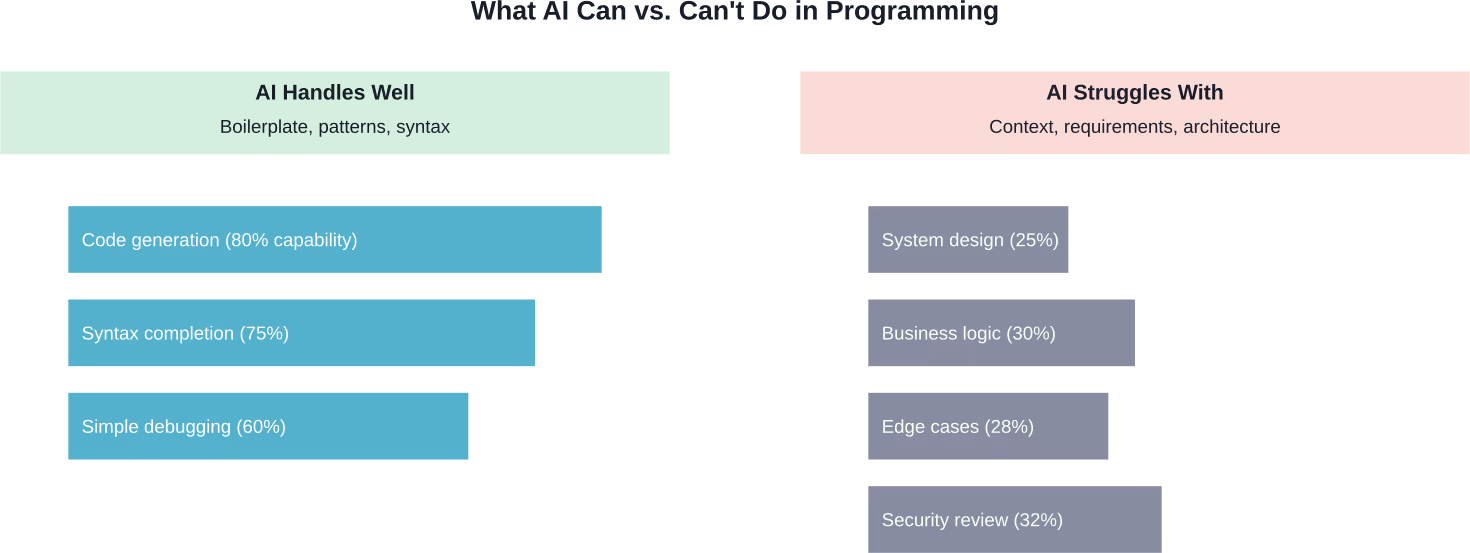

Building Practical AI Solutions With AI Superior
AI Superior develops AI solutions that are designed to work within real systems rather than as standalone tools. Work typically starts with understanding the use case and continues through development and integration.
Looking to Apply AI in a Practical Way?
AI Superior can help with:
- creating AI models for specific business tasks
- evaluating use cases and technical direction
- integrating AI into existing infrastructure
👉 Contact AI Superior to discuss your project, data, and implementation approach
The Real Shift: From Code Typists to Solution Architects
Community discussions among developers reveal a consistent theme: AI isn’t replacing programmers, but it’s definitely changing what programming looks like. The developers at risk? Those who only know how to translate requirements into code without understanding the why behind technical decisions. But developers who solve problems, design systems, mentor teams, and bridge technical and business needs? They’re more valuable than ever. Think about a typical workday. Morning: an AI assistant generates a basic implementation in seconds. Afternoon: the developer does the actual work—integrating that code into the real system, handling edge cases, optimizing for the specific use case, ensuring it plays nicely with existing infrastructure. AI handles the mechanical typing. Developers handle the thinking.
What Happens When AI Writes Most Code
Recent analysis from industry experts highlights an important trend: AI coding capabilities jumped significantly with newer models. Tools genuinely one-shot many real-life coding tasks that previously required iteration. So where does that leave software engineering? In a better place, actually. When AI handles routine implementation, developers spend more time on:
- Architectural decisions that determine system success
- User experience design and interface optimization
- Performance tuning and scalability planning
- Security audits and vulnerability assessment
- Cross-functional collaboration and requirement gathering
- Code review and quality assurance
- Mentoring junior developers and sharing domain knowledge
These activities create more business value than typing out boilerplate code ever did.
The Skills That Matter Now
Adapting to AI-augmented development means shifting focus. Pure syntax memorization matters less. Understanding systems matters more.
| Traditional Focus | AI-Era Focus | Why It Matters |
|---|---|---|
| Syntax mastery | System architecture | AI handles syntax; humans design systems |
| Code writing speed | Problem decomposition | Breaking complex problems into solvable parts |
| Framework knowledge | Integration expertise | Making different systems work together |
| Language expertise | Domain knowledge | Understanding business context and user needs |
| Individual coding | Team collaboration | Building products requires coordinated effort |
| Feature implementation | Performance optimization | Making code work vs. making it work well |
Developers who treat AI as a productivity multiplier rather than a replacement adapt successfully. Those who resist the tools while competitors embrace them? That’s where risk lives.
What Different Types of Programmers Should Know
AI impacts different developer roles differently. Not all coding jobs face the same pressures or opportunities.
Junior Developers and Career Starters
Entry-level positions face the most obvious question: if AI writes basic code, why hire juniors? Because junior developers don’t just write code—they learn systems, fix bugs, handle edge cases, write tests, participate in code reviews, and grow into senior roles. AI can’t do that career progression. Companies still need developers who can build and maintain AI-based business solutions. Someone has to set up and maintain the data infrastructure. Someone has to integrate AI tools into actual products. The path changes, though. Learning to use AI tools effectively becomes as important as learning the language itself.
Mid-Level and Senior Developers
Experienced developers actually benefit most from AI coding assistants. They already know what good code looks like, understand architectural tradeoffs, and can spot when AI-generated code needs refinement. Using AI to handle routine tasks frees up time for higher-value work: system design, performance optimization, mentoring, technical leadership. The developers who say “only bad programmers will be replaced” miss the point. Good programmers use every tool available, including AI.
Specialized Domain Experts
Developers with deep expertise in specific domains—embedded systems, security, financial systems, healthcare applications—face minimal AI displacement risk. Why? Because AI lacks the specialized knowledge these fields require. Regulatory compliance, safety-critical systems, complex domain logic—these need human expertise that goes beyond code syntax.
How Organizations Are Actually Using AI in Development
Based on McKinsey job postings for software engineering roles, elite organizations seek developers who work hands-on with clients to bring digital ambitions to life, drive architectural design, make key technology decisions, and employ agile methodologies. These roles require developers to lead project workstreams, build client technical capabilities, and foster engineering culture. AI doesn’t do any of that. In practice, AI tools get deployed as:
- Code completion assistants that speed up implementation
- Documentation generators that reduce manual writing
- Test case creators that improve coverage
- Code review helpers that catch common issues
- Refactoring assistants that suggest improvements
None of these replace the developer. They augment productivity.
The Myth of Complete Automation
Some enthusiasts claim AI will soon write entire applications from natural language descriptions. Just tell the AI what software to build, and it appears. Sounds great. Doesn’t work that way. Software development involves constant decision-making: performance tradeoffs, security considerations, user experience optimization, technical debt management, team coordination. These decisions require context, judgment, and domain expertise. Even when AI generates a working prototype, production deployment requires scalability engineering, security hardening, integration testing, monitoring setup, deployment automation, and ongoing maintenance. The gap between “code that runs” and “production-ready software” remains massive. AI helps with the former. Developers handle the latter.
What the Next Five Years Look Like
Reasonable projections based on current trends suggest several outcomes through 2030: AI coding assistants become standard tools, like IDEs and version control. Developers who don’t use them fall behind in productivity, not because AI replaces them but because competitors work faster. Entry-level hiring shifts toward candidates who demonstrate problem-solving ability and system thinking rather than pure coding speed. Bootcamps and computer science programs adapt curricula accordingly. Demand for software developers continues growing because software keeps eating the world. Every industry needs more applications, more integration, more automation—and AI systems themselves require developer expertise. Specialization becomes more valuable. Generic full-stack developers face more competition, while experts in security, performance, specific domains, or AI/ML integration command premium compensation. The nature of programming work evolves toward higher abstraction levels. Less time writing boilerplate, more time designing systems and solving complex problems.
Practical Steps for Developers Right Now
Waiting to see what happens isn’t a strategy. Adapting is. Start using AI coding tools daily. Learn their strengths and limitations through hands-on experience. GitHub Copilot, ChatGPT, Claude—pick one and integrate it into actual work. Focus skill development on areas AI can’t easily replicate: system design, architecture patterns, performance optimization, security best practices, domain expertise. Build breadth beyond coding. Understanding user needs, communicating with stakeholders, leading technical discussions—these skills differentiate senior developers from junior ones, and AI from humans. Stay current with emerging technologies. The developers who learned mobile development early, or cloud infrastructure, or containerization gained career advantages. AI-native development is the current frontier. Contribute to areas where AI needs human guidance: code review, architectural decisions, mentoring, documentation, process improvement.
Frequently Asked Questions
Will AI completely replace programmers by 2030?
No. Bureau of Labor Statistics projections show continued demand for software developers through 2034. AI automates specific tasks but creates new demand for developers who build and maintain AI systems. The role evolves rather than disappears.
Should beginners still learn to code in 2026?
Absolutely. Software development skills remain highly valuable and well-compensated. Learning to code now includes learning to work effectively with AI tools, which increases productivity rather than eliminating opportunities. Companies still need humans who understand systems, architecture, and business requirements.
What programming jobs are most at risk from AI?
Positions focused purely on translating requirements into basic code without architectural or domain expertise face the most pressure. However, even entry-level roles remain necessary for career pipeline development. Specialized developers in security, embedded systems, or complex domains face minimal risk.
How can experienced developers stay relevant as AI improves?
Focus on high-value activities AI can’t replicate: system architecture, cross-functional collaboration, domain expertise, performance optimization, security, and technical leadership. Embrace AI tools to handle routine tasks more efficiently. Develop breadth beyond pure coding skills.
Do companies plan to reduce developer headcount because of AI?
Most organizations are hiring developers specifically to build AI-based solutions and maintain AI infrastructure. AI increases developer productivity, which often leads to expanding project scope rather than reducing team size. Software demand continues growing faster than AI can automate.
Will AI make coding bootcamps and CS degrees obsolete?
No. Educational programs are adapting to teach AI-augmented development alongside traditional programming. Understanding computer science fundamentals, algorithms, data structures, and system design remains essential—AI tools don’t replace this foundational knowledge.
What’s the biggest misconception about AI and coding jobs?
That AI and developers compete for the same role. In reality, AI handles mechanical implementation while developers handle problem-solving, architecture, and context-dependent decisions. The relationship is augmentation, not replacement. Developers who resist AI tools face more risk than those who embrace them.
The Bottom Line
Will AI replace coders? The data says no. AI transforms what coding looks like, how developers work, and which skills matter most. But software development requires human judgment, business understanding, architectural thinking, and contextual decision-making that AI can’t replicate. The developers thriving through this transition treat AI as a power tool, not a replacement. They automate the tedious parts and focus energy on complex problem-solving, system design, and delivering business value. Government employment data, industry hiring patterns, and real-world developer experiences tell the same story: coding jobs aren’t disappearing. They’re evolving into higher-level work that creates more value. The question isn’t whether to adapt. It’s how quickly.