Quick Summary: AI will not replace electricians, but will transform how they work. The profession requires hands-on skills, physical dexterity, problem-solving in unpredictable environments, and human judgment that current AI and robotics cannot replicate. Instead, AI will serve as a powerful tool that enhances electrician efficiency, improves safety diagnostics, and streamlines administrative tasks while creating demand for tech-savvy electrical professionals. The question keeps popping up in trade forums, apprenticeship programs, and even job sites: will AI replace electricians? As artificial intelligence reshapes industry after industry, it’s natural for skilled tradespeople to wonder whether their livelihoods face disruption. Here’s the reality. AI won’t replace electricians anytime soon—and probably not in our lifetimes. But it will change the trade in significant ways. The electrical profession involves far more than tasks a computer can learn. It demands physical presence in cramped spaces, finger dexterity threading wires through walls, and the judgment to assess situations that don’t fit textbook scenarios. These human elements create a substantial barrier to full automation.
The Automation Risk for Electricians: What the Data Shows
According to analysis from multiple job automation studies, electricians face a minimal automation risk of 7% (calculated) and 14% (based on polling). The 7% calculated risk places the profession firmly in the minimal-risk category, while the 14% polled risk reflects a low-risk assessment compared to other occupations. The Bureau of Labor Statistics projects total employment to grow from 170.0 million in 2024 to 175.2 million in 2034, an increase of 3.1 percent. Over the 2024–34 projections period, AI is expected to primarily affect occupations whose core tasks can be most easily replicated by Generative AI in its current form—roles involving routine information processing, data entry, and predictable digital tasks. Electrical work doesn’t fit that profile. The trade requires navigating unpredictable physical environments, adapting to unique building layouts, and making safety-critical decisions based on incomplete information. 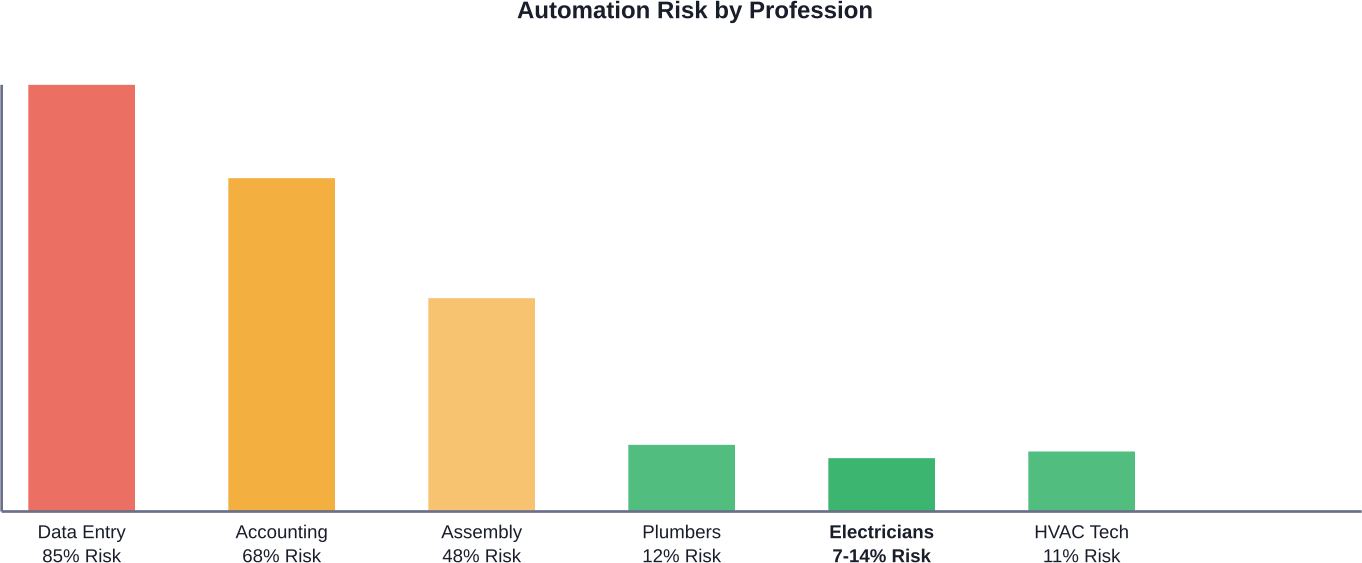

Practical AI Integration With AI Superior
AI Superior focuses on integrating AI into real business environments where systems and data already exist. Work usually starts with understanding the task and available data, then moves into building models that can be tested and connected to existing workflows.
Exploring AI for Day-to-Day Operations?
AI Superior can help with:
- developing AI solutions that fit current processes
- evaluating whether AI is suitable for your use case
- integrating AI into existing systems and tools
👉 Contact AI Superior to discuss your project, data, and implementation approach
Why Electricians Can’t Be Replaced by AI and Robots
Several critical factors make electrical work resistant to automation. These aren’t minor obstacles—they’re fundamental barriers rooted in the nature of the profession.
Physical Environment Complexity
Electricians work in cramped crawl spaces, navigate attics filled with insulation, climb ladders in awkward positions, and squeeze into mechanical rooms with minimal clearance. These environments weren’t designed for robots. Current robotics struggle with unstructured environments. Factory robots excel at repetitive tasks in controlled settings, but residential and commercial buildings present infinite variations in layout, age, materials, and access constraints. Some very important qualities of the electrical trade are difficult to automate: cramped work space navigation and awkward positioning. These physical realities create substantial technical challenges for robotic systems.
Manual Dexterity and Tactile Feedback
Threading wire through conduit, making proper terminal connections, stripping insulation without nicking copper, bending conduit to precise angles—these tasks require finger dexterity and manual skill developed over years of practice. Robots lack the tactile feedback humans use instinctively. An experienced electrician feels when a connection is tight enough, senses when wire insulation is compromised, and detects subtle resistance changes that indicate problems.
Problem-Solving in Unpredictable Situations
Every job site presents unique challenges. Outdated wiring that doesn’t match current codes. Building modifications that created undocumented electrical changes. Equipment malfunctions with symptoms that don’t match standard troubleshooting guides. Electricians constantly adapt, improvise within code requirements, and solve problems that have never been documented in any training manual. This adaptive intelligence remains far beyond current AI capabilities. Look, AI can diagnose a fault when fed clean sensor data. But it can’t walk into a 1960s building, trace unmarked circuits through walls, identify bootleg grounds, and develop a remediation plan that balances safety, cost, and minimal disruption.
Human Judgment and Safety Assessment
Electrical work involves life-safety decisions. Determining whether existing wiring can handle additional load. Assessing whether an installation meets code intent in ambiguous situations. Deciding whether to de-energize systems serving critical equipment. These judgment calls require understanding context, weighing trade-offs, and accepting responsibility for outcomes. They involve persuasion—convincing clients why certain upgrades are necessary, explaining options to homeowners, coordinating with other trades. AI doesn’t do persuasion well. It can’t read a customer’s expression when explaining why their DIY electrical work needs complete replacement.
How AI Is Actually Transforming Electrical Work
The real story isn’t replacement—it’s augmentation. AI tools are enhancing what skilled electricians can accomplish, making the trade more efficient and safer.
Smart Diagnostic Tools
AI-powered diagnostic equipment can analyze electrical systems faster and more thoroughly than traditional methods. Thermal imaging cameras with AI interpretation identify hot spots indicating loose connections or overloaded circuits. Power quality analyzers use machine learning to detect harmonic distortion patterns that cause equipment failures. These tools don’t replace electrician expertise—they amplify it. The electrician still interprets results in context, determines root causes, and implements solutions.
Automated Design and Load Calculations
AI assists with circuit design, automatically calculating voltage drop, determining conductor sizing, and checking code compliance. These systems reduce calculation errors and speed up design work. According to technical sources, AI has potential to take much of the dull complexity out of designing custom circuit boards and electrical systems. Software developers are needed to develop these AI-based business solutions, and electricians who understand both electrical systems and AI tools will have competitive advantages.
Predictive Maintenance Systems
Industrial and commercial buildings increasingly use AI-driven monitoring systems that predict equipment failures before they occur. Sensors track motor vibration, temperature patterns, and power consumption anomalies. These systems generate work for electricians rather than eliminating it. Someone needs to install the sensors, interpret the alerts, and perform the actual maintenance and repairs.
Streamlined Administrative Work
AI handles time-consuming paperwork: generating material lists from project drawings, creating preliminary quotes, scheduling jobs based on location and crew availability, tracking inventory. This frees electricians to focus on the skilled work that justifies their wages rather than administrative tasks that don’t require trade knowledge. 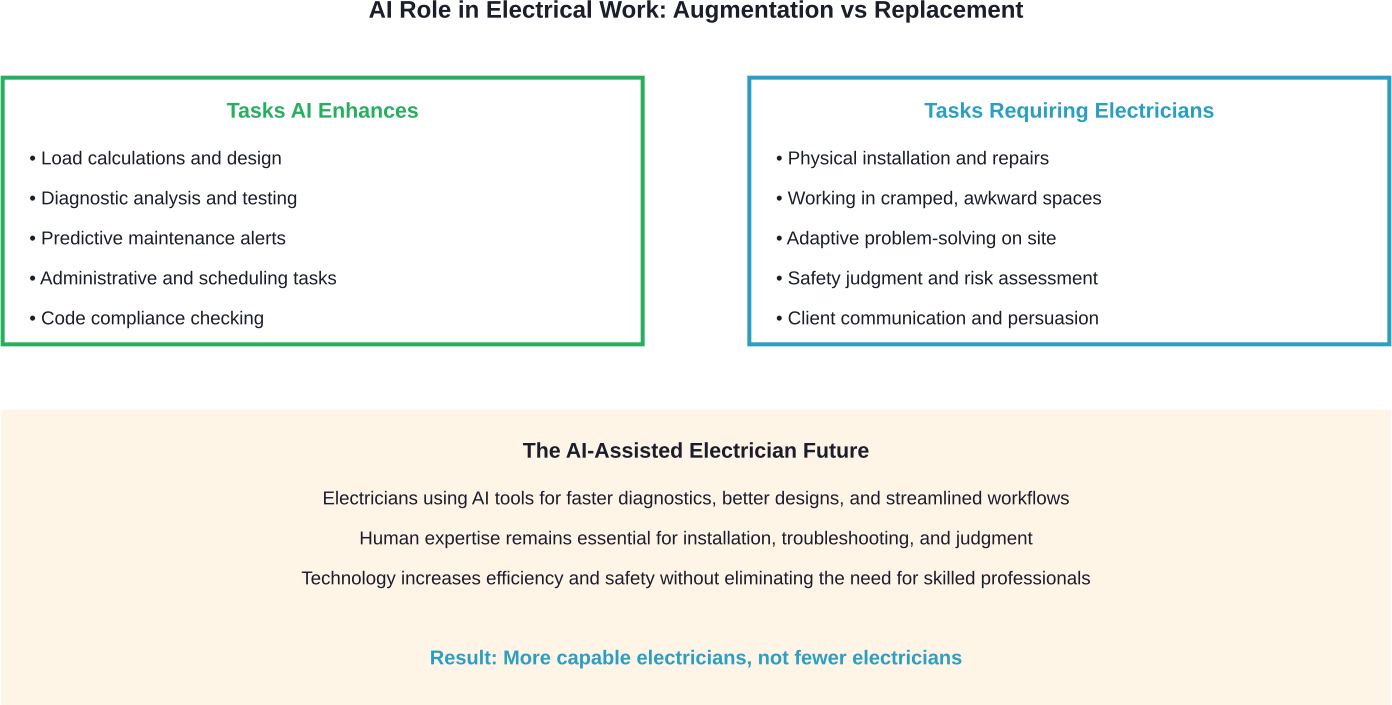
The Future Demand for Electricians
Labor demand for electricians is projected to grow 9%-9.5% by 2034. This growth reflects several converging trends that AI won’t diminish. Electrification of transportation, heating, and industrial processes creates massive new electrical infrastructure needs. Electric vehicle charging stations. Heat pump installations replacing gas furnaces. Data centers supporting AI computing infrastructure—ironically, AI itself drives electrical work demand. Renewable energy systems require skilled electricians for installation and maintenance. Solar arrays, battery storage systems, and grid integration projects all need hands-on electrical expertise. The Bureau of Labor Statistics notes that while AI may support demand for computer occupations—as software developers are needed to develop AI-based business solutions—it won’t reduce demand for skilled trades that work in physical environments. Real talk: society is becoming more electrified, not less. Every new technology, every green energy initiative, every smart building system creates work for electricians.
What Electricians Should Know About AI Tools
The trade is evolving. Electricians who adapt will thrive; those who ignore technological change may find themselves at a competitive disadvantage.
Smart Building Systems Knowledge
Modern commercial and high-end residential buildings incorporate smart lighting controls, energy management systems, and integrated building automation. Electricians increasingly need to understand network protocols, wireless communication, and system integration. This doesn’t replace traditional electrical knowledge—it adds to it. The electrician who can both pull wire properly and configure a lighting control system has more value than one who only does traditional work.
Diagnostic Technology Proficiency
Thermal imaging, power quality analysis, and advanced multimeter functions are becoming standard tools. Electricians should embrace these technologies rather than viewing them as threats. A thermal camera doesn’t replace an electrician’s troubleshooting knowledge—it makes that knowledge more effective by revealing problems invisible to the naked eye.
Digital Documentation and Communication
Project documentation increasingly happens through tablets and smartphones. Photos, videos, digital markups on drawings, real-time communication with project managers—these are now standard practices. The future belongs to electricians comfortable with technology as a tool, not threatened by it.
| Traditional Skills (Still Essential) | Emerging Skills (Increasingly Valuable) |
|---|---|
| Conduit bending and installation | Smart building system integration |
| Wire pulling and termination | Network and communication protocols |
| Circuit troubleshooting | Advanced diagnostic tool interpretation |
| Code compliance knowledge | Energy management system configuration |
| Panel and switchgear installation | Renewable energy system integration |
| Motor control wiring | EV charging infrastructure installation |
Why the Trade Remains Automation-Resistant
Beyond the technical barriers, economic factors also protect electrician jobs from automation. The cost to develop, manufacture, and maintain robots capable of general electrical work would be astronomical. Such robots would need to navigate stairs, crawl through attics, work on ladders, manipulate hundreds of different tools, and adapt to millions of unique situations. Compare that investment to training human electricians—apprenticeships already exist, the infrastructure is established, and humans naturally possess the physical and cognitive capabilities needed. For specialized, high-volume tasks in controlled environments (like factory electrical panel assembly), automation might make economic sense. But for the diverse, unpredictable work most electricians perform? The business case doesn’t exist. Moreover, liability and regulatory frameworks require licensed professionals for electrical work. These legal requirements won’t disappear simply because technology advances. Codes and standards evolve slowly, and electrical safety regulations prioritize human accountability.
Preparing for an AI-Enhanced Trade
The electrical trade isn’t immune to change—no profession is. But the changes ahead involve working alongside AI tools, not being replaced by them. Apprentices entering the trade today should focus on mastering fundamentals while remaining open to new technologies. Strong foundational knowledge in electrical theory, code requirements, and practical skills remains non-negotiable. These fundamentals don’t change even as tools improve. Continuing education should include both traditional topics and emerging technologies. Understanding LED lighting systems, power quality issues in modern electronics, and renewable energy integration prepares electricians for the work that’s actually growing. The electricians who will command premium wages are those who combine deep trade knowledge with comfort using advanced tools. They’ll leverage AI for faster diagnostics while relying on experience to interpret results and implement solutions.
Frequently Asked Questions
Will robots eventually replace electricians?
Not in the foreseeable future. Robotics technology struggles with the unstructured environments, physical dexterity requirements, and adaptive problem-solving that electrical work demands. While specialized robots might handle specific factory tasks, general electrical work in residential and commercial buildings will require human electricians for decades to come.
What percentage of electrician jobs are at risk from AI?
Automation risk analysis places electricians at 7% (calculated) to 14% (based on polling) risk, categorizing the profession as minimal to low risk for AI replacement. This low risk reflects the hands-on nature of electrical work, physical environment challenges, and need for human judgment in safety-critical situations.
How will AI change the electrical trade?
AI will enhance electrician capabilities through better diagnostic tools, automated design calculations, predictive maintenance systems, and streamlined administrative work. These changes increase efficiency and safety but don’t eliminate the need for skilled electricians to perform physical installation, troubleshooting, and repairs.
Should electricians be worried about job security?
No. Electrician employment is projected to grow 9%-9.5% by 2034 driven by electrification trends, renewable energy expansion, and infrastructure modernization. AI creates new electrical work (data centers, smart buildings, EV charging) rather than eliminating existing jobs.
What skills should electricians learn to stay competitive?
Electricians should master traditional fundamentals while developing competency in smart building systems, network protocols, advanced diagnostic tools, energy management systems, and renewable energy integration. Combining strong foundational knowledge with technology proficiency creates the most career opportunities.
Can AI do electrical troubleshooting?
AI can assist with troubleshooting by analyzing sensor data, comparing symptoms to known fault patterns, and suggesting diagnostic steps. However, AI can’t physically trace circuits, work in cramped spaces, use tactile feedback to identify problems, or adapt to the countless unique situations encountered in real-world electrical work.
Will electrician wages decrease because of AI?
Unlikely. Electrician wages (median $62,350 or $29.97 per hour) reflect the skilled nature of the work, licensing requirements, and safety responsibilities. AI tools that increase electrician productivity may actually support higher wages by enabling professionals to complete more complex, higher-value work.
The Bottom Line on AI and Electricians
Will AI replace electricians? The evidence overwhelmingly says no. Electrical work combines physical demands, environmental challenges, manual dexterity requirements, and adaptive intelligence in ways that current and foreseeable AI and robotics simply cannot replicate. The profession’s minimal automation risk reflects these fundamental barriers. But AI will transform how electricians work. Diagnostic tools will become more sophisticated. Design software will handle complex calculations automatically. Predictive maintenance systems will identify problems before failures occur. Administrative tasks will require less time. These changes benefit electricians who embrace them. The trade becomes safer, more efficient, and more capable of tackling complex projects. Electricians equipped with AI-enhanced tools can deliver better results in less time. The future isn’t AI replacing electricians—it’s electricians using AI to do things that weren’t previously possible. Smart diagnostics that identify intermittent faults. Energy audits that pinpoint inefficiencies. Maintenance schedules optimized for actual equipment condition rather than arbitrary intervals. That’s a future where skilled electrical professionals remain in high demand, combining trade expertise with powerful tools to solve increasingly complex challenges. For anyone considering the electrical trade, the message is clear: this career path remains secure. The work is changing, technology is advancing, but the fundamental need for skilled humans who can navigate physical spaces, make sound judgments, and implement safe electrical systems isn’t going anywhere. The best time to enter the electrical trade or advance your career in it? Still right now. Learn the fundamentals thoroughly, stay current with technology, and you’ll have job security that workers in many other fields can only envy.