Quick Summary: AI will not replace recruiters but will fundamentally transform their role. According to SHRM, 35-45% of companies now use AI in hiring to automate administrative tasks, reducing cost-per-hire by up to 30%. However, the human elements of recruitment—relationship building, nuanced judgment, empathy, and strategic talent consulting—remain irreplaceable and are becoming more valuable as AI handles routine work. The question of whether AI will replace recruiters has shifted from theoretical to urgent. Headlines predict widespread job displacement. Automation tools promise to eliminate the need for human intervention. And yet, the reality unfolding across the recruitment landscape tells a different story. Here’s what the data actually shows.
What Government Data Reveals About Recruiting Jobs
The Bureau of Labor Statistics offers a reality check. Human resources specialists earned a median wage of $72,910 in 2024, while HR managers brought in $140,030 annually. These aren’t roles on the verge of extinction. More telling: the Occupational Outlook Handbook still lists recruiting, screening, and interviewing as core human functions. Job openings data from February 2026 showed 6.9 million openings across the economy, with hires decreasing to 4.8 million—the lowest rate since April 2020. This tightening market makes quality recruitment more critical, not less. The World Economic Forum’s Future of Jobs Report 2025 projects 170 million new jobs created by 2030, with 92 million displaced—a net gain of 78 million positions. The skills gap remains the most significant barrier to hiring, according to data from over 1,000 companies. That gap won’t be closed by algorithms alone.
Where AI Actually Fits in Recruitment
Around 39% of companies have adopted AI in hiring processes, according to SHRM research. The AI recruitment sector is projected to expand at a 6.17% compound annual growth rate from 2023 to 2030. But adoption doesn’t equal replacement. Look at what AI actually does well. The technology excels at resume screening, parsing thousands of applications against keyword criteria. It automates interview scheduling, eliminating the email ping-pong. It reduces cost-per-hire by as much as 30%, according to SHRM data, by handling administrative overhead. These are meaningful efficiencies. They free recruiters from hours of manual work. But they don’t constitute the full scope of talent acquisition. 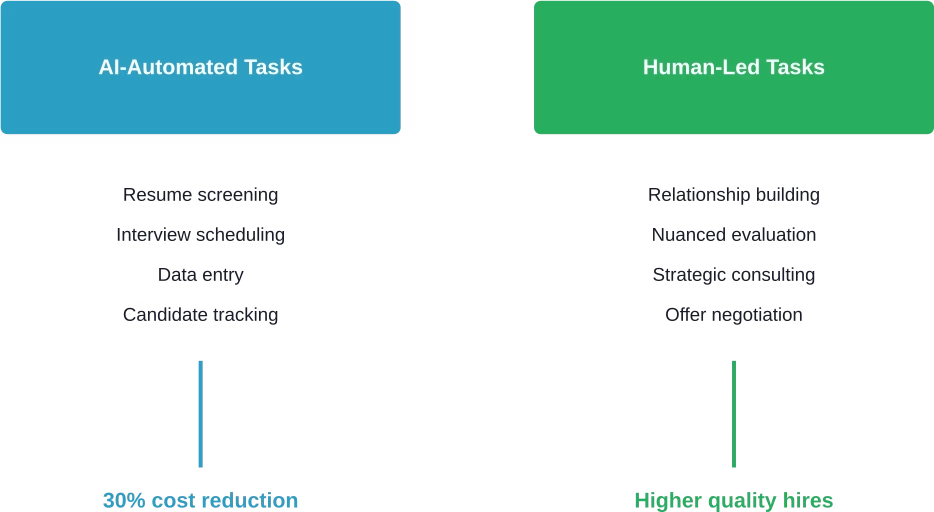

Structured AI Development With AI Superior
AI Superior approaches AI development as a structured process rather than a one-off task. Work typically includes evaluating feasibility, developing models, and gradually integrating them into existing systems.
Looking for a Structured Approach to AI?
AI Superior can help with:
- end-to-end AI solution development
- evaluating and defining AI use cases
- integrating AI into operational systems
👉 Contact AI Superior to discuss your project, data, and implementation approach
The Human Elements That AI Can’t Replicate
Community discussions among recruiters consistently highlight what technology struggles with. Hiring managers often can’t articulate what they actually need. They say they want five years of experience, but what they really need is someone who can learn quickly and fit the team culture. That gap between stated requirements and actual needs? It takes human probing to uncover. Consider the candidate experience. Switching jobs represents a major life decision for most people. Research from Harvard Business School reveals that people are mostly okay with AI handling routine tasks, but they draw the line when human judgment and empathy matter. Job transitions fall squarely in that territory. AI-generated job adverts tend toward generic corporate speak. They don’t capture what makes a role genuinely compelling. Automated outreach to passive candidates lacks the personalization that prompts someone to consider leaving a stable position. Then there’s offer management. Negotiating compensation, addressing concerns, and closing candidates requires finesse. It requires reading between the lines of what someone says and what they mean. It requires relationship capital built throughout the hiring process.
How the Recruiter Role Is Evolving
Rather than disappearing, recruiters are becoming talent consultants. The administrative burden decreases. The strategic value increases. According to SHRM, AI allows recruiters to spend more time building relationships with a shortlist of qualified candidates rather than sorting through hundreds of resumes. This shift elevates the profession rather than diminishing it. The World Economic Forum notes that employers expect 39% of key skills required in the job market will change by 2030. Recruiters serve as translators between evolving skill requirements and available talent. They help hiring managers understand which skills are transferable and which candidates can grow into roles.
| Traditional Recruiter Tasks | Emerging Recruiter Responsibilities |
|---|---|
| Manual resume review | Candidate relationship management |
| Job posting management | Employer brand consulting |
| Interview coordination | Talent market intelligence |
| Reference checking | Strategic workforce planning |
| Compliance tracking | Diversity and inclusion strategy |
Harvard Business School research examining AI’s impact on jobs finds that employers are seeking more AI-related skills in certain fields, while demand for structured and repetitive tasks is waning. Recruiting itself follows this pattern. The repetitive parts get automated. The complex judgment calls become more important.
The Reality Check From Implementation
Here’s where theory meets practice. SHRM research from 2025 reveals that AI hasn’t lived up to the hype—but companies aren’t giving up. Implementation is moving into a more pragmatic phase. SHRM’s study on AI’s workplace impact shows that 23.2 million American jobs have been affected by automation technologies. But the effect is more nuanced than simple replacement. MIT Sloan research suggests AI is more likely to augment human work than substitute for it, highlighting areas where human expertise remains important and complementary. Entry-level jobs in the US have fallen by 35% in the last 18 months, in large part because of AI handling routine screening. But mid-level and senior recruiting positions remain stable. The career path is changing, not vanishing. Real talk: some recruiting tasks will disappear. Recruiters who only perform administrative functions will struggle. But those who develop expertise in talent strategy, market intelligence, and relationship management will find themselves more valuable than ever.
What This Means for Talent Acquisition Teams
Organizations that treat AI as a recruiter replacement will struggle. Those that deploy it as a recruiter enhancement will gain competitive advantage in tight talent markets. The most effective approach follows what community discussions describe as the 80/20 rule: automate 80% of the work and focus intently on the remaining 20% that requires skills AI can’t compete with. For talent teams, this means:
- Implementing AI tools for screening, scheduling, and candidate tracking
- Investing in recruiter training for consultative skills and market intelligence
- Redefining recruiter roles around relationship management and strategy
- Measuring success by quality of hire, not just time-to-fill
- Maintaining the human touch in candidate communication
SHRM research on automating HR while keeping the human touch emphasizes that eliminating repetitive manual tasks allows focus to remain on building engagement, supporting inclusion efforts, and enhancing the employee life cycle. This applies directly to recruitment.
Looking Ahead
The World Economic Forum’s analysis of four AI and talent scenarios through 2030 shows varied outcomes. But none involve the wholesale elimination of recruiting professionals. The scenarios differ in how AI augments human work, not whether humans remain necessary. More than half of business executives globally expect technology to displace existing jobs, according to World Economic Forum surveys. But 24% said AI will create new jobs. The net effect remains positive for those who adapt. Research from Harvard Business School analyzing actual job postings finds that employers are seeking more AI-related skills even in recruiting roles. But they’re also emphasizing communication, judgment, and strategic thinking—distinctly human capabilities. So will AI replace recruiters? No. But it will replace recruiters who don’t evolve. The profession is shifting from administrative execution to strategic consultation. From processing applications to building talent pipelines. From filling requisitions to shaping workforce strategy. That’s not replacement. That’s elevation.
Frequently Asked Questions
Will AI completely automate the hiring process?
No. While AI handles screening, scheduling, and data management effectively, the hiring process still requires human judgment for cultural fit assessment, nuanced candidate evaluation, and relationship building. According to SHRM, AI reduces cost-per-hire by up to 30% by automating administrative tasks, but human oversight remains essential for quality hiring decisions.
Are entry-level recruiting jobs disappearing?
Entry-level jobs in the US have declined by 35% over the last 18 months, partially due to AI handling routine tasks. However, this reflects a shift in role responsibilities rather than total elimination. Entry-level recruiters now need to demonstrate consultative and analytical skills alongside basic recruiting competencies.
How many companies are currently using AI in recruitment?
Around 39% of companies have adopted AI in their hiring processes as of 2026, according to SHRM data. The AI recruitment sector is projected to grow at a 6.17% compound annual growth rate from 2023 to 2030, indicating continued expansion but not universal adoption.
What recruiting tasks does AI handle best?
AI excels at resume parsing and screening against specific criteria, interview scheduling, candidate database management, and compliance tracking. These structured, repetitive tasks benefit most from automation. AI struggles with tasks requiring empathy, persuasion, complex judgment, and relationship building.
What skills do recruiters need to stay relevant?
The World Economic Forum notes that 39% of key skills will change by 2030. For recruiters, the most valuable skills include talent market intelligence, strategic workforce planning, consultative abilities to uncover hidden hiring needs, relationship management, employer branding, and the ability to leverage AI tools effectively while focusing on high-value human interactions.
Is the demand for HR specialists declining?
Government data from the Bureau of Labor Statistics shows stable demand for human resources specialists and managers. The median wage for HR specialists was $72,910 in 2024, with HR managers earning $140,030 annually. The Occupational Outlook Handbook continues to list recruiting and screening as core human functions.
Will hiring managers just use AI directly without recruiters?
Unlikely for most organizations. Hiring managers typically lack the time and expertise to manage the full recruitment process effectively. Community discussions among recruiters consistently note that hiring managers often struggle to articulate their actual needs and require someone who knows how to ask the right questions. AI tools don’t replace that consultative relationship.