
Quick Summary: AI will not replace statisticians entirely. While automation handles routine tasks, statisticians bring irreplaceable skills: contextual judgment, ethical reasoning, domain expertise, and the ability to formulate novel research questions. The Bureau of Labor Statistics projects 30%+ growth for statistician jobs through 2034, driven by AI expansion itself. The future favors collaboration—statisticians who leverage AI tools while providing critical human oversight. The question keeps surfacing in university corridors, LinkedIn threads, and career planning sessions: will artificial intelligence eventually replace statisticians? It’s a reasonable concern. AI systems now process datasets that would’ve taken human teams months to analyze. Machine learning models detect patterns invisible to traditional methods. But here’s the thing—the answer isn’t a simple yes or no. The reality is more nuanced and, frankly, more interesting than the binary framing suggests. AI is transforming statistical work, not eliminating it. And the data tells a story that might surprise anyone betting on wholesale replacement.
What the Employment Data Actually Shows
Look at the numbers from authoritative sources before jumping to conclusions about obsolescence. According to the Bureau of Labor Statistics, the median annual wage for statisticians was $103,300 in May 2024. That’s not the salary trajectory of a profession facing extinction. More telling? The employment outlook. The Bureau of Labor Statistics projects employment for statisticians will grow by 8% from 2024-2034, driven largely by expansion in AI and automation sectors. Read that again—AI adoption is creating demand for statisticians, not destroying it. The broader employment picture shows total U.S. employment growing from 170.0 million in 2024 to 175.2 million in 2034—a 3.1% increase. Statistician growth at 30%+ vastly outpaces general job market expansion. Industries with the highest statistician employment as of May 2023 include scientific research and development services (5,460 positions at $124,310 mean annual wage) and federal, state, and local government roles. These sectors aren’t shrinking their statistical workforces. They’re expanding them.
The Automation Risk Assessment: What Can Actually Be Replaced?
Not all statistical tasks face equal automation pressure. Analysis from willrobotstakemyjob.com places statisticians at a moderate 48% automation risk—a blend of calculated algorithmic assessment (52%) and user polling (44% based on 530 votes). That moderate designation matters. What does moderate mean in practical terms? 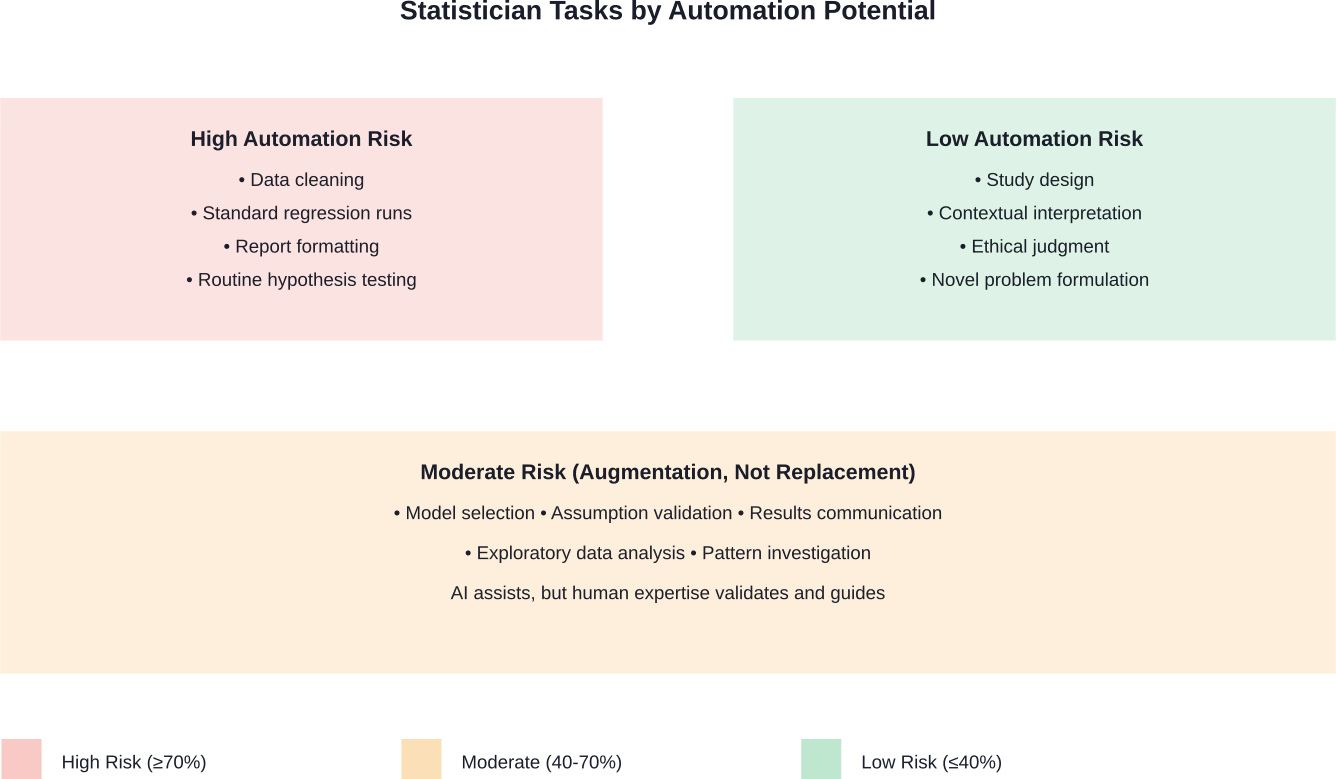 Routine tasks face pressure. Data cleaning, standard statistical tests on structured datasets, and report generation—AI handles these increasingly well. Some software already auto-generates basic descriptive statistics and visualizations. But statistical work extends far beyond mechanical computation. The qualities difficult to automate, according to analysis, include originality—the ability to devise new analytical approaches for unprecedented problems. Statisticians regularly encounter situations without established methodologies. No training dataset prepares AI for genuinely novel research questions.
Why Statisticians Possess Irreplaceable Skills
Community discussions among practicing statisticians highlight capabilities that resist automation.
Specialized Experience That Defies Replication
Professional statisticians emphasize how difficult it is to replicate 15 years of domain-specific experience. Every statistician develops a unique problem-solving approach shaped by thousands of projects, edge cases, and domain contexts. Statistical problems might appear standardized on the surface—run a regression, test significance, build a model. But context transforms everything. A clinical trial analysis demands different considerations than marketing attribution modeling, which differs from econometric forecasting. The same statistical method applied across these domains requires entirely different judgment calls about assumptions, confounders, and interpretation. AI trained on statistical textbooks and published papers misses the tacit knowledge gained from watching analyses fail in production, discovering data quality issues mid-project, or navigating stakeholder constraints that textbooks never mention.
The Intuition Problem
Experienced statisticians develop a sixth sense for problems before they fully materialize. That feeling when a dataset looks “too clean.” The suspicion that a particular variable might be a collider even before running diagnostics. The instinct that a client’s research question, as stated, won’t actually answer their underlying business problem. This intuition emerges from pattern recognition across thousands of projects—many involving rare problems that’ll never appear in AI training data. Statisticians regularly solve problems so specific to particular organizational contexts that no general-purpose AI will encounter similar cases. One practicing statistician noted that many problems are actually rare, occurring in unique combinations of domain, data structure, and analytical needs that may never be documented in accessible form.
Combining Multiple Reasoning Modes
Statistical work demands a combination of philosophical reasoning, formal logic, symbolic abstraction, and mathematical rigor. This integration remains challenging for current AI systems. Statisticians navigate questions like: Does this correlation reflect causation? What assumptions am I implicitly making? How might selection bias distort these results? Is this association scientifically meaningful despite statistical significance? These questions require moving fluidly between mathematical formalism and conceptual reasoning about real-world systems. AI excels at pattern matching within established frameworks but struggles with the meta-level reasoning about which framework applies.
The Accuracy Imperative: Why Small Mistakes Matter
Statistical work tolerates virtually no margin for error in many applications. Drug approval decisions, policy recommendations affecting millions, financial risk models—these contexts demand extreme accuracy. A misplaced decimal in a clinical trial analysis could mean approving an ineffective treatment or rejecting a beneficial one. As one professional noted, accuracy is paramount in statistical professions. Small mistakes change everything. That’s not an ideal environment for AI systems that operate probabilistically and occasionally generate confident-sounding nonsense. Current AI models produce outputs that are usually reasonable but occasionally catastrophically wrong, and they can’t reliably distinguish between the two cases. A statistician reviewing AI-generated analysis catches those errors. But who reviews the AI when it’s working unsupervised?
What AI Actually Changes for Statistical Work
AI isn’t replacing statisticians. It’s changing what they spend time on. The transformation follows a predictable pattern: automation handles routine cognitive labor, freeing professionals for higher-value work.
| Task Category | Pre-AI Time Allocation | Post-AI Time Allocation | Impact |
|---|---|---|---|
| Data cleaning and preparation | 40-50% | 15-20% | AI-assisted automation |
| Running standard analyses | 20-25% | 10-15% | Faster execution with AI tools |
| Study design and planning | 10-15% | 20-25% | More time for strategic thinking |
| Interpretation and communication | 15-20% | 25-30% | Increased focus on insight delivery |
| Methodological innovation | 5-10% | 15-20% | Enabled by freed capacity |
AI tools accelerate the mechanical aspects. What once required a week of coding and computation might now take hours. That efficiency doesn’t eliminate the statistician—it redirects their expertise toward questions machines can’t answer. Designing studies that actually test hypotheses properly. Identifying which variables matter and why. Communicating uncertainty to non-technical stakeholders. Deciding whether an analytical approach aligns with scientific goals. These remain human responsibilities.
The Tech Industry Paradox: AI Creates Statistical Jobs
Technology companies building AI systems hire statisticians in growing numbers. Why? Because AI development confronts fundamentally statistical challenges. Model validation requires rigorous statistical methodology. Understanding when models generalize versus overfit demands statistical reasoning. Designing experiments to evaluate AI performance is classical statistics. Quantifying uncertainty in predictions—pure statistical territory. According to insights from statistical industry sources, tech companies increasingly seek statisticians who can bridge analytics, engineering, and AI development. The digital economy runs on data, and every recommendation engine, fraud detection system, and predictive model depends on statistical thinking. Statisticians entering tech emphasize measurable outcomes in their experience descriptions. Statements demonstrating measurable outcomes such as improved model accuracy demonstrate impact more persuasively than generic “performed predictive modeling.” The demand isn’t for people who can run canned algorithms. It’s for professionals who understand the mathematical foundations, recognize when standard approaches fail, and design valid inference procedures for novel situations.
Where AI Actually Threatens Jobs: The Data Abundance Factor
Not all analytical roles face equal AI disruption. Research examining AI’s labor market impact identifies data abundance as the critical variable. Industries with extensive, high-quality, structured data face higher AI adoption rates—potentially 60-70%. Sectors with sparse, messy, or context-dependent data may struggle with AI adoption, seeing rates below 25%. Software development, for instance, gets hit hard because code repositories provide massive training datasets. Certain finance roles face pressure because financial data is abundant and well-structured. But statistical work often involves precisely the messy, context-rich situations where AI struggles. Observational studies with confounding. Small sample sizes. Domain-specific constraints that generic models miss. Unique business contexts without comparable training examples. The statistician’s advantage? Much statistical work exists precisely in the domains AI finds difficult.
The Ethical Dimension AI Can’t Navigate Alone
Statistical ethics requires human judgment that AI systems can’t replicate. Consider p-hacking—the practice of manipulating analyses until achieving desired significance levels. An AI trained on published research might learn this behavior since publication bias favors significant results. But statisticians serve as ethical sheriffs, recognizing and preventing such practices. Questions of fairness in algorithmic systems demand statistical expertise plus ethical reasoning. When does a model’s differential performance across demographic groups constitute unacceptable bias versus legitimate risk differentiation? There’s no purely mathematical answer. Privacy-preserving data analysis, appropriate use of statistical significance, and transparent communication of uncertainty—these require judgment calls that embed values, not just technical competence. AI might eventually assist with ethical reasoning, but delegating these decisions entirely to automated systems creates obvious hazards. Someone needs to define the values that guide statistical practice.
Communicating Uncertainty to Stakeholders
Translating statistical findings for non-technical audiences remains stubbornly human work. A confidence interval means something precise mathematically. But explaining what it means for business decisions? That requires understanding both the statistics and the decision-maker’s mental models, risk tolerance, and strategic context. Stakeholders often want definitive answers: “Will this campaign work?” Statisticians provide probabilistic statements: “Based on historical data, similar campaigns showed positive ROI in 73% of cases with effects ranging from…” That translation—from mathematical formalism to decision-relevant insight—demands understanding human cognition, organizational politics, and domain context in ways current AI can’t match.
Skills That Matter Most in the AI Era
The statistical profession isn’t static. The skills that ensure relevance are shifting. According to the World Economic Forum’s Future of Jobs Report 2025, employers expect 39% of key skills required in job markets will change by 2030. For statisticians, certain capabilities become increasingly valuable:
- Creative thinking and problem formulation: AI executes defined analytical tasks efficiently. Statisticians who excel at identifying which questions to ask and which methods apply to novel situations become more valuable, not less.
- Cross-functional communication: As AI democratizes basic analytics, the ability to collaborate across engineering, product, and business teams grows in importance. Statisticians who speak multiple professional languages thrive.
- Technical breadth beyond traditional statistics: Understanding machine learning, causal inference, experimental design, and computational methods creates versatility. The boundary between statistics and data science continues blurring.
- Domain expertise: Statistical generalists face more competition from AI than specialists with deep knowledge in healthcare, finance, environmental science, or other specific fields where context shapes methodology.
- Ethical reasoning and judgment: As AI systems make more decisions, the need for professionals who can evaluate fairness, validity, and appropriate use intensifies.
The Collaboration Model: Statisticians Using AI
The most likely future isn’t AI replacing statisticians or statisticians working unchanged. It’s statisticians leveraging AI as a powerful tool. What does this look like practically? AI handles the first pass of exploratory data analysis, flagging potential patterns. The statistician examines those patterns with domain knowledge, identifying which merit deeper investigation and which are spurious. AI generates code for standard analyses. The statistician reviews, modifies, and validates that code, ensuring it matches the specific study design and handles edge cases appropriately. AI produces draft reports with boilerplate language. The statistician refines interpretation, adds context, and tailors communication for the intended audience. This collaboration amplifies productivity without eliminating expertise. A statistician working with AI tools accomplishes more than either could alone. Research on knowledge workers using AI assistance shows performance improvements when people retain oversight and judgment rather than blindly accepting AI outputs. The statistician’s role shifts toward validator, designer, and strategic thinker.
What About Entry-Level Jobs?
One legitimate concern: will AI eliminate the entry-level positions where statisticians build experience? This worry has merit. If AI automates routine analysis that junior statisticians typically perform, how do newcomers develop expertise? The pattern emerging across professions suggests entry-level work transforms rather than disappears. Junior statisticians increasingly focus on tasks AI finds difficult: understanding client needs, learning domain context, validating AI-generated outputs, and handling edge cases. The apprenticeship model evolves. Instead of spending months on data cleaning to build familiarity, junior statisticians might spend that time learning to design validation procedures for automated cleaning pipelines. Organizations still need people who can grow into senior statistical roles. They’re adjusting training approaches, not eliminating the pipeline entirely. That said, the barrier to entry may rise. Statisticians entering the field need stronger foundational skills to add value beyond what AI provides. Graduate education in statistics remains highly relevant—perhaps more so as it differentiates professionals from AI-assisted amateurs.
Industry-Specific Variations in AI Impact
AI’s effect on statistical work varies dramatically by sector:
- Pharmaceutical and clinical research: Regulatory requirements demand human accountability. AI assists with data management and preliminary analysis, but statisticians remain legally responsible for trial designs and results interpretation. The FDA doesn’t accept “the algorithm said so” as justification.
- Tech companies: Heavy AI adoption creates demand for statisticians who can evaluate AI systems, design experiments comparing models, and solve novel problems AI systems encounter. Ironically, companies automating other jobs hire statisticians to build and validate automation.
- Government and policy: Census, economic statistics, and policy evaluation involve high-stakes decisions affecting millions. These applications require transparency, ethical oversight, and contextual judgment that resist full automation. The Bureau of Labor Statistics itself employs statisticians to produce the employment projections showing statistician job growth.
- Finance and insurance: Regulatory scrutiny and the cost of errors keep humans in the loop. AI models for credit scoring or insurance pricing require statistical validation to ensure fairness and accuracy. When a model misfires, organizations need statisticians who can diagnose why.
- Academia and research: Scientific inquiry requires formulating novel questions, designing studies for causal inference, and advancing statistical methodology itself. AI assists with computation but doesn’t drive the research agenda.
Preparing for the Future: Practical Steps
For statisticians and aspiring statisticians, adaptation matters more than resistance:
- Embrace AI tools as productivity multipliers: Learning to work with AI assistance effectively becomes a core competency. That means understanding both the tools’ capabilities and limitations.
- Deepen domain expertise: Generalist statisticians face more AI competition than specialists with irreplaceable knowledge in specific fields. Combining statistical expertise with deep understanding of healthcare, environmental systems, social science, or other domains creates defensible value.
- Develop communication skills: As technical execution becomes easier, explaining results and influencing decisions grows more important. Statisticians who write clearly, present persuasively, and translate between technical and business contexts remain indispensable.
- Stay current with methodological developments: Causal inference, Bayesian methods, modern experimental design—these areas continue evolving. Statisticians who master emerging methods stay ahead of what AI can automate.
- Focus on problem formulation, not just problem solving: AI excels at solving well-defined problems. Humans retain the advantage in recognizing which problems matter and how to frame them analytically.

Turn Statistical Workflows Into Something AI Can Support
AI can process data fast, but turning that output into valid analysis still depends on how models are built, tested, and interpreted. AI Superior works at that layer where statistical thinking meets real systems. They help teams design and implement machine learning solutions, structure data pipelines, and integrate AI into existing workflows so results are usable and consistent. In practice, that often means supporting analysts and statisticians with better infrastructure and tools, while leaving interpretation, assumptions, and decisions in human hands. If you’re looking at AI as a way to support statistical work without losing control over the results, reach out to AI Superior and see how it can fit into your current setup.
The Bigger Picture: AI and the Future of Work
Statistician job security connects to broader patterns in AI’s labor market impact. The World Economic Forum’s Future of Jobs Report 2025 indicates approximately 170 million new jobs will be created globally this decade, even as AI and automation advance. Job displacement happens, but job creation continues. The composition of work changes more than total employment. Roles combining technical skills with human judgment, creativity, and interpersonal abilities show resilience. Statistical work fits this pattern—technical enough to require expertise, human enough to resist full automation. The jobs most vulnerable to AI share characteristics: highly repetitive, rule-based, operating on abundant structured data, minimal need for contextual judgment. Statistician roles generally avoid these vulnerabilities. That doesn’t mean complacency. The statistical profession in 2034 will look different from 2024. But different doesn’t mean extinction.
Frequently Asked Questions
Will AI completely replace statisticians by 2030?
No. The Bureau of Labor Statistics projects 30%+ growth in statistician employment through 2034. AI automates routine tasks but creates demand for statistical expertise in AI development, validation, and application. The role evolves rather than disappears.
What’s the automation risk for statisticians?
Analyses place statisticians at moderate automation risk around 48%. Routine data processing faces pressure, but core responsibilities like study design, contextual interpretation, ethical judgment, and novel problem formulation resist automation. The risk is partial task automation, not wholesale job elimination.
How much do statisticians earn in 2024?
According to the Bureau of Labor Statistics, the median annual wage for statisticians reached $103,300 in May 2024. Statisticians in scientific research and development services earned a mean annual wage of $124,310. Salaries vary by industry, experience, and specialization.
Which statistical skills remain valuable as AI advances?
Critical skills include creative problem formulation, domain expertise, cross-functional communication, ethical reasoning, experimental design, causal inference methodology, and the ability to validate AI-generated analyses. Technical breadth spanning traditional statistics, machine learning, and computational methods also matters.
Should I still pursue a statistics degree or career?
Yes, if you’re genuinely interested in statistical thinking and data analysis. The field shows strong growth projections, solid compensation, and increasing relevance as organizations become more data-driven. Focus on developing skills AI can’t easily replicate—contextual judgment, domain knowledge, and communication abilities alongside technical competence.
How is AI changing daily work for statisticians?
AI tools handle more routine data cleaning, standard analyses, and report generation. This frees statisticians to focus on higher-value activities: study design, methodological innovation, interpretation requiring domain knowledge, and communicating insights to stakeholders. The work becomes more strategic and less mechanical.
What industries have the strongest demand for statisticians?
Scientific research and development, federal and state government, pharmaceutical and biotech companies, tech firms building AI systems, finance and insurance, and healthcare organizations all employ significant numbers of statisticians. Tech sector demand is particularly strong due to AI expansion.
The Verdict: Transformation, Not Replacement
So will AI replace statisticians? The evidence points clearly toward no—not in the wholesale sense the question implies. AI transforms statistical work by automating mechanical tasks and amplifying analytical capacity. Statisticians spend less time on data cleaning and more on interpretation. Less on running standard tests and more on designing novel studies. Less on calculation and more on judgment. That transformation demands adaptation. Statisticians must embrace AI tools, deepen domain expertise, and focus on capabilities machines can’t replicate. But the profession itself shows remarkable resilience. The same AI revolution creating concern about job displacement is simultaneously creating unprecedented demand for statistical expertise. Someone needs to design, validate, and interpret all those models. Someone needs to ask the right questions before automation provides answers. The future belongs to statisticians who work with AI, not against it. And based on current trajectories, there will be plenty of them. Ready to future-proof your statistical career or explore opportunities in this growing field? Focus on developing the irreplaceable human skills that complement AI capabilities—judgment, creativity, communication, and domain expertise. The numbers suggest you’re entering a profession with staying power.