
Quick Summary: Artificial intelligence delivers measurable cost savings through process automation, operational efficiency gains, and productivity improvements. Research from Wharton shows AI will increase productivity and GDP by 1.5% by 2035, while companies adopting AI automation report 30% reduction in compliance costs and 50% faster processing times.
The conversation around artificial intelligence has shifted. It’s not just about what AI can do anymore—it’s about what it actually costs and saves.
Companies across industries are reporting concrete numbers. Some of them are impressive. Others raise questions about implementation costs versus long-term benefits.
Here’s the thing though—the data is starting to tell a consistent story. AI isn’t delivering cost savings through some magic process. It works through specific, measurable mechanisms: reducing manual labor, eliminating errors, optimizing workflows, and accelerating decision-making.
Let’s look at what the numbers actually show.
What the Research Shows About AI Cost Savings
Academic institutions and research organizations have produced some of the most reliable data on AI’s economic impact. These aren’t vendor claims or marketing statistics—they’re peer-reviewed findings.
The Wharton Budget Model published research in September 2025 estimating that AI will increase productivity and GDP by 1.5% by 2035, nearly 3% by 2055, and 3.7% by 2075. The boost to annual productivity growth peaks in the early 2030s, with a maximum contribution of 0.2 percentage points in 2032.
Stanford HAI’s 2025 AI Index Report tracked adoption rates and found that 78% of survey respondents reported AI use by their organizations in 2024, up from 55% in 2023. Respondents using generative AI in at least one business function more than doubled from 33% in 2023 to 71% in 2024.
That’s rapid adoption. But does that actually translate to savings?
Real Company Results
Companies implementing AI-powered automation report specific cost reductions. According to data from business process automation providers, organizations experience:
- 30% reduction in compliance costs
- 50% faster processing times
- 25% improvement in operational efficiency
These numbers come from companies using AI for data processing, robotic process automation (RPA), and predictive analytics. The savings stem from eliminating manual labor, reducing errors, and optimizing workflows.
One study showed AI-powered customer support agents could handle 13.8% more inquiries per hour compared to human-only teams. That’s not replacing humans entirely—it’s augmenting their capacity and reducing the cost per interaction.
How AI Reduces Operational Costs
Cost reduction happens through specific mechanisms. Understanding these helps organizations identify where AI investments deliver the highest returns.
Business Process Automation
AI-powered automation targets repetitive, rule-based tasks that consume significant human hours. Data entry, invoice processing, compliance reporting, and document verification all fall into this category.
RPA combined with AI delivers faster results than traditional automation. The AI component adds pattern recognition, natural language processing, and decision-making capabilities that basic scripts can’t handle.
Companies implementing AI for business process automation see processing times drop by 50% while reducing compliance costs by 30%. That’s not theoretical—those numbers come from organizations tracking before-and-after metrics.
Error Reduction and Quality Control
Manual processes introduce errors. Human fatigue, distraction, and simple mistakes add up to significant costs through rework, customer complaints, and compliance issues.
AI systems maintain consistent accuracy rates. They don’t get tired. They apply the same criteria to every transaction, every time.
The cost savings here are twofold: preventing errors in the first place, and catching them early when they do occur. Both reduce the expensive downstream effects of mistakes.
Predictive Analytics and Resource Optimization
Predictive analytics helps organizations allocate resources more efficiently. AI models analyze historical data to forecast demand, identify bottlenecks, and optimize inventory levels.
In healthcare, AI tools are helping control surging costs through better resource allocation and diagnostic support. In manufacturing, predictive maintenance reduces downtime and extends equipment life.
Research from Brookings Institution shows AI has spurred firm growth and increased employment at companies investing in AI capabilities. The technology creates efficiency gains that allow businesses to scale without proportional cost increases.
Cost Savings by Industry
Different industries see AI cost savings manifest in different ways. Healthcare, finance, retail, and manufacturing all report benefits, but the specific applications vary.
| Industry | Primary AI Application | Key Cost Savings |
|---|---|---|
| Healthcare | Diagnostic support, resource allocation | Reduced readmissions, optimized staffing |
| Finance | Fraud detection, automated processing | Lower transaction costs, reduced losses |
| Retail | Inventory optimization, customer service | Decreased overstock, faster support resolution |
| Manufacturing | Predictive maintenance, quality control | Less downtime, fewer defects |
Healthcare Cost Control
A systematic review examining cost-effectiveness of clinical AI interventions across diverse healthcare settings found applications spanning oncology, cardiology, ophthalmology, and other specialties. The research evaluated both budget impact and utility of AI systems in patient care environments.
Healthcare organizations face unique pressures. Costs continue rising while reimbursement rates remain constrained. AI offers a path to manage this tension through operational efficiency and clinical decision support.
Financial Services Efficiency
Banks and financial institutions use AI for transaction processing, fraud detection, and customer service. The volume of transactions at large institutions makes even small percentage improvements significant.
Automated processing reduces the cost per transaction while improving accuracy. Fraud detection systems catch suspicious activity faster, limiting losses. AI-powered chatbots handle routine inquiries, freeing human agents for complex cases.
The Implementation Reality
Here’s what the glowing statistics often miss: implementation costs money. Time. Effort.
Organizations need to invest in infrastructure, training, and change management before they see returns. That upfront cost creates a barrier, especially for smaller companies.
According to McKinsey research cited in industry reports, 71% of employees trust their employers to act ethically as they develop AI. That trust matters because successful implementation requires employee buy-in.
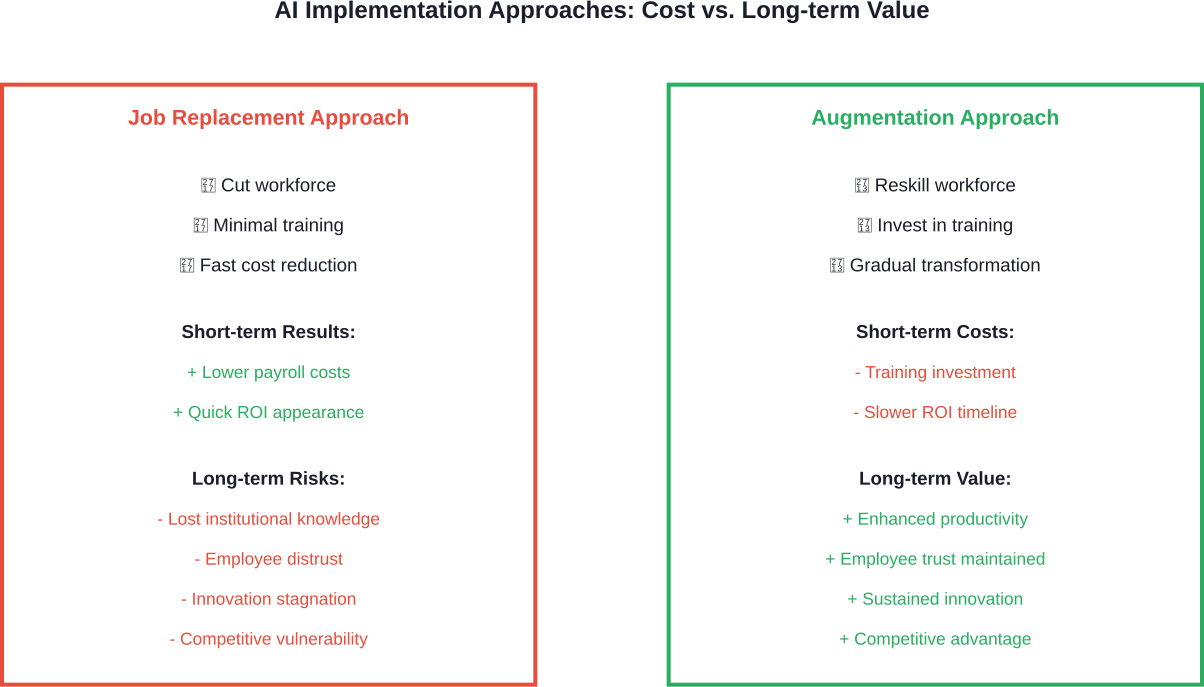
But wait. What happens when companies focus exclusively on cost cutting through job elimination?
The Reskilling Gap
Some organizations approach AI as a simple substitution: replace human workers with cheaper automation. That strategy might boost short-term profits, but it creates longer-term problems.
Industry observers note that cutting jobs for AI without investing in reskilling could cost organizations the future they actually want. The window of opportunity to get AI adoption right is narrow.
Companies that invest in training workers to use AI tools—rather than replacing workers with AI—see better outcomes. Augmentation beats replacement in most scenarios.
Beyond Cost Cutting: Growth Potential
The most successful AI implementations don’t just cut costs—they enable growth that wasn’t previously possible.
A cost-cutting mindset caps AI’s potential at the current size and scope of human-performed tasks. If a digital agent can do the work of three analysts, thinking of that as just 3x efficiency misses the bigger picture.
AI allows organizations to pursue opportunities that weren’t economically viable before. Analysis that was too expensive becomes affordable. Personalization that requires too many human hours becomes scalable.
Revenue Enhancement vs. Cost Reduction
Companies are learning to reframe AI strategy around capacity for business expansion and innovation, not just efficiency gains.
AI-powered tools assisting with scheduling or automating routine reporting tasks improve office productivity, enabling workers to allocate time toward more high-value activities. That shift creates space for revenue-generating work rather than just reducing the cost of existing work.
The difference matters. Cost reduction has a floor—you can only cut so much. Revenue enhancement has a much higher ceiling.
Measuring True ROI
Calculating AI return on investment requires looking beyond direct labor cost savings. The full picture includes:
- Reduced error rates and rework costs
- Faster time-to-market for products and services
- Improved customer satisfaction and retention
- Enhanced decision-making quality
- Increased capacity for innovation
Some of these are harder to quantify than simple headcount reduction. But they’re often more valuable over longer time horizons.
| Metric Type | Easy to Measure | Hard to Measure |
|---|---|---|
| Direct Costs | Labor hours saved, processing speed | Opportunity cost of delayed decisions |
| Quality Impact | Error rates, defect reduction | Customer satisfaction improvements |
| Strategic Value | Time-to-market acceleration | Innovation capacity, competitive position |
The Labor Market Impact Question
Yale Budget Lab research examining AI’s impact on the labor market found that while the occupational mix is changing more quickly than in the past, the difference isn’t large and predates widespread AI introduction.
Current measures of exposure, automation, and augmentation show no sign of being related to changes in employment or unemployment at the macro level. That doesn’t mean individual companies aren’t making workforce changes—it means the aggregate effect hasn’t created mass unemployment.
Better data is needed to fully understand AI’s labor market impact. Researchers plan to update their analysis regularly as more information becomes available.
Implementation Strategies That Work
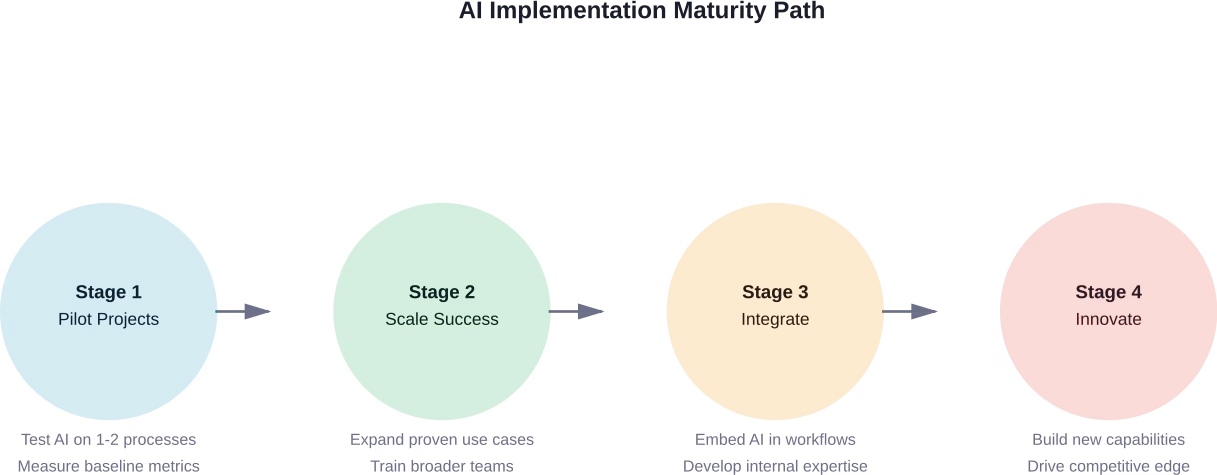
Organizations successfully capturing AI cost savings share common approaches. They start small, measure carefully, and scale what works.
Focus on High-Impact Processes
Not every process benefits equally from AI automation. The best candidates are:
- High-volume, repetitive tasks
- Processes with clear, consistent rules
- Activities where speed matters
- Functions requiring 24/7 availability
- Tasks with high error rates when done manually
Starting with processes that meet multiple criteria increases the likelihood of measurable success.
Build Internal Capabilities
Companies achieving the best results invest in developing internal AI expertise rather than relying entirely on vendors. That doesn’t mean building everything in-house, but it does mean having people who understand the technology and can evaluate solutions.
MIT Sloan Management Review research on practical AI implementation shows companies focusing on small and medium-sized wins while ensuring powerful AI tools are used appropriately. Early stages of generative AI use are best described as extensive experimentation with focused applications.
Maintain Human Oversight
AI systems capable of making decisions still require human oversight, especially for high-stakes choices. The most effective implementations use AI to present options and recommendations, with humans making final decisions.
This approach combines AI’s processing speed and analytical power with human judgment, context understanding, and ethical reasoning.

Reduce AI Costs at the System Level, Not Just the Surface
AI Superior works on the parts that actually determine long-term AI costs – model choice, architecture, data pipelines, and how systems are deployed. Instead of focusing only on usage metrics or short-term optimizations, the work usually involves building or refining LLM and generative AI systems so they run with fewer resources and more predictable performance. This includes custom model development, fine-tuning, and setting up infrastructure that does not overconsume compute by default.
If your AI costs keep rising, it is often tied to decisions made early – oversized models, inefficient prompts, or pipelines that generate unnecessary load. Fixing those reduces both compute and ongoing tooling costs at the same time. If you want to cut spending in a way that actually holds over time, contact AI Superior and review your AI system end to end.
Common Pitfalls to Avoid
Even well-intentioned AI initiatives can fail to deliver expected cost savings. Understanding common mistakes helps organizations avoid them.
Overestimating Immediate Impact
AI implementation takes time. Systems need training. Processes require redesign. Employees need to learn new workflows.
Organizations expecting immediate 30% cost reductions often face disappointment when results take quarters rather than weeks to materialize. Setting realistic timelines prevents premature project cancellations.
Underestimating Change Management
Technology is often the easy part. Getting people to change how they work is harder.
Successful implementations invest heavily in communication, training, and support. They address employee concerns directly rather than assuming people will automatically embrace new tools.
Neglecting Data Quality
AI systems are only as good as their training data. Poor data quality leads to unreliable outputs, which undermines trust and limits adoption.
Organizations need to invest in data governance, cleaning, and validation before expecting AI to deliver value.
The 2026 Landscape
The AI market continues growing. More companies are moving from experimentation to production deployment.
Research from academic institutions tracking AI adoption shows global private AI investment hitting record highs with 26% growth. That capital is funding both new product development and organizational implementations.
The focus is shifting from proof-of-concept projects to scalable, production-grade systems. Companies are learning what works and what doesn’t through practical experience rather than theoretical projections.
Generative AI’s Expanding Role
Generative AI tools have moved beyond content creation into business process applications. Procurement, customer service, software development, and data analysis all use generative models for specific tasks.
The technology is producing tangible bottom-line cost reductions in organizations that implement it thoughtfully. But it’s not a magic solution that works automatically—it requires careful application design and ongoing refinement.
Frequently Asked Questions
How much can AI actually reduce business costs?
Companies implementing AI automation report 30% reduction in compliance costs and 50% faster processing times on average. The actual savings vary significantly based on industry, process maturity, and implementation quality. Wharton research projects AI will increase overall productivity and GDP by 1.5% by 2035, nearly 3% by 2055, and 3.7% by 2075.
What business processes benefit most from AI cost savings?
High-volume, repetitive tasks with clear rules see the biggest benefits. Data entry, invoice processing, compliance reporting, customer service inquiries, and quality control checks are prime candidates. AI delivers the most value in processes where speed matters, errors are costly, and 24/7 availability provides competitive advantage.
How long does it take to see ROI from AI implementation?
Timelines vary based on scope and complexity. Pilot projects can show results in 3-6 months. Broader implementations typically require 12-18 months before delivering measurable cost savings. Organizations that start small, measure carefully, and scale what works see faster returns than those attempting large-scale transformations immediately.
Does AI reduce costs by eliminating jobs?
Research from Brookings Institution shows AI has actually spurred firm growth and increased employment at companies investing in AI. Yale Budget Lab found no relationship between AI exposure measures and employment changes at the macro level. The most successful implementations augment workers rather than replacing them, redirecting human effort toward higher-value activities.
What are the hidden costs of AI implementation?
Beyond software and infrastructure costs, organizations face expenses for data preparation, integration work, employee training, and change management. Many projects also require ongoing costs for model maintenance, performance monitoring, and continuous improvement. Underestimating these hidden costs is a common reason AI initiatives fail to meet ROI expectations.
Can small businesses achieve AI cost savings?
Small businesses can benefit from AI, but their approach differs from enterprise implementations. Cloud-based AI services with pay-as-you-go pricing reduce upfront investment. Focusing on specific, high-impact processes rather than comprehensive transformation makes implementation more manageable. Many small businesses see results from AI-powered customer service, scheduling automation, or inventory optimization.
How do you measure AI cost savings accurately?
Establish baseline metrics before implementation covering processing time, error rates, labor hours, and operational costs. Track the same metrics after deployment to calculate direct impact. Include indirect benefits like improved customer satisfaction, faster decision-making, and increased innovation capacity. Compare total costs including implementation and maintenance against total benefits over a 3-5 year horizon for realistic ROI assessment.
Moving Forward with AI Cost Optimization
The evidence is clear: AI delivers measurable cost savings when implemented strategically. But the emphasis belongs on that last word—strategically.
Organizations that treat AI purely as a cost-cutting tool miss its larger potential. Those that view it as an enabler of growth, innovation, and competitive advantage capture more value over time.
The path forward requires balancing short-term efficiency gains with long-term capability building. That means investing in employee training alongside automation. It means measuring diverse metrics beyond simple headcount reduction. It means maintaining the trust of workers while transforming how work gets done.
Real talk: we’re still early in understanding AI’s full economic impact. The Wharton projections extend to 2075 because this is a multi-decade transformation, not a quarterly initiative.
Companies getting AI cost optimization right in 2026 are those experimenting aggressively, measuring rigorously, and scaling carefully. They’re building internal expertise rather than just buying vendor solutions. They’re asking how AI enables new possibilities, not just how it replicates current processes more cheaply.
The window of opportunity is open. The question isn’t whether AI can reduce costs—the data shows it can. The question is whether organizations will capture those savings while building foundations for sustainable growth.
Start with one high-impact process. Measure the results. Learn what works. Then scale from there. That’s how the companies reporting 30% cost reductions and 50% efficiency gains got their results. That’s how the next wave will get theirs.
 English
  German
  Arabic
  French
  Dutch
Dutch  Spanish