
Quick Summary: AI development costs in 2026 range from $5,000 for basic rule-based chatbots to over $1 million for enterprise-grade LLM and computer-vision solutions. Project complexity is the dominant cost driver, accounting for 30-40% of total expenses, followed by infrastructure, team expertise, data quality, and ongoing maintenance. Most business AI projects fall between $40,000 and $400,000 depending on functionality and scale.
According to industry data, a significant percentage of companies have adopted AI in at least one function. That’s a notable adoption rate, and it’s pushing demand—and pricing—higher than ever.
But here’s the thing: asking “how much does AI cost?” is like asking “how much does a building cost?” The answer depends entirely on what’s being built.
AI development costs vary dramatically based on complexity, ranging from a few thousand dollars for simple rule-based systems to well over $1 million for enterprise-grade solutions. The wide range makes budget planning difficult, especially for organizations new to AI implementation.
This guide breaks down actual AI development costs in 2026, covering everything from initial development to ongoing maintenance. The numbers come from real project data, not theoretical estimates.
Understanding the AI Development Cost Spectrum
AI development costs aren’t linear. A project that costs $50,000 doesn’t necessarily deliver half the value of a $100,000 project.
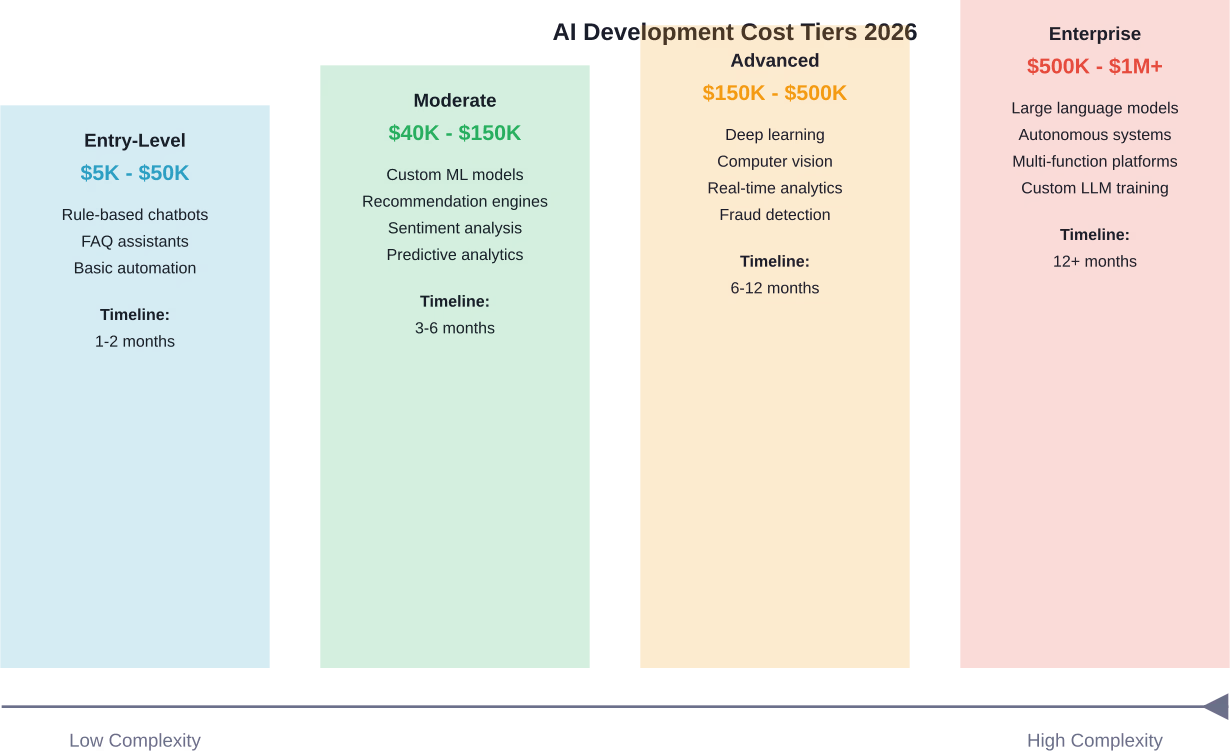
The cost structure breaks down into distinct tiers based on complexity. Each tier represents a different level of technical sophistication and business impact.
Entry-Level AI Projects: $5,000 – $50,000
Simple AI projects typically involve rule-based systems or basic machine learning implementations. Think rule-based chatbots that answer common questions, basic FAQ bots, or simple automation tools that follow set rules.
These projects typically start from $2,499 and can reach $50,000 depending on scope. The development timeline is short, usually within a few weeks to two months.
What’s included at this level? Basic natural language processing (NLP), pre-trained models with minimal customization, simple decision trees, and straightforward integration with existing systems.
The AI FAQ assistant is a classic example. It handles common customer queries using predetermined responses and basic intent recognition. Development takes 1-2 months with minimal infrastructure needs.
Moderate Complexity Projects: $40,000 – $150,000
This is where most business AI projects land. Moderate complexity involves custom machine learning models, more sophisticated NLP, or computer vision applications that require training on specific datasets.
Projects in this range include ML-powered recommendation engines, sentiment analysis tools, predictive analytics platforms, and custom chatbots with context awareness.
Development time extends to 3-6 months. The team needs data scientists, ML engineers, and often domain experts to ensure model accuracy.
Data requirements become critical here. Models need substantial training data—often thousands to millions of examples depending on the task. Data quality directly impacts both cost and performance.
Advanced AI Solutions: $150,000 – $500,000
Advanced projects involve deep learning architectures, large-scale computer vision systems, or sophisticated NLP applications. These solutions often process unstructured data at scale.
Examples include advanced image recognition systems, real-time video analytics, complex fraud detection platforms, and AI-powered medical diagnosis tools.
Development takes 6-12 months minimum. The team expands to include specialized ML engineers, data engineers for pipeline development, and MLOps professionals for deployment.
Infrastructure costs spike at this level. Training deep learning models requires significant compute power, often involving GPU clusters running for weeks or months.
Enterprise-Grade AI Systems: $500,000 – $1,000,000+
Enterprise implementations involve large language models, autonomous systems, or AI platforms that integrate across multiple business functions.
Building or fine-tuning large-scale AI models from scratch requires vast amounts of data, significant computing power, and substantial financial resources. The complexity of these models can account for 30-40% of the total project cost.
Development timelines extend beyond a year. These projects require full AI teams including research scientists, multiple ML engineers, dedicated infrastructure teams, and comprehensive security specialists.
The investment isn’t just in development—it’s in building AI capabilities that become core business assets.
Cost Breakdown by Project Type
Different AI applications have distinct cost structures. Here’s what various AI solutions actually cost in 2026 based on real project data.
AI Chatbot Development Costs
Chatbots represent the most common AI implementation, but costs vary significantly based on capabilities.
Basic rule-based chatbots cost between $10,000 and $25,000. These handle predetermined conversation flows with limited flexibility. Development takes 4-8 weeks.
Context-aware chatbots with NLP capabilities range from $30,000 to $80,000. They understand user intent, maintain conversation context, and integrate with business systems. Development requires 2-4 months.
Advanced conversational AI with learning capabilities costs $80,000 to $200,000+. These systems improve through interactions, handle complex queries, and integrate with multiple data sources.
AI Mobile App Development
Mobile apps with AI features typically cost $20,000 to $50,000 for basic implementations. This includes simple image recognition, voice commands, or basic personalization.
More sophisticated AI-powered mobile applications range from $50,000 to $150,000. These involve real-time processing, complex computer vision, or advanced recommendation systems.
The platform choice matters. Developing for both iOS and Android increases costs by 40-60% compared to single-platform development.
AI Agent and Assistant Development
AI agents that perform autonomous tasks start at $40,000 and frequently exceed $100,000 depending on complexity.
Simple task automation agents cost $40,000 to $70,000. These handle specific workflows like email sorting, data entry, or basic customer service routing.
Intelligent assistants with decision-making capabilities range from $70,000 to $150,000. They analyze context, make recommendations, and adapt to user preferences.
Advanced autonomous agents exceed $150,000. These systems handle complex multi-step processes, learn from outcomes, and operate with minimal human oversight.
Custom Model Development
Building custom AI models from scratch represents the most variable cost category.
Basic custom models start at $15,000. These involve training on specific datasets using established architectures. Development takes 1-3 months.
Intermediate models cost $50,000 to $150,000. They require custom architectures, extensive data preprocessing, and iterative refinement.
Advanced models exceed $150,000 and can reach several million for cutting-edge research applications. These push the boundaries of current AI capabilities.
| AI Solution Type | Cost Range | Development Time | Key Features |
|---|---|---|---|
| Basic Chatbot | $10,000 – $25,000 | 1-2 months | Rule-based, FAQ, simple flows |
| Advanced Chatbot | $30,000 – $80,000 | 2-4 months | NLP, context awareness, integrations |
| AI Mobile App | $20,000 – $150,000 | 2-6 months | Computer vision, personalization, real-time processing |
| AI Agent/Assistant | $40,000 – $150,000+ | 3-8 months | Autonomous tasks, decision-making, learning |
| Custom Model | $15,000 – $100,000+ | 1-12 months | Domain-specific, custom architecture, research-grade |
Primary Cost Drivers in AI Development
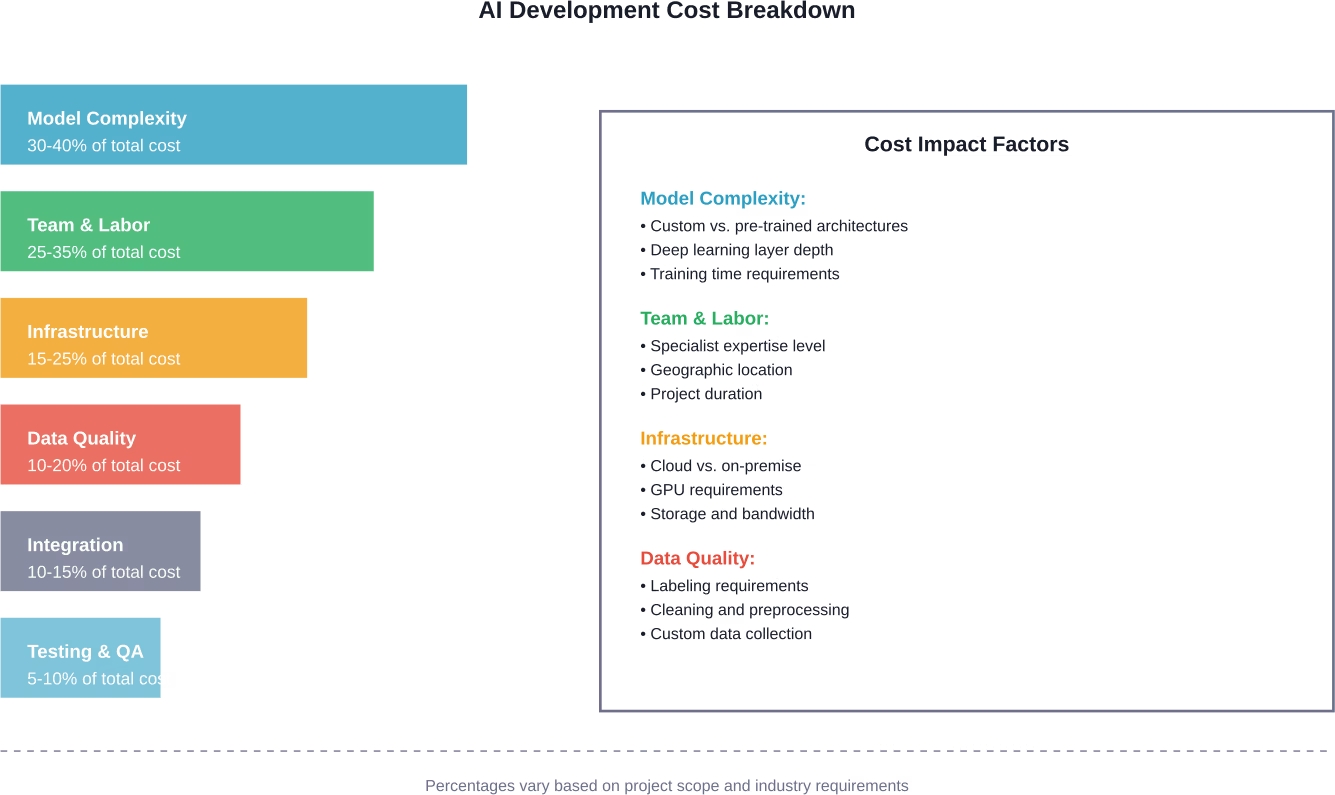
Understanding what drives AI costs helps with accurate budget planning. Project complexity is the dominant factor, but several other elements significantly impact the final price.
Model Complexity and Architecture
The complexity of the AI model can account for 30-40% of the total project cost.
Simple models using pre-trained architectures with minimal customization cost less. Transfer learning—taking an existing model and adapting it—reduces both time and expense.
Custom architectures require significant engineering time. Data scientists must design, test, and refine the model structure. This iterative process extends timelines and increases costs.
Deep learning models with multiple layers demand extensive computational resources for training. A model that takes weeks to train on GPU clusters can add tens of thousands in infrastructure costs alone.
Data Requirements and Quality
AI is only as good as the data it runs on. If data is clean, organized, and labeled, development moves faster and costs less. If data is messy, scattered, or unlabeled, costs spike.
Data collection costs vary dramatically. Public datasets are free but may not fit specific needs. Custom data collection through surveys, web scraping, or manual gathering adds $10,000 to $100,000+ depending on volume and complexity.
Data labeling represents a hidden cost that catches many organizations off guard. Manual labeling can cost $0.01 to $5 per data point depending on complexity. A computer vision project needing 100,000 labeled images at $0.50 each adds $50,000 just for annotation.
Data cleaning and preprocessing typically consume 60-80% of a data scientist’s time in AI projects. This doesn’t show up as a separate line item, but it’s built into development costs.
Infrastructure and Computing Resources
Infrastructure costs depend heavily on whether the project uses cloud services or on-premise hardware.
Cloud-based AI development offers flexibility but costs accumulate quickly. Based on typical configurations, monthly cloud infrastructure for a moderate AI project can include:
- Amazon EC2 compute instances: $20,959.76 per month
- Amazon Elastic Block Store: $1,233.29 per month
- S3 storage: $471.04 per month
- VPN connection: $275 per month
That’s over $22,900 monthly or $275,000 annually for infrastructure alone. For a 12-month project, infrastructure represents a substantial portion of total costs.
On-premise deployment requires upfront capital investment. GPU servers suitable for AI training cost $10,000 to $50,000+ per unit. Organizations need multiple units for serious AI development.
Taking the H100 or B200 GPU as an example, the hourly cost for high-end AI compute in 2026 typically ranges from $2.50 to $4.50 per hour per card on major cloud platforms.
Team Composition and Expertise
AI development requires specialized talent, and salaries reflect high demand.
According to academic research on AI developer careers, AI developer salaries are competitive, reflecting high demand and specialized skills. Annual earnings usually range from $106,000 to $150,000, with top earners surpassing $150,000. Several factors influence compensation including experience, specialization, and location.
A typical AI project team includes:
- Project manager: $80,000 – $130,000 annually
- Data scientists: $100,000 – $160,000 each
- ML engineers: $110,000 – $170,000 each
- Data engineers: $90,000 – $140,000 each
- Frontend/backend developers: $70,000 – $120,000 each
For a 6-month project requiring 2 data scientists, 2 ML engineers, 1 data engineer, and 1 project manager, team costs alone exceed $400,000.
Offshore development reduces costs but introduces coordination challenges. Rates in Eastern Europe or Asia run 40-60% lower than North American rates, but time zone differences and communication overhead must be factored in.
Integration Complexity
AI rarely operates in isolation. Integration with existing systems often represents 20-30% of total project costs.
Simple API-based integrations cost $5,000 to $15,000. These involve connecting the AI system to a few well-documented external services.
Complex enterprise integrations range from $20,000 to $100,000+. These require custom middleware, data pipeline development, and extensive testing across multiple systems.
Legacy system integration presents unique challenges. Older systems may lack modern APIs, requiring custom connectors or middleware layers. This work is time-consuming and expensive.
Hidden and Ongoing Costs
Initial development represents only part of total AI investment. Several ongoing costs emerge after deployment that organizations frequently underestimate.
Model Maintenance and Retraining
AI models degrade over time as data patterns shift. This phenomenon, called model drift, requires regular retraining to maintain accuracy.
Monitoring costs run $1,000 to $5,000 monthly depending on system complexity. This includes performance tracking, drift detection, and alerting systems.
Retraining frequency depends on the application. Some models need monthly updates, others quarterly or annually. Each retraining cycle costs 10-30% of initial model development.
For a model that cost $80,000 to develop, annual retraining might add $24,000 to $72,000 depending on frequency and extent of updates needed.
Infrastructure and Hosting
Inference costs—the computational expense of running predictions—add up quickly at scale.
Cloud inference pricing varies by provider and model complexity. Simple models might cost $0.001 per prediction, while complex deep learning models reach $0.10+ per prediction. An application serving 1 million predictions monthly at $0.01 each costs $10,000 monthly or $120,000 annually.
Storage costs accumulate as training data, model versions, and logs expand. Budget $500 to $5,000 monthly for storage depending on data volumes.
Security and Compliance
AI systems handling sensitive data require robust security measures. Healthcare, finance, and legal applications face strict regulatory requirements.
Initial security implementation adds 15-25% to development costs. This includes encryption, access controls, audit logging, and compliance frameworks.
Ongoing security maintenance costs $2,000 to $10,000 monthly. This covers security monitoring, vulnerability patching, compliance audits, and incident response capabilities.
Support and Operations
AI systems need operational support distinct from traditional software. MLOps practices require specialized personnel and tools.
A dedicated MLOps engineer costs $100,000 to $150,000 annually. Smaller projects might allocate 20-40% of an engineer’s time, reducing costs proportionally.
User support adds another layer. Organizations need staff who understand both the technical system and business context. Budget $50,000 to $100,000 annually for support personnel depending on user base size.
Scaling Costs
Successful AI projects often face scaling challenges. A proof-of-concept that works for 1,000 users may need significant rework to serve 100,000.
Performance optimization to handle scale typically costs 20-40% of initial development. This includes database optimization, caching strategies, load balancing, and sometimes architectural redesign.
Infrastructure costs scale roughly linearly with usage, but optimization can improve efficiency. A well-optimized system might serve 10x the users with only 3-5x the infrastructure cost.
| Ongoing Cost Category | Monthly Cost | Annual Cost | Frequency/Notes |
|---|---|---|---|
| Model Monitoring | $1,000 – $5,000 | $12,000 – $60,000 | Continuous |
| Model Retraining | Varies | $24,000 – $72,000 | Quarterly to annually |
| Infrastructure/Hosting | $5,000 – $25,000 | $60,000 – $300,000 | Scales with usage |
| Security & Compliance | $2,000 – $10,000 | $24,000 – $120,000 | Continuous |
| MLOps Support | $8,000 – $12,500 | $100,000 – $150,000 | Full-time equivalent |
| User Support | $4,000 – $8,000 | $50,000 – $100,000 | Based on user base |
Industry-Specific AI Development Costs
AI costs vary significantly across industries due to different regulatory requirements, data complexity, and accuracy demands.
Healthcare AI Development
Healthcare AI faces stringent regulatory requirements and high accuracy demands. Patient safety depends on system reliability, driving costs upward.
Medical diagnosis AI systems cost $200,000 to $800,000+. These require extensive validation, clinical trials, and regulatory approval processes.
HIPAA compliance adds 20-30% to development costs. Security measures, audit trails, and privacy protections require specialized implementation.
Data annotation for medical AI is expensive. Expert clinicians must label training data, costing $50 to $500 per case depending on complexity. A dataset of 10,000 cases could require $500,000 to $5 million just for annotation.
Financial Services AI
Financial AI systems handle sensitive data and face strict regulatory oversight. Fraud detection, risk assessment, and algorithmic trading applications dominate this sector.
Fraud detection systems cost $150,000 to $500,000. These process massive transaction volumes in real-time, requiring robust infrastructure and highly accurate models.
Risk assessment models range from $100,000 to $400,000. Regulatory requirements mandate explainability, adding complexity beyond pure accuracy optimization.
Financial data security requirements add 25-35% to base costs. Multi-factor authentication, encryption at rest and in transit, and comprehensive audit logging are mandatory.
Retail and E-Commerce AI
Retail AI focuses on recommendation engines, inventory optimization, and customer service automation.
Product recommendation systems cost $50,000 to $200,000 depending on catalog size and sophistication. These must handle real-time personalization at scale.
Inventory optimization AI ranges from $80,000 to $300,000. These systems predict demand, optimize stock levels, and minimize waste.
Visual search and computer vision applications for retail cost $100,000 to $400,000. Training models to recognize products across varied conditions requires substantial data and computing resources.
Manufacturing AI
Manufacturing AI emphasizes predictive maintenance, quality control, and process optimization.
Predictive maintenance systems cost $100,000 to $350,000. These analyze sensor data to predict equipment failures before they occur.
Computer vision for quality control ranges from $120,000 to $450,000. High-speed inspection systems must achieve near-perfect accuracy to avoid defects reaching customers.
Process optimization AI costs $150,000 to $600,000. These systems optimize complex manufacturing processes with multiple variables and constraints.
Generative AI vs Traditional AI Costs
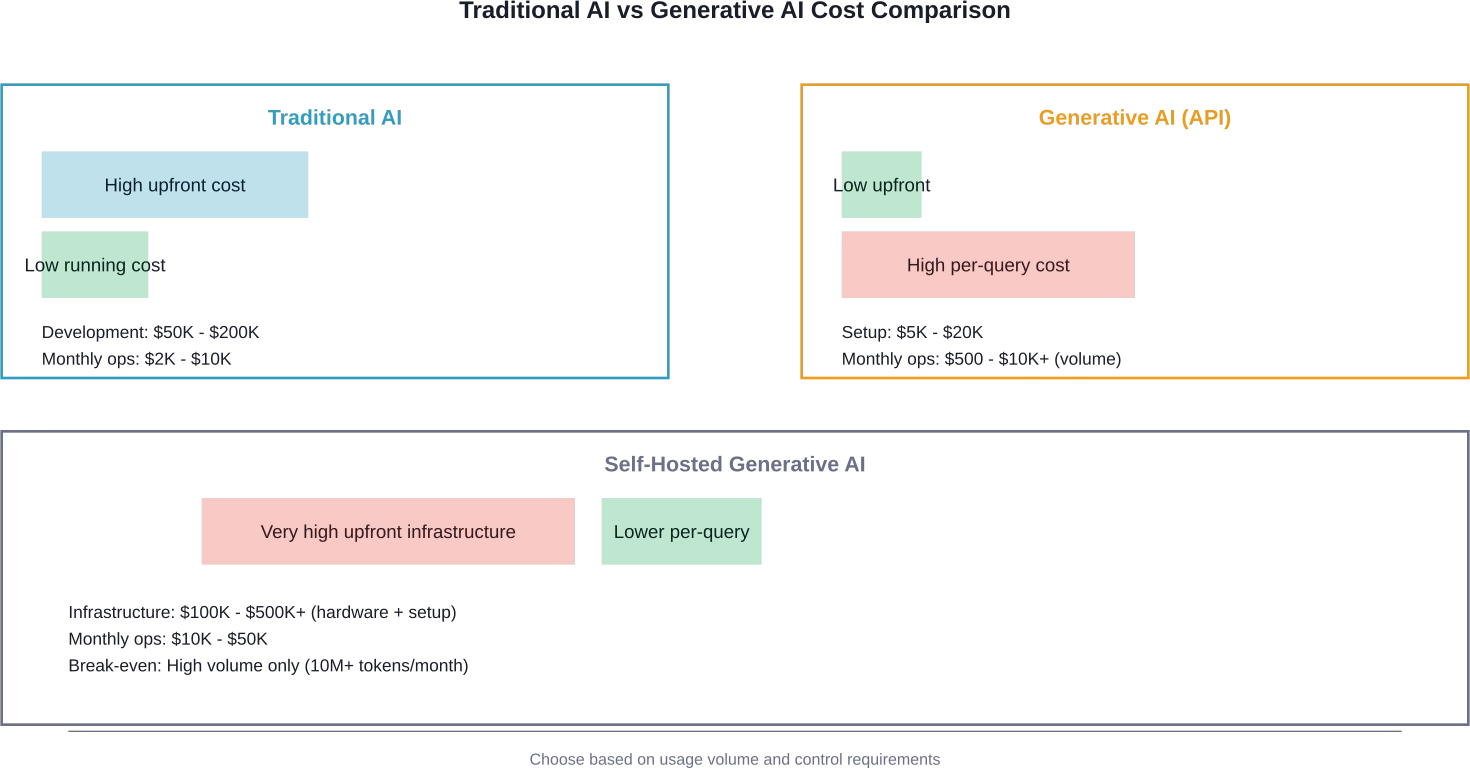
Generative AI systems like large language models have different cost structures compared to traditional AI.
Traditional AI Cost Structure
Traditional AI (classification, regression, computer vision) follows predictable cost patterns. Development costs dominate the budget, with inference relatively inexpensive.
A traditional ML model might cost $80,000 to develop and $5,000 monthly to run. The cost structure is front-loaded with development, then levels off during operation.
Generative AI Cost Structure
Generative AI reverses this pattern. Using pre-trained models via API is cheap initially but expensive at scale due to per-token pricing.
GPT-4 pricing typically runs $0.03 per 1,000 input tokens and $0.06 per 1,000 output tokens. An application generating 10 million tokens monthly costs $300 to $600 just for API calls.
Fine-tuning existing models costs $15,000 to $80,000 depending on dataset size and training requirements. This provides better performance and lower per-query costs than generic models.
Training large language models from scratch requires massive resources. According to research on LLM resource consumption, context windows have expanded dramatically—GPT-5.4 now supports 1M tokens, while Claude Opus 4.6 handles 200K tokens with 1M in beta. Larger context windows mean higher computational costs per query.
Self-hosting open-source models like Llama requires upfront infrastructure investment. Research on on-premise LLM deployment shows organizations face a decision between subscribing to commercial services or deploying on their own infrastructure. Break-even analysis depends on query volume, with high-volume applications favoring self-hosted solutions.
Cost Comparison
For low-volume applications (under 1 million tokens monthly), API-based generative AI is most cost-effective. Initial investment is minimal, and monthly costs stay under $1,000.
Medium-volume applications (1-10 million tokens monthly) benefit from fine-tuned models. The upfront investment pays off through reduced per-query costs.
High-volume applications (over 10 million tokens monthly) justify self-hosted solutions. Infrastructure costs are high but per-query costs drop significantly, making it economical at scale.
How to Reduce AI Development Costs
Strategic planning can significantly reduce AI development expenses without sacrificing quality.
Start with Pre-Trained Models
Transfer learning dramatically reduces costs. Pre-trained models have already learned general patterns, requiring only fine-tuning for specific use cases.
Fine-tuning a pre-trained model costs 60-80% less than training from scratch. A custom model that might cost $150,000 to build from the ground up could cost $30,000 to $60,000 through transfer learning.
Open-source models like BERT, GPT variants, ResNet, and YOLO provide excellent starting points. These models are free to use and come with extensive documentation.
Focus on Data Quality Over Quantity
More data isn’t always better. High-quality, relevant data often outperforms massive low-quality datasets.
Invest in proper data cleaning and validation upfront. Fixing data issues early costs far less than discovering problems after model training.
Active learning strategies can reduce labeling costs by 50-70%. The model identifies which data points need human labeling, focusing effort where it matters most.
Use Cloud Services Strategically
Cloud infrastructure offers flexibility but requires cost management. Unmonitored cloud usage frequently exceeds budgets.
Use spot instances for training workloads. These cost 60-90% less than on-demand instances. Training can tolerate interruptions by implementing checkpoint systems.
Implement auto-scaling for inference workloads. Scale up during peak usage and down during quiet periods. This can cut infrastructure costs by 40-60%.
Set up cost alerts and budgets. Cloud providers offer tools to alert when spending exceeds thresholds, preventing surprise bills.
Adopt Incremental Development
Build minimum viable AI products before full-scale development. Start with simplified models that address core use cases.
An MVP might cost $20,000 to $50,000 instead of $200,000 for a full system. This validates the approach and demonstrates value before major investment.
Iterate based on real-world feedback. Users often care more about reliability and ease of use than maximum accuracy. A 85% accurate system that works consistently beats a 95% accurate system that’s unreliable.
Consider Alternative Talent Models
Full-time hires aren’t always necessary. Flexible talent models can reduce costs while maintaining quality.
Contract specialists for short-term needs. Bring in experts for specific phases like model architecture design or deployment optimization.
Use offshore or nearshore development for appropriate tasks. Data preprocessing, basic model training, and integration work often don’t require onsite presence.
Partner with universities for research-heavy projects. Academic partnerships can access cutting-edge expertise at lower costs while providing research opportunities.

Cut AI Development Costs Before They Lock In
In most AI projects, the biggest costs are decided early, not during scaling. AI Superior focuses on the stages that usually define how expensive AI becomes over time – model selection, data preparation, training, and deployment. Their work covers end-to-end development, from building and fine-tuning custom LLMs to setting up infrastructure that is actually sized for the use case, not overbuilt by default. This helps avoid common cost drivers like oversized models, inefficient pipelines, and unnecessary compute usage.
Most AI cost overruns are not random – they come from early decisions that stay in the system. Fixing those at the architecture level reduces both development and ongoing operational costs. If you want a realistic cost structure instead of constant adjustments later, contact AI Superior and review how your AI system is designed.
AI Development Cost Case Studies
Real-world examples illustrate how AI costs play out across different implementations.
Case Study: Customer Service Chatbot
A mid-sized e-commerce company implemented an AI chatbot to handle common customer inquiries.
Requirements: Handle 50,000 monthly conversations, integrate with existing CRM, support English and Spanish, escalate complex issues to humans.
Approach: Used a pre-trained language model fine-tuned on customer service conversations, developed custom integration with Salesforce, implemented conversation routing logic.
Costs:
- Initial development: $65,000 (3 months)
- Data labeling (500 conversations): $8,000
- Integration development: $12,000
- Testing and refinement: $8,000
- Total initial investment: $93,000
Ongoing costs:
- Cloud hosting: $1,200 monthly
- Monitoring and maintenance: $2,500 monthly
- Quarterly model updates: $6,000 each
- Annual ongoing: $68,400
Outcome: Chatbot handles 70% of inquiries without human intervention, saving approximately $180,000 annually in support costs. ROI achieved in 10 months.
Case Study: Fraud Detection System
A regional bank developed an AI system to detect fraudulent transactions in real-time.
Requirements: Process 2 million transactions daily, detect fraud with 99%+ accuracy, maintain under 100ms latency, meet regulatory requirements.
Approach: Custom gradient boosting model trained on 5 years of transaction history, real-time feature engineering pipeline, A/B testing framework for model updates.
Costs:
- Model development: $180,000 (6 months)
- Infrastructure setup: $45,000
- Data engineering: $60,000
- Security and compliance: $35,000
- Testing and validation: $25,000
- Total initial investment: $345,000
Ongoing costs:
- Cloud infrastructure: $8,500 monthly
- Model monitoring: $3,000 monthly
- Monthly retraining: $12,000
- Security audits: $15,000 quarterly
- Annual ongoing: $258,000
Outcome: System prevents approximately $2.4 million in fraud annually while reducing false positives by 40%. ROI achieved in 3 months.
The Business Case for AI Investment
According to the National Science Foundation, the United States performed an estimated $940 billion in research and development across all sectors in 2023, up from $892 billion in 2022. The business sector performed the largest amount—$735 billion, or 78% of total U.S. R&D performance.
This massive investment reflects AI’s transformative potential, but individual organizations need clear justification for their specific projects.
Calculating AI ROI
AI ROI follows a straightforward formula: (Total Benefits – Total Costs) / Total Costs × 100.
Benefits include direct cost savings, revenue increases, and efficiency improvements. Quantify these where possible.
A customer service chatbot that reduces support calls by 10,000 annually at $8 per call saves $80,000. If it costs $60,000 to develop and costs $15,000 annually to maintain, first-year ROI is 7%, with subsequent years at 433%.
Indirect benefits matter but are harder to quantify. Improved customer satisfaction, faster decision-making, and enhanced employee productivity contribute to ROI but require assumptions.
Risk Factors in AI Investment
AI projects carry technical and business risks that must be factored into investment decisions.
Technical failure risk is significant. Many AI projects don’t achieve target accuracy or performance. Budget contingencies of 20-30% for unexpected technical challenges.
Data availability risk emerges when required data doesn’t exist or is inaccessible. Validate data availability before committing to full development.
Adoption risk occurs when users don’t embrace the AI system. Change management and training are critical but often overlooked.
Regulatory risk is particularly acute in healthcare, finance, and legal applications. Regulations change, potentially requiring expensive system modifications.
Time to Value Considerations
AI projects often take longer than anticipated to deliver business value.
Simple projects might deliver value in 2-4 months. Moderate complexity projects typically need 6-9 months from kickoff to production value. Complex projects often require 12-18 months.
Phased approaches reduce time to value. Deploy basic functionality first, then iterate. This generates early returns while building toward the complete vision.
AI Development: Build vs Buy vs Partner
Organizations face a strategic choice between building custom solutions, buying commercial products, or partnering with AI vendors.
Building In-House
- Advantages: Complete control over functionality, data privacy, customization to specific needs, intellectual property ownership.
- Disadvantages: Highest upfront cost, requires specialized talent, longer time to deployment, ongoing maintenance burden.
- Best for: Organizations with unique requirements, sensitive data constraints, or AI as core competitive advantage.
- Cost range: $50,000 to $1,000,000+ depending on complexity.
Buying Commercial Solutions
- Advantages: Fast deployment, proven technology, included support and updates, predictable costs.
- Disadvantages: Limited customization, subscription costs over time, potential vendor lock-in, generic functionality.
- Best for: Standard use cases, quick deployment needs, limited internal AI expertise.
- Cost range: $1,000 to $100,000+ annually depending on scale.
Partnering with AI Vendors
- Advantages: Access to specialized expertise, faster development than pure in-house, customization possible, knowledge transfer.
- Disadvantages: Higher cost than off-the-shelf solutions, dependency on partner, potential quality variation.
- Best for: Organizations building custom solutions without full in-house AI capability.
- Cost range: $40,000 to $500,000+ depending on project scope.
| Approach | Initial Cost | Ongoing Cost | Time to Deploy | Customization |
|---|---|---|---|---|
| Build In-House | $50K – $1M+ | $50K – $300K/year | 3-18 months | Complete |
| Buy Commercial | $5K – $50K | $12K – $200K/year | Days to weeks | Limited |
| Partner/Vendor | $40K – $500K | $30K – $150K/year | 2-12 months | High |
2026 AI Development Cost Trends
Several trends are reshaping AI development economics in 2026.
Commoditization of Basic AI
Basic AI capabilities are becoming commoditized. Simple chatbots, basic image recognition, and standard recommendation engines cost significantly less than three years ago.
Cloud providers offer pre-built AI services that reduce development from months to days. What required custom development now often works with configuration.
This commoditization pushes organizations toward more sophisticated AI applications where differentiation remains possible.
Rising Infrastructure Efficiency
Hardware improvements are reducing infrastructure costs. New GPU architectures deliver better performance per dollar.
Model optimization techniques like quantization and pruning reduce inference costs by 40-70% with minimal accuracy impact.
Edge computing shifts processing closer to data sources, reducing bandwidth costs and enabling real-time applications.
Increasing Talent Costs
Demand for AI specialists continues outpacing supply. Salaries for experienced AI developers, as noted earlier, typically range from $106,000 to over $150,000 annually.
Organizations compete intensely for talent, pushing compensation higher. Senior AI engineers in competitive markets command $200,000+ total compensation.
This talent scarcity drives adoption of low-code AI tools and vendor partnerships to supplement limited internal expertise.
Regulatory Compliance Overhead
AI regulation is expanding globally. The EU AI Act, various state privacy laws, and industry-specific regulations add compliance costs.
Documentation, testing, and audit requirements increase development time by 15-30% for regulated applications.
Organizations must budget for ongoing compliance monitoring and updates as regulations evolve.
Frequently Asked Questions
What is the average cost to develop an AI solution in 2026?
AI development costs vary dramatically based on complexity. Simple rule-based systems start around $5,000 to $50,000, while moderate complexity projects range from $40,000 to $150,000. Advanced AI solutions cost $150,000 to $500,000, and enterprise-grade systems frequently exceed $1 million. Most business AI projects fall in the $40,000 to $400,000 range depending on requirements and scale.
How long does AI development typically take?
Development timelines depend on project complexity. Simple AI implementations take 1-2 months, moderate complexity projects require 3-6 months, and advanced solutions need 6-12 months. Enterprise-grade AI systems often exceed 12 months from conception to production deployment. These timelines include requirements gathering, development, testing, and deployment but not ongoing optimization.
What are the main hidden costs in AI development?
Hidden costs include data labeling ($0.01 to $5 per item), model retraining (10-30% of initial development annually), infrastructure scaling, security and compliance (adding 15-25% to initial costs), ongoing monitoring ($1,000 to $5,000 monthly), and MLOps support ($100,000 to $150,000 annually for dedicated personnel). These ongoing costs often equal or exceed initial development expenses over a 3-year period.
Is it cheaper to build AI in-house or hire a vendor?
This depends on project complexity and organizational capability. For standard use cases, commercial solutions are most cost-effective with lower upfront costs and faster deployment. Custom projects benefit from vendor partnerships when internal AI expertise is limited. Building in-house makes sense for unique requirements, sensitive data, or when AI represents core competitive advantage. In-house development costs 2-3x more initially but provides greater long-term control.
How much does it cost to maintain an AI system annually?
Annual maintenance typically runs 30-60% of initial development cost. A system costing $100,000 to develop might require $30,000 to $60,000 annually for infrastructure, monitoring, retraining, security, and support. High-volume applications with frequent retraining needs can reach 80-100% of initial cost annually. Maintenance costs are often underestimated, leading to budget shortfalls after deployment.
What factors most significantly impact AI development cost?
Model complexity accounts for 30-40% of total cost, making it the dominant factor. Team expertise and location significantly impact labor costs, which represent 25-35% of budgets. Infrastructure and computing resources add 15-25%, particularly for deep learning applications. Data quality and availability contribute 10-20%, especially when extensive labeling or cleaning is required. Integration complexity adds another 10-15% depending on existing systems.
Can AI development costs be reduced without sacrificing quality?
Several strategies reduce costs while maintaining quality. Using pre-trained models through transfer learning cuts development costs by 60-80%. Strategic use of cloud spot instances for training reduces infrastructure costs by 60-90%. Active learning reduces labeling costs by 50-70% by intelligently selecting which data needs annotation. Starting with MVP implementations validates approaches before full investment. Offshore development for appropriate tasks can reduce labor costs by 40-60%.
Conclusion: Planning Your AI Development Budget
AI development costs span an enormous range—from $5,000 for basic automation to over $1 million for enterprise systems. But the investment often delivers substantial returns when approached strategically.
Project complexity drives costs more than any other factor, accounting for 30-40% of total expenses. Understanding this helps organizations right-size their AI initiatives to match business needs and budget constraints.
Hidden ongoing costs frequently surprise organizations. Budget for annual maintenance at 30-60% of initial development cost. Infrastructure, retraining, monitoring, and support add up quickly once systems are deployed.
Start small and iterate. A $50,000 MVP that validates the approach beats a $500,000 system that doesn’t meet needs. Successful AI projects begin with clear business objectives, realistic success metrics, and commitment to iterative improvement.
The key question isn’t “how much does AI cost?” but rather “what business value will this AI investment deliver?” Organizations that clearly articulate expected benefits, measure results, and optimize based on outcomes consistently achieve positive ROI from AI projects.
Ready to move forward with AI development? Start by defining specific business problems, gathering stakeholders to clarify requirements, and consulting with AI specialists to validate feasibility. A small investment in upfront planning saves substantial costs during development.
 English
  German
  Arabic
  French
  Dutch
Dutch  Spanish