
Quick Summary: AI will not replace accountants entirely, but it will fundamentally transform the profession. While AI excels at automating repetitive tasks like data entry, reconciliations, and basic reporting, accountants remain essential for strategic decision-making, complex judgment calls, compliance interpretation, and client advisory services that require human expertise and ethical reasoning.
The question keeps surfacing in accounting firms and finance departments worldwide: will artificial intelligence eventually make accountants obsolete?
Short answer? No.
But here’s the thing—AI is already changing what accounting work looks like. The repetitive, manual tasks that once consumed hours of an accountant’s day are increasingly handled by software. Data entry, invoice matching, basic reconciliations—these routine activities are prime candidates for automation.
That doesn’t mean accountants are heading toward unemployment. It means the profession is evolving, shifting from number-crunching toward strategic advisory roles that machines simply can’t replicate.
What AI Actually Does in Accounting
AI technology in accounting isn’t some futuristic concept anymore. It’s deployed right now, handling specific tasks with impressive efficiency.
Machine learning algorithms can process invoices, extract relevant data from receipts, and categorize transactions faster than any human. Optical character recognition (OCR) technology reads documents and populates accounting systems automatically. Reconciliation software matches payments to invoices without manual intervention.
According to the World Economic Forum’s Future of Jobs Report 2025, automation is expected to change how work tasks are performed, with employers estimating that 47% of work tasks are performed mainly by humans alone, 22% performed mainly by technology, and 30% completed through a combination of humans and technology.
These tools don’t get tired. They don’t make transcription errors. And they work 24/7 without coffee breaks.
| Accounting Task | AI Automation Level | Human Role Remaining |
|---|---|---|
| Data entry from invoices | High | Exception handling, verification |
| Bank reconciliation | High | Investigating discrepancies |
| Transaction categorization | Medium-High | Unusual transaction review |
| Financial reporting | Medium | Analysis, presentation, context |
| Tax planning | Low | Strategy, interpretation, client advice |
| Audit judgment | Low | Risk assessment, materiality decisions |
| Client advisory | Very Low | Relationship management, strategic guidance |
But look at that table closely. Notice how automation level drops as tasks require judgment, interpretation, and human interaction?
That’s the pattern that defines AI’s role in accounting.
Why AI Won’t Fully Replace Human Accountants
Technology can crunch numbers brilliantly. What it struggles with is context, nuance, and the messy reality of business decisions.
Judgment Calls Require Human Expertise
Accounting involves constant interpretation. Should this expense be capitalized or expensed? How should this complex transaction be classified? What’s the appropriate depreciation method given the company’s specific circumstances?
These questions don’t have simple algorithmic answers. They require understanding business strategy, industry context, regulatory requirements, and the specific objectives of the organization.
AI can suggest options based on historical patterns. But the final decision—and the professional responsibility for that decision—rests with human accountants.
Compliance and Ethics Need Human Oversight
Tax codes change. Accounting standards evolve. Regulatory requirements vary by jurisdiction and industry.
Accountants don’t just apply rules mechanically. They interpret how regulations apply to unique situations, stay current with evolving standards, and make ethical judgments when gray areas emerge.
AICPA & CIMA research (2026) shows a significant readiness gap: only 24-27% of organizations report having adequate AI-skilled talent or IT system readiness, while 73% of early adopters state that AI is already providing a strategic advantage.
That shift requires human expertise to guide, not just software to execute.
Client Relationships Matter
Many accounting roles involve direct client interaction—understanding their business challenges, explaining complex financial concepts, providing strategic advice during critical decisions.
Clients don’t just want accurate numbers. They want trusted advisors who understand their industry, anticipate problems, and help navigate uncertainty.
AI can provide data. Accountants provide wisdom.

Don’t Replace Accountants – Fix the Workflows First
The idea that AI will replace accountants often overlooks how real financial processes work. In most companies, systems are fragmented, and many tasks still depend on human judgment. What AI usually does here is partial automation – handling repetitive work while people stay involved in review and decision-making.
That’s where AI Superior fits in. The company focuses on helping businesses move from AI ideas to working systems, combining consulting with custom AI development. Their work typically includes automation, data processing, and predictive analytics, built around real use cases and integrated into existing operations rather than running as separate tools.
If you are trying to understand what AI can realistically take over in your accounting or finance workflows, it makes more sense to test it in your own setup first. Reach out to AI Superior to discuss your case and see what can be automated without disrupting how your team already works.
What’s Actually Changing in the Accounting Profession
So AI won’t replace accountants. But it’s definitely changing what accountants do day-to-day.
Less Time on Routine Tasks
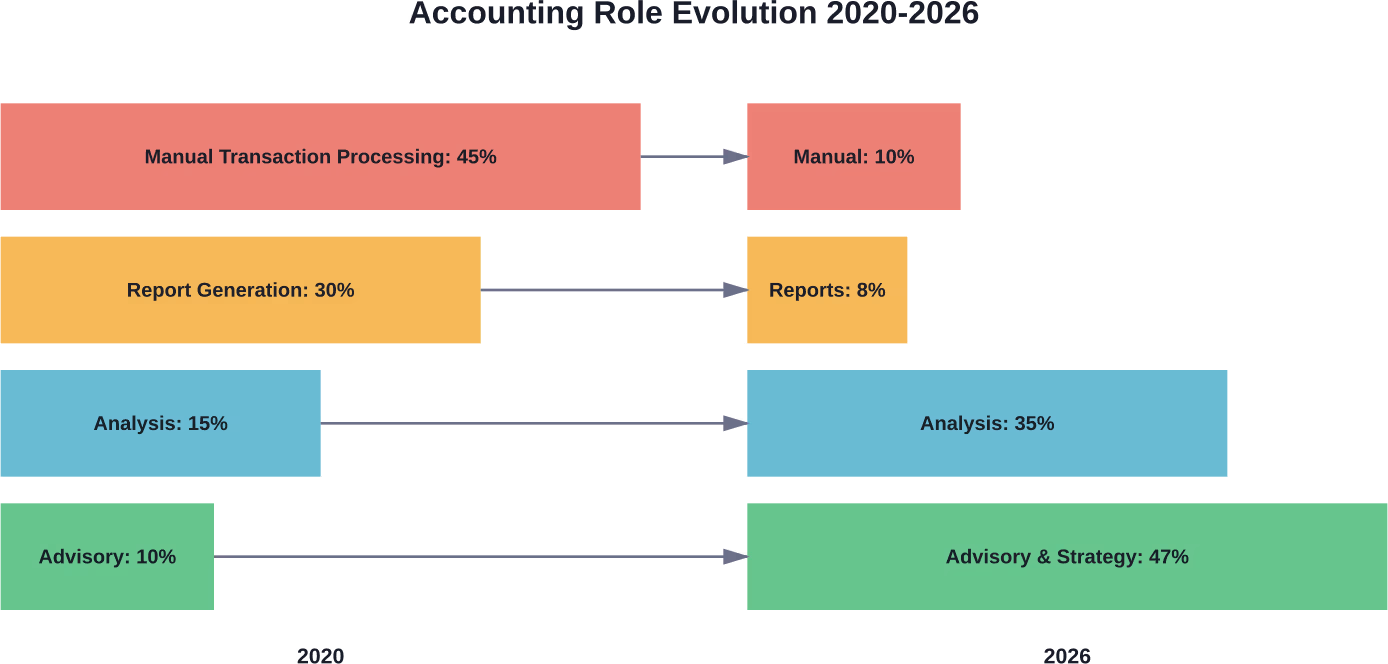
The boring stuff—manual data entry, matching thousands of transactions, generating standard reports—is increasingly automated.
For accountants, this is actually good news. Nobody entered the profession dreaming of typing invoice numbers into spreadsheets for hours.
Automation handles these tasks faster and more accurately, freeing professionals to focus on work that actually requires their expertise and training.
More Focus on Analysis and Strategy
As routine tasks get automated, accounting roles are shifting toward interpretation, analysis, and strategic advisory.
Instead of spending hours compiling financial statements, accountants can spend that time analyzing what those statements reveal about business performance, identifying trends, forecasting scenarios, and advising leadership on financial strategy.
This shift moves the profession from a cost center to a value center—exactly what finance leaders have been seeking, according to AICPA research from their global CFO roundtables.
New Skills Become Essential
The accountants who thrive in this AI-enabled environment aren’t necessarily the ones who can process transactions fastest. They’re the ones who can:
- Understand and work with accounting technology and AI tools
- Interpret complex data and communicate insights clearly
- Apply professional judgment to ambiguous situations
- Provide strategic business advice beyond pure financial compliance
- Build and maintain trusted client relationships
- Stay current with evolving regulations and standards
Technical accounting knowledge remains essential. But it’s no longer sufficient on its own.
What the Employment Data Actually Shows
Despite AI adoption across industries, employment projections for accountants tell an interesting story.
According to the Bureau of Labor Statistics Occupational Outlook Handbook, the 2024 median annual wage for accountants and auditors was $81,680 per year ($39.27 per hour). The BLS notes that completing certification in specific accounting fields, such as becoming a licensed Certified Public Accountant (CPA), may improve job prospects.
The Bureau of Labor Statistics has been actively incorporating AI impacts into their employment projections for the 2023-33 and 2024-34 periods. Their analysis indicates that AI is expected to primarily affect occupations whose core tasks can be most easily replicated by generative AI in its current form.
Interestingly, while AI may automate certain tasks, it may also support demand for some professions. For example, software developers may be needed to develop AI-based business solutions and maintain AI systems, and database administrators are expected to be needed to set up and maintain more complex data infrastructure.
Total employment is projected to grow from 170.0 million in 2024 to 175.2 million in 2034, an increase of 3.1 percent, much slower than the 13.0-percent employment growth recorded over the 2014–24 decade.
The key insight? Jobs are changing, not disappearing.
How Accounting Firms Are Responding
Major accounting firms aren’t panicking about AI. They’re investing in it.
According to industry reporting, major accounting firms including the Big Four have indicated that AI will not replace accountants. Instead, they’re implementing AI tools to handle routine work while redirecting their professionals toward higher-value services.
This makes business sense. Clients don’t want to pay premium rates for data entry. They’ll pay for strategic tax planning, complex audit judgment, business advisory, and financial strategy—services that require experienced professionals.
Based on industry implementation patterns, accountants who can effectively leverage AI tools become more productive and valuable, not less.
What This Means for Current and Future Accountants
If someone is considering entering the accounting profession or currently working as an accountant, what should they focus on?
Technical Skills Still Matter
Strong foundational accounting knowledge remains essential. Understanding GAAP, tax regulations, audit procedures, and financial reporting standards isn’t optional.
But that foundation needs to expand.
Technology Competency Becomes Non-Negotiable
Accountants don’t need to become software developers. But they do need comfort working with technology, understanding what AI tools can and can’t do, and knowing how to interpret their outputs.
The ability to work alongside AI systems, rather than being threatened by them, separates thriving accountants from struggling ones.
Soft Skills Gain Importance
As routine tasks get automated, the distinctly human skills become differentiators:
- Clear communication of complex financial concepts
- Critical thinking and professional skepticism
- Relationship building and client management
- Strategic thinking and business acumen
- Adaptability and continuous learning
These capabilities can’t be automated. And they’re exactly what makes accountants valuable in an AI-enabled environment.
Specialization Creates Opportunity
Becoming a Certified Public Accountant or pursuing specialized certifications in areas like forensic accounting, financial planning, or specific industries creates career advantages.
Specialized expertise is harder to automate than general knowledge.
The Real Risk Isn’t AI—It’s Resistance to Change
Industry observations suggest that accountants who embrace technology and adapt their skills tend to be less concerned about AI replacing them, while those who resist learning new tools may express greater concern.
The actual threat isn’t that AI will replace accountants. It’s that accountants who effectively use AI will replace those who don’t.
Research by Wharton’s Pinar Yildirim and co-authors examining AI implementation in workflows found that where AI gets deployed matters enormously. Organizations that thoughtfully integrate AI into team workflows see productivity gains. Those that simply automate the highest-paid person’s job first often see motivation and coordination problems.
The lesson? AI works best as a complement to human expertise, not a replacement for it.
Looking Ahead: Accounting in 2030 and Beyond
What will accounting look like in another five years?
Routine transaction processing will be almost entirely automated. Financial statement preparation will be largely system-generated. Basic tax return preparation for simple situations will require minimal human intervention.
But accountants will still be essential for:
- Complex tax planning and strategy
- High-level financial analysis and forecasting
- Audit judgment on materiality and risk
- Business advisory and strategic consulting
- Regulatory compliance in complex situations
- Forensic accounting and fraud investigation
- Mergers, acquisitions, and business valuations
The profession will look different. It already does. But it’s not disappearing.
According to the World Economic Forum, the fastest-growing jobs through 2030 include big data specialists, fintech engineers, and AI and machine learning specialists—roles that work with technology. But roles requiring judgment, ethics, and strategic thinking remain human-centered.
| Accounting Function | AI Impact by 2030 | Human Accountant Role |
|---|---|---|
| Bookkeeping | Near-complete automation | Exception handling, system oversight |
| Payroll processing | Fully automated | Complex situations, compliance changes |
| Financial reporting | System-generated | Analysis, context, presentation |
| Tax compliance | Automated for simple returns | Complex planning, strategy, representation |
| Audit | Data analytics, testing | Judgment, risk assessment, client interaction |
| CFO services | Enhanced data tools | Strategy, leadership, decision-making |
Frequently Asked Questions
Will AI completely replace accountants in the future?
No. AI will continue automating routine accounting tasks like data entry, reconciliations, and standard reporting. However, accountants remain essential for professional judgment, complex decision-making, compliance interpretation, strategic advisory, and client relationships—capabilities that require human expertise, ethical reasoning, and contextual understanding that AI cannot replicate.
What accounting jobs are most at risk from AI automation?
Roles focused primarily on repetitive, rule-based tasks face the highest automation risk. These include basic bookkeeping, routine data entry, simple transaction processing, and straightforward payroll processing. However, even in these areas, human oversight for exceptions, unusual situations, and system management remains necessary.
What skills should accountants develop to stay relevant?
Accountants should strengthen technology competency to work effectively with AI tools, develop strong analytical and strategic thinking abilities, enhance communication skills for explaining complex concepts, build relationship management capabilities, pursue specialized certifications like CPA, and cultivate adaptability for continuous learning as technology and regulations evolve.
How is AI currently being used in accounting?
AI currently handles invoice processing through optical character recognition, automates bank reconciliations, categorizes transactions using machine learning, generates standard financial reports, identifies unusual patterns for fraud detection, processes expense reports, and assists with tax research. These applications reduce manual work while improving accuracy and speed.
Are accounting jobs growing or declining?
According to Bureau of Labor Statistics projections, overall employment is growing, though at a slower pace than previous decades. The nature of accounting work is changing rather than disappearing. Routine transaction processing roles may decline, while strategic advisory, complex compliance, and specialized accounting positions continue to offer opportunities, particularly for credentialed professionals.
Will small businesses still need accountants with AI tools available?
Absolutely. While AI tools help small businesses with basic bookkeeping and transaction recording, they still need accountants for tax planning and strategy, financial advice during critical decisions, ensuring compliance with changing regulations, interpreting financial data for business decisions, and providing guidance during audits, loans, or business sales.
How long until AI can replace human accountants?
There’s no timeline for full replacement because certain accounting functions fundamentally require human capabilities. While AI will continue advancing and automating more routine tasks, professional judgment, ethical decision-making, complex interpretation, strategic advisory, and trusted client relationships aren’t problems technology can solve. The profession is transforming, not ending.
The Bottom Line
Will AI replace accountants? No.
Will AI transform what accountants do? Absolutely.
The accountants who view AI as a threat are missing the bigger picture. Technology that handles routine work isn’t eliminating the profession—it’s elevating it.
Automation frees accountants from the tedious tasks that consume time without adding much value. That creates space for the strategic, analytical, and advisory work that actually requires professional expertise.
The accounting profession isn’t facing extinction. It’s facing evolution.
And professionals who embrace that evolution—who develop both technical accounting knowledge and the technology skills, strategic thinking, and relationship capabilities that complement it—will find themselves more valuable and in-demand than ever.
The future of accounting isn’t humans versus machines. It’s humans working with machines to deliver better insights, smarter strategies, and higher-value services than either could provide alone.
For accountants willing to adapt and grow, that’s not a threat. That’s an opportunity.
 English
  German
  Arabic
  French
  Dutch
Dutch  Spanish