
Quick Summary: AI will not completely replace actors but will significantly transform the entertainment industry. While digital double technology and AI-generated characters are advancing rapidly, human actors remain essential for authentic emotional performances, creative collaboration, and cultural storytelling that audiences connect with on a deeper level.
The fear is real. With Google’s Veo 3 generating increasingly realistic video and studios quietly scanning performers’ faces, actors across Hollywood are asking the same question: Will AI technology eventually make human performers obsolete?
But here’s the thing—the answer isn’t nearly as simple as the doomsday headlines suggest.
According to a McKinsey report published in January 2026, the film and TV industry could see up to $60 billion in value redistribution within five years of AI adoption at scale. That’s not just a minor shift. That’s a complete restructuring of how entertainment gets made, financed, and delivered.
Yet research from MIT Sloan School of Management tells a different story about displacement. Their 2025 paper suggests AI is more likely to complement human workers than substitute them entirely. The technology raises the floor for production quality but doesn’t replace the creative judgment that separates good performances from unforgettable ones.
The Current State of AI in Entertainment
Digital double technology has been advancing faster than most people realize. Motion capture and detailed face scans now allow production teams to replicate a performer’s likeness with startling accuracy. Generative AI is making this process faster and cheaper.
Research on deepfake detection reveals just how convincing these synthetic videos have become. According to studies evaluating human sensitivity to AI-generated content, people struggle to identify fake videos even when explicitly instructed to look for manipulation. Detection rates remain surprisingly low across different educational backgrounds and demographics.
The global deepfake AI market tells the financial story. Market research indicates the sector was worth approximately $550 million in 2023 and is projected to reach $18,989.4 million by 2033—a compound annual growth rate of 42.5%. That kind of explosive growth doesn’t happen unless the technology delivers real value to content creators.
Where AI Actually Works Today
Real talk: AI isn’t replacing lead actors in major productions yet. But it’s already changing the production pipeline in specific ways.
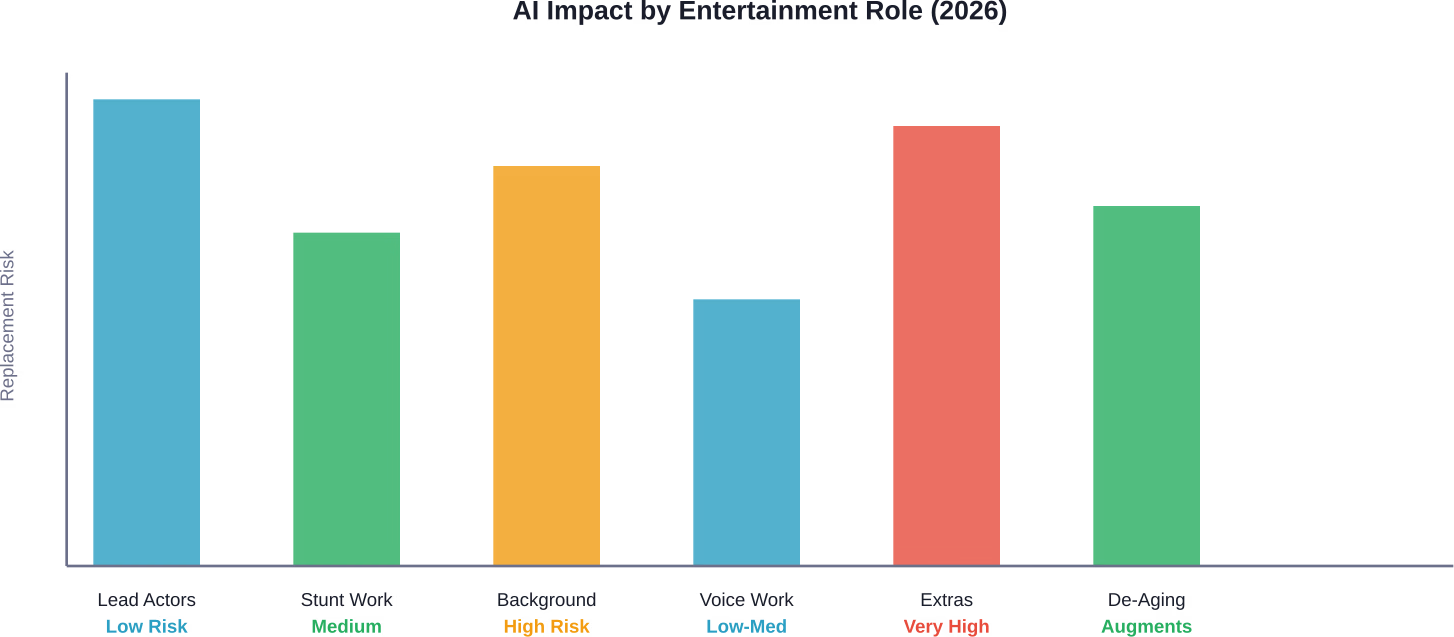
De-aging technology lets filmmakers show younger versions of actors without recasting. Background performers can be multiplied digitally to fill crowd scenes. Stunt work increasingly uses digital doubles for the most dangerous sequences.
And here’s where it gets interesting—the leverage point isn’t in post-production anymore. McKinsey’s research highlights a shift “from fix it in post to fix it in pre.” AI tools help directors and storyboard artists iterate faster during pre-production, making creative decisions before cameras roll.
That upstream optimization changes budget allocation, timeline planning, and ultimately which projects get greenlit.

Applied AI Development With AI Superior
AI Superior works on applying AI to real business problems where data and processes already exist. The approach usually starts with understanding the task, checking data quality, and building models that can be tested quickly before full integration.
Exploring AI for Your Operations?
AI Superior can help with:
- building AI solutions around existing workflows
- evaluating whether AI is practical for your use case
- integrating AI into systems already in place
👉 Contact AI Superior to discuss your project, data, and implementation approach
What Research Shows About Job Displacement
A Pew Research Center survey found that 64% of Americans believe AI will lead to fewer jobs over the next 20 years. The anxiety is understandable given the headlines about mass layoffs at Amazon, Microsoft, and other tech companies.
But labor market data from Yale’s Budget Lab paints a more nuanced picture. Their analysis of AI’s impact on employment found that “measures of exposure, automation, and augmentation show no sign of being related to changes in employment or unemployment” as of their latest update.
Research from Brookings Institution examining generative AI and American workers found that more than 30% of workers could be significantly impacted by the technology. The greatest effects appear concentrated in middle- to higher-paid occupations and clerical roles rather than creative performance work.
For actors specifically, Bureau of Labor Statistics data provides context. As of May 2024, the median annual wage for actors was $46,660, with 2024 employment at 27,700 workers. Projected employment change from 2024-2034 shows 900 new jobs expected—modest growth, not catastrophic decline.
The Occupations Most At Risk
Harvard Business School research by Suraj Srinivasan examined which jobs AI will most likely change. The analysis found employers increasingly seek AI-related skills in certain fields while demand for structured and repetitive tasks wanes. The largest reductions appeared in finance and technology sectors—not creative industries.
Johns Hopkins Carey Business School experts noted in February 2026 that the picture isn’t clear-cut. While some layoffs get blamed on AI, the connection between automation technology and job losses remains difficult to prove conclusively in creative fields.
Why Human Actors Remain Irreplaceable
Sound familiar? Every technological leap in entertainment—from silent films to talkies, from practical effects to CGI—triggered predictions that human performers would become obsolete.
It never happened. And there are fundamental reasons why complete replacement remains unlikely even as AI capabilities advance.
The Authenticity Problem
AI can replicate facial expressions and body movements. What it can’t genuinely replicate is the lived experience that informs authentic performance.
When an actor draws on personal grief to portray loss, or channels real joy into a celebration scene, audiences perceive something AI-generated characters lack. Research on synthetic video shows that while people struggle to identify technical fakery, they often sense something feels “off” even when they can’t articulate why.
That uncanny valley effect matters for narrative storytelling. Viewers invest emotionally in characters who feel genuinely human, with all the imperfections and spontaneity that entails.
Creative Collaboration Magic
Directors consistently emphasize that filmmaking is collaborative. Actors don’t just deliver pre-written lines—they bring interpretation, improvisation, and creative choices that reshape scenes during production.
An AI-generated character can’t suggest a different line reading that captures a moment better. It can’t react spontaneously to another performer’s unexpected choice in a way that creates something neither the script nor director anticipated.
That collaborative magic is where memorable performances come from. And it requires human creative judgment on both sides of the camera.
The Diversity and Representation Issue
AI training data reflects historical patterns—including the biases, stereotypes, and limited representation that plagued entertainment for decades.
When AI generates characters or augments performances, it risks perpetuating those problems rather than correcting them. Research on deepfake technology highlights concerns about reinforcing stereotypes, racism, and misogyny from past content used in training datasets.
Real bodies and authentic cultural performances matter for representation. Digital erasure of diverse performers in favor of AI-generated “ideal” characters would be a massive step backward for an industry still working toward equitable representation.
How AI Will Transform Acting (Not Eliminate It)
The more interesting question isn’t whether AI replaces actors. It’s how the technology reshapes what acting work looks like and where value gets created.
The Democratization Paradox
AI lowers barriers to high-end production quality. Independent filmmakers can achieve visual effects that previously required studio budgets. That democratization creates opportunities for more diverse storytelling.
But here’s the paradox—while AI raises the floor for technical quality, it doesn’t eliminate the competitive advantage of premium storytelling and exceptional performance. If anything, authentic human performance becomes more valuable as AI-generated content floods the market.
| Production Element | Traditional Approach | AI-Augmented Approach | Impact on Actors |
|---|---|---|---|
| Pre-Production | Manual storyboards | AI-generated previsualization | Better context for performance |
| Casting | In-person auditions | Digital auditions + AI analysis | More accessible, but less personal |
| Principal Photography | Multiple takes for coverage | AI-assisted camera planning | More efficient shooting schedules |
| Stunt Work | Physical stunt performers | Digital doubles for extreme danger | Safer but reduced stunt opportunities |
| Post-Production | Manual effects and editing | AI enhancement and cleanup | Minimal direct impact on actors |
New Skill Requirements
Actors increasingly need to understand motion capture technology, facial scanning processes, and digital rights management for their likeness. Performance capture work requires different techniques than traditional on-camera acting.
Voice actors face both opportunities and challenges. AI voice synthesis threatens certain types of voice work while creating demand for performers who can provide the source performances that make synthetic voices convincing.
The actors who thrive will likely be those who embrace new technologies while maintaining the core craft skills that make performances compelling.
Where Value Gets Redistributed
McKinsey’s research emphasizes that AI’s biggest impact isn’t faster production—it’s redefinition of how projects get developed, financed, and scaled.
More value flows to early-stage creative development and IP creation. Less value goes to execution of routine production tasks. For actors, that means star power and unique creative contributions become even more important relative to basic technical competence.
The Ethics and Rights Questions
Technology capabilities have outpaced legal frameworks and industry standards. That gap creates real risks for performers.
Digital Likeness Rights
When studios scan an actor’s face and body, who owns that digital asset? Can it be reused in future projects without additional compensation? What about after the actor dies?
These questions led to the 2023 SAG-AFTRA strike, where digital likeness rights became a central negotiation point. The resulting agreements provide some protections, but technology continues evolving faster than contract language can keep pace.
Consent and Training Data
AI models trained on existing films and TV shows use performances actors never consented to have used for synthetic character generation. The legal status of this training data remains contested.
Industry experts increasingly call for what some describe as “nutrition labels” for AI training data—transparency about what source material trained each model and whether appropriate rights were secured.
The Deepfake Threat
Beyond professional production use, deepfake technology enables malicious impersonation. Actors face reputation risks from synthetic videos showing them in contexts they never participated in.
Research examining deepfakes in different demographic contexts found that detection remains challenging even for tech-savvy populations. The psychological effectiveness of these manipulations creates both professional and personal risks for public figures.
What This Means for Aspiring Actors
So should someone still pursue acting as a career? The data suggests yes—but with eyes wide open about how the profession is changing.
Bureau of Labor Statistics projections show modest growth rather than catastrophic decline. But the nature of available work is shifting.
Background work and extras roles face the most displacement risk. Lead roles requiring emotional depth and creative collaboration remain relatively protected. The middle—supporting roles, stunt work, certain voice performances—faces the most uncertainty.
Building a Sustainable Career
Successful actors will likely need to:
- Develop distinctive creative voices that AI can’t easily replicate
- Understand digital production technologies and how to work effectively with them
- Negotiate contracts that protect digital likeness rights
- Build diverse income streams rather than relying solely on traditional acting work
- Cultivate direct audience relationships through social media and other platforms
The democratization of production tools means actors can increasingly create their own content rather than waiting for traditional gatekeepers. That shift predates AI but accelerates as technology makes high-quality production more accessible.
| Career Stage | Traditional Path | AI-Era Adaptation |
|---|---|---|
| Training | Acting classes, theater experience | Add motion capture, digital performance techniques |
| Breaking In | Auditions, agent representation | Self-produced content, digital portfolios |
| Early Career | Background work, small roles | More competition from AI, focus on distinctive work |
| Mid-Career | Supporting roles, building reputation | Negotiate digital rights, diverse income streams |
| Established | Lead roles, star power | Creative collaboration, production involvement |
Industry Adaptation and the Path Forward
McKinsey’s research emphasizes that studios, creators, and platforms that build clear governance and transparency into AI systems will move faster and farther than competitors who rush adoption without ethical frameworks.
The entertainment industry has weathered technological disruption before. The shift from silent films to talkies eliminated some jobs while creating others. Television was supposed to kill cinema. Streaming was supposed to destroy traditional media.
Each transition redistributed value and changed how entertainment got made and consumed. But audiences kept seeking compelling stories told by talented performers.
What Studios Are Doing Now
Major production companies are experimenting with AI tools while navigating union agreements and public perception challenges. Most current applications focus on efficiency improvements rather than performer replacement.
De-aging technology extends the careers of established stars rather than eliminating roles. Virtual production using LED walls and real-time rendering changes shooting logistics but still requires actors delivering performances.
The technology enables productions that wouldn’t otherwise be financially viable—potentially creating more total work even as it changes what that work looks like.
Trust as Competitive Advantage
Research consistently shows that adoption speed depends on trust. Studios demonstrating respect for performer rights, transparency about AI use, and commitment to ethical implementation gain cooperation from talent.
Those that treat AI as a cost-cutting tool to eliminate workers face resistance, negative publicity, and potential loss of access to top creative talent who can choose where to work.
The entertainment companies that thrive won’t necessarily be those with the most advanced AI—they’ll be those that use AI to enhance human creativity rather than replace it.
Frequently Asked Questions
Will AI completely replace human actors in the next 10 years?
No. While AI will transform production workflows and change available opportunities, research shows human actors remain essential for authentic emotional performances and creative collaboration. Bureau of Labor Statistics projections show modest job growth rather than elimination through 2034. Background performers and extras face higher displacement risk than lead actors.
Can audiences tell the difference between AI-generated and real actors?
Research on deepfake detection shows mixed results. While people struggle to identify technical manipulation when specifically looking for it, audiences often sense something feels inauthentic about AI-generated performances even without knowing why. The uncanny valley effect remains a significant barrier to full audience acceptance of synthetic characters in lead roles.
How are actors protecting their digital likeness rights?
The 2023 SAG-AFTRA strike resulted in contract provisions requiring consent and compensation when studios create digital replicas of performers. However, enforcement remains challenging and technology continues evolving faster than legal frameworks. Actors increasingly negotiate specific digital rights language in individual contracts beyond baseline union protections.
Which acting jobs are most at risk from AI automation?
Background performers and extras face the highest displacement risk since their work involves less individualized performance. Stunt work using digital doubles reduces opportunities for physical performers in extreme danger situations. Voice actors face competition from AI synthesis for certain types of narration and dubbing work. Lead dramatic roles requiring emotional depth remain relatively protected.
Should someone still pursue acting as a career given AI developments?
The data suggests yes, with realistic expectations about career paths. Total employment projections remain positive, but the nature of work is shifting. Aspiring actors should develop distinctive creative voices, understand digital production technologies, and build diverse income streams. The ability to create self-produced content using accessible tools potentially opens new opportunities even as traditional paths narrow.
How does AI impact diversity and representation in entertainment?
AI training on historical content risks perpetuating past biases, stereotypes, and limited representation rather than correcting them. Digital generation of “ideal” characters could reduce opportunities for diverse performers whose bodies and authentic cultural experiences matter for meaningful representation. Industry experts emphasize that ethical AI use requires intentional focus on equitable outcomes rather than simply optimizing technical capabilities.
What skills do actors need to work with AI technology?
Understanding motion capture and performance capture techniques becomes increasingly important. Actors need to negotiate and protect digital likeness rights in contracts. Familiarity with virtual production environments and LED wall technology helps performers adapt to new shooting methods. The ability to collaborate effectively with AI-augmented pre-visualization tools allows actors to provide input earlier in the creative process.
The Bottom Line
Will AI replace actors? The evidence says no—not completely, not soon, and probably not ever for the roles audiences care most about.
But will AI transform what acting careers look like? Absolutely. The transformation is already happening.
McKinsey’s projection of $60 billion in value redistribution isn’t about eliminating actors. It’s about fundamentally restructuring when and how creative talent contributes to productions, where budget dollars flow, and which skillsets command premium compensation.
MIT research showing complementarity rather than substitution provides reason for measured optimism. The technology augments human capabilities rather than replacing the authentic emotional connection that makes storytelling powerful.
Yet the anxiety actors feel is legitimate. Background work faces genuine displacement risk. Digital rights remain inadequately protected. The pace of change creates uncertainty about which skills and specializations will remain valuable.
The actors who thrive in this transition will be those who embrace technology as a tool while maintaining the core craft that makes performances memorable. They’ll understand digital production workflows, negotiate proper protections for their likeness, and develop distinctive creative voices that AI can’t easily replicate.
Because here’s what technology can’t change: audiences crave authentic human stories. They want to see real emotions from performers who’ve lived experiences that inform their art. They invest in characters who feel genuinely human, with all the beautiful imperfection that entails.
AI can make production more efficient. It can reduce costs and expand creative possibilities. It can change how entertainment gets made.
But it can’t replace the magic that happens when a talented performer connects with an audience in a way that makes them feel less alone.
That remains irreplaceable. And that’s why actors still have a future—just one that looks different than the past.
 English
  German
  Arabic
  French
  Dutch
Dutch  Spanish