
Quick Summary: AI will not replace accountants. Instead, it automates repetitive tasks like data entry, invoice processing, and reconciliations, allowing accounting professionals to focus on strategic advisory, compliance oversight, and judgment-based decision-making that technology cannot replicate.
The question comes up constantly in finance departments and accounting firms: will artificial intelligence eliminate accounting jobs?
Short answer: no. But the role is transforming fast.
AI handles the boring stuff—matching invoices, extracting data from PDFs, flagging anomalies in spreadsheets. That’s not science fiction anymore. According to research from Michigan State University’s Broad College, firms adopting automation and AI accounting software show stronger internal controls, fewer mistakes in financial reports, and greater efficiency in accounting processes.
Here’s the thing though: technology creates capacity, it doesn’t replace expertise. The U.S. Bureau of Labor Statistics confirms that accountants and auditors earned a median annual wage of $81,680 in 2024, and the profession continues growing despite decades of automation concerns.
So what’s actually changing? And what stays stubbornly human?
What AI Already Does in Accounting
Walk into any mid-sized accounting firm today and you’ll see automation everywhere. Not the flashy kind—the practical, repetitive-task-crushing kind.
Optical character recognition pulls vendor names, dates, and amounts from scanned invoices. Bank reconciliation software matches thousands of transactions automatically. Anomaly detection flags unusual entries for review.
These tools work. They save time. And they’re getting better.
| Accounting Task | Automated with AI? | Human Responsibility |
|---|---|---|
| Manual data entry | Yes | Oversight, exception handling |
| Invoice processing | Yes | Vendor relationships, disputes |
| Bank reconciliation | Yes | Investigating discrepancies |
| Expense categorization | Yes | Policy compliance, judgment calls |
| Financial statement preparation | Partial | Analysis, interpretation, footnotes |
| Tax planning | Partial | Strategy, compliance, client consultation |
| Audit judgment | No | Risk assessment, materiality decisions |
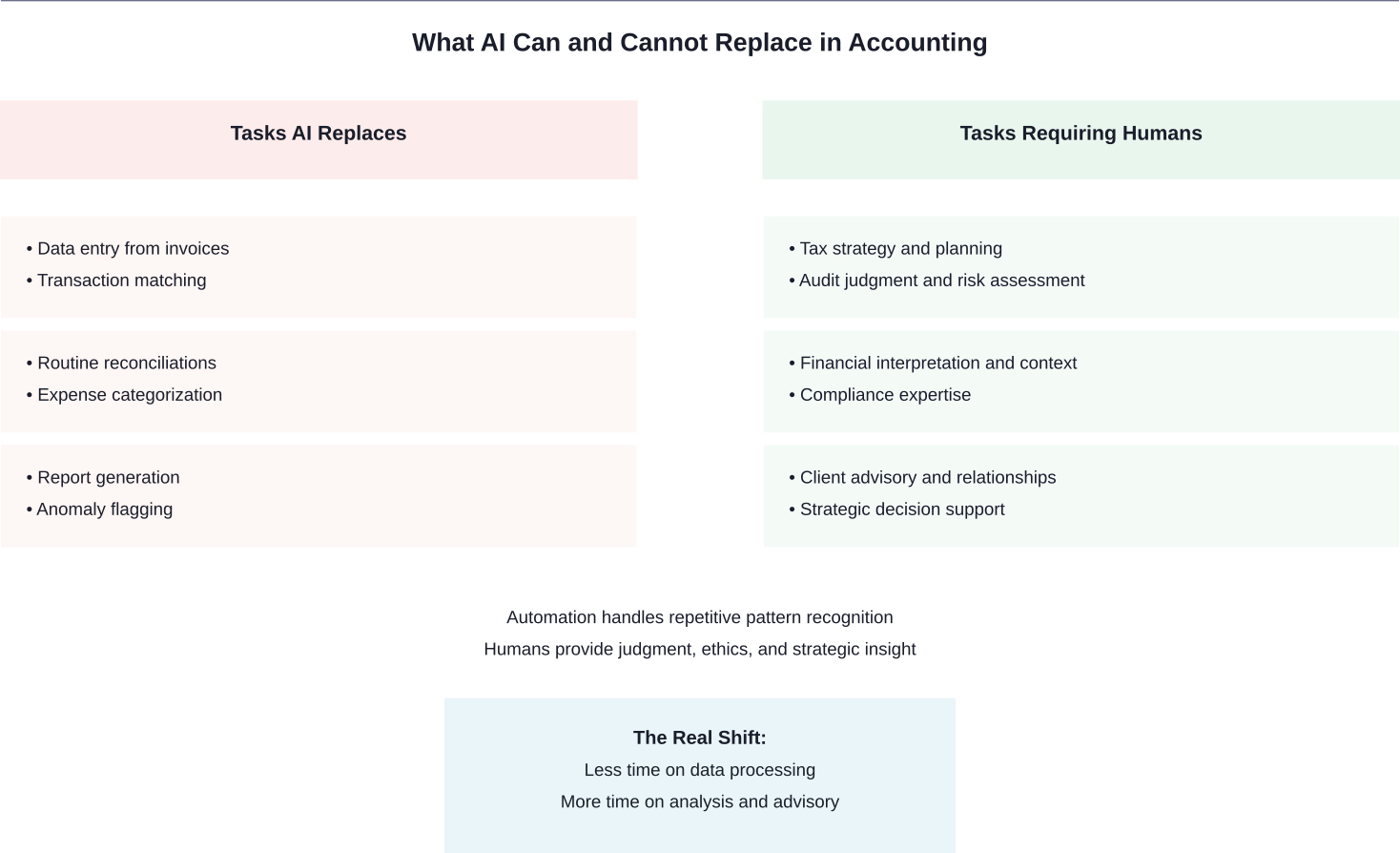
Notice the pattern? Routine tasks get automated. Judgment stays human.
The AICPA and CIMA research reveals something important: finance teams still spend 65% of their reporting time on hindsight activities—descriptive and diagnostic methods. Predictive and prescriptive analytics, the stuff that actually drives business decisions, remains underutilized.
That gap represents opportunity, not obsolescence.

AI Development and Integration With AI Superior
AI Superior works with companies that need structured AI implementation. The focus is on building models, testing them through controlled stages, and integrating them into operational systems.
Need Help Implementing AI End-to-End?
AI Superior can help with:
- full-cycle AI development and deployment
- feasibility analysis and planning
- integration of AI into ongoing processes
👉 Contact AI Superior to discuss your project, data, and implementation approach
Why Accountants Won’t Be Replaced
Technology handles patterns. Accounting requires judgment.
Here’s what no algorithm can replace:
Interpretation and Context
An AI can flag a 30% jump in office supply expenses. It cannot explain that the company relocated, bought furniture for a new office, and split the cost across two fiscal periods to manage cash flow.
That context? Pure human territory.
Compliance and Ethics
Tax codes change. Regulations evolve. Companies operate across jurisdictions with conflicting rules.
Becoming a licensed Certified Public Accountant involves mastering these complexities. According to the Bureau of Labor Statistics, completing certification in specific accounting fields improves job prospects precisely because this expertise cannot be automated.
Strategic Advisory
CFOs and finance leaders increasingly want their teams to function as value centers, not cost centers. AICPA research from roundtables with hundreds of finance leaders across Johannesburg, London, and Boston reveals consistent demand: executives want guidance, not just reporting.
They want someone who understands the business, interprets the numbers, and recommends action. Software generates reports. Accountants drive strategy.
Client Relationships
Real talk: clients don’t want to negotiate tax strategies with a chatbot.
They want a professional who understands their industry, anticipates their concerns, and communicates complex concepts clearly. Those interpersonal skills matter more as technology handles routine work.
The Historical Pattern: Technology Augments, Doesn’t Eliminate
This isn’t the first time automation sparked job-loss concerns in accounting.
Spreadsheet software arrived in the 1980s. Industry observers predicted mass layoffs. Instead, accountants stopped spending weeks on manual calculations and started performing more sophisticated analysis.
The Bureau of Labor Statistics noted similar concerns in the 1950s and 1960s when computers and industrial automation emerged. Congressional hearings examined whether machines would cause massive unemployment.
They didn’t.
Employment patterns shifted, skills evolved, but jobs remained. Technology creates capacity. People fill that capacity with higher-value work.
How Accounting Roles Are Evolving
The profession isn’t disappearing. It’s upgrading.
From Compliance to Advisory
Traditional accounting focused on scorekeeping: recording transactions, preparing statements, ensuring compliance.
Modern accounting emphasizes advisory: interpreting data, forecasting outcomes, recommending strategies.
When software handles month-end closes automatically, accountants have time to explain what the numbers mean and what actions the business should take.
Skills That Matter Now
Technical accounting knowledge remains essential. But the skill mix is changing.
Researchers at NC State’s Poole College emphasize that workers need strong AI literacy, critical thinking, interpersonal skills, and technical knowledge. That combination creates value machines cannot replicate.
Learning to work with AI tools—understanding their outputs, identifying errors, knowing when human judgment overrides algorithmic recommendations—becomes as important as mastering debits and credits.
The Oversight Problem
Here’s a warning from the Michigan State research: automation technology isn’t perfect. It cannot prevent 100% of mistakes.
When companies reduce human oversight too aggressively, the errors that slip through tend to be significantly larger and more consequential.
Smart firms use AI for efficiency, but maintain human checkpoints for quality and accuracy.
What This Means for Accounting Professionals
If your day involves hours of manual data entry, that part of the job faces pressure. But if you provide interpretation, judgment, and client guidance, demand for those skills is rising.
For Current Accountants
Embrace the tools. Learn what they do well and where they fail.
The professionals who thrive combine technical accounting expertise with technology fluency. They know when to trust the algorithm and when to question it.
Develop the skills automation cannot replicate: communication, critical thinking, business acumen, ethical reasoning.
For Students and Career Changers
Accounting remains a solid career path. The Bureau of Labor Statistics projects continued growth in professional, scientific, and technical services—the fastest growing industry sector from 2023 to 2033.
But the entry-level tasks that once occupied junior accountants increasingly get automated. New professionals need to demonstrate value beyond data processing from day one.
That means stronger analytical skills, better communication, and comfort with technology.
The Big Firms Versus Small Practices
Automation adoption varies significantly by firm size.
Large firms invest heavily in AI tools. They have the capital, the transaction volume, and the technical resources to implement sophisticated automation.
Small practices often lag. They rely on relationships and personalized service rather than cutting-edge technology.
But research and industry observations suggest clients of small firms value that human touch. They want an accountant who knows their business, returns calls promptly, and explains options clearly.
Technology can enhance that relationship, but it cannot replace it.
What Gets Better With AI
Let’s be clear: automation creates real benefits.
Fewer errors in routine tasks. Faster month-end closes. More time for analysis. Better identification of unusual transactions.
Research consistently shows that firms using AI accounting software demonstrate greater efficiency and fewer mistakes in financial reports.
That’s not threatening. That’s progress.
The question isn’t whether accountants should resist these tools. The question is how to use them effectively while maintaining the human expertise that creates real value.
| AI Strength | Human Strength | Best Outcome |
|---|---|---|
| Processing speed | Context understanding | Fast analysis with accurate interpretation |
| Pattern recognition | Exception judgment | Anomalies flagged and properly investigated |
| Consistency | Adaptability | Reliable processes with flexibility for edge cases |
| Scale handling | Relationship building | Efficient service delivery with personal touch |
| Data extraction | Strategic insight | Clean data transformed into actionable recommendations |
The Jobs That Change Most
Not all accounting roles face the same pressure.
Bookkeepers handling basic transaction recording see significant automation. Software now extracts data from receipts, categorizes expenses, and reconciles accounts with minimal human input.
Tax preparers for straightforward returns face competition from consumer software. But complex tax planning—multi-state businesses, international operations, estate planning—remains firmly in human territory.
Auditors still need to assess risk, evaluate controls, and apply professional skepticism. AI can analyze transactions, but judgment about materiality, fraud risk, and audit scope requires human expertise.
Management accountants and controllers increasingly function as strategic partners. They interpret variance analysis, forecast scenarios, and guide business decisions. Automation gives them better data to work with, not a reason to eliminate their role.
Frequently Asked Questions
Will AI completely replace accountants in the future?
No. AI automates specific tasks but cannot replicate the judgment, ethical reasoning, strategic thinking, and client relationships that define professional accounting. The role evolves toward advisory work rather than disappearing entirely.
What accounting tasks are most at risk from automation?
Repetitive, rules-based tasks face the most pressure: manual data entry, invoice matching, basic reconciliations, routine categorization, and standard report generation. These activities follow predictable patterns that software handles efficiently.
How should accountants prepare for increased AI adoption?
Develop skills that complement automation rather than compete with it. Focus on interpretation, strategic advisory, communication, critical thinking, and technology fluency. Learn to work with AI tools effectively while providing the judgment they lack.
Are accounting jobs still growing despite automation?
Yes. The Bureau of Labor Statistics projects continued growth in accounting employment. Professional, scientific, and technical services represent the fastest growing industry sector from 2023 to 2033. Demand shifts toward higher-value work as automation handles routine tasks.
Do small accounting firms need to worry about AI?
Small firms compete on relationships and personalized service, not transaction volume. While they benefit from adopting practical automation tools, their competitive advantage lies in human expertise and client connections that technology cannot replicate.
What’s the biggest risk of relying too much on accounting automation?
Reducing human oversight too aggressively. Research shows automation isn’t perfect—it cannot prevent 100% of mistakes. When errors slip through automated systems without human review, they tend to be larger and more significant. Effective implementation balances efficiency with quality control.
Will entry-level accounting jobs disappear?
Entry-level roles are changing rather than vanishing. The traditional path of spending years on data entry before advancing to analysis is compressing. New accountants need to demonstrate analytical skills and business insight earlier in their careers as automation handles basic processing.
The Bottom Line
AI won’t replace accountants. It replaces tasks.
The distinction matters. Every technology wave in accounting—calculators, spreadsheets, accounting software, cloud platforms—followed the same pattern. Tools eliminate drudgery. Professionals focus on work that requires expertise.
This wave isn’t different. It’s faster and more comprehensive, but the fundamental dynamic holds: automation creates capacity, and skilled professionals fill that capacity with higher-value work.
The accountants who thrive understand this. They adopt tools that make them more efficient. They develop skills that technology cannot replicate. They position themselves as strategic advisors rather than transaction processors.
Finance leaders want transformation from cost centers to value centers. They want predictive and prescriptive analytics, not just historical reporting. That creates opportunity for accountants who can deliver insight, not just data.
So the real question isn’t whether AI will replace accounting. The real question is whether individual accountants will adapt to the changing skill requirements and embrace tools that make them more valuable, not obsolete.
The profession has a future. Make sure your skills do too.
 English
  German
  Arabic
  French
  Dutch
Dutch  Spanish