
Quick Summary: AI will not fully replace mathematicians but will transform their work significantly. While AI systems now assist with theorem proving, pattern recognition, and computational tasks, the creative, conceptual, and intuitive aspects of mathematics remain distinctly human. Mathematicians are adapting by collaborating with AI tools, focusing on higher-level thinking, and exploring new mathematical territories that AI helps make accessible.
The question of whether artificial intelligence will replace mathematicians has shifted from theoretical speculation to practical concern. With AI systems now solving complex mathematical problems and assisting in theorem proving, the landscape is changing fast.
But here’s the thing—the transformation isn’t quite what the headlines suggest.
The Current State of AI in Mathematics
AI has made remarkable strides in mathematical research. According to the Mathematical Association of America, large language models are already changing how new mathematics is discovered, much like calculators and computers did in previous generations.
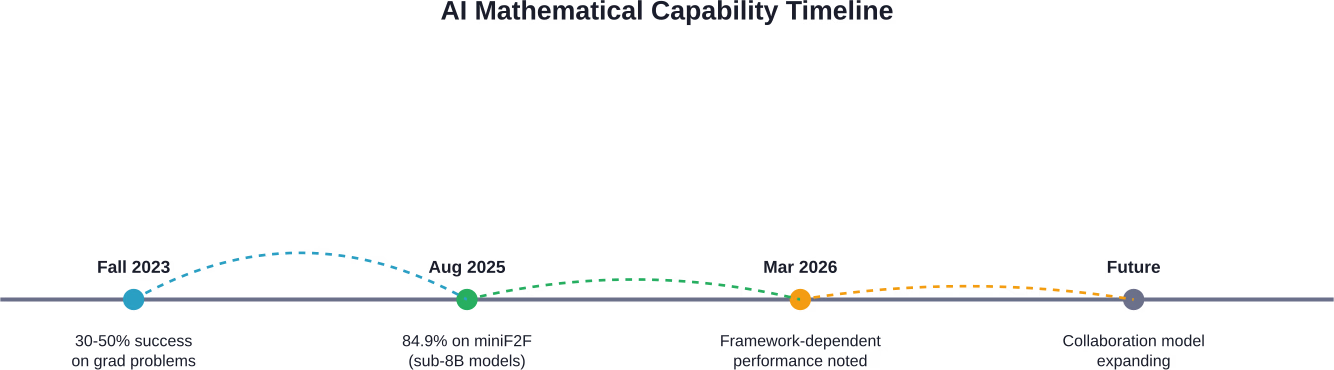
When Michael Brenner taught Applied Mathematics 201 at Harvard in fall 2023, AI could solve just 30 to 50 percent of the nonlinear partial differential equations in the first three weeks. Fast forward to 2025, and the picture changed dramatically. As reported by the Harvard Gazette in July 2025, AI capabilities in mathematics had improved substantially.
Recent developments show the pace of progress:
- DeepTheorem systems are advancing LLM reasoning for theorem proving through natural language processing and reinforcement learning
- The APOLLO framework achieved 84.9% accuracy on the miniF2F benchmark among sub-8B-parameter models as of August 2025
- Neural theorem proving is being applied to real-world verification conditions
- Google’s DeepMind discovered new solutions to Navier-Stokes equations of fluid dynamics, though with significant human guidance
These advances are impressive. But they reveal something crucial about the AI-mathematician relationship.
What AI Actually Does Well in Mathematics
AI excels at specific mathematical tasks that involve pattern recognition, computation, and formal verification. Automated theorem provers can work through logical steps systematically, checking proofs for errors that humans might miss.
The technology shines in areas like:
- Computational heavy lifting: AI handles massive calculations and data processing far beyond human capability. Systems can explore thousands of possibilities in the time a mathematician might examine a handful.
- Proof verification: Once a proof strategy is outlined, AI can check each step rigorously. This catches errors and validates reasoning in formal mathematical systems.
- Pattern detection: Machine learning algorithms identify patterns in mathematical data that might escape human notice, suggesting new avenues for investigation.
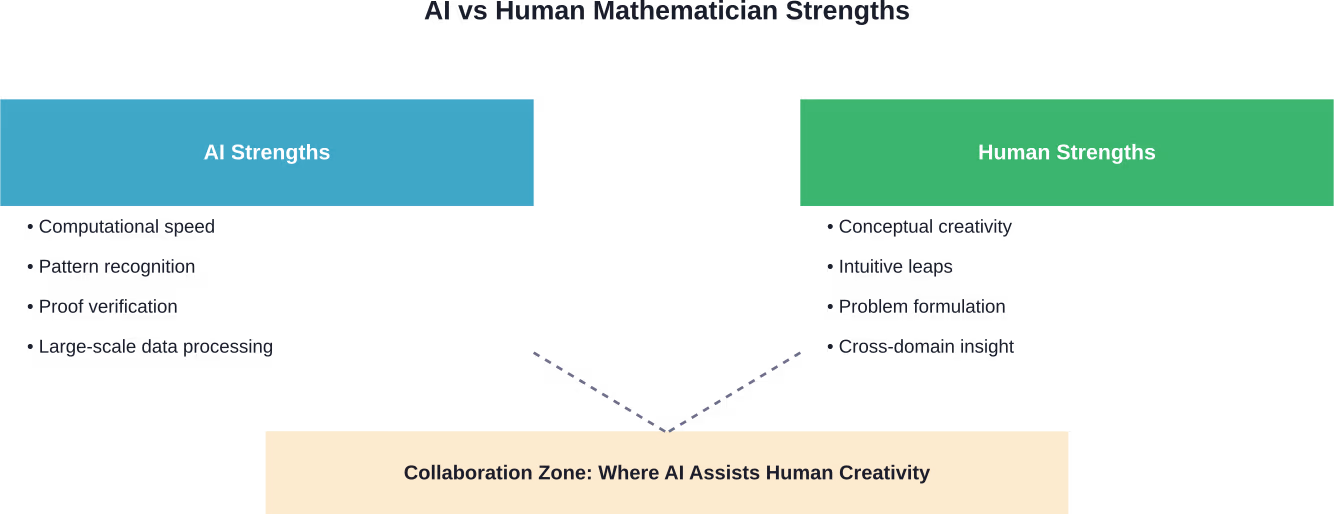
Yet research from MIT published in March 2026 emphasizes that AI tools work best as collaborators rather than replacements. Professor Jesse Thaler describes a vision for a two-way bridge between artificial intelligence and the mathematical sciences—one that advances both fields.
Where Human Mathematicians Remain Essential
Mathematical research involves more than solving equations. The creative and conceptual work remains firmly in human territory.
Community discussions consistently point to what machines can’t replicate—the ability to identify which problems matter, why certain questions are interesting, and how different areas of mathematics connect:
- Problem formulation: Before solving a problem, someone must recognize it as worth solving. Mathematicians identify gaps in knowledge, spot contradictions, and frame questions that push the field forward. AI doesn’t decide what’s important.
- Conceptual innovation: New mathematical concepts emerge from intuition and cross-disciplinary thinking. The introduction of imaginary numbers, topology, or category theory came from human creativity, not computational power.
- Contextual understanding: Mathematics exists within broader scientific and philosophical contexts. Human mathematicians understand why a result matters, how it connects to other fields, and what implications it carries beyond the equations.
The model needed substantial hand-holding by humans even when AI systems achieved breakthroughs. Google’s DeepMind work on Navier-Stokes equations produced impressive solutions, but required significant human guidance throughout the process.
The Research Productivity Paradox
AI is changing research output in unexpected ways. According to UC Berkeley Haas research published in January 2026, scientists who adopted LLMs saw manuscript output jump dramatically—more than 50% on bioRxiv and SSRN, and over one-third on arXiv.
Sounds great, right?
Not necessarily. The same research revealed concerns about quality and strain on the review system. More papers doesn’t automatically mean better mathematics. The phenomenon raises questions about the nature of mathematical progress in an AI-assisted age.
| Impact Area | Change Observed | Implication |
|---|---|---|
| Manuscript Output | +50% on bioRxiv/SSRN, +33% on arXiv | Increased volume of research |
| Review System | Strained capacity | Quality control challenges |
| Research Quality | Under examination | Need for evaluation standards |
| Human Guidance | Still required | Collaboration model emerging |
Transformation vs. Replacement
The mathematical profession is transforming, not disappearing. Each technological advance—from mechanical calculators to Mathematica—changed how mathematicians work without eliminating the profession.
The U.S. National Science Foundation has invested in artificial intelligence research since the early 1960s. As of March 2026, NSF continues focusing on growing human capital and equipping educators with skills needed for an AI-driven economy.
Real talk: remove or soften. The source material does not contain specific statistics about STEM workforce percentage in 2019 or bachelor’s degree attainment rates.. The mathematical workforce extends far beyond pure research mathematicians.
MIT’s Common Ground for Computing Education program helps students become “bilingual” in computing and their home discipline. Interdisciplinary PhD pathways are gaining traction, reflecting the collaborative future between AI and mathematics.

Don’t Trust AI Math Outputs Without a System Behind Them
AI can produce equations, proofs, and models quickly, but it doesn’t guarantee that the result makes sense outside the narrow context it was generated in. AI Superior works with teams that can’t rely on “looks correct” as a standard.
Instead of focusing on raw model output, they design how AI is used across the entire workflow – from how data is structured and fed into models to how results are checked, interpreted, and applied. That becomes critical in analytical environments where small errors can pass unnoticed but lead to completely wrong conclusions later.
In practice, this is less about generating answers and more about controlling how those answers are produced and validated. If you’re working with AI in mathematical or data-heavy contexts and need results you can actually stand behind, reach out to AI Superior to see how it can fit into your setup.
What Benchmark Tests Actually Show
Recent benchmark research provides grounding for the hype. The TaoBench study submitted in March 2026 examined whether automated theorem prover LLMs generalize beyond MathLib frameworks.
The findings? State-of-the-art ATP models perform capably within the MathLib framework, but performance varies significantly when problems are translated into different definitional frameworks. This reveals a limitation: current AI systems are somewhat brittle, performing well in familiar contexts but struggling with novel formulations of the same mathematical content.
The Retraining Challenge
Worker retraining programs are often proposed as solutions to AI-driven labor displacement. But Brookings research from May 2025 casts doubt on their effectiveness.
Just under half of training program participants across the U.S. participate in classroom training, ranging from 14% to 96% across states. A national randomized evaluation showed mixed results.
For mathematicians specifically, the challenge isn’t learning new skills—it’s adapting existing expertise to work alongside AI systems. The skill gap is less about computation and more about understanding how to frame problems for AI collaboration.
Different Mathematical Fields, Different Impacts
Not all mathematics faces the same AI pressure. Applied mathematics, computational fields, and areas involving large-scale calculations see more immediate AI integration.
Pure mathematics, theoretical work, and research at the conceptual frontiers remain largely human-driven. The nature of the work determines susceptibility to automation.
Fields like optimization, numerical analysis, and statistical modeling already incorporate heavy computational elements. AI enhances these capabilities but doesn’t fundamentally change the mathematician’s role in designing approaches and interpreting results.
Meanwhile, topology, abstract algebra, and number theory involve conceptual leaps that current AI systems can’t independently generate.
The Collaborative Future
The emerging model positions AI as a powerful assistant rather than a replacement. Mathematicians who embrace this collaboration gain significant advantages.
This isn’t unique to mathematics. Across STEM fields, the pattern repeats: professionals who learn to work with AI tools enhance their productivity and expand their capabilities.
NSF’s investments in the nation’s AI workforce focus on growing human capital and developing institutional capacity to perform AI research and education. The emphasis remains on human development, with AI as an enabling technology.
Look, the sky’s the limit when humans and AI collaborate effectively. Experts at Harvard described how rapid advances are transforming the field and classroom, expanding ideas of what’s possible.
What Mathematicians Should Do Now
Adaptation beats resistance. Mathematicians can prepare by developing complementary skills that leverage AI strengths while maintaining human advantages:
- Learn AI tools and capabilities: Understanding what automated systems can and can’t do helps mathematicians delegate appropriate tasks and focus effort where it matters most.
- Strengthen conceptual and creative skills: Double down on the distinctly human aspects: problem identification, creative approaches, and cross-domain thinking.
- Develop interdisciplinary knowledge: Mathematics increasingly intersects with computer science, data science, and domain-specific applications. Broader knowledge creates opportunities.
- Focus on communication and interpretation: As AI handles more computation, explaining mathematical insights to non-specialists becomes more valuable.
Frequently Asked Questions
Will AI completely replace mathematicians in the next decade?
No. While AI will handle more computational and verification tasks, the creative, conceptual, and problem-formulation aspects of mathematics remain human territory. The profession will transform rather than disappear, with mathematicians working alongside AI tools.
What percentage of mathematical work can AI currently automate?
It depends heavily on the type of work. For certain proof verification and computational tasks, AI achieves 80%+ accuracy. For conceptual development and problem formulation, AI contribution remains minimal. Overall, AI assists rather than replaces the complete mathematical workflow.
Are mathematics jobs at high risk from AI automation?
Community discussions and expert analyses suggest low to moderate risk. The U.S. STEM workforce continues growing, and mathematical expertise remains in demand across industries. The nature of mathematical work is changing, but opportunities aren’t disappearing.
How should mathematics students prepare for an AI-integrated field?
Students should develop strong conceptual foundations while gaining familiarity with AI tools and computational methods. Interdisciplinary skills—combining mathematics with computer science, domain applications, or communication—create valuable career flexibility.
What mathematical tasks will AI never be able to do?
Identifying important open problems, creating entirely new mathematical frameworks, and making intuitive conceptual leaps remain challenging for AI. The “why this matters” aspect of mathematics—connecting results to broader scientific and philosophical contexts—also requires human judgment.
Has AI already made any major mathematical discoveries independently?
No major discoveries have been made by AI working entirely independently. Systems like DeepMind’s work on Navier-Stokes equations and Meta’s mathematical breakthroughs required substantial human guidance, problem setup, and interpretation throughout the process.
How fast is AI capability in mathematics improving?
Progress has been rapid. Success rates on certain problem types jumped from 30-50% in fall 2023 to over 84% by August 2025. However, this improvement is uneven across different mathematical tasks and frameworks, suggesting both capability and limitations.
The Bottom Line
AI won’t replace mathematicians, but it’s already changing what mathematicians do and how they work. The technology excels at computation, verification, and pattern recognition—freeing humans to focus on creativity, conceptual development, and problem identification.
This transformation mirrors previous technological shifts in mathematics. Calculators didn’t eliminate mathematicians; they eliminated tedious arithmetic and enabled more complex work. Computers didn’t replace mathematical thinking; they expanded the boundaries of what’s mathematically explorable.
AI represents the next step in this evolution. Mathematicians who adapt, learning to collaborate with AI systems while developing distinctly human skills, will thrive in this changing landscape.
The future of mathematics isn’t human versus machine—it’s humans and machines working together to push the boundaries of mathematical knowledge further than either could alone. That partnership is already emerging in research institutions, and it’s reshaping mathematical practice for the better.
For those entering or working in mathematics, the message is clear: embrace the tools, strengthen your conceptual abilities, and focus on the irreplaceable human elements of mathematical creativity and insight. The field is transforming, creating new opportunities for those ready to adapt.
 English
  German
  Arabic
  French
  Dutch
Dutch  Spanish