Quick Summary: AI will not replace YouTubers entirely, but it will transform how content is created. While AI tools can generate shorts and assist with editing, human creativity, authenticity, and personal connection remain irreplaceable. The future likely involves YouTubers using AI as a production assistant rather than being displaced by it. The question keeping content creators up at night: will AI replace YouTubers? It’s not paranoia. Google has rolled out AI tools that generate six-second video clips from text prompts. YouTube CEO Neal Mohan dismissed the idea that AI would eliminate creator jobs, but the rapid expansion of AI capabilities tells a more complex story. Here’s the thing though—this isn’t a simple yes-or-no question. The reality sits somewhere between “AI takes over everything” and “nothing changes.”
What YouTube’s CEO Actually Said About AI Replacement
Neal Mohan has been clear about YouTube’s position. According to community discussions and recent announcements, YouTube maintains that AI won’t replace human creativity but will “enhance it” instead. Creators will soon be able to generate AI shorts using their own likeness. But wait. If AI can create videos using a creator’s face and voice, what exactly is left for the human to do? The short answer? Strategy, storytelling, and authentic connection. AI can assemble clips. It can’t replicate the creative decisions that make a channel unique or build genuine relationships with audiences.
How AI Is Currently Changing YouTube Content Creation
Research from arXiv shows that prompt-driven agentic video editing systems can now autonomously comprehend long-form, story-driven media. These systems handle tasks that previously required hours of manual editing. According to VideoDiff research, professional video creators now use AI co-creation tools that generate alternatives and speed up production. Study participants in the VideoDiff research—compensated at an average of $28 per hour (SD=5.3)—had an average of 10.5 years of experience (SD=3.0) and reported significant time savings. 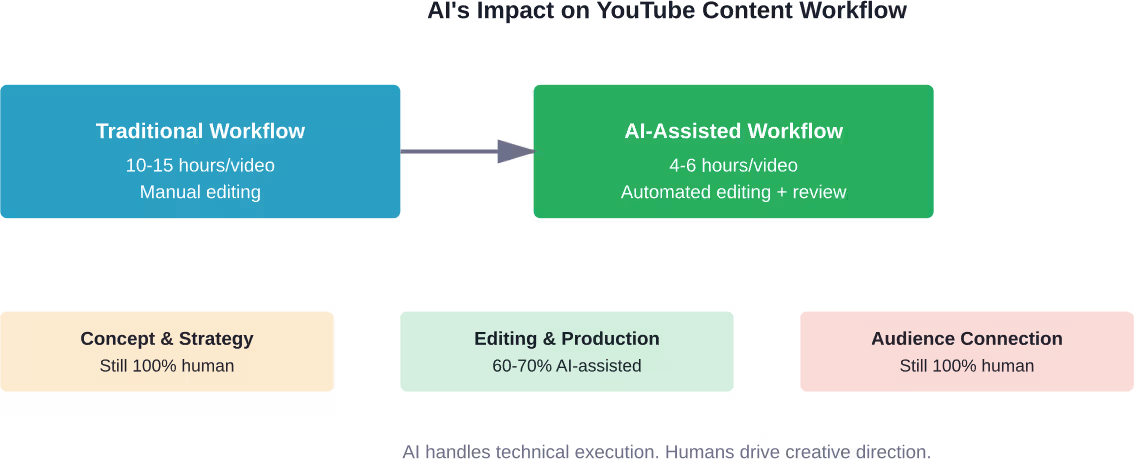 Real talk: AI is already here, doing the grunt work. The question isn’t whether it’s coming—it’s how creators will adapt.
Where AI Actually Threatens Creator Jobs
Research from Brookings Institution examining AI-driven job displacement reveals concerning patterns. Freelancers in occupations more exposed to generative AI experienced a 2% decline in contracts and a 5% drop in earnings following AI software releases in 2022. Experienced freelancers saw the most pronounced negative effects. More than 30% of all workers could have at least half of their work tasks exposed to generative AI technology, according to Brookings analysis. However, this exposure varies dramatically by role and skill level.
| Content Type | AI Replacement Risk | Why |
|---|---|---|
| Generic tutorials | High | Formulaic, template-based content easily automated |
| Compilation videos | High | AI can aggregate and edit clips automatically |
| Personality-driven vlogs | Low | Audiences watch for the specific person, not just content |
| Educational deep-dives | Medium | AI can research but struggles with unique insights |
| Entertainment/comedy | Low | Humor and timing require human creativity |
According to the Bureau of Labor Statistics, overall employment in media and communication occupations is projected to grow slower than the average for all occupations from 2024 to 2034. But that doesn’t mean replacement—it means transformation.
The Economics: Cost vs. Human Value
Research on generative video authoring (Doki paper from arXiv 2025) reveals that generating video costs $3.20 per clip (Veo 3), compared to $0.04 per image generation (Imagen 4). This cost difference means AI video generation remains expensive at scale. According to Brookings research citing Bureau of Labor Statistics data, writers and authors in the motion picture and video industry earned an average annual wage of $136,690 in 2022, compared to $61,900 across all occupations. That premium reflects the specialized skills required—skills AI can’t fully replicate yet. According to the Bureau of Labor Statistics, broadcast, sound, and video technicians have a median annual wage of $56,600. These technical roles face higher AI exposure than creative positions.
What the Hollywood Writers Strike Taught Us
The 2023 Hollywood writers strike centered on protecting livelihoods from generative AI. According to Brookings research on the strike, writers achieved a remarkable victory by establishing guardrails around AI use in their contracts. The lesson? Organized creators can shape how AI gets deployed in their industries. YouTube creators might not have unions, but they have platform leverage and audience relationships that AI can’t dissolve overnight. 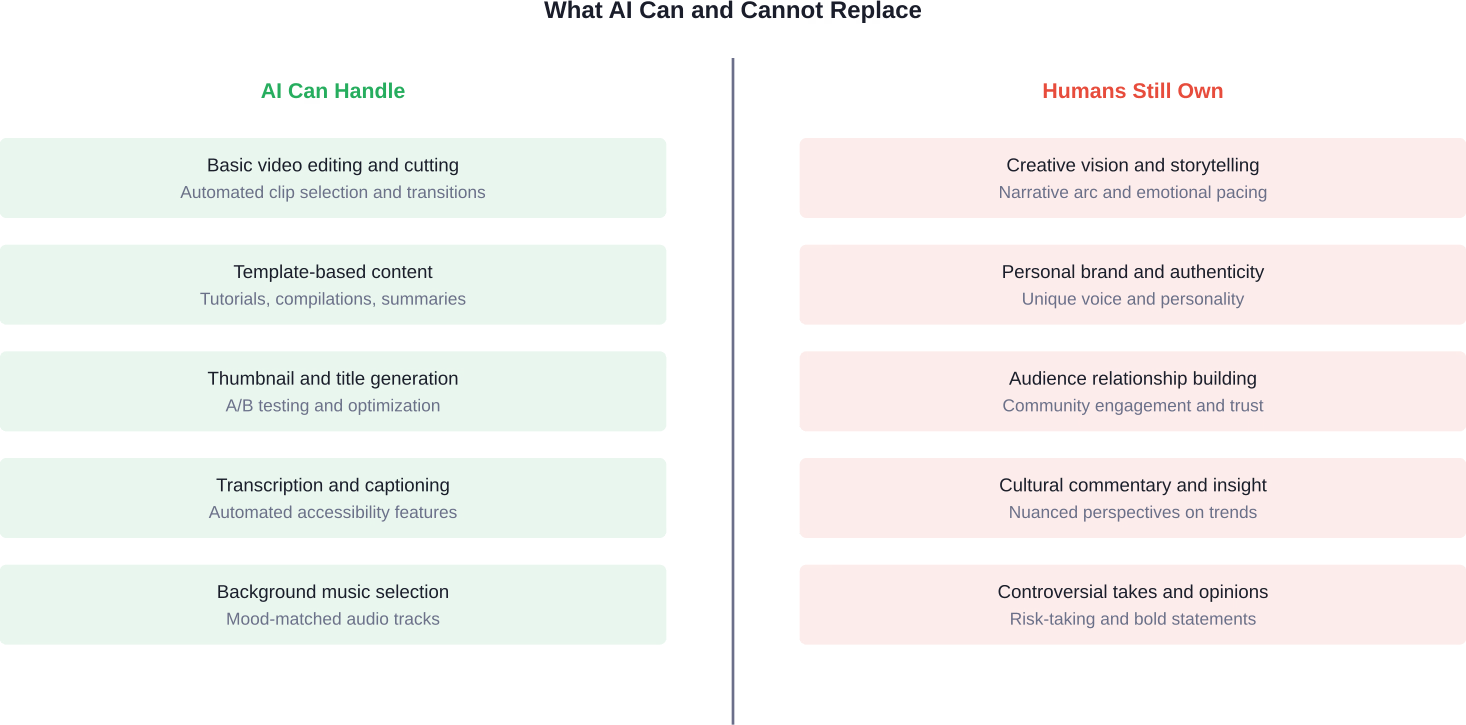
The Future: Collaboration, Not Replacement
World Economic Forum research on AI and creative industries suggests that AI will significantly impact creative work, especially for voice actors and technical roles. But impact doesn’t equal elimination. Look at it this way: calculators didn’t eliminate mathematicians. Photoshop didn’t eliminate photographers. AI won’t eliminate YouTubers—it’ll separate those who adapt from those who don’t. Creators who view AI as a production assistant—handling tedious editing, generating initial drafts, optimizing thumbnails—will produce more content faster. Those who resist any AI integration might find themselves outpaced. 
Don’t Let AI Turn Your Content Into Templates
AI can generate scripts, edits, and even full videos, but most outputs start looking the same once everyone uses the same tools. AI Superior works with teams that go beyond content generation and focus on how AI fits into the whole production process. Instead of relying on generic outputs, they help design systems where AI supports scripting, editing, and data handling while still aligning with a creator’s format, style, and workflow. That includes building custom AI components, connecting them with internal data or content libraries, and making sure the output actually reflects how the channel works, not just what the model predicts. The difference shows up over time. Channels that rely only on tools drift into repetition. Systems built with structure keep content consistent and scalable without losing identity. 👉Contact AI Superior and see how it can fit into your setup.
Which YouTubers Face the Highest Risk?
Industry discussions highlight specific vulnerabilities. Faceless channels that rely on stock footage and voiceovers face substantial displacement risk. AI can generate this content type efficiently and cheaply. News aggregators and compilation channels also sit in the danger zone. If the value proposition is “I watch things so you don’t have to,” AI can replicate that function. Sound familiar? If content creation involves more assembly than creativity, automation becomes viable.
How YouTubers Can AI-Proof Their Careers
The creators who’ll thrive are building moats AI can’t cross:
- Personality-driven content: Audiences subscribe to people, not content formats
- Deep expertise: Unique insights and specialized knowledge resist commodification
- Community building: Relationships and two-way engagement create irreplaceable value
- Strategic AI adoption: Using AI tools to enhance productivity without sacrificing authenticity
According to World Economic Forum analysis on workforce transformation, organizations that invest in enhancing human capabilities with technology report improved performance. The same principle applies to individual creators.
Conclusion: Evolution, Not Extinction
Will AI replace YouTubers? Not entirely. But it will replace certain types of content and force every creator to reconsider their value proposition. The YouTubers who survive won’t be those with the fanciest editing or the slickest production. They’ll be the ones audiences can’t get anywhere else—the personalities, the experts, the storytellers who use AI as a tool rather than competing against it. The platform is changing. Creators who evolve with it will find opportunities. Those who don’t will become case studies in why adaptation matters more than resistance. Ready to future-proof your channel? Start experimenting with AI tools now, but never outsource the core of what makes your content uniquely yours.
Frequently Asked Questions
Can AI completely replace human YouTubers?
No, AI cannot completely replace human YouTubers. While AI can handle technical tasks like editing and generating shorts, it cannot replicate authentic personality, unique insights, or genuine audience relationships. YouTube CEO Neal Mohan has stated that AI will enhance rather than replace human creativity. Personality-driven channels remain largely protected from AI displacement.
What types of YouTube content are most at risk from AI?
Generic tutorials, compilation videos, news aggregators, and faceless channels using stock footage face the highest AI replacement risk. These content types rely on formulaic structures that AI can efficiently replicate. Industry discussions highlight channels that add minimal creative value beyond content assembly as most vulnerable to automation.
How much does AI-generated video content cost?
Research shows that generating video using services like Veo 3 costs approximately $3.20 per clip, compared to $0.04 per image generation (Imagen 4). While costs are decreasing, AI video generation remains relatively expensive at scale, which provides some economic protection for human creators in the near term.
Are YouTube creator jobs declining because of AI?
Research from Brookings Institution found that freelancers in AI-exposed occupations experienced a 2% decline in contracts and 5% drop in earnings after 2022 AI releases. However, the Bureau of Labor Statistics projects about 104,800 openings yearly in media and communication occupations through 2034, indicating ongoing demand despite slower growth.
How should YouTubers adapt to AI tools?
Successful adaptation involves using AI for technical tasks—editing, thumbnails, transcription—while focusing human effort on creative strategy, personality-driven content, and community building. Professional creators in recent studies reported significant time savings by integrating AI co-creation tools while maintaining creative control over their content direction.
Will YouTube’s AI shorts replace traditional creators?
YouTube’s AI-generated shorts tool allows creators to generate six-second videos from text prompts, including using their own likeness. However, these shorts serve as supplementary content rather than replacements for longer-form videos. The tool is designed to enhance creator productivity, not eliminate the need for human-driven content strategy.
What did the Hollywood writers strike teach us about AI and creativity?
According to Brookings research, the 2023 Hollywood writers strike resulted in a remarkable victory for creators, establishing contractual guardrails around AI use. This demonstrates that organized creative workers can shape AI deployment in their industries, setting precedents for how technology integrates with rather than replaces human creativity.