Quick Summary: AI will not replace human editors but will transform their role into AI-assisted editing. While generative AI tools can handle basic grammar and formatting tasks, the nuanced judgment, cultural context, author relationship management, and creative decision-making that define professional editing remain beyond AI’s capabilities. The future points toward hybrid workflows where editors leverage AI for efficiency while focusing on high-value strategic and creative work. The panic is real. Editors across publishing houses, newsrooms, and content agencies are watching AI tools get smarter by the month. ChatGPT can now polish prose. Grammarly catches errors humans miss. And automated fact-checking systems scan faster than any research assistant. So here’s the question everyone’s asking: Will AI replace editors? The short answer? Not entirely. But the profession is changing faster than most people realize.
What Government Data Reveals About AI and Editorial Jobs
Let’s start with hard numbers instead of speculation. According to the U.S. Bureau of Labor Statistics, AI is expected to primarily affect occupations whose core tasks can be most easily replicated by generative AI in its current form. The BLS projects total employment to grow from 170.0 million in 2024 to 175.2 million in 2034, an increase of just 3.1 percent—much slower than the 13.0-percent employment growth recorded over 2014–24. That slowdown matters for editors. Economists at Goldman Sachs estimate that AI could replace 6% to 7% of U.S. jobs. Computer programmers and data entry specialists face the highest exposure. But creative and editorial roles occupy a more complex middle ground. The journalism industry provides a preview. According to Brookings Institution research, the U.S. lost two-thirds of its newspaper journalist jobs in the past 20 years. According to 2024 reports, the journalism industry slashed 2,700 jobs, and 2.5 newspapers closed each week on average. Despite a 43% rise in traffic to the top 46 news sites over the past decade, their revenues declined 56%. But here’s where it gets interesting. That decline started long before ChatGPT arrived. The culprit wasn’t AI—it was digital platformization and the advertising revenue collapse that began in the early 2000s.
The Freelance Market Tells a Different Story
Recent evidence from online freelance markets reveals AI’s more immediate impact on editorial work. Researchers at Washington University in St. Louis analyzed freelance platforms following the 2022 release of ChatGPT and similar tools. They found that freelancers in occupations more exposed to generative AI experienced a 2% decline in the number of contracts and a 5% drop in earnings following the release of new AI software in 2022. These negative effects were especially pronounced among experienced freelancers. That’s not catastrophic. But it’s not nothing either. The data suggests AI is creating downward pressure on routine editorial tasks—basic copyediting, formatting, simple rewrites. Meanwhile, strategic editorial work requiring judgment and context remains in demand. 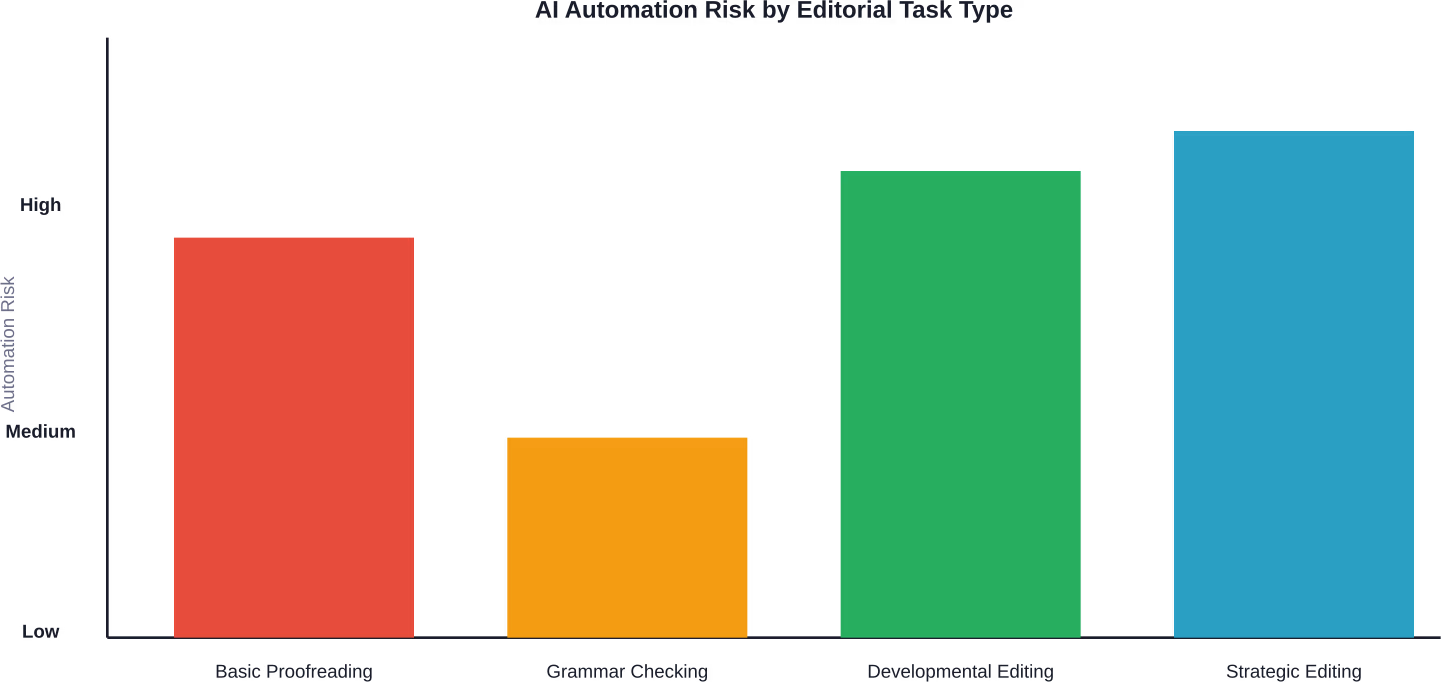
What AI Can Actually Do in Editorial Work
Let’s be clear about AI’s current capabilities. Modern AI tools excel at:
- Catching spelling and basic grammar errors with near-perfect accuracy
- Identifying inconsistent style choices across long documents
- Suggesting simpler word alternatives for complex phrases
- Reformatting citations and references to match style guides
- Generating first-draft summaries or outlines from source material
- Translating content between languages with reasonable accuracy
That’s legitimately useful. And it’s already changing workflow for many editors. But look at what AI can’t do.
The Irreplaceable Human Elements of Editing
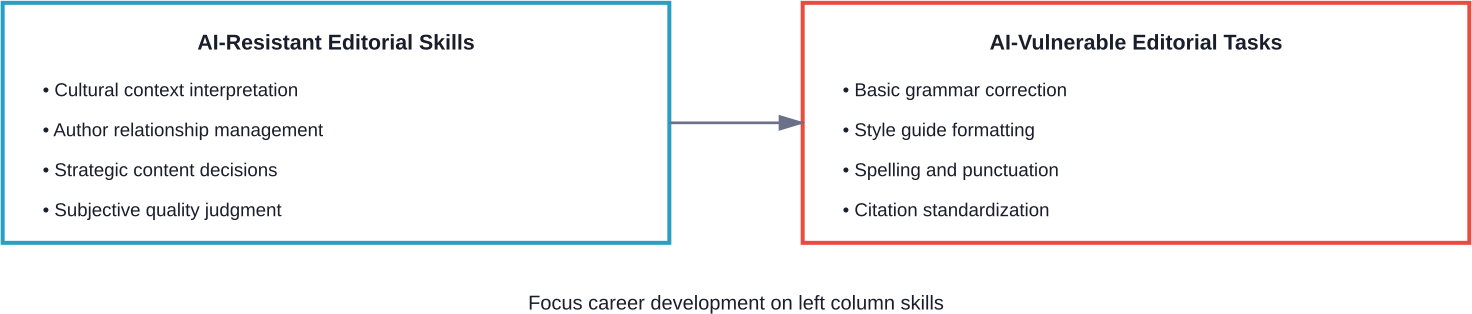
Professional editing involves layers of judgment that remain beyond AI’s reach:
- Cultural and contextual nuance: AI doesn’t understand why a phrase might offend readers in Manchester but land fine in Melbourne. It can’t navigate the shifting boundaries of sensitive topics or recognize when breaking a grammar rule strengthens rather than weakens writing.
- Author relationship management: Editors don’t just fix text—they manage egos, coach emerging writers, negotiate difficult conversations about major revisions, and know when to push back versus when to let an author’s voice win. As one editorial professional noted in community discussions, “AI does not think. It cannot make editorial decisions. It cannot break a rule when it needs to. It cannot understand an author’s writing style or voice. It cannot engage in the author-editor client relationship.”
- Strategic content decisions: Should this article lean more technical or accessible? Does this narrative structure serve the intended audience? Which of three competing angles will resonate most with readers? These questions require understanding of market dynamics, audience psychology, and publication strategy.
- Quality judgment in ambiguous cases: Much of editing happens in gray zones where multiple correct approaches exist. Choosing between them requires taste, experience, and understanding of the larger editorial vision for a publication or author’s body of work.
Real talk: AI is getting better at mimicking these capabilities. But mimicking isn’t the same as understanding.
How Editorial Work Is Actually Changing
The transformation isn’t about replacement. It’s about role evolution. Smart editors are already adapting by:
- Delegating mechanical tasks to AI: Why manually check every comma splice when Grammarly can flag them instantly? Editors who once spent 40% of their time on basic proofreading now allocate that time to higher-value work.
- Focusing on developmental and strategic editing: The market increasingly values editors who can improve story structure, strengthen arguments, identify gaps in logic, and shape content strategy—all tasks where AI provides minimal value.
- Specializing in high-stakes content: Legal documents, medical publications, investigative journalism, and other contexts where errors carry serious consequences still require human verification. AI assistance is welcomed, but human final review remains mandatory.
- Building hybrid workflows: The most effective approach combines AI speed with human judgment. First-pass AI editing catches obvious issues. Human editors then focus exclusively on nuanced judgment calls.
| Task Category | AI Capability | Human Editor Role | Likely 2030 Scenario |
|---|---|---|---|
| Basic proofreading | Excellent | Quality verification | Mostly automated with spot-checking |
| Style consistency | Very good | Exception handling | AI-assisted with human oversight |
| Fact-checking | Moderate | Source evaluation | Hybrid: AI finds, humans verify |
| Structural editing | Limited | Primary responsibility | Primarily human with AI suggestions |
| Voice/tone refinement | Poor | Primary responsibility | Human-led with minimal AI input |
| Author coaching | None | Exclusive domain | Entirely human |

Keep Editorial Control When AI Starts Rewriting Everything
AI can rewrite, summarize, and polish content in seconds, but it doesn’t know why one version works better than another or what should be left untouched. AI Superior works with organizations that rely on structured content processes and can’t afford unpredictable output. Instead of treating AI as a standalone writing tool, they focus on how it’s used inside real systems – connecting models with internal data, defining how content is generated or edited, and making sure outputs stay aligned with editorial standards, tone, and purpose. That becomes critical when content moves across teams, channels, or regulated environments where consistency actually matters. If you’re considering AI for content workflows but want to keep control over quality and decisions, reach out to AI Superior to see how it can fit into your setup.
The Creative Industry Precedent
Other creative fields offer useful parallels. When OpenAI launched Sora, a text-to-video AI tool, it triggered immediate concern in film production. Tyler Perry, a major producer and studio owner, paused an $800 million expansion of his Atlanta studio after seeing the technology’s capabilities. But here’s what happened next. The film industry didn’t collapse. Instead, roles shifted. According to Brookings Institution analysis, AI tools in creative industries tend to eliminate entry-level positions while creating demand for experienced professionals who can direct, refine, and quality-control AI outputs. Junior positions face pressure. Senior strategic roles often see increased demand. The same pattern appears likely for editorial work.
Which Editorial Jobs Face the Most Pressure
Not all editorial roles face equal AI exposure:
- Highest risk: Entry-level copyeditors working on routine content, proofreaders handling straightforward material, and formatters focused purely on style guide compliance. These roles involve tasks AI handles increasingly well.
- Moderate risk: Mid-level editors working on standard commercial content where speed matters more than nuance. AI assistance will increase productivity expectations, potentially reducing headcount even as total output grows.
- Lower risk: Senior editors, developmental editors, commissioning editors, and specialists in technical, medical, legal, or investigative content. These roles require expertise and judgment AI can’t replicate.
- Minimal risk: Editorial directors, editor-in-chiefs, and others in strategic leadership positions. Their work centers on decisions about publication direction, team management, and high-stakes judgment calls.
What Editors Should Do Right Now
Waiting to see what happens isn’t a strategy:
- Learn AI tools thoroughly: Editors who understand AI capabilities and limitations will outcompete those who ignore the technology. Experiment with ChatGPT, Claude, Grammarly Business, and other tools relevant to editorial work.
- Develop specialized expertise: Generalist copyeditors face more pressure than specialists. Building expertise in technical editing, medical writing, legal content, or another niche creates defensible value.
- Strengthen strategic skills: Content strategy, audience analysis, narrative structure, and editorial judgment become more valuable as mechanical tasks get automated. Invest development time accordingly.
- Build author relationships: Editors with strong client relationships and reputations for improving writers’ work have built-in protection. AI can’t replicate trust earned over years of collaboration.
- Communicate value clearly: Many clients don’t understand the difference between proofreading and developmental editing. Editors who can articulate their value proposition—especially the judgment and strategic thinking AI can’t provide—position themselves more effectively.
The Economic Reality Publishing Faces
Here’s the uncomfortable truth. Publishing economics are pushing toward AI adoption regardless of quality concerns. As one analysis noted, despite traffic to major news sites rising 43% over the past decade, their revenues declined 56%. That gap creates enormous pressure to cut costs. AI offers publishers a way to maintain output while reducing editorial headcount. Whether that produces better content is secondary to whether it produces profitable content. For editors, this means the bar for demonstrating value keeps rising. Being “good enough” won’t cut it when AI provides “adequate enough” at a fraction of the cost.
Why Some Editorial Work Will Always Need Humans
Despite economic pressure, certain editorial contexts guarantee continued human involvement:
- High-stakes content: Medical journals, legal briefs, investigative journalism, and other content where errors cause serious harm will require human verification for liability reasons if nothing else.
- Premium publishing: High-end literary journals, prestigious book publishers, and quality-focused outlets competing on editorial excellence rather than volume will maintain human editorial teams as a competitive advantage.
- Regulated industries: Content requiring regulatory compliance often mandates human review. Pharmaceutical companies, financial services firms, and government agencies face legal obligations that can’t be delegated to AI.
- Author-facing editorial services: Writers hiring developmental editors want conversation, coaching, and collaborative refinement. That relationship-based work can’t be automated without fundamentally changing the service.
But let’s be honest. These categories represent a fraction of total editorial employment.
The 2026 Editorial Job Market Reality
So what does the current job market actually look like? Community discussions among editors reveal a mixed picture. Some report clients explicitly requesting “AI-edited” content at lower rates. Others find demand increasing for high-quality human editing specifically marketed as non-AI work. The split suggests a bifurcating market. Commodity content increasingly uses AI with minimal human oversight. Premium content doubles down on skilled human editors as a quality differentiator. Entry-level positions have become noticeably scarcer. Publishers who previously hired junior editors to handle routine copyediting now use AI tools with senior editor spot-checking instead. But experienced editors with specialized skills report stable or even growing demand. The market increasingly values editorial judgment over mechanical error-catching.
Looking Forward: The Next Five Years
What happens between now and 2030? Most projections suggest accelerating AI capabilities. Tools that currently require human refinement of AI outputs may eventually produce publication-ready content for routine material. That will continue eliminating entry-level positions and putting pressure on mid-career editors working on standard commercial content. Simultaneously, the volume of content being produced continues exploding. More content means more need for editorial oversight, even if the ratio of editors to content volume declines. The net effect? Probably fewer total editorial jobs, but not the catastrophic elimination of some fear. More likely, a 15-25% headcount reduction across the industry over five years, concentrated in entry-level and routine positions. For editors willing to adapt, specialize, and learn to work effectively with AI tools, opportunities will remain. For those trying to compete with AI on mechanical tasks, prospects look grim.
Frequently Asked Questions
Will AI completely replace human editors?
No. AI will automate mechanical editorial tasks like basic proofreading and formatting, but strategic editing, developmental work, and author relationship management require human judgment. The profession is transforming rather than disappearing, with editors shifting toward higher-value work while delegating routine tasks to AI tools.
Which types of editors face the highest risk from AI?
Entry-level copyeditors and proofreaders working on routine content face the most immediate pressure. According to freelance market research, workers in AI-exposed occupations experienced a 2% decline in contracts and 5% drop in earnings following ChatGPT’s release. Specialized editors working on technical, medical, legal, or developmental editing face much lower risk.
Should aspiring editors still pursue this career?
Yes, but with strategic focus. Build expertise in areas AI handles poorly: developmental editing, content strategy, specialized subject matter, and author coaching. Treat AI tools as assistants rather than competitors. The market still needs skilled editors, but the entry path has become more competitive as routine positions disappear.
How can current editors protect their jobs from AI disruption?
Develop specialized expertise, learn to use AI tools effectively, strengthen strategic and relationship-based skills, and clearly communicate the value of human judgment. Editors who position themselves as strategic partners rather than error-catchers create defensible value that AI can’t replicate.
What’s the difference between editing tasks AI can handle versus those requiring humans?
AI excels at pattern-matching tasks: catching spelling errors, identifying style inconsistencies, suggesting simpler word choices, and formatting citations. Humans remain necessary for contextual judgment, understanding cultural nuance, making strategic content decisions, managing author relationships, and determining when to break rules for effect.
Are publishing companies actually replacing editors with AI?
Publishing companies are reducing entry-level editorial headcount while maintaining experienced editors in strategic roles. The trend reflects a shift toward hybrid workflows where AI handles first-pass editing and humans focus on judgment-intensive work. Total editorial employment is declining, but not through wholesale replacement—rather through reduced hiring as AI increases individual editor productivity.
How will AI change the editor-author relationship?
AI cannot replicate the coaching, negotiation, and collaborative refinement that characterize effective editor-author relationships. While AI may handle mechanical editing, developmental editing still requires human conversation. Authors seeking genuine partnership and skill development will continue working with human editors. However, authors prioritizing speed and cost over relationships may increasingly opt for AI-only editing.
The Bottom Line
Will AI replace editors? Not entirely. But anyone claiming the profession won’t fundamentally change is selling false comfort. The editorial work that involves mechanical pattern-matching—catching typos, enforcing style consistency, formatting references—is already being automated. That trend will accelerate. The editorial work that requires judgment, context, relationships, and strategic thinking remains firmly in human territory. But the market for that work is becoming more competitive as routine positions disappear. Editors who adapt, specialize, and learn to leverage AI as a tool rather than viewing it as a threat will find plenty of opportunity. Those who compete with AI on mechanical tasks will struggle. The profession isn’t dying. It’s evolving. And the editors who evolve with it will thrive. Start by honestly assessing which of your current tasks AI could handle. Then deliberately develop the skills AI can’t replicate. The future belongs to editors who combine AI efficiency with irreplaceable human judgment.