Quick Summary: AI will not completely replace designers, but it will fundamentally transform the profession. The U.S. Bureau of Labor Statistics projects employment for graphic designers will remain steady through 2034, while the World Economic Forum forecasts 78 million net new jobs globally despite AI disruption. Designers who evolve beyond screen production to embrace strategic thinking, human-centered problem-solving, and AI collaboration will thrive. The panic around AI replacing designers has reached fever pitch. Every design forum, LinkedIn thread, and industry conference buzzes with the same anxious question: how long until we’re obsolete? Here’s the thing though—the data tells a different story than the doomsday predictions. While AI is undeniably changing design work, the notion of complete replacement doesn’t hold up against employment projections, industry analysis, or what’s actually happening on the ground. Let’s cut through the noise and examine what government statistics, workforce research, and real-world trends reveal about designers’ future in an AI-augmented world.
What Employment Data Actually Shows
According to the U.S. Bureau of Labor Statistics, the median annual wage for graphic designers was $61,300 in May 2024. But the more interesting number is what’s projected for the decade ahead. The BLS projects total U.S. employment will grow from 170.0 million in 2024 to 175.2 million in 2034—a 3.1 percent increase. This is considerably slower than the 13.0 percent employment growth recorded over the 2014–24 decade, reflecting broader demographic trends and economic shifts rather than AI-specific disruption. For graphic designers specifically, employment projections remain relatively stable. The profession isn’t facing the catastrophic collapse that panicked headlines suggest. Now, this doesn’t mean nothing’s changing. The World Economic Forum’s Future of Jobs Report 2025 paints a more nuanced picture: while job disruption will affect 22% of jobs by 2030, the net result is 78 million new positions globally (170 million created minus 92 million displaced). This represents a net employment increase of 78 million jobs. Technological advancement ranks among the key drivers reshaping industries, but demographic shifts, geoeconomic tensions, and economic pressures matter just as much.
The Real Question: What Kind of Designers?
AI won’t replace designers wholesale. But it will replace certain types of design work—and certain approaches to the profession. Look, if your entire value proposition is pushing pixels and producing screens, that’s a problem. AI tools have gotten frighteningly good at executing visual work when given clear direction. The current arguments against AI in design are weakening:
- Quality isn’t quite at elite designer level, but it’s already better than many average practitioners
- AI needs guidance and can’t make strategic decisions independently
- It excels at following instructions and existing design patterns
These limitations matter less than they did even a year ago. The technology is improving rapidly. But here’s where the replacement narrative falls apart: producing screens was never the whole job. It was just the most visible, most easily commoditized part.
What AI Actually Can’t Do
Real talk: AI has no taste. No intuition. No ability to read a room during a client presentation and pivot on the fly. As noted by design professionals working intensive project cycles, immersion in creative work involves research, prototyping, assembling, revising, and presenting—but also timeline management, priority juggling, technical problem-solving, compromise navigation, and judgment calls that balance competing constraints. Client rapport matters. Vendor relations matter. Team motivation matters. These human elements don’t automate away. The creative process itself resists algorithmic reproduction. It’s messy: laying out concepts, walking away, returning with fresh eyes, realizing it doesn’t work, discarding most of it, finding inspiration elsewhere, remixing ideas, discovering that new direction affects other assets, revising those, remembering something from years back, cross-pollinating concepts. AI cannot engage in the spontaneous discovery and inspiration-gathering that characterizes the creative process. It can’t have that moment in the shower where the solution clicks. It can’t draw on decades of accumulated pattern recognition that happens below conscious awareness. 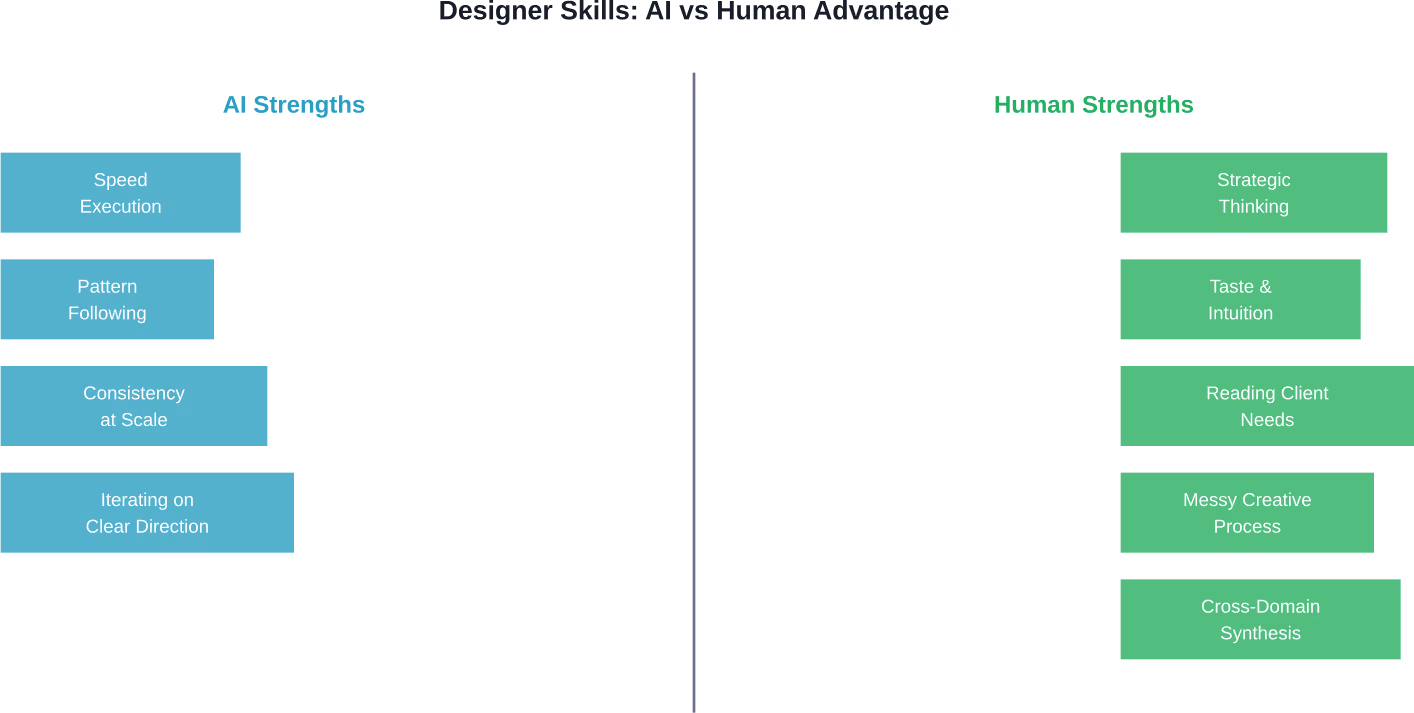
The Skills Gap Is the Real Story
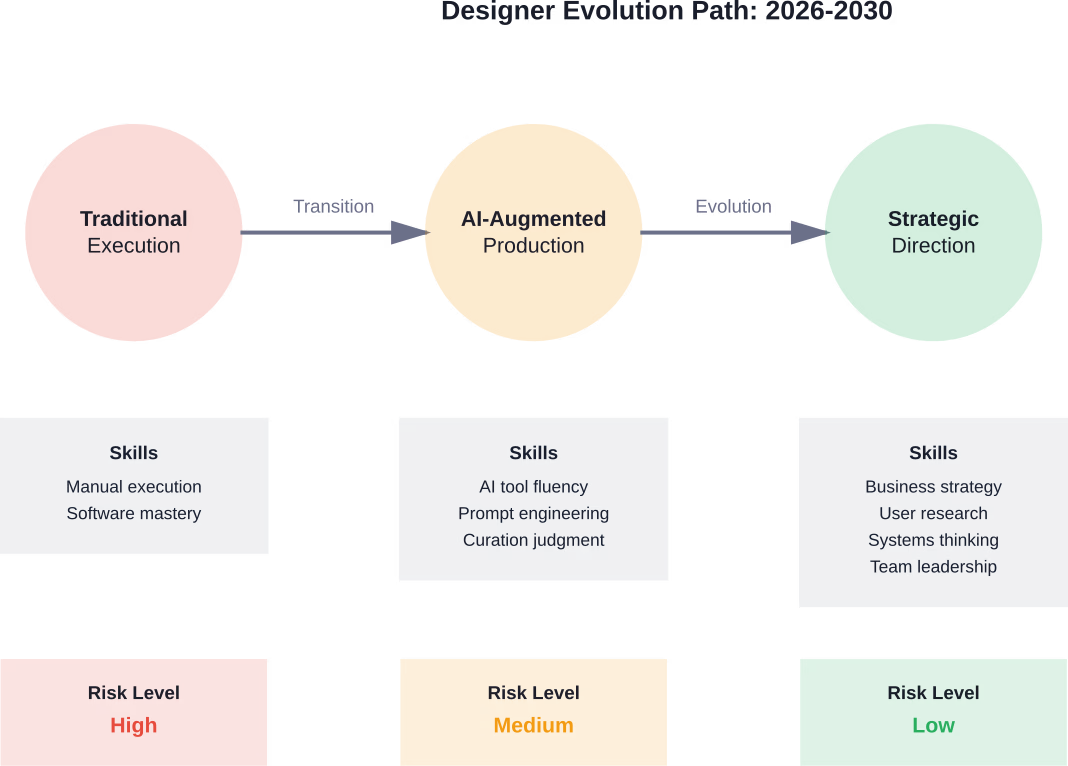
Here’s where things get interesting. According to the World Economic Forum’s data from over 1,000 companies, employers expect 39% of workers’ core skills to change by 2030, though this represents stabilization rather than acceleration. That’s a significant ongoing disruption. The skills gap continues to be the most significant barrier to business transformation. For designers, this translates to specific pressure points. Skills that will matter more, not less, in an AI-augmented environment include:
- Human-centric interaction design that prioritizes user needs and behaviors
- Systems design that structures complex elements into cohesive, functional wholes
- Visual communication that translates abstract ideas into comprehensible form
- Strategic problem-solving that defines what to build, not just how to build it
These capabilities transfer particularly well to AI-related roles. Designers who develop them aren’t just protecting their careers—they’re positioning themselves for expanded opportunities.
The Collaboration Model
The future isn’t designers versus AI. It’s designers plus AI versus designers who refuse to adapt. Think of AI as the most capable junior designer imaginable—one that executes flawlessly when given clear direction but needs that direction from someone with judgment, experience, and strategic vision. This collaboration model is already emerging in forward-thinking studios and in-house teams. Designers use AI tools to rapidly explore variations, generate initial concepts, automate repetitive tasks, and handle production work that doesn’t require creative judgment. The designer’s role shifts toward curation, direction, and the high-level thinking that determines which of AI’s outputs actually solve the problem at hand. Sound familiar? It’s not entirely different from how designers have always worked with junior team members, freelancers, or offshore production resources. The tool changed; the fundamental relationship didn’t. 
Build Design Systems Where AI Doesn’t Break the Outcome
AI can produce layouts and visuals in seconds, but turning that into something consistent, usable, and aligned with a product still takes real design decisions. AI Superior works with teams that need AI to fit into actual product and design environments, not just generate isolated assets. Their focus is on building and integrating AI in a way that supports how products are designed and used – connecting generated outputs with system logic, user flows, and the structure behind the interface. That means treating AI as one layer inside a larger system, where design still defines how everything comes together. 👉Reach out to AI Superior to see how it can fit into your setup.
Industry Trends and Transformations
Creative work is being reshaped by generative AI, but not eliminated. Research on creative communities shows practitioners actively developing what researchers call “AI literacy”—understanding how to integrate these tools effectively rather than being replaced by them. Online creative communities demonstrate designers grappling with prompting practices, refinement techniques, and how to maintain creative control while leveraging AI capabilities. This isn’t passive acceptance of replacement; it’s active evolution of practice. The broader workforce data reinforces this pattern. While technological advancement drives change across industries, the net employment effect remains positive. New roles emerge as others transform or disappear. For design specifically, we’re seeing growth in areas like:
- AI tool customization and training for design applications
- Design systems architecture that guides AI outputs
- User experience research that AI can’t automate
- Strategic design leadership roles
| Designer Type | AI Vulnerability | Future Outlook |
|---|---|---|
| Screen Producers | High | Must evolve or transition |
| Pattern Followers | High | Automation will handle routine work |
| Strategic Thinkers | Low | Increased value and demand |
| User Researchers | Low | Growing importance |
| Systems Designers | Low | Critical for AI integration |
| Creative Directors | Very Low | More essential than ever |
What Designers Should Do Now
Waiting to see what happens isn’t a strategy. The transformation is happening whether individual designers engage with it or not. The practical steps matter more than abstract worrying:
- Experiment with AI tools extensively: Not just once or twice, but enough to understand their capabilities and limitations viscerally. Tools like Midjourney, DALL-E, and design-specific AI assistants evolve monthly. Hands-on experience beats speculation.
- Develop skills AI can’t easily replicate: Double down on strategic thinking, user research, client relationship management, and creative direction. These aren’t just designer skills—they’re business skills that make designers indispensable.
- Learn to direct AI effectively: Prompting is a skill. Understanding how to extract useful output from AI tools, then refine and apply that output, becomes a competitive advantage.
- Focus on problems, not just deliverables: Clients and employers don’t actually need screens or logos—they need solutions to business problems. Designers who position themselves as problem-solvers rather than artifact-producers weather automation better.
- Build cross-functional capabilities: The most resilient designers understand business strategy, basic development, user psychology, and project management alongside their visual skills.
The Ethical Dimension
Beyond employment concerns, AI in creative industries raises thorny ethical questions that designers can’t ignore. AI-generated art and design output is trained on existing creative work—often without compensation or consent from the original creators. This raises fundamental questions about intellectual property, fair compensation, and the sustainability of creative ecosystems. There’s also the deepfake problem. Design tools that can manipulate images and video with unprecedented ease create risks that go beyond creative work into misinformation and fraud territory. Designers who engage with AI tools need to think carefully about these implications. Using AI doesn’t make someone complicit in every problematic aspect of the technology, but ignoring the ethical dimensions isn’t tenable either. Many experts suggest that designers are actually well-positioned to shape how AI develops in creative fields—but only if they’re at the table, not on the sidelines.
Different Design Disciplines, Different Impacts
Not all design roles face the same AI pressure. The impact varies considerably by specialty:
- Graphic design for marketing faces high automation pressure for routine work—social media graphics, ad variations, basic layouts. But strategic brand work remains firmly in human territory.
- UX/UI design splits interestingly. Wireframing and visual design execution are increasingly AI-assisted, but user research, information architecture, and interaction design remain difficult to automate.
- Product design (physical products) faces less immediate AI disruption, though generative design for engineering optimization is advancing.
- Motion design and animation are seeing AI tools that handle routine animation, but creative direction and complex storytelling remain human domains.
- Design leadership and creative direction become more valuable, not less, as AI handles execution. Someone still needs to set strategy and make final calls.
| Design Specialty | Automation Risk for Routine Tasks | Strategic Work Protection |
|---|---|---|
| Marketing Graphics | Very High | Medium - brand strategy protected |
| UX Research | Low | High - human insight critical |
| UI Production | High | Medium - systems thinking valued |
| Illustration | High | Medium - unique style defensible |
| Product Design | Medium | High - complex constraints |
| Creative Direction | Very Low | Very High - judgment irreplaceable |
The Long View
Zoom out, and the AI-replacement narrative looks less like an unprecedented crisis and more like the latest iteration of a very old pattern. Design has weathered the transition from physical to digital. Desktop publishing was supposed to eliminate the need for designers—instead it democratized basic layout while increasing demand for sophisticated visual communication. The web was going to make print designers obsolete. Mobile was going to upend web design. Each wave brought disruption. Each wave also created new opportunities for designers who adapted rather than resisted. This doesn’t mean AI is just another tool with no meaningful impact. The scope and pace of change is genuinely different this time. But the fundamental dynamic—technology automating routine work while creating demand for higher-level thinking—remains consistent. Generally speaking, creative professions prove more resilient than predicted during periods of technological upheaval. The work changes form, but the underlying need for human creativity, judgment, and communication persists.
What Employers and Clients Need to Understand
This isn’t just a designer problem. Organizations hiring and working with designers need to recalibrate their expectations. The cheapest option isn’t always AI doing everything. AI-generated design work still requires direction, quality control, and strategic oversight. Organizations that try to eliminate designers entirely often discover they’ve eliminated the very expertise needed to use AI tools effectively. The smart play for most organizations is hybrid teams: designers who skillfully leverage AI to amplify their output while providing the strategic thinking and creative judgment that AI lacks. Companies that understand this will attract and retain top design talent. Those that treat designers as interchangeable with AI will struggle with quality, consistency, and strategic coherence.
Frequently Asked Questions
Will AI completely replace graphic designers?
No. Government employment data shows graphic designer positions remaining stable through 2034, and the World Economic Forum projects net job growth despite AI disruption. AI will automate routine design tasks but can’t replace strategic thinking, creative judgment, and human-centered problem-solving that defines professional design work.
What design jobs are most at risk from AI?
Roles focused purely on production and execution face the highest risk—creating social media graphics, basic layouts, and routine marketing materials. Designers who only follow templates or existing patterns without strategic input are most vulnerable to automation.
How can designers protect their careers from AI disruption?
Focus on skills AI can’t easily replicate: strategic thinking, user research, client relationship management, systems design, and creative direction. Learn to use AI tools effectively rather than avoiding them. Position yourself as a problem-solver who uses AI as one tool among many, not as someone who simply executes deliverables.
Should designers learn AI tools now?
Absolutely. Designers who develop fluency with AI tools gain competitive advantages in speed and capability. Experimentation with tools like Midjourney, Adobe Firefly, and design-specific AI assistants helps designers understand both the possibilities and limitations, making them more effective collaborators with the technology.
What skills will designers need by 2030?
According to the World Economic Forum, 39% of core skills will change by 2030. Critical capabilities include human-centric interaction design, systems thinking, strategic problem-solving, AI tool fluency, cross-functional collaboration, and business strategy understanding. Technical execution skills become less differentiating as strategic skills become more valuable.
Are UX designers safer from AI than graphic designers?
Generally, yes—but with nuances. User research and interaction design involve complex human understanding that AI struggles to replicate. However, UI production and wireframing are increasingly AI-assisted. UX designers who focus on research, strategy, and complex problem-solving face lower automation risk than those focused primarily on visual execution.
What’s the biggest misconception about AI replacing designers?
That design is primarily about producing artifacts—screens, logos, layouts. Professional design work involves understanding business problems, researching user needs, developing strategy, managing stakeholder relationships, and making judgment calls that balance competing constraints. AI can help produce artifacts, but it can’t replace the holistic thinking that defines effective design practice.
The Bottom Line
Will AI replace designers? Not in the wholesale way that panic-driven headlines suggest. Will AI fundamentally transform what design work looks like, which skills matter most, and how designers spend their time? Absolutely. That transformation is already underway. The designers who thrive won’t be those who resist AI or pretend it doesn’t matter. They’ll be the ones who understand both the technology’s capabilities and its limitations—who use AI to amplify their effectiveness while doubling down on the strategic, creative, and human skills that remain irreplaceable. The profession is evolving, not dying. The question isn’t whether designers have a future—it’s whether individual designers will evolve fast enough to claim it. Start experimenting with AI tools today. Develop strategic skills that complement rather than compete with automation. Position yourself as a problem-solver, not just a screen-producer. The future belongs to designers who adapt.