
Quick Summary: Predictive analytics in retail uses historical data, machine learning, and statistical models to forecast customer behavior, optimize inventory, and improve decision-making. Retailers leverage these tools to reduce stockouts by up to 30%, personalize marketing campaigns, and predict demand trends. The technology combines data from sales, customer interactions, and external factors to drive smarter operations and boost profitability.
Retail has always been about anticipating what customers want before they walk through the door. But guesswork doesn’t cut it anymore.
Predictive analytics transforms mountains of transaction data, browsing patterns, and market signals into actionable intelligence. Retailers now forecast demand spikes, prevent stockouts, and personalize offers with precision that was impossible a decade ago.
The technology isn’t reserved for massive chains with unlimited budgets. Mid-sized retailers and specialty stores are implementing predictive models to compete smarter, not just harder.
What Is Predictive Analytics in Retail?
Predictive analytics applies statistical algorithms and machine learning techniques to historical retail data to predict future outcomes. The practice analyzes patterns in sales records, customer interactions, inventory movements, and external variables like weather or economic indicators.
Unlike traditional reporting that tells what happened last quarter, predictive models answer what’s likely to happen next month. Or next season. Or during the holiday rush.
The core components include data collection from point-of-sale systems, customer relationship management platforms, and supply chain records. Machine learning algorithms identify correlations humans might miss — like how temperature shifts affect ice cream sales two weeks in advance, or how social media buzz predicts product demand.
Academic research demonstrates the effectiveness of these approaches. Studies on demand forecasting show that SARIMAX models (Seasonal Autoregressive Integrated Moving Average with eXogenous variables) deliver substantial improvements over basic forecasting.
Here’s the thing though — predictive analytics isn’t a single tool. It’s a collection of techniques ranging from regression analysis to neural networks, each suited to different retail challenges.
How Predictive Analytics Works in Retail Operations
The process starts with data aggregation. Retailers pull information from multiple sources: transaction logs, loyalty program activity, website clickstreams, mobile app usage, inventory databases, and supplier delivery schedules.
Data preparation follows. Raw data contains gaps, duplicates, and inconsistencies. Cleaning and normalizing this information ensures accurate model training. A missing SKU or incorrect timestamp can throw off predictions.
Model selection comes next. Different algorithms excel at different tasks:
- Time series models predict seasonal trends and cyclical patterns
- Classification algorithms segment customers into behavioral groups
- Regression models forecast sales volume based on pricing changes
- Neural networks identify complex, non-linear relationships in large datasets
Training involves feeding historical data into the chosen algorithm. The model learns patterns — which products sell together, how promotions affect basket size, when demand peaks occur.
Validation tests the model against data it hasn’t seen. Does it accurately predict last holiday season’s sales when trained only on previous years? If predictions match reality within acceptable margins, the model graduates to production use.
Deployment integrates the model into operational systems. Inventory managers receive reorder alerts. Marketing teams get lists of customers likely to respond to specific campaigns. Store planners see forecasts for foot traffic by day and hour.
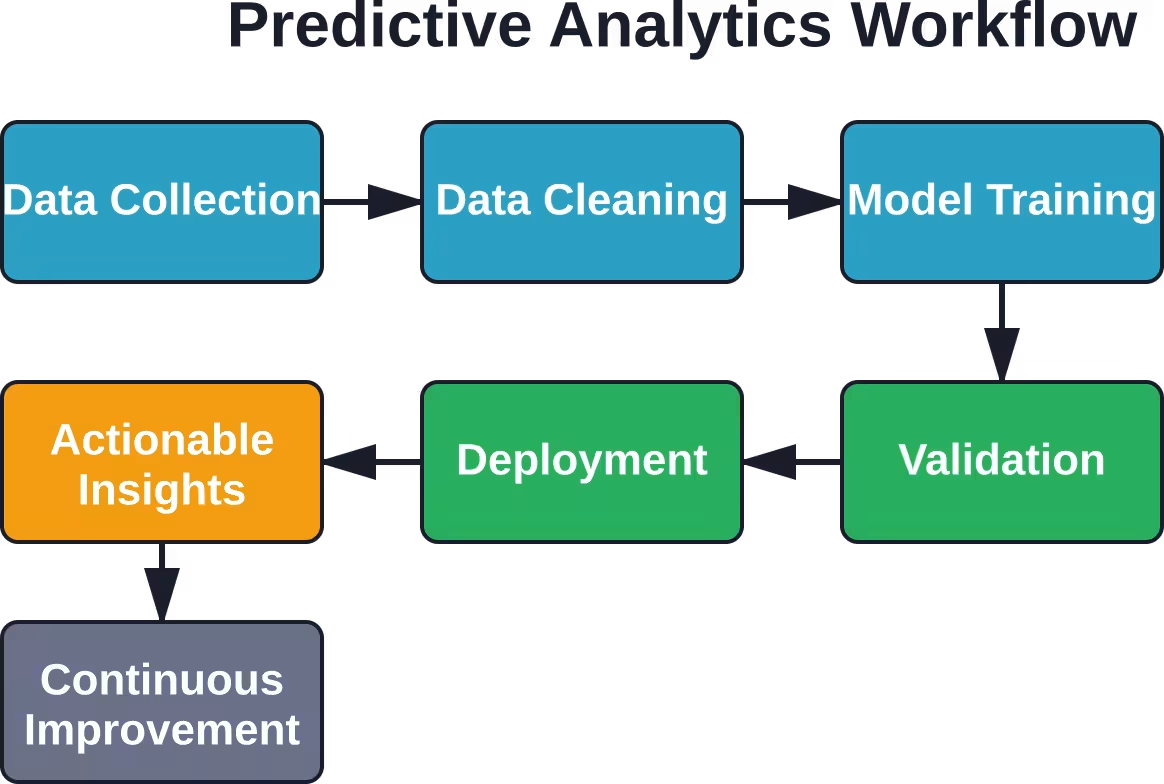
Continuous monitoring ensures models stay accurate. Customer preferences shift. Competitors launch promotions. Economic conditions change. Models require regular retraining with fresh data to maintain predictive power.
Key Use Cases That Drive Results
Retailers implement predictive analytics across multiple operational areas. Here are the applications delivering measurable impact.
Demand Forecasting and Inventory Optimization
Stockouts lose sales. Overstock ties up capital and leads to markdowns. Predictive models find the balance.
Retailers using predictive analytics have reported up to 30% reductions in both overstock and stockouts. Better forecasting means ordering the right quantity at the right time, reducing waste from unsold merchandise while ensuring popular items stay available.
Seasonal products present particular challenges. Fashion retailers must commit to orders months before selling seasons. Predictive analytics incorporates trend signals, historical sell-through rates, and early-season performance to adjust orders mid-season.
Fresh food retailers face even tighter windows. Predictive models account for weather forecasts, local events, and day-of-week patterns. A grocery store might find that although customers adopted home delivery during the pandemic, only 10% of fresh fish sales are happening through delivery — possibly indicating quality concerns or delivery timing issues that need addressing.
Customer Behavior Prediction and Personalization
Not all customers respond to the same messaging. Predictive analytics segments audiences based on purchase history, browsing behavior, and demographic attributes.
Academic research emphasizes that predictive models excel at handling large datasets and integrating diverse variables including demographic data, economic indicators, and consumer sentiment. These algorithms effectively forecast consumer product selection behavior, helping firms refine strategy.
Churn prediction identifies customers at risk of defecting to competitors. Models flag warning signs: declining purchase frequency, reduced basket sizes, longer gaps between visits. Retention campaigns target these individuals before they leave.
Lifetime value predictions prioritize high-value customers for special treatment. Why offer the same discount to someone who shops weekly versus someone who visits twice a year?
Product recommendation engines predict what each customer wants next. Based on past purchases and similar customer patterns, these systems suggest complementary items, increasing average order values.
Dynamic Pricing and Promotion Optimization
Price sensitivity varies by product, customer segment, and timing. Predictive models test countless scenarios to find optimal price points.
Promotion planning benefits enormously from analytics. Which products should be discounted? By how much? For how long? Models simulate outcomes before committing marketing budgets.
The promotional impact research showed dramatic improvements when external variables were included in forecasting models. Promotions don’t just boost sales during the discount period — they can shift purchasing patterns for weeks afterward. Predictive models capture these ripple effects.
Markdown optimization determines when to reduce prices on slow-moving inventory. Too early, and profit erodes unnecessarily. Too late, and merchandise moves to clearance at a loss. Analytics finds the timing sweet spot.
Workforce Planning and Scheduling
Labor costs represent a major expense. Understaffing frustrates customers and loses sales. Overstaffing wastes money.
Predictive models forecast foot traffic by hour, day, and location. Schedules align staff levels with predicted customer volume. Stores stay adequately staffed during rushes without paying idle employees during slow periods.
Seasonal hiring becomes more precise. Historical data shows exactly when holiday shopping peaks, informing recruitment timelines and training schedules.
Supply Chain Risk Management
Disruptions happen. Suppliers miss deliveries. Weather closes distribution centers. Predictive analytics identifies vulnerabilities before they cause stockouts.
Models monitor supplier performance, flagging reliability issues early. Alternative sourcing can be arranged before critical shortages develop.
Route optimization uses predicted demand at each location to plan efficient delivery schedules, reducing transportation costs while ensuring timely restocking.
Benefits Retailers Actually See
The value proposition extends beyond better forecasts. Implementation creates cascading improvements across operations.
| Benefit Area | Impact | Business Outcome |
|---|---|---|
| Inventory Efficiency | Up to 30% reduction in overstock and stockouts | Lower carrying costs, fewer markdowns, higher in-stock rates |
| Customer Experience | Personalized recommendations and availability | Increased satisfaction, loyalty, and repeat purchases |
| Operational Costs | Optimized labor scheduling and supply chain | Reduced waste, better resource allocation |
| Revenue Growth | Targeted promotions and pricing | Higher conversion rates, improved margins |
| Competitive Position | Faster response to market changes | Agility in product assortment and strategy |
Improved decision speed matters as much as accuracy. Traditional planning cycles involve lengthy committee reviews. Predictive systems provide real-time recommendations, enabling rapid response to emerging trends.
Data-driven cultures replace gut feelings with evidence. When analytics consistently outperforms intuition, organizations shift toward systematic decision-making.
But wait. Technology adoption doesn’t automatically improve worker situations. According to research on technology adoption and workforce impacts, studies show mixed results on worker skill changes, with some businesses reporting positive impacts while others report minimal changes overall. Technology adoption showed mixed employment impacts across businesses, with some reporting increases and others reporting decreases. The impact appears roughly neutral overall, contradicting both utopian and dystopian predictions.
Implementation Roadmap
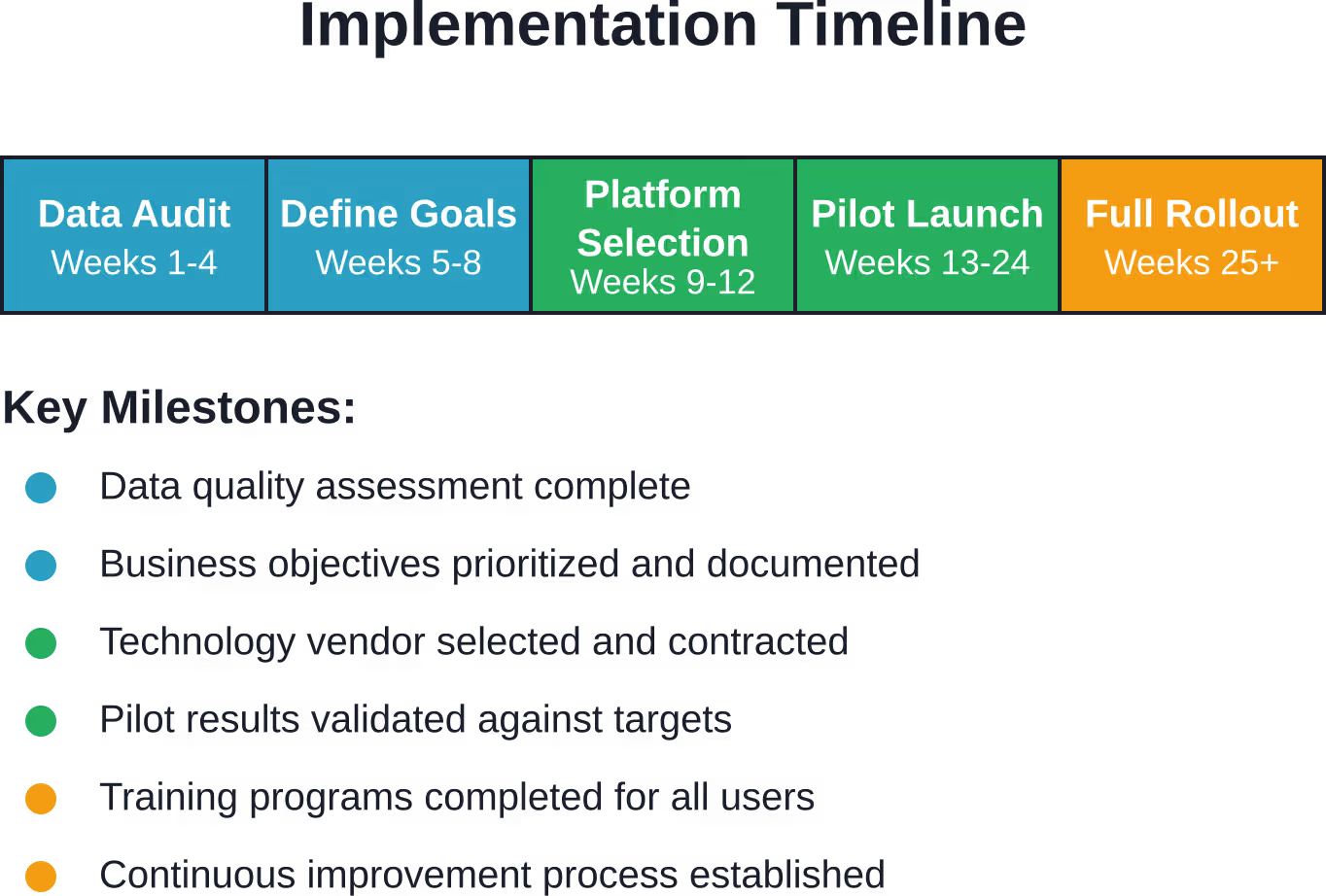
Rolling out predictive analytics requires planning. Successful implementations follow a structured approach.
Assess Current Data Infrastructure
Evaluate existing data sources. Are sales records complete and accurate? Can customer data be linked across channels? Do inventory systems provide real-time visibility?
Gaps in data quality or availability require remediation before advanced analytics deliver value. Garbage in, garbage out remains true regardless of algorithmic sophistication.
Define Business Objectives
Start with specific problems. “We want predictive analytics” isn’t a goal. “We need to reduce fresh produce waste by 20%” or “We want to improve seasonal inventory turnover” provide clear targets.
Prioritize use cases based on potential impact and feasibility. Tackle wins that build organizational confidence before attempting complex transformations.
Select Technology and Partners
Build versus buy decisions depend on internal capabilities and timeline urgency. Large retailers with data science teams may develop custom models. Smaller operations typically deploy commercial platforms.
Cloud-based solutions reduce infrastructure investment. Software-as-a-service models provide ongoing updates and support without dedicated maintenance teams.
Pilot Before Scaling
Test models in controlled environments. Apply demand forecasting to a single product category or geographic region. Measure results against traditional methods.
Pilots reveal integration challenges, data quality issues, and change management needs. Better to discover problems in a limited rollout than during enterprise-wide deployment.
Train Teams and Establish Governance
Employees need training on interpreting predictions and acting on recommendations. Analytics only creates value when insights drive different decisions.
Governance frameworks establish accountability. Who reviews model performance? How often are models retrained? What accuracy thresholds trigger intervention?

Get Predictive Models for Retail Demand and Inventory
Retail teams don’t struggle with lack of data – they struggle with using it in time. Sales history, inventory levels, and customer activity already exist, but without working models they stay as reports instead of inputs for planning. AI Superior develops custom AI software where predictive models are built around this data and applied to forecasting and operational decisions, rather than kept as separate analysis layers.
Use Predictive Analytics Where Retail Decisions Happen
AI Superior focuses on making predictions usable in practice:
- Build forecasting models using sales and inventory data
- Combine data from different retail systems
- Test models before wider rollout
- Apply predictions in planning and replenishment processes
- Update models as patterns and demand change
If forecasting still relies on static reports, talk to AI Superior and move to decisions based on predictive models.
Common Implementation Challenges
Obstacles arise in every deployment. Anticipating these issues accelerates resolution.
Data Silos and Quality Issues
Retail data lives in disconnected systems. Point-of-sale platforms don’t talk to e-commerce databases. Loyalty programs run on separate infrastructure. Supply chain visibility remains limited.
Integration projects consume significant time and resources. Data warehousing or data lake architectures centralize information, but building these platforms requires investment.
Quality varies wildly. Missing fields, inconsistent formats, and duplicate records plague most datasets. Cleaning requires both automated tools and manual review.
Organizational Resistance
Experienced buyers trust their intuition. Category managers defend established processes. Introducing algorithmic recommendations threatens perceived expertise.
Change management programs address cultural barriers. Demonstrating model accuracy builds trust. Positioning analytics as decision support rather than replacement reduces resistance.
Transparency helps. When merchandisers understand why models make specific recommendations, they’re more likely to accept guidance.
Skill Gaps
Data science expertise remains scarce. Retailers compete with tech companies for analytical talent.
Managed service providers offer an alternative to hiring full teams. External experts configure models and provide ongoing support while internal staff focus on business strategy.
Training existing employees in analytics concepts improves adoption even when they don’t build models themselves. Understanding the basics of statistical confidence and model limitations leads to better use of predictions.
Technology Costs and ROI Pressure
Initial investments can be substantial. Software licenses, infrastructure upgrades, consulting fees, and training costs accumulate quickly.
Building a business case requires realistic ROI projections. Conservative estimates based on pilot results prove more credible than optimistic vendor promises.
Phased deployments spread costs over time and demonstrate value incrementally. Each successful use case funds expansion to additional applications.
Future Trends Shaping Retail Analytics
The field continues evolving rapidly. Several developments will reshape capabilities over the next few years.
Real-time analytics closes the gap between data generation and action. Current systems often work with day-old data. Streaming analytics processes information instantly, enabling dynamic pricing adjustments or inventory alerts within minutes of changing conditions.
Computer vision adds visual data to predictive models. Cameras monitor shelf conditions, detecting stockouts or misplaced products. Facial recognition (where legally permitted) tracks shopper attention and emotional responses to displays.
Internet of Things sensors provide granular data. Smart shelves measure inventory levels continuously. RFID tags track individual items through the supply chain. Environmental sensors optimize fresh food storage conditions.
Natural language processing mines unstructured data from reviews, social media, and customer service interactions. Sentiment analysis identifies emerging issues or opportunities that structured data misses.
Collaborative filtering improves as data sharing increases. Retailers participating in industry benchmarking consortiums gain insights from aggregated patterns across companies while maintaining competitive privacy.
Frequently Asked Questions
What’s the difference between predictive analytics and business intelligence?
Business intelligence reports what happened — last quarter’s sales, inventory turns, customer counts. Predictive analytics forecasts what will happen — next month’s demand, which customers will churn, optimal price points. BI looks backward; predictive analytics looks forward. Both use data, but predictive models apply statistical techniques and machine learning to generate forecasts rather than just summarizing historical performance.
How much data do retailers need before predictive analytics becomes effective?
The minimum depends on the use case. Simple demand forecasting can work with one to two years of sales history. Customer behavior models benefit from longer timeframes capturing multiple purchase cycles. Generally, more data improves accuracy, but quality matters more than quantity. Clean, consistent data from six months outperforms messy records spanning five years. Start with available data and let models improve as history accumulates.
Can small retailers implement predictive analytics or is it only for large chains?
Small and mid-sized retailers absolutely can leverage predictive analytics. Cloud-based platforms eliminate infrastructure costs. Software-as-a-service models provide enterprise capabilities at accessible price points. Many solutions scale pricing to business size. The key is focusing on high-impact use cases — inventory optimization for your top-selling categories or targeted email campaigns for your best customers rather than trying to predict everything at once.
How accurate are predictive models in retail environments?
Accuracy varies by application and data quality. Demand forecasting for stable product categories often achieves 80-90% accuracy. New product launches or fashion items with limited history predict less reliably. The research cited earlier showed improvements ranging from 12.5% to 54% over baseline models when incorporating relevant variables. Perfect predictions don’t exist, but consistent improvement over current methods delivers substantial value. Regular model retraining maintains accuracy as conditions change.
What happens when predictions are wrong?
All models make errors. The question is whether they’re better than current methods. Retailers should establish confidence intervals around predictions and create contingency plans for outlier scenarios. When forecasts miss targets, post-mortems identify causes — was it data quality, model selection, or genuinely unpredictable events? These insights improve future performance. Treat predictions as guidance that informs decisions rather than infallible truth, and maintain operational flexibility to respond when reality diverges from forecasts.
How often do predictive models need updating?
Update frequency depends on how fast the underlying patterns change. Fast fashion retailers might retrain models weekly as trends shift. Grocery stores selling staple products can update monthly or quarterly. Seasonal businesses should retrain before each major selling period with the latest comparable data. Monitor prediction accuracy continuously — when error rates rise above acceptable thresholds, it’s time to retrain. Most implementations settle into monthly or quarterly refresh cycles with real-time monitoring in between.
Do retailers need a dedicated data science team?
Not necessarily. Managed analytics services and user-friendly platforms reduce the need for in-house expertise. Many retailers successfully deploy predictive analytics using vendor-provided models and external consulting support. That said, having someone who understands analytics concepts — even if they’re not building models from scratch — improves results significantly. This person translates business problems into analytical requirements and helps teams interpret predictions. The role is more translator than builder.
Taking the First Steps
Predictive analytics delivers competitive advantages, but only when properly implemented and actively used.
Start by identifying pain points where better predictions would improve decisions. Is inventory the biggest challenge? Customer retention? Pricing strategy? Focus initial efforts where impact will be most visible and measurable.
Assess current data capabilities honestly. Investing in analytics platforms before addressing fundamental data quality issues wastes resources. Sometimes the best first step is data governance improvement rather than algorithm deployment.
Look for quick wins that build organizational confidence. A successful pilot forecasting demand for one product category proves the concept and secures budget for broader initiatives.
The retailers thriving in 2026 don’t just collect data — they act on predictions derived from it. Markets move too fast for quarterly planning cycles and gut-feel decisions. Predictive analytics provides the intelligence infrastructure modern retail demands.
The technology is proven. The platforms are accessible. The question isn’t whether predictive analytics works in retail, but how quickly organizations can adopt it before competitors gain an insurmountable edge.
 English
  German
  Arabic
  French
  Dutch
Dutch  Spanish