
Quick Summary: Predictive analytics in logistics uses historical data, machine learning, and statistical algorithms to forecast future outcomes like demand patterns, shipping delays, and equipment failures. This technology enables logistics companies to optimize inventory levels, improve route planning, reduce costs, and proactively address supply chain disruptions before they impact operations.
The modern logistics sector faces unprecedented complexity. Global supply chains stretch across continents, customer expectations demand faster deliveries, and disruptions—from fuel price volatility to weather events—can derail operations in minutes.
That’s where predictive analytics steps in.
Rather than reacting to problems after they occur, logistics companies now forecast challenges days or weeks ahead. The U.S. Department of Transportation’s Volpe National Transportation Systems Center has highlighted how data analytics and machine learning are transforming mobility at every level, creating opportunities for greater safety and efficiency across the transportation enterprise.
Here’s what makes this transformation different: predictive analytics doesn’t just look backward at what happened. It projects forward, identifying patterns in massive datasets that humans would never spot.
What Is Predictive Analytics in Logistics?
Predictive analytics involves using statistical algorithms, machine learning techniques, and historical data to forecast future outcomes. In logistics specifically, this means analyzing shipping records, weather patterns, traffic data, equipment performance logs, and market trends to anticipate what’s coming next.
The process combines several elements working together. Historical data forms the foundation—years of shipping routes, delivery times, fuel consumption, and maintenance records. Statistical algorithms identify patterns within that data, spotting correlations between variables like seasonal demand spikes or weather-related delays.
Machine learning takes this further by continuously improving predictions as new data arrives. The algorithms learn which factors matter most for accurate forecasts and adjust their models accordingly.
Real-time data integration completes the picture. Modern systems don’t rely solely on past information; they incorporate live feeds from GPS trackers, traffic monitoring systems, weather services, and market pricing platforms.
Core Applications Transforming Logistics Operations
Several key areas demonstrate how predictive analytics reshapes day-to-day logistics work.
Demand Forecasting and Inventory Management
Predicting customer demand ranks among the most valuable applications. Instead of maintaining excessive safety stock or experiencing stockouts, companies forecast requirements with remarkable precision.
The algorithms analyze purchase history, seasonal patterns, economic indicators, social media trends, and promotional calendars. They identify subtle correlations—like how weather in one region impacts buying behavior weeks later in another market.
According to the Bureau of Labor Statistics, logisticians held 241,000 jobs in 2024, with 23% working in manufacturing where demand forecasting directly impacts production scheduling and inventory levels. These professionals increasingly rely on predictive models to balance stock levels against storage costs.
Better forecasting reduces waste, especially for perishable goods. It also optimizes warehouse space utilization and minimizes the capital tied up in excess inventory.
Route Optimization and Transportation Management
Transportation costs represent a massive expense for logistics operations. Predictive analytics optimizes routing by forecasting traffic patterns, weather conditions, road construction, and even driver availability.
UPS implemented a route optimization platform that recalculates delivery paths in real time, accounting for traffic conditions, pickup commitments, and new orders. This predictive capability has saved the company between $100 and $200 million annually while improving fuel efficiency and customer satisfaction.
The system considers variables most dispatchers couldn’t juggle simultaneously: historical traffic patterns for specific times and days, current weather impacting road conditions, vehicle capacity constraints, delivery time windows, and driver hours-of-service regulations.
For freight transportation, predictive models forecast shipping rates—a particularly complex challenge. According to MIT’s Center for Transportation Logistics, contract rates cover 80-95% of freight trucking volume and remain fixed over time, while spot rates from the secondary market typically run higher and fluctuate significantly.
Predictive Maintenance for Fleet and Equipment
Equipment failures cause expensive downtime and cascade delays throughout the supply chain. Predictive maintenance shifts from fixed schedules or reactive repairs to condition-based interventions.
Sensors monitor vehicle performance metrics—engine temperature, brake wear, tire pressure, transmission behavior, battery health. Machine learning models establish baselines for normal operation and flag anomalies indicating impending failures.
A trucking company might receive alerts that a specific vehicle’s transmission shows early warning signs, allowing scheduled maintenance during planned downtime rather than a breakdown on the highway. The same principles apply to warehouse equipment like forklifts, conveyor systems, and automated storage units.
This approach maximizes equipment uptime while minimizing maintenance costs. It also improves safety by catching potential failures before they create hazardous situations.
Risk Management and Disruption Mitigation
Supply chain disruptions come from countless sources: port congestion, customs delays, labor strikes, extreme weather, geopolitical events, supplier bankruptcies. Predictive analytics helps anticipate and prepare for these risks.
Systems monitor news feeds, weather forecasts, financial reports, and social media to identify emerging threats. When a hurricane forms in the Atlantic, the model predicts which ports will close, estimates duration, and recommends alternative routing before the storm makes landfall.
For companies operating global supply chains, this visibility proves invaluable. Maersk, which operates 14.6% of the global container shipping market, uses predictive analytics to navigate the complexities of international logistics, anticipating disruptions across its massive network.
Transportation emissions make up over 28% of the EU’s carbon footprint, making environmental risk another consideration. Predictive models help optimize routes not just for cost but also for emissions reduction, supporting sustainability goals while managing regulatory compliance risks.
Real-World Impact Across the Industry
The logistics sector isn’t experimenting with predictive analytics—it’s deploying it at scale. Several patterns emerge from successful implementations.
Large carriers and third-party logistics providers invest heavily in proprietary platforms. They combine internal operational data with external feeds to create comprehensive forecasting systems. The competitive advantage comes from superior predictions enabling better pricing, routing, and capacity utilization.
Mid-size operators increasingly adopt specialized software platforms rather than building in-house solutions. These tools democratize access to advanced analytics, allowing smaller players to compete more effectively.
According to Bureau of Labor Statistics data from May 2023, logisticians in different sectors earn varying wages reflecting the complexity and value of their analytical work. Those in Federal, State, and Local Government positions (33,010 employees) earn an annual mean wage of $99,460. Logisticians’ overall median annual wage was $79,400 in May 2023.
Implementation Challenges and Practical Considerations
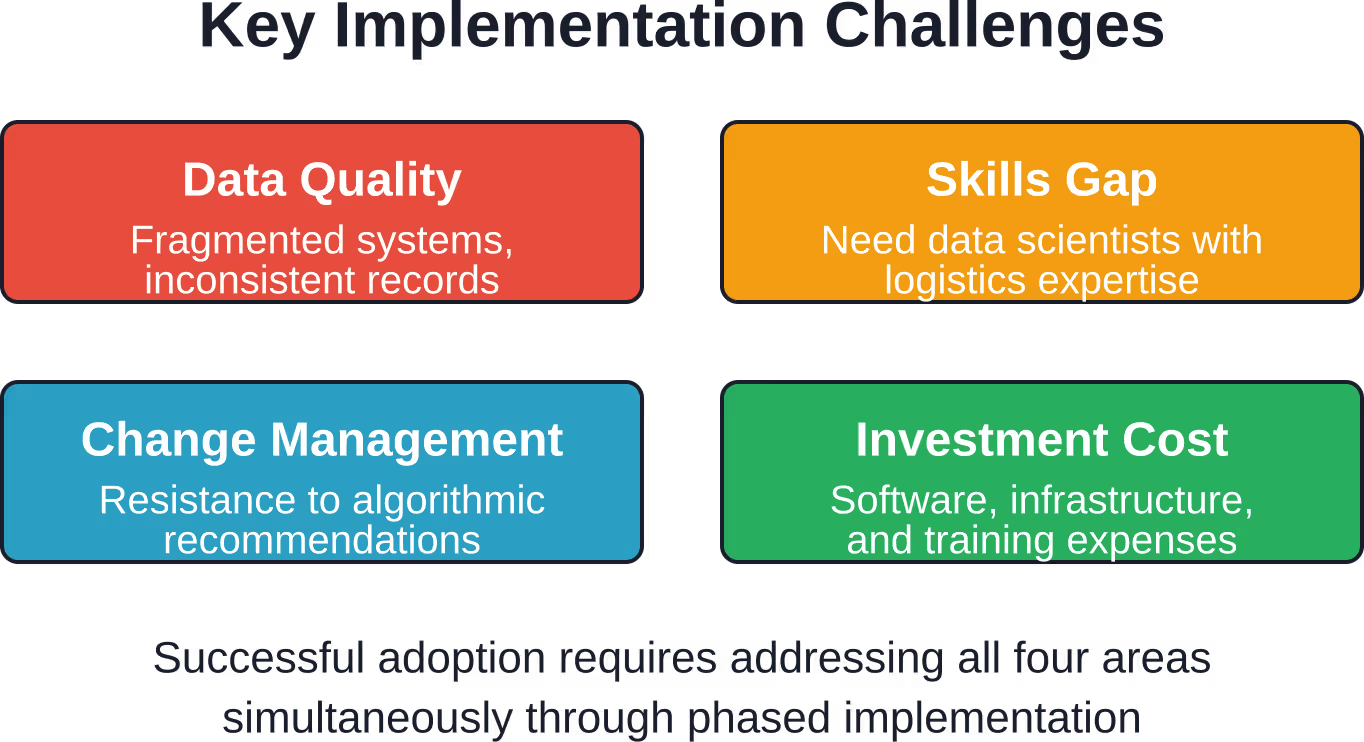
Despite proven benefits, adopting predictive analytics presents obstacles. Data quality issues top the list. Algorithms depend on accurate, consistent historical records. Many logistics operations have fragmented systems—separate databases for warehousing, transportation, inventory, and customer orders.
Integrating these disparate sources and cleaning inconsistent data requires significant effort. A shipment delayed by weather might be coded differently across systems, making pattern recognition difficult.
Skills gaps represent another barrier. Building and maintaining predictive models requires data scientists familiar with logistics operations. Finding professionals who understand both domains proves challenging. Industry reports suggest Python has become the dominant programming language for analytics work, used in 67-90% of analytics-related jobs.
Change management shouldn’t be underestimated either. Dispatchers and planners who’ve relied on experience and intuition for years may resist algorithmic recommendations. Successful implementations combine human expertise with machine predictions rather than replacing one with the other.
Cost considerations matter too. Enterprise-grade predictive analytics platforms require substantial investment in software, infrastructure, and training. Smaller operators must carefully evaluate return on investment.
The Role of Real-Time Data Integration
Historical analysis alone provides limited value in dynamic logistics environments. Real-time data integration transforms predictive models from interesting forecasts into actionable operational tools.
Modern logistics systems pull live feeds from multiple sources. GPS trackers provide vehicle locations and movement patterns. Traffic monitoring APIs deliver current congestion data and accident reports. Weather services supply radar imagery and severe weather alerts. Port authorities publish vessel arrival schedules and berth availability.
IoT sensors add another layer. Temperature monitors in refrigerated containers, weight sensors detecting cargo shifts, door sensors tracking loading dock activity—all generate continuous data streams.
The predictive models ingest these real-time inputs and update forecasts continuously. A route optimized at 6 AM might be recalculated by 9 AM based on developing traffic conditions. An inventory reorder point could adjust hourly based on actual sales velocity.
This responsiveness distinguishes modern predictive analytics from traditional forecasting. Static predictions made days in advance have limited utility when conditions change rapidly.
Industry-Specific Applications
Different logistics sectors emphasize different predictive analytics applications based on their unique challenges.
Last-Mile Delivery
E-commerce growth has made last-mile delivery both critical and expensive. Predictive analytics optimizes delivery windows, routes, and capacity allocation. Models forecast which delivery attempts will succeed on the first try versus requiring multiple visits, allowing more realistic customer communication.
Parcel density predictions help determine when a geographic area justifies dedicated routes versus contracted delivery services. Time-window forecasting balances customer convenience against operational efficiency.
Freight Forwarding
International freight forwarding involves complex multi-modal transportation with numerous handoff points. Predictive analytics forecasts customs clearance times, identifies high-risk shipments likely to face inspections, and recommends optimal carrier combinations.
Port congestion predictions prove particularly valuable. When models indicate a specific port will face delays, freight forwarders reroute shipments through alternatives before containers arrive.
Warehousing and Distribution
Warehouse operations use predictive analytics for labor planning, space optimization, and order fulfillment prioritization. Models forecast daily order volumes, allowing appropriate staffing levels. They predict which inventory will move quickly versus sitting in storage, informing slotting decisions.
Pick path optimization reduces travel distance for order fulfillment. The algorithms learn patterns in product combinations frequently ordered together and arrange storage accordingly.
Future Trajectories
Several trends shape the evolution of predictive analytics in logistics.
Artificial intelligence capabilities continue advancing. Neural networks now recognize complex non-linear patterns humans couldn’t identify. These models handle increasing numbers of variables simultaneously, capturing subtle interactions affecting outcomes.
Edge computing brings analytics closer to data sources. Rather than sending all sensor data to central servers for processing, edge devices perform initial analysis locally. This reduces latency and bandwidth requirements while enabling faster responses.
Collaborative forecasting platforms emerge where supply chain partners share predictions. A manufacturer’s production forecast feeds into a carrier’s capacity planning, which informs a warehouse’s labor scheduling. These interconnected predictions reduce the bullwhip effect that amplifies demand variation through supply chains.
Sustainability metrics gain prominence. Predictive models increasingly optimize for carbon emissions alongside traditional cost and service metrics. Regulatory requirements and customer expectations drive this expansion.
According to Bureau of Labor Statistics projections, employment of transportation, storage, and distribution managers (216,700 jobs in 2024) is projected to grow 6% from 2024-2034, with approximately 13,100 employment changes over the decade. This growth reflects the increasing complexity of logistics operations and the need for professionals who can leverage predictive analytics tools effectively.
| Technology Trend | Impact on Predictive Analytics | Timeline |
|---|---|---|
| Advanced AI/Neural Networks | Recognition of complex non-linear patterns across hundreds of variables | Currently deployed |
| Edge Computing | Real-time analytics at data source, reduced latency for time-critical decisions | Expanding adoption |
| Collaborative Platforms | Shared predictions across supply chain partners, reduced bullwhip effect | Early implementation |
| Sustainability Integration | Multi-objective optimization balancing cost, service, and emissions | Regulatory-driven growth |
Getting Started with Predictive Analytics
Organizations beginning their predictive analytics journey should follow a phased approach. Starting with a well-defined pilot project focusing on a specific problem delivers quick wins that build organizational support.
Demand forecasting for a single product category or route optimization for a specific region work well as initial projects. These limited scopes allow testing models and refining approaches without enterprise-wide commitments.
Data infrastructure assessment comes next. Identify what historical data exists, where it lives, and what quality issues need addressing. This groundwork determines whether building custom models or adopting commercial platforms makes more sense.
Skills development matters just as much as technology. Training existing logistics professionals in analytics concepts creates internal champions who understand both domains. Hiring specialists fills specific gaps but shouldn’t replace developing organizational capability.
Vendor selection requires careful evaluation. Some platforms focus narrowly on specific applications like route optimization or inventory forecasting. Others offer broader suites covering multiple logistics functions. Matching capabilities to actual needs prevents paying for unused features.
Integration capabilities determine practical value. A predictive analytics platform that doesn’t connect with existing warehouse management, transportation management, and ERP systems forces manual data transfers that undermine benefits.

Get Predictive Models for Logistics Decisions
A shipment delay rarely looks serious at the start. One late vehicle or missed window can quietly shift the entire schedule, but most teams only react once the impact is already visible.
AI Superior develops custom AI software where predictive models are used with logistics data to support planning and operational decisions. This includes demand forecasting and anticipating delays using data that already exists in supply chain systems.
Put Predictions Where Logistics Decisions Actually Happen
Instead of keeping analytics separate, AI Superior focuses on applying predictive models directly in day-to-day workflows. Models are used alongside existing data to support routing, delivery planning, and ongoing operational decisions, with updates as conditions and data change.
👉Talk to AI Superior if you want predictive models to support logistics decisions before issues start affecting delivery timelines.
Frequently Asked Questions
What’s the difference between predictive analytics and traditional forecasting?
Traditional forecasting typically uses simple statistical methods like moving averages or linear regression on limited variables. Predictive analytics employs machine learning algorithms that analyze dozens or hundreds of variables simultaneously, identify complex patterns, and continuously improve as new data arrives. It also integrates real-time data for dynamic updating rather than generating static forecasts.
How much historical data is needed for accurate predictions?
Requirements vary by application, but generally at least two years of clean historical data provides sufficient patterns for initial models. More data improves accuracy, particularly for capturing seasonal variations and rare events. However, data quality matters more than quantity—one year of accurate, consistent records outperforms five years of fragmented, error-filled data.
Can small logistics companies benefit from predictive analytics?
Absolutely. While large enterprises build custom solutions, small and mid-size operators increasingly access sophisticated analytics through cloud-based platforms offered at subscription pricing. These tools democratize capabilities that were previously available only to major players. The key is selecting focused applications that address specific pain points rather than attempting comprehensive implementation.
What ROI should companies expect from predictive analytics investments?
ROI varies significantly based on application and implementation quality. Route optimization typically delivers 5-15% reductions in fuel costs and 10-20% improvements in on-time delivery. Inventory optimization commonly reduces carrying costs by 10-25% while decreasing stockouts. Predictive maintenance extends equipment life by 20-40% while cutting maintenance costs 10-30%. Companies like UPS have documented annual savings exceeding $100 million from comprehensive implementations.
How do predictive models handle unexpected disruptions like the pandemic?
Models trained on historical patterns initially struggle with unprecedented events that lack historical precedent. However, systems that incorporate real-time data adapt relatively quickly as new patterns emerge. The key is human oversight—analytics should augment rather than replace human judgment during extraordinary circumstances. Advanced systems now include scenario planning capabilities that stress-test predictions against various disruption types.
What skills do logistics professionals need to work with predictive analytics?
Professionals working alongside predictive systems need statistical literacy to interpret model outputs, understanding of data quality principles, and critical thinking to question unreasonable predictions. They don’t necessarily need programming skills or deep mathematical knowledge. Data scientists building the models require programming expertise (Python dominates with 67-90% usage in analytics roles), statistical knowledge, and crucially, understanding of logistics operations to ensure models address real business problems.
How does predictive analytics support sustainability goals?
Predictive models optimize routes to minimize fuel consumption and emissions, which is significant given that transportation emissions represent over 28% of the EU’s carbon footprint. They improve load consolidation to reduce empty miles, optimize inventory levels to decrease waste from obsolescence and spoilage, and predict optimal maintenance timing to extend equipment life. Many modern systems now include emissions metrics as optimization objectives alongside traditional cost and service targets.
Moving Forward
Predictive analytics has moved from experimental technology to operational necessity in logistics. The companies leveraging it most effectively treat it not as a standalone system but as an integrated capability touching every aspect of operations.
Success requires three elements working together: quality data infrastructure capturing comprehensive operational history, analytical tools that transform data into actionable predictions, and organizational capabilities to act on those insights effectively.
The logistics industry continues evolving rapidly. E-commerce demands faster delivery. Customers expect real-time shipment visibility. Sustainability pressures mount. Labor shortages persist. Geopolitical uncertainties create supply chain volatility.
Predictive analytics provides the visibility and foresight needed to navigate these challenges. It won’t eliminate uncertainty—logistics will always involve unpredictable elements. But it dramatically reduces blind spots and enables proactive rather than reactive management.
For organizations not yet using predictive analytics, the question isn’t whether to adopt but how quickly to begin. The competitive advantages and operational efficiencies prove too significant to ignore. Start with focused pilots addressing specific pain points, build organizational capability gradually, and scale based on demonstrated results.
The future of logistics belongs to companies that can see what’s coming and adjust before it arrives.
 English
  German
  Arabic
  French
  Dutch
Dutch  Spanish