
Quick Summary: Predictive analytics in sales uses historical data, machine learning algorithms, and statistical models to forecast future outcomes—from revenue projections to customer behavior. It helps sales teams prioritize high-value opportunities, optimize resource allocation, and make data-driven decisions that boost performance and profitability.
Sales leaders have always wanted to predict the future. Which deals will close? What revenue will the quarter bring? Which customers are about to churn?
The difference now? Predictive analytics can actually answer those questions with remarkable accuracy.
Instead of relying on gut feeling or static spreadsheets, modern sales organizations leverage algorithms, machine learning, and vast data sets to forecast outcomes before they happen. And the results aren’t theoretical—academic research from Stanford shows that productivity can be up to $918,000 higher in organizations that use predictive analytics effectively, compared to similar competitors.
But here’s the catch: not every company sees those gains. Success depends on combining the right technology with skilled teams, quality data, and strategic implementation.
This guide walks through what predictive analytics in sales actually is, how it works, where it delivers measurable ROI, and how to avoid the common pitfalls that cause some implementations to fail.
What Predictive Analytics in Sales Actually Means
Predictive sales analytics uses algorithms, patterns in historical data, and machine learning to anticipate future outcomes as they relate to sales. It goes beyond reporting what happened last quarter—it forecasts what’s likely to happen next quarter, next month, or even next week.
The foundation is data. Customer interactions, purchase history, deal stage progression, email open rates, demographic information, seasonal trends, competitive activity—all of it feeds into models that identify patterns invisible to the human eye.
Machine learning algorithms then analyze those patterns to generate probabilistic forecasts. They can predict which leads are most likely to convert, which existing customers might buy additional products, which deals are at risk of stalling, and which sales tactics tend to work best in specific scenarios.
Four Types of Sales Analytics
Sales analytics generally falls into four categories, each answering a different question:
| Analytics Type | Time Focus | Key Question | Primary Use |
|---|---|---|---|
| Descriptive Analytics | Past | What happened? | Performance reporting |
| Diagnostic Analytics | Past | Why did it happen? | Root cause analysis |
| Predictive Analytics | Future | What will happen? | Forecasting outcomes |
| Prescriptive Analytics | Future | What should we do? | Action recommendations |
Descriptive and diagnostic analytics look backward. They tell you your close rate dropped 12% last month and help you understand why—maybe your top rep left, or a competitor launched an aggressive promotion.
Predictive analytics shifts the focus forward. It tells you which of the 47 deals in your pipeline are most likely to close this quarter, and which prospects in your marketing database are ready to buy.
Prescriptive analytics takes it one step further, recommending specific actions: “prioritize these five accounts,” or “increase outreach frequency to this segment.”
How Predictive Analytics Works in Practice
The mechanics start with data collection. Sales CRMs, marketing automation platforms, customer support tickets, website behavior, transaction histories, and external data sources all contribute.
That data gets cleaned and structured—duplicates removed, formats standardized, missing values handled. Then feature engineering begins: the process of identifying which variables (features) matter most for predictions.
For example, variables might include deal size, days since last contact, number of stakeholders involved, industry vertical, past purchase frequency, email engagement scores, and competitive mentions in conversation transcripts.
Machine learning models—regression algorithms, decision trees, neural networks, ensemble methods—train on historical data to learn which combinations of features correlate with successful outcomes. The model then applies those learned patterns to current data to generate predictions.
No predictive model is 100% accurate. But they’re generally more reliable than human intuition alone, especially when processing hundreds or thousands of data points simultaneously.
Real-World Impact: The ROI Numbers
Academic research analyzing retail predictive analytics implementations found concrete improvements. One study examining sales forecasting in an emerging market retailer documented a 17.8% decline in inventory costs and a 15.4% reduction in stockouts when using LSTM (Long Short-Term Memory) predictive models.
The same research showed a 9.5% increase in ROI through the investment in predictive analytics infrastructure. Forecast error rates dropped dramatically—by 50% for top-selling products and 33.5% for the highest revenue products when using ensemble models compared to traditional statistical methods.
Stanford research examining over 30,000 American manufacturing establishments found that productivity gains from predictive analytics can reach up to $918,000 in higher sales compared to similar competitors. But here’s the critical qualifier: those gains only materialized when predictive analytics combined with at least one of three workplace complements—significant IT capital investment, educated workers, or workplaces designed for high-efficiency production.
Organizations that deployed predictive analytics without those supporting factors saw little to no benefit.
Personalization Pays Off
Customer targeting accuracy matters enormously. Research from Harvard Extension School shows that 78% of customers would be more likely to make future purchases if given offers targeted to their interests, wants, or needs.
Research shows significant variance in campaign performance across different creative approaches and messaging strategies. Predictive analytics helps identify which customers respond to which messages, enabling that kind of precision at scale.
Key Applications in Sales Organizations
Sales Forecasting Accuracy
Traditional forecasting relies on rep intuition and static historical averages. Predictive models incorporate dozens of variables simultaneously—deal velocity, contact frequency, stakeholder engagement, competitive activity, seasonal patterns, and historical close rates segmented by dozens of attributes.
The result? Revenue projections that account for nuanced factors human forecasters can’t realistically process manually.
Lead Scoring and Prioritization
Not all leads are created equal. Predictive lead scoring assigns probability scores to prospects based on attributes and behaviors that historically correlate with conversion.
A B2B lead from a company with 500 employees in the technology sector, who attended a webinar, downloaded two whitepapers, and visited the pricing page three times might score 87/100. Another lead from a 20-person retail company who only filled out a contact form might score 23/100.
Reps focus energy where it’s most likely to pay off.
Churn Prediction and Retention
Predictive models analyze usage patterns, support ticket frequency, payment delays, contract renewal timing, engagement drop-offs, and competitive research signals to flag customers at high risk of churning.
Early warning allows intervention—personalized outreach, special offers, product training, or executive engagement—before the customer makes a decision to leave.
Upsell and Cross-Sell Opportunities
Pattern recognition identifies which customers are likely candidates for additional products. If historical data shows that 30% of customers who buy product A return to buy product B within a month, predictive models can flag current product A customers who match that profile but haven’t yet purchased product B.
Bundling strategies, targeted campaigns, and sales outreach become more precise.
Sales Team Performance Optimization
Predictive analytics surface which tactics correlate with success. Do deals progress faster when reps conduct demos within 48 hours of first contact? Do proposals with video walkthroughs close at higher rates? Does multi-threading to three or more stakeholders increase win probability?
Data-driven coaching replaces guesswork.
Industry Examples That Illustrate the Power
Retail giants leverage predictive analytics extensively. Amazon attributes a significant portion of revenue to personalized recommendations—reports indicate that 35% of Amazon’s sales come from those recommendations, and customers who engage with them are 4.5 times more likely to add items to their cart.
In healthcare, predictive analytics help optimize patient outreach. One large health system used machine learning to predict which patients were likely to miss appointments, enabling targeted reminder campaigns that improved show rates and reduced wasted clinical capacity.
Financial services firms apply predictive models to cross-sell products. By analyzing transaction patterns, life events, and engagement signals, banks can predict when customers are likely to need mortgages, investment services, or insurance products.
Manufacturing sales teams use demand forecasting to align production capacity with expected orders, reducing both overproduction waste and stockout lost sales.
Choosing the Right Predictive Analytics Approach
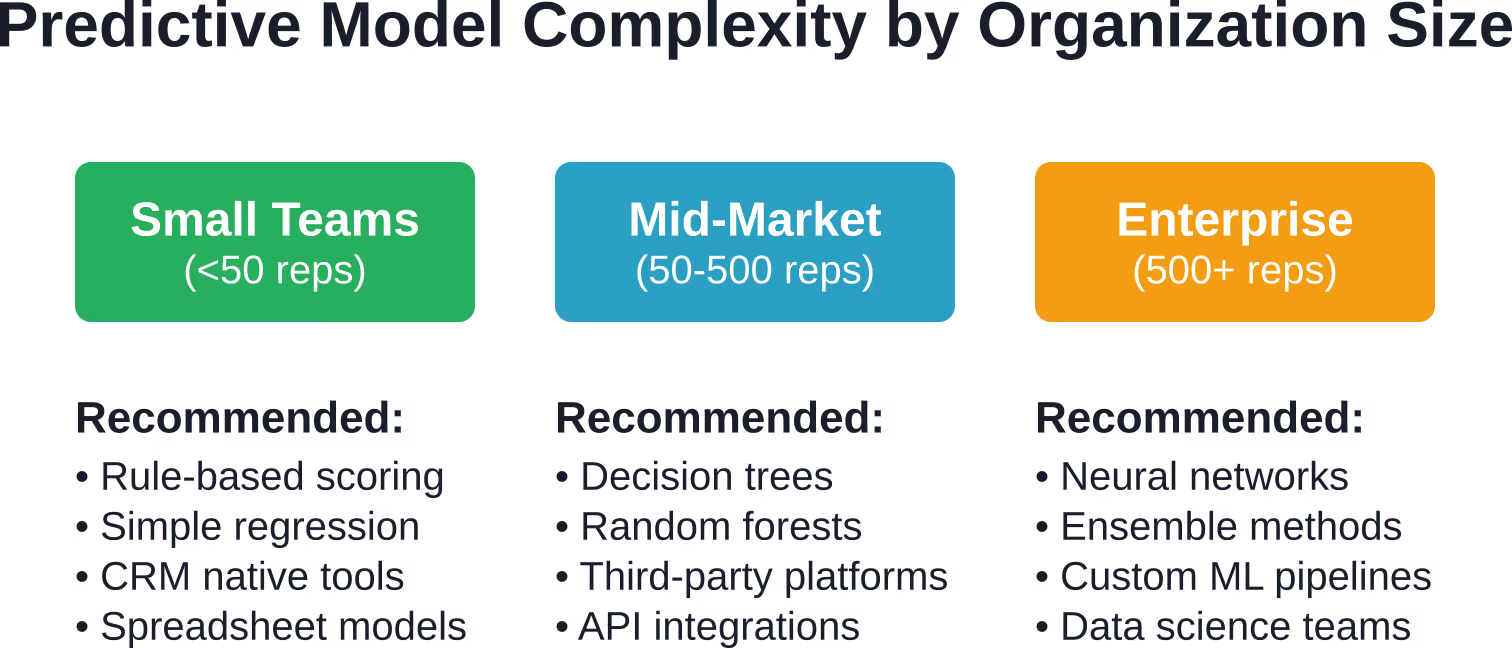
Not every organization needs the same level of sophistication. Small sales teams with limited data might start with simple regression models and rule-based scoring. Large enterprises with millions of customer records can deploy deep learning neural networks.
Data Quality Matters More Than Algorithms
The most sophisticated algorithm can’t compensate for poor data. Garbage in, garbage out remains the fundamental rule.
High-quality data is accurate, complete, consistent, timely, and relevant. If half your CRM records have missing fields, if contact information is six months stale, if reps log activities inconsistently, predictions will be unreliable.
Data hygiene needs to be a continuous process, not a one-time cleanup project.
Integration with Existing Systems
Predictive analytics tools need to connect seamlessly with CRMs, marketing automation platforms, customer support systems, and business intelligence dashboards. Friction in data flow undermines adoption.
Look for solutions with pre-built connectors for common platforms. API availability matters for custom integrations.
Interpretability vs. Accuracy Trade-offs
Black-box models (deep neural networks) can achieve higher accuracy but offer little insight into why a prediction was made. Simpler models (logistic regression, decision trees) are more interpretable—you can see which factors drove a score.
For regulatory environments or situations requiring human oversight, interpretability often trumps marginal accuracy gains.
Common Implementation Pitfalls to Avoid
Many organizations deploy predictive analytics expecting immediate transformation and become frustrated when results disappoint. Here’s what typically goes wrong:
Deploying Technology Without Process Changes
Installing software doesn’t change outcomes. If reps continue following the same routines and ignoring model recommendations, nothing improves.
Successful implementations pair technology with process redesign, training, incentive alignment, and cultural shifts toward data-driven decision-making.
Ignoring the Need for Complementary Capabilities
Remember the Stanford research finding: productivity gains only occur when predictive analytics combine with IT capital, educated workers, or efficient workflows.
Organizations need analytical talent who understand both the models and the business context. They need clean data infrastructure. They need workflows that incorporate predictions into daily activity.
Overfitting Models to Historical Quirks
Models trained too narrowly on past data can learn patterns that don’t generalize. If your historical data includes an unusual market disruption or one-time campaign that won’t repeat, the model might weight those factors incorrectly.
Regular retraining and validation against hold-out data sets help prevent this.
Failing to Monitor Model Drift
Markets change. Customer behaviors evolve. Competitive dynamics shift. A model trained on 2024 data might perform poorly in 2026 if conditions have changed.
Continuous monitoring of model performance and periodic retraining keeps predictions accurate.
The Human Element Still Matters
Predictive analytics augments human judgment—it doesn’t replace it. Reps with deep relationship knowledge, nuanced understanding of customer politics, and contextual awareness of market shifts bring value models that can’t replicate.
The best implementations combine machine precision with human intuition. Models flag the deals most likely to close. Reps assess whether the timing is right or if a stakeholder change warrants waiting. Models identify at-risk customers. Account managers decide whether the issue requires technical support, pricing adjustments, or executive engagement.
Think of predictive analytics as a force multiplier, not a substitute for skilled sales professionals.
Getting Started: A Practical Roadmap
Organizations new to predictive analytics don’t need to deploy enterprise-scale machine learning infrastructure on day one. A phased approach works better.
Phase One: Data Foundation
Start with data quality. Audit CRM completeness, standardize data entry, implement validation rules, establish governance policies.
Even basic analytics depend on clean data.
Phase Two: Simple Models
Begin with straightforward applications—rule-based lead scoring, historical trend forecasting, cohort analysis.
These don’t require specialized algorithms but deliver value and build organizational comfort with data-driven approaches.
Phase Three: Machine Learning
Once data infrastructure is solid and teams understand analytics workflows, introduce supervised learning models. Start with one high-impact use case—deal close probability or customer churn prediction.
Measure results, refine the model, and expand to additional applications as confidence grows.
Phase Four: Advanced Capabilities
Mature implementations incorporate natural language processing to analyze call transcripts, sentiment analysis on customer communications, reinforcement learning for dynamic pricing, and real-time recommendation engines.
This phase requires dedicated data science resources and significant technical investment.

Get Predictable Revenue Forecasts Based on Your Sales Data
If your sales forecasts change every month, you don’t have a system. AI Superior builds predictive models using your CRM, pipeline, and customer data to forecast revenue, identify deal risks, and show where growth actually comes from.
Build Sales Forecasting Models That Reflect How Your Pipeline Works
AI Superior develops predictive systems tailored to your sales process and integrates them into your existing tools. What you get:
- Revenue forecasts based on real pipeline and customer behavior
- Early signals of deal drop-offs and conversion risks
- Lead scoring and prioritization based on data, not assumptions
- Integration into CRM and reporting workflows with validation
If you want sales forecasts you can plan around, contact AI Superior and go through your case.
Frequently Asked Questions
What is predictive analytics in sales?
Predictive analytics in sales uses historical data, statistical algorithms, and machine learning to forecast future sales outcomes. It helps identify which leads are most likely to convert, which deals will close, which customers might churn, and what revenue to expect in coming periods. The approach combines multiple data sources—CRM records, customer interactions, purchase history, behavioral signals—to generate probability-based predictions that guide sales strategy and resource allocation.
How accurate are predictive sales forecasts?
Accuracy varies based on data quality, model sophistication, and market stability. Academic research documented forecast error reductions of 50% for top-selling products and 33.5% for highest revenue products when using ensemble models versus traditional statistical methods. While predictive models are never 100% accurate, they consistently outperform human intuition alone when properly implemented. Regular model retraining and monitoring help maintain accuracy as conditions change.
Do small sales teams benefit from predictive analytics?
Yes, though the approach differs from enterprise implementations. Small teams often start with rule-based scoring, simple regression models, and CRM-native analytics tools rather than custom machine learning pipelines. The key is having clean data and well-defined processes. Even basic predictive models help prioritize leads, forecast revenue more accurately, and identify which activities correlate with success. Start simple, measure results, and scale complexity as data volume and analytical maturity grow.
What data is needed for sales predictive analytics?
Essential data includes customer demographics, purchase history, deal stage progression, contact frequency, email engagement, website behavior, product usage patterns, support ticket volume, and transaction values. External data like industry trends, economic indicators, and competitive intelligence can enhance predictions. Data quality matters more than volume—accurate, complete, consistent records from 500 customers outperform messy data from 50,000. Focus first on capturing clean data for core variables, then expand to additional sources.
How long does it take to see ROI from predictive analytics?
Implementation timelines vary. Organizations with strong data foundations and simple use cases (rule-based lead scoring, basic forecasting) can see initial results in 1-3 months. More complex machine learning implementations requiring data infrastructure buildout, model development, and process changes typically need 6-12 months before delivering measurable ROI. Research documented a 9.5% ROI increase through predictive analytics investment in retail, with inventory cost reductions of 17.8% and stockout improvements of 15.4%. Success requires pairing technology with complementary capabilities like skilled workers and efficient processes.
Can predictive analytics replace sales managers?
No. Predictive analytics augments human judgment but doesn’t replace the relationship skills, contextual understanding, negotiation expertise, and strategic thinking that effective sales managers provide. Models excel at processing large data sets to identify patterns and generate forecasts. Managers excel at interpreting nuanced customer signals, navigating complex organizational politics, coaching reps through challenging situations, and adapting strategy to market shifts. The most successful implementations combine machine precision with human insight—models surface opportunities and risks, managers decide how to act on them.
What’s the difference between predictive and prescriptive analytics?
Predictive analytics answers “what will happen?” by forecasting future outcomes based on historical patterns. It tells you which deals are likely to close, what revenue to expect, which customers might churn. Prescriptive analytics goes further to answer “what should we do?” by recommending specific actions. It tells you to prioritize these five accounts, increase outreach to this segment, adjust pricing on these products, or allocate more resources to that territory. Prescriptive builds on predictive—you need forecasts before you can optimize decisions. Most organizations start with predictive capabilities and gradually incorporate prescriptive recommendations as analytical maturity increases.
Looking Forward: The Evolution Continues
Predictive analytics in sales will only become more sophisticated as technology advances and data volumes grow.
Natural language processing improves, enabling richer analysis of unstructured data—call recordings, email threads, chat transcripts, social media mentions. Real-time data streams allow models to adjust predictions dynamically as new information arrives. Integration of external data sources—economic indicators, social trends, news sentiment—adds contextual depth.
But the fundamentals remain constant. Quality data, appropriate models, skilled teams, and processes that act on insights determine success. Organizations that combine those elements will continue to outperform competitors relying on intuition alone.
The U.S. Bureau of Labor Statistics projects total employment to grow from 170.0 million in 2024 to 175.2 million in 2034, an increase of 3.1 percent, which is slower than the 13.0-percent employment growth recorded over the 2014–24 decade. Sales roles will evolve as predictive analytics automates routine forecasting and lead scoring tasks, freeing professionals to focus on relationship building, strategic account planning, and complex negotiations.
The sales teams that thrive will be those that embrace data-driven approaches while maintaining the human skills that build trust and close deals.
Final Thoughts
Predictive analytics transforms sales from reactive guesswork to proactive strategy. It surfaces opportunities earlier, flags risks sooner, and allocates resources more efficiently.
But success isn’t automatic. Technology alone doesn’t deliver results. Organizations need clean data, analytical skills, process redesign, and cultural willingness to trust data over gut feeling.
Start with a clear use case—lead scoring, churn prediction, revenue forecasting—and build from there. Measure results rigorously. Iterate based on what works.
The organizations that master predictive analytics in sales won’t just forecast the future more accurately. They’ll shape it—by making better decisions, faster, at scale.
Ready to move beyond spreadsheets and gut feeling? The data is already there. The algorithms are proven. The question is whether your organization will use them.
 English
  German
  Arabic
  French
  Dutch
Dutch  Spanish