
Quick Summary: Predictive analytics in risk management uses machine learning, statistical algorithms, and historical data to forecast potential risks before they materialize. Organizations across finance, supply chain, and compliance sectors are shifting from reactive to proactive risk strategies, enabling them to identify vulnerabilities, optimize resource allocation, and prevent costly disruptions through real-time data-driven insights.
Traditional risk management has always looked backward, analyzing past incidents to build defenses. But here’s the thing—by the time historical data reveals a pattern, the damage is often done.
Predictive analytics flips that script entirely. Instead of waiting for risks to surface, organizations now forecast potential threats using machine learning, statistical models, and decades of historical data. The shift from reactive to proactive isn’t just incremental improvement. It’s a fundamental change in how companies protect assets, reputation, and long-term viability.
As global risks grow in complexity—from supply chain disruptions to regulatory changes and cyber threats—predictive analytics has become essential infrastructure for modern risk management programs.
What Makes Predictive Analytics Different From Traditional Risk Management
Traditional risk management relies on backward-looking analysis. Teams review incident reports, audit findings, and compliance violations, then build controls around what already happened.
Predictive analytics operates differently. It ingests historical data, identifies patterns, and runs statistical models to forecast what might happen next. Machine learning algorithms continuously refine these predictions as new data flows in, creating a dynamic risk assessment that updates in real time.
According to industry analyses, all models—even forward-looking ones—must be supported by historical data to have any validity. The difference isn’t whether you use historical data; it’s how you apply it. Predictive models look for leading indicators and correlations that humans might miss, transforming raw data into actionable forecasts.
The approach allows risk functions to input decades of historic data, run predictive models, and predict risk exposures and costs with greater accuracy than static frameworks allow.
Core Applications Across Industries
Financial Services and Credit Risk
Financial institutions have been early adopters, using predictive analytics to assess credit risk, detect fraud, and ensure regulatory compliance.
Credit risk modeling demonstrates the power clearly. Under standard modeling tools, a prospective borrower might show an estimated probability of default (PD) of 20%. But models using broader risk drivers can reduce that estimate to around 5% by incorporating variables traditional methods overlook. That difference transforms lending decisions and capital allocation.
Fraud detection systems now analyze transaction patterns in real time, flagging anomalies before losses occur. Compliance teams use predictive models to identify potential regulatory breaches before regulators do, shifting from reactive penalties to proactive prevention.
Supply Chain Resilience
Supply chain disruptions can cause massive financial losses and undermine company reputation. Predictive analytics enhances supply chain resilience by identifying vulnerabilities before they cascade into full crises.
Models analyze supplier financial health, geopolitical risks, weather patterns, and logistics data to forecast potential interruptions. When a supplier shows early warning signs—deteriorating financials, delayed shipments, regulatory scrutiny—predictive systems alert risk teams to diversify sources or build inventory buffers.
The ISO 31000 standard provides a systematic framework for supply chain risk management, and predictive analytics tools integrate naturally with that structure, automating risk identification and assessment phases that previously required manual analysis.
Regulatory Compliance and Data Analytics Conflicts
The Securities and Exchange Commission proposed new requirements on July 26, 2023 to address conflicts of interest associated with the use of predictive data analytics by broker-dealers and investment advisers. These proposed rules were formally withdrawn by the SEC on June 12, 2025, but the regulatory attention highlights an important reality: predictive analytics introduces new compliance considerations even as it solves old problems.
Firms using predictive models must ensure those systems don’t create conflicts that disadvantage investors. Compliance teams now monitor analytics systems themselves, auditing algorithms for bias, transparency, and alignment with fiduciary duties.

Use Predictive Analytics with AI Superior
AI Superior works with companies that need predictive models for risk assessment and decision support. The focus is on building systems that can process data continuously and support real-time decisions.
They begin with feasibility analysis, develop a working model, and integrate it into operational workflows.
Looking to Apply Predictive Analytics in Risk Management?
AI Superior can help with:
- assessing risk-related data
- building predictive models
- integrating models into existing systems
- refining outputs based on usage
👉 Contact AI Superior to discuss your project, data, and implementation approach
Predictive vs. Prescriptive Analytics: Understanding the Difference
Predictive analytics identifies potential risks. Prescriptive analytics provides actionable insights on what to do about them.
Think of predictive analytics as the weather forecast: it tells you there’s an 80% chance of rain tomorrow. Prescriptive analytics is the recommendation to carry an umbrella, reschedule the outdoor event, or waterproof the venue.
Both are essential components of a comprehensive risk management strategy. Predictive models surface the risks; prescriptive systems prioritize them, simulate intervention scenarios, and recommend optimal responses based on cost-benefit analysis.
| Aspect | Predictive Analytics | Prescriptive Analytics |
|---|---|---|
| Primary Function | Forecast what might happen | Recommend what to do about it |
| Output | Risk probabilities and scores | Action plans and decision guidance |
| Techniques | Machine learning, regression, time-series analysis | Optimization algorithms, simulation, decision trees |
| Use Case Example | Identifying high-risk suppliers | Suggesting alternative suppliers and transition plans |
Companies need both. Predictive analytics without prescriptive guidance leaves teams knowing risks exist but uncertain how to respond. Prescriptive analytics without predictive foundations operates on incomplete information.
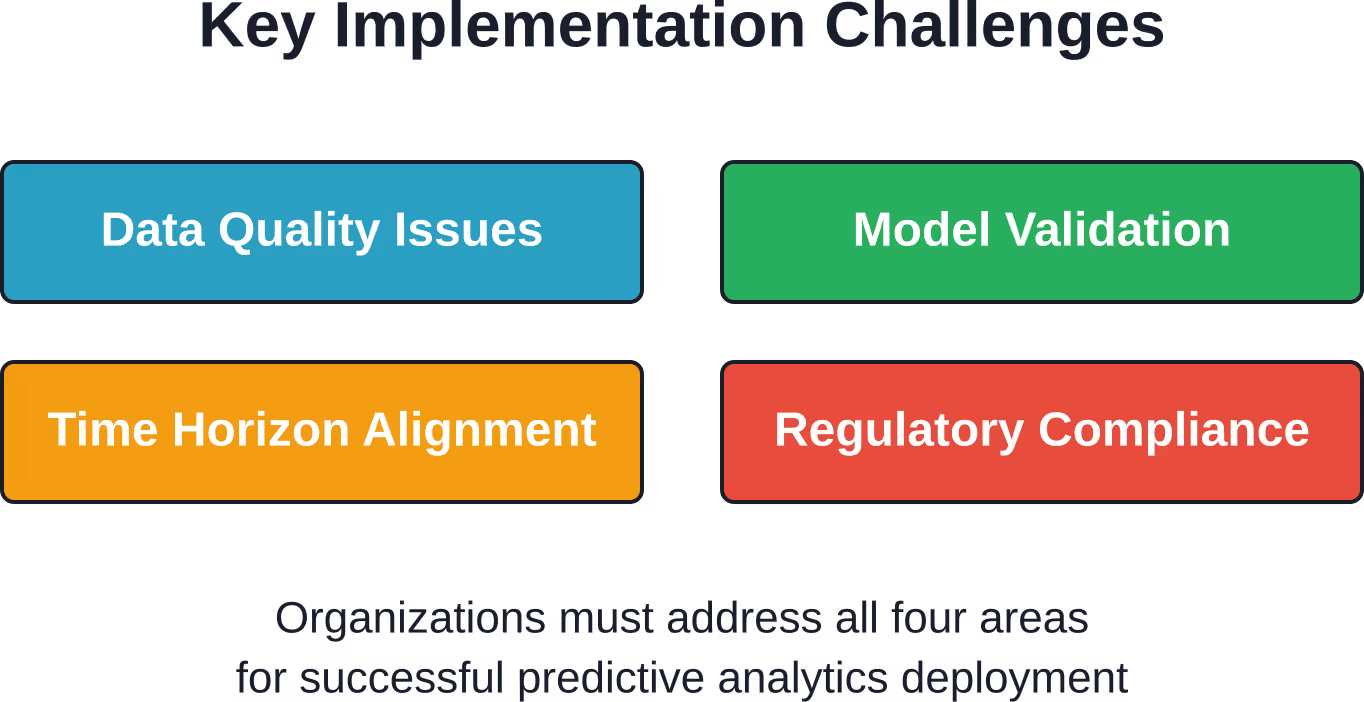
Implementation Challenges and Practical Considerations
Data Quality and Availability
Predictive models are only as good as their training data. Incomplete, inconsistent, or biased historical data produces unreliable forecasts.
Organizations often discover data gaps when building predictive systems. Incident data might exist in unstructured formats—emails, reports, meeting notes—that algorithms can’t easily process. Risk teams must invest in data governance, standardization, and integration before predictive models deliver value.
Model Validation and Regulatory Scrutiny
Regulators play an important role in assessing risk models, particularly in financial services. While model innovation drives competitive advantage, regulatory scrutiny can limit heterogeneity if oversight becomes too prescriptive.
Validation processes must balance innovation with reliability. Models require testing against holdout data, stress scenarios, and edge cases. Documentation needs to explain model logic, assumptions, and limitations transparently enough for auditors and regulators to assess.
Time Horizons and Forward-Looking Limitations
Credit risk modeling is heavily influenced by time horizons and forward-looking market data. A model optimized for 30-day default risk may fail at predicting 5-year default risk because different variables matter over different timeframes.
Modelers who ignore these complexities do so at their own peril. The elusiveness of truly forward-looking data means even the most sophisticated models rely fundamentally on historical patterns. When market conditions shift dramatically—pandemic lockdowns, geopolitical shocks, technological disruption—historical patterns lose predictive power.
That doesn’t make predictive analytics useless in volatile environments. It means models need continuous recalibration and human oversight to recognize when underlying assumptions no longer hold.
Getting Started With Predictive Risk Analytics
Organizations don’t need to build enterprise-wide predictive platforms on day one. Start small, prove value, then scale.
Identify one high-impact risk domain—fraud detection, supplier risk, credit defaults, safety incidents—where good historical data exists and stakeholder pain is acute. Build or acquire a model for that specific use case.
Focus initial efforts on data infrastructure. Centralize risk data from disparate systems. Standardize incident reporting. Establish data quality metrics and governance processes.
Pilot models in parallel with existing processes rather than replacing them immediately. Compare predictive forecasts against actual outcomes. Calibrate thresholds. Build confidence among risk professionals who might be skeptical of algorithmic recommendations.
Invest in talent. Predictive analytics requires data scientists who understand statistical modeling and risk professionals who understand business context. The best implementations bring both perspectives together in cross-functional teams.
Real-Time Risk Insights and Decision-Making
The most powerful predictive analytics systems operate in real time, updating risk assessments as new data arrives.
Real-time capabilities transform risk management from periodic reporting to continuous monitoring. Instead of quarterly risk reviews, executives see live dashboards showing current exposures, emerging threats, and predictive indicators trending in concerning directions.
Decision-making accelerates. When a supplier’s financial metrics deteriorate, procurement teams receive alerts within hours rather than discovering the problem during the next annual review. When fraud patterns shift, detection rules update automatically rather than waiting for manual rule revisions.
This shift requires infrastructure investment—streaming data pipelines, low-latency processing, automated alerting—but the operational advantages justify the costs for organizations managing complex, dynamic risk landscapes.
The Future: Agentic AI and Autonomous Risk Management
Emerging developments point toward agentic AI systems that don’t just predict and prescribe but execute risk responses autonomously within defined parameters.
Imagine fraud detection systems that automatically freeze suspicious transactions, notify customers, and initiate investigations without human intervention. Or supply chain systems that dynamically reroute shipments when predictive models forecast port delays or weather disruptions.
We’re not there yet at scale, but the trajectory is clear. As predictive models become more accurate and organizations grow comfortable with algorithmic decision-making, autonomous risk management will handle routine scenarios while escalating edge cases to humans.
That evolution will raise new challenges around accountability, transparency, and control. But the underlying trend—from reactive to predictive to autonomous risk management—appears irreversible.
Frequently Asked Questions
What is predictive analytics in risk management?
Predictive analytics in risk management uses machine learning, statistical algorithms, and historical data to forecast potential risks before they occur. Organizations analyze patterns in past incidents, market data, and operational metrics to identify vulnerabilities and predict future exposures, enabling proactive mitigation rather than reactive response.
How does predictive analytics differ from traditional risk assessment?
Traditional risk assessment looks backward at historical incidents to build controls. Predictive analytics uses those same historical patterns to forecast future risks, identifying leading indicators and correlations that suggest emerging threats. The approach shifts from documenting what went wrong to preventing problems before they materialize.
What industries benefit most from predictive risk analytics?
Financial services, supply chain management, healthcare, insurance, and cybersecurity see particularly strong benefits. Any industry with substantial risk exposure, good historical data, and high costs from risk events can leverage predictive analytics to improve outcomes and reduce losses.
What data is needed to implement predictive risk models?
Predictive models require quality historical data on risk events, near-misses, operational metrics, external factors, and outcomes. Data must be structured, consistent, and representative. Organizations typically need several years of incident data, though requirements vary by use case. Data quality matters more than quantity—clean, accurate data from two years outperforms noisy data from ten years.
Can small organizations use predictive analytics for risk management?
Yes, though implementation approaches differ. Small organizations can start with cloud-based analytics platforms that require minimal infrastructure investment, focus on specific high-impact risk domains rather than enterprise-wide deployments, and leverage industry benchmark data when internal historical data is limited. The key is starting small and scaling as capabilities mature.
What are the main challenges in implementing predictive risk analytics?
Data quality and availability often present the biggest hurdles—historical risk data may be incomplete, unstructured, or inconsistent. Model validation and regulatory compliance add complexity, particularly in regulated industries. Organizations also face talent gaps, requiring both data science expertise and risk domain knowledge, plus cultural resistance from teams accustomed to traditional risk methods.
How accurate are predictive risk models?
Accuracy varies by domain, data quality, and model sophistication. Well-designed models in data-rich environments can achieve high accuracy on specific predictions, but no model is perfect. The goal isn’t perfect prediction but significant improvement over baseline methods. Models must be continuously validated, recalibrated, and monitored for drift as conditions change.
Conclusion
Predictive analytics has fundamentally changed what’s possible in risk management. Organizations that master these tools shift from reactive firefighting to proactive prevention, identifying threats before they escalate and optimizing resource allocation based on data-driven forecasts.
The technology isn’t magic. It requires quality data, rigorous validation, continuous monitoring, and human oversight. But when implemented thoughtfully, predictive analytics delivers measurably better risk outcomes than traditional backward-looking approaches.
Start where you are. Identify one high-impact risk domain, build or acquire predictive capabilities for that specific use case, and prove value before scaling. The organizations that wait for perfect conditions will find themselves outmaneuvered by competitors already learning from real-world deployments.
The future of risk management is predictive. The question isn’t whether to adopt these capabilities but how quickly you can build them.
 English
  German
  Arabic
  French
  Dutch
Dutch  Spanish