
Quick Summary: AI in predictive analytics combines machine learning algorithms, statistical models, and artificial intelligence to analyze historical data and forecast future outcomes with unprecedented accuracy. Organizations use these technologies to identify patterns, anticipate behaviors, and make data-driven decisions across industries from healthcare to finance. Unlike traditional analytics, AI-powered systems continuously learn and improve their predictions, enabling businesses to proactively manage risks, optimize operations, and gain competitive advantages. The ability to forecast future events has shifted from educated guesswork to precise, data-driven science. Artificial intelligence has fundamentally transformed predictive analytics, enabling organizations to process vast datasets and generate insights that were previously impossible. But what does this actually mean for businesses today? The integration of AI into predictive analytics represents more than just technological advancement. It’s reshaping how companies approach decision-making, risk management, and strategic planning across every sector imaginable.
Understanding AI-Powered Predictive Analytics
Predictive analytics uses statistical analysis and machine learning to identify patterns, anticipate behaviors, and forecast upcoming events. When artificial intelligence enters the equation, these capabilities expand dramatically. Traditional predictive analytics relied heavily on manual model building and static datasets. Analysts would create hypotheses, select variables, and run statistical tests to identify relationships within historical data. AI changes this fundamentally. Machine learning algorithms automatically detect complex patterns across massive datasets without explicit programming for each scenario. These systems continuously improve as they process more information, adapting their models to reflect changing conditions.
The Core Components
Several key technologies work together in AI-driven predictive analytics:
- Machine learning algorithms that recognize patterns and make predictions without explicit instructions
- Statistical models that quantify relationships between variables and measure uncertainty
- Data processing systems that handle structured and unstructured information at scale
- Neural networks that mimic human cognitive processes for complex pattern recognition
These components work in concert, each contributing specific capabilities that enhance overall predictive accuracy. 
Implement AI-Driven Predictive Analytics with AI Superior
AI Superior develops AI systems where predictive models are part of broader applications. The focus is on making models usable within real processes, not as standalone experiments. They work through data evaluation, prototype development, and full integration into business systems.
Looking to Build AI-Based Predictive Models?
AI Superior can help with:
- defining the right AI approach
- building predictive models
- integrating AI into existing infrastructure
- improving models over time
👉 Contact AI Superior to discuss your project, data, and implementation approach
How AI Transforms Predictive Capabilities
The difference between traditional predictive analytics and AI-powered approaches isn’t just incremental. It’s transformative. Standard statistical models require analysts to specify relationships between variables upfront. If you don’t tell the model to look for a particular pattern, it won’t find it. AI systems, conversely, explore data autonomously, uncovering relationships that human analysts might never consider. Here’s the thing though—AI excels at handling complexity. Traditional models struggle when dealing with hundreds or thousands of variables simultaneously. Machine learning algorithms thrive in these high-dimensional spaces, identifying subtle interactions that influence outcomes. 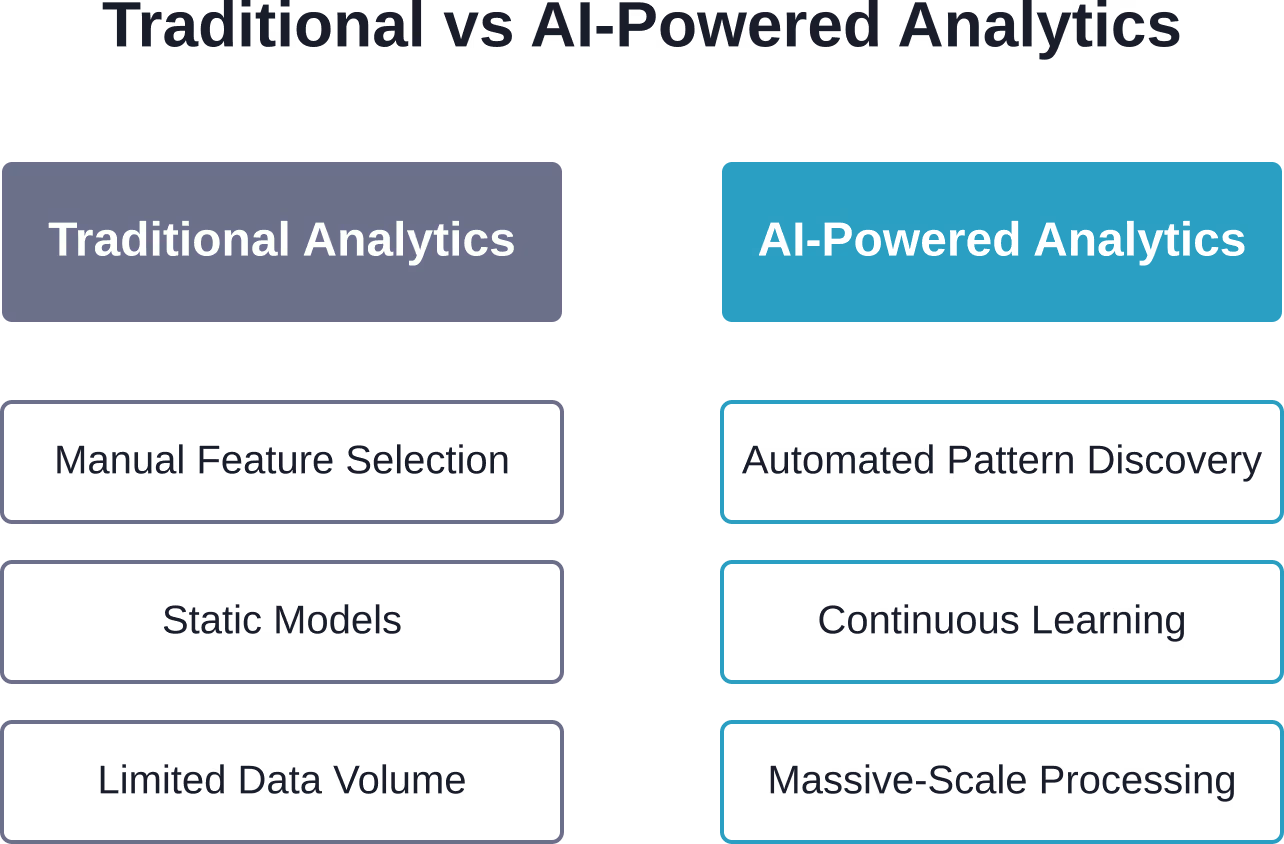 Speed matters too. What once took weeks of analyst time now happens in minutes or hours. Models retrain automatically as new data arrives, maintaining accuracy without constant manual intervention.
Continuous Improvement Through Learning
Perhaps the most significant advantage is adaptability. Business conditions change. Customer behaviors evolve. Market dynamics shift. Traditional predictive models become outdated quickly, requiring periodic rebuilding from scratch. AI systems adapt organically, incorporating new patterns as they emerge and discarding relationships that no longer hold true.
Real-World Applications Across Industries
The practical applications of AI in predictive analytics span virtually every business sector. Some of the most impactful implementations include:
Healthcare and Medical Predictions
AI-driven predictive analytics is transforming mental health care by enabling earlier detection and personalized treatment approaches. Predictive models analyze patient history, genetic factors, and behavioral patterns to forecast treatment outcomes with remarkable accuracy. Medical institutions use these systems to predict patient deterioration, identify individuals at risk for specific conditions, and optimize treatment protocols. The technology promises to shift healthcare from reactive to proactive, addressing potential issues before they become critical.
Financial Services and Risk Management
Banks and investment firms deploy AI predictive models to assess credit risk, detect fraudulent transactions, and forecast market movements. These systems process thousands of variables simultaneously—transaction patterns, economic indicators, social media sentiment, and more.
Human Resources and Talent Management
Organizations increasingly use predictive analytics to optimize recruitment processes. Machine learning algorithms compare candidate characteristics with historical hiring data and subsequent job performance metrics to predict successful placements. Research comparing various machine learning algorithms for HR recruitment has examined Random Forest, Support Vector Machines, Neural Networks, and Gradient Boosting models. These studies assess algorithms using performance criteria like accuracy, precision, recall, and F1 score to help organizations select the optimal approach for their specific needs.
Business Process Management
According to research published in academic journals, the Business Process Management Journal published 27 papers on AI and machine learning in business process management between 2010 and 2024, representing approximately 25% of all articles in this domain during that period. Decision Support Systems contributed 6 publications. This body of research demonstrates how AI contributes to predictive business process management, particularly in process enhancement and improvement approaches.
Key Algorithms and Techniques
Several machine learning approaches dominate the predictive analytics landscape:
| Algorithm Type | Best For | Key Strength |
|---|---|---|
| Random Forest | Classification tasks | Handles complex interactions, resistant to overfitting |
| Neural Networks | Image/pattern recognition | Models highly non-linear relationships |
| Gradient Boosting | Structured data prediction | Exceptional accuracy on tabular datasets |
| Support Vector Machines | High-dimensional data | Effective with limited training samples |
Each algorithm brings specific advantages. Random Forest models excel at handling missing data and maintaining performance across diverse scenarios. Neural networks shine when dealing with unstructured information like images or text. Gradient Boosting methods consistently win data science competitions for structured prediction problems. Support Vector Machines work well when features outnumber observations.
The Challenge of Model Accuracy and Trust
Despite their power, AI predictive systems face significant challenges around accuracy and trustworthiness. Research from the NIST 2011 Text Retrieval (TREC) Legal Track study revealed substantial discrepancies in perceived versus actual model performance. One team estimated their recall at 81%, but actual measured recall was only 56% according to IEEE SA documentation on trusted AI systems. between expectation and reality. This highlights a critical issue: confidence in AI predictions doesn’t always align with actual performance. Organizations must implement rigorous validation processes to ensure models perform as expected.
Managing Data Drift
Another major challenge is data drift—the phenomenon where the data supporting machine learning models becomes outdated, causing model performance to degrade. Once the statistical properties of input data change, predictions based on historical patterns lose accuracy. Organizations need robust MLOps practices that continuously monitor data distributions and retrain models when drift is detected. 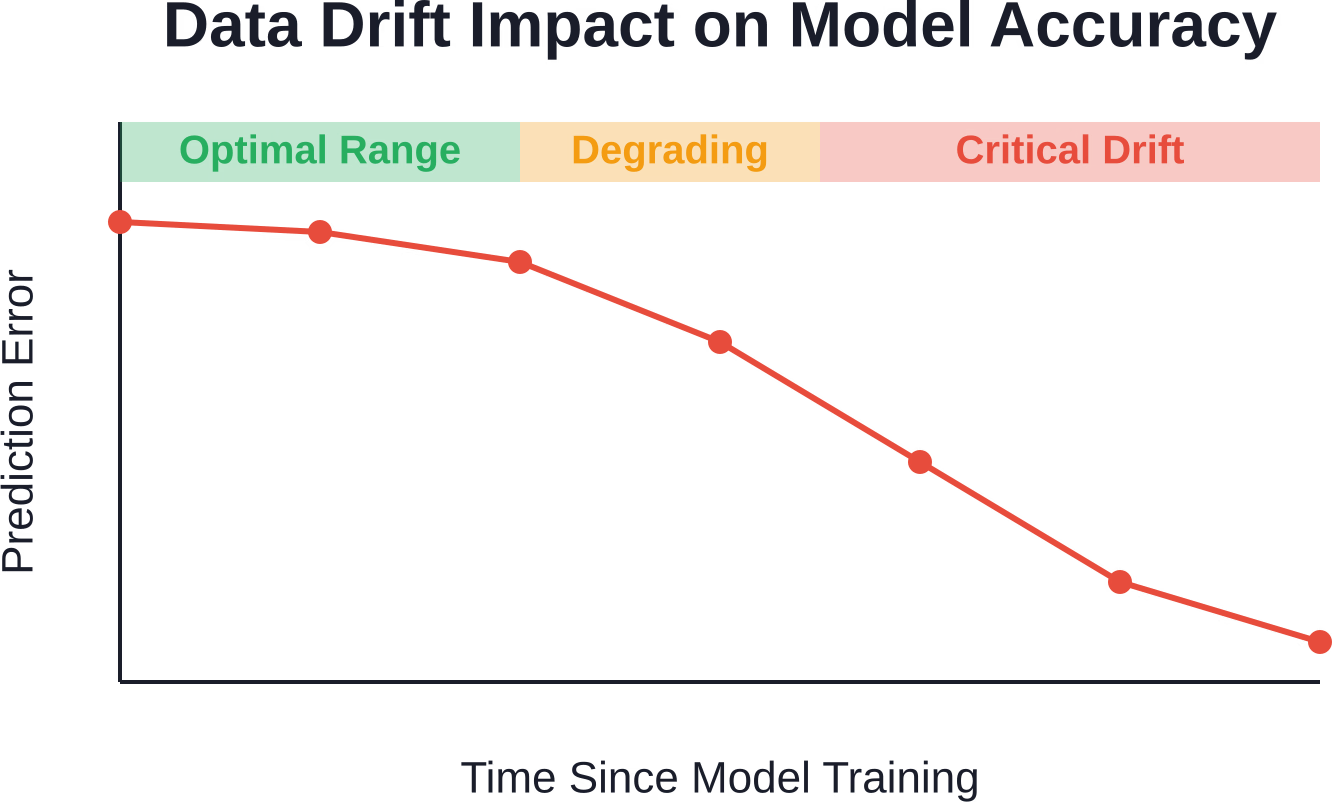
Building Trustworthy AI Systems
The National Institute of Standards and Technology (NIST) has established frameworks for effective risk management of artificial intelligence. These guidelines emphasize that AI systems may not necessarily be the right solution for every business task or problem. Standard risk management practices require organizations to formally determine whether an AI system achieves its intended purpose and stated objectives before full deployment proceeds.
Four Pillars of Trust
Building trusted AI systems requires attention to four key conditions:
- Effectiveness: The system must reliably accomplish its stated objectives with measurable performance
- Competence: Models must maintain accuracy across diverse scenarios and edge cases
- Accountability: Clear ownership and responsibility for system decisions and outcomes
- Transparency: Stakeholders understand how the system reaches its conclusions
Organizations should prioritize interpretable and explainable machine learning methods, particularly for high-stakes decisions. When predictions directly impact people’s lives—hiring decisions, loan approvals, medical treatments—understanding the reasoning behind predictions becomes essential.
Generative AI Versus Predictive AI
Recent advances in generative AI have created some confusion about how these technologies relate to predictive analytics. Predictive AI focuses on forecasting specific outcomes based on historical patterns. It answers questions like “What will happen?” or “Which customers are likely to churn?” Generative AI creates new content—text, images, code, or other outputs—based on learned patterns. While both technologies use machine learning, their objectives differ fundamentally. That said, these approaches increasingly complement each other. Generative models can synthesize realistic scenarios for testing predictive systems. Predictive models can guide generative systems toward more useful outputs.
| Characteristic | Predictive AI | Generative AI |
|---|---|---|
| Primary Function | Forecast outcomes | Create new content |
| Output Type | Predictions, scores, classifications | Text, images, audio, code |
| Common Use Cases | Risk assessment, demand forecasting | Content creation, design assistance |
| Data Requirements | Historical labeled data | Large unstructured datasets |
Benefits Driving Business Success
Organizations implementing AI in predictive analytics report several compelling advantages:
Proactive Risk Management
Rather than reacting to problems after they occur, businesses can identify potential issues before they materialize. Financial institutions detect fraud patterns, healthcare systems predict patient complications, and manufacturers anticipate equipment failures.
Resource Optimization
Accurate forecasting enables more efficient resource allocation. Retailers optimize inventory levels, reducing both stockouts and excess inventory. Service organizations staff appropriately for predicted demand.
Personalization at Scale
AI systems analyze individual customer behaviors and preferences to deliver tailored experiences. E-commerce platforms recommend relevant products, content providers suggest personalized entertainment, and healthcare systems customize treatment plans.
Competitive Intelligence
Predictive models identify emerging trends before they become obvious. Early detection of shifting customer preferences, market dynamics, or competitive threats provides strategic advantages. 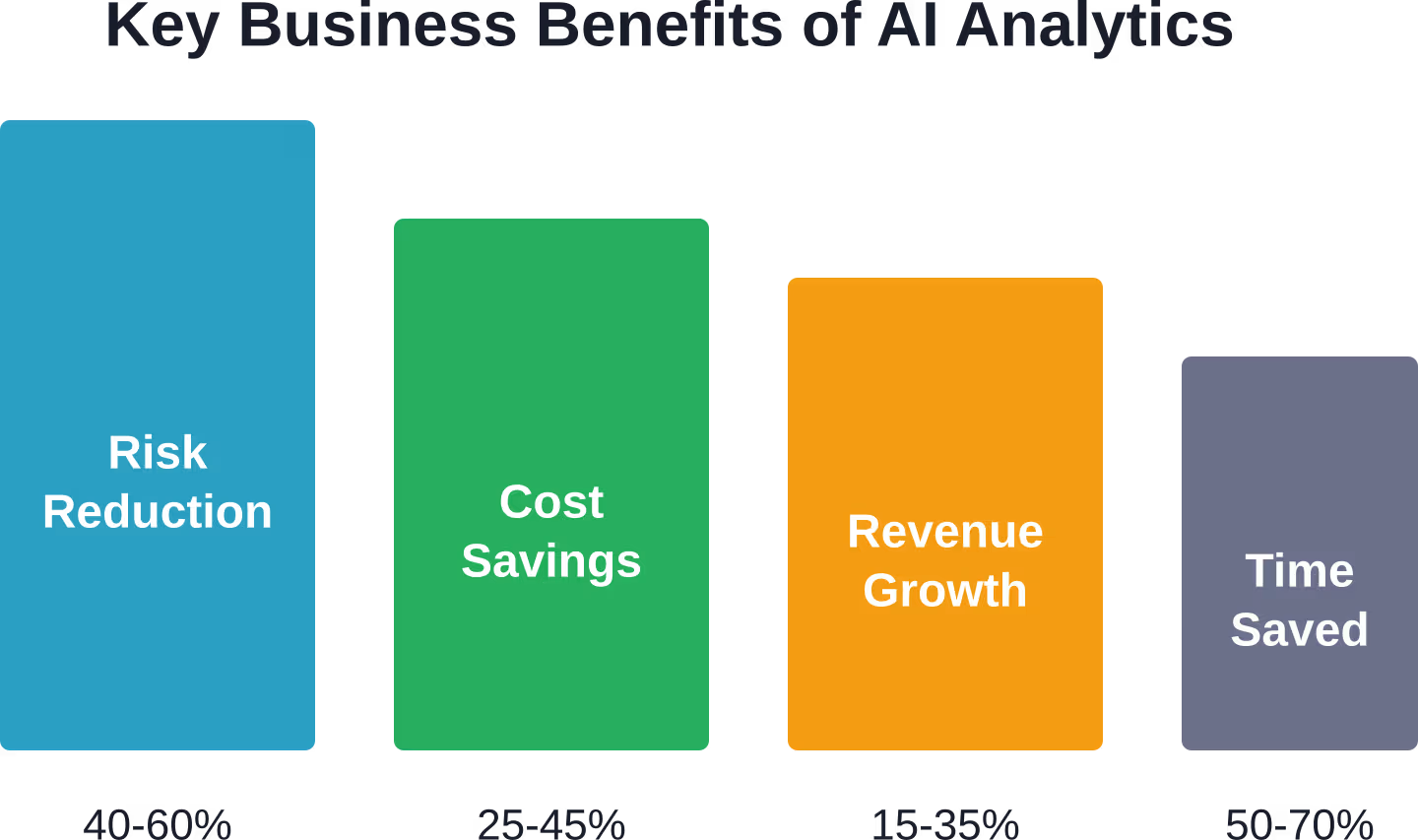
Ethical Considerations and Privacy
The power of AI in predictive analytics raises important ethical questions that organizations must address. Predictive models can inadvertently encode biases present in historical data. If past hiring decisions favored certain demographic groups, models trained on that data may perpetuate those biases. Similar concerns arise in criminal justice, lending, and other high-stakes domains. Transparency becomes particularly important when predictions affect individual opportunities or outcomes. People deserve to understand why a system made a particular prediction about them and have recourse when predictions are incorrect. Data privacy represents another critical concern. Effective predictive models require substantial personal information. Organizations must balance analytical capabilities with individual privacy rights, implementing robust security measures and obtaining appropriate consent.
Implementation Best Practices
Successfully implementing AI in predictive analytics requires more than just deploying algorithms. Start with clear business objectives. What specific decisions will predictions inform? What outcomes matter most? Vague goals like “use AI to improve our business” rarely succeed. Invest in data infrastructure before models. Predictive accuracy depends entirely on data quality. Incomplete, inconsistent, or biased data produces unreliable predictions regardless of algorithmic sophistication. Build cross-functional teams that combine domain expertise with technical skills. Data scientists understand algorithms but may not grasp business context. Subject matter experts know the domain but may not understand model limitations. Effective implementation requires both perspectives. Establish governance frameworks that define acceptable uses, performance standards, and review processes. Who approves model deployment? How often are predictions audited? What triggers model retirement or retraining?
The Future of AI-Driven Predictions
Looking ahead, several trends are shaping the evolution of AI in predictive analytics. Automated machine learning (AutoML) platforms are making sophisticated modeling accessible to non-experts. These systems automatically handle feature engineering, algorithm selection, and hyperparameter tuning—tasks that previously required specialized data science expertise. Real-time prediction capabilities continue advancing. Rather than batch processing historical data, systems increasingly make predictions instantly as events occur. This enables immediate intervention in time-sensitive scenarios. Explainable AI techniques are improving, addressing the black-box criticism of complex models. New methods provide human-interpretable explanations for individual predictions while maintaining high accuracy. Edge computing brings predictive intelligence closer to data sources. Rather than sending all data to centralized cloud systems, models run directly on devices—sensors, smartphones, or industrial equipment—reducing latency and privacy concerns.
Frequently Asked Questions
What’s the difference between AI and traditional predictive analytics?
Traditional predictive analytics relies on pre-specified statistical models where analysts manually select variables and define relationships. AI-powered systems use machine learning algorithms that automatically discover patterns, continuously improve through experience, and handle much larger and more complex datasets without explicit programming for each scenario.
Which industries benefit most from AI in predictive analytics?
Healthcare, financial services, retail, manufacturing, and human resources see particularly strong benefits. Healthcare uses predictive AI for patient outcome forecasting and treatment optimization. Financial institutions deploy it for fraud detection and risk assessment. Retailers optimize inventory and personalize customer experiences. Manufacturers predict equipment failures. HR departments improve recruitment and retention.
How accurate are AI predictive models?
Accuracy varies significantly based on data quality, problem complexity, and implementation approach. Well-designed systems often achieve 85-95% accuracy for classification tasks, though actual performance depends heavily on the specific use case. Organizations should validate model performance rigorously, as research shows estimated accuracy sometimes exceeds actual measured performance by substantial margins.
What are the main challenges in implementing predictive AI?
Data drift represents a major challenge—models degrade as underlying data patterns change over time. Other obstacles include data quality issues, lack of interpretability in complex models, potential bias in historical data, privacy concerns, and difficulty integrating predictions into existing business processes. Organizations also struggle with talent shortages and appropriate governance frameworks.
How does data quality affect predictive accuracy?
Data quality fundamentally determines model performance. Incomplete records, measurement errors, inconsistent formatting, and biased sampling all reduce predictive accuracy. Models can only learn patterns present in training data, so garbage in truly means garbage out. Organizations typically spend 60-80% of predictive analytics projects on data cleaning and preparation rather than modeling itself.
Can small businesses benefit from AI predictive analytics?
Absolutely. Cloud-based platforms have democratized access to sophisticated predictive tools that previously required massive infrastructure investments. Small businesses can use these systems for customer churn prediction, demand forecasting, personalized marketing, and operational optimization. The key is starting with focused use cases that have clear business value and available data.
How often should predictive models be retrained?
Retraining frequency depends on how quickly underlying patterns change. Fraud detection models may need weekly or daily updates as bad actors adapt tactics. Customer preference models might retrain monthly. Equipment failure models in stable manufacturing environments could work for months or years. Best practice involves continuous monitoring of prediction accuracy with automated retraining triggered when performance degrades beyond acceptable thresholds.
Making Predictions Work for Your Organization
AI in predictive analytics isn’t just about technology. It’s about transforming how organizations make decisions. The most successful implementations start small, prove value quickly, and scale gradually. Pick a specific high-value problem with available data and clear success metrics. Build a functional model, demonstrate business impact, and use that success to justify broader initiatives. Remember that predictions complement rather than replace human judgment. The goal isn’t autonomous decision-making but augmented intelligence—systems that surface insights and forecasts while leaving important decisions to people who understand context and consequences. Organizations that effectively combine AI’s pattern recognition capabilities with human expertise in interpretation and application gain sustainable competitive advantages. The technology continues advancing rapidly, but the fundamental principle remains constant: data-driven predictions enable proactive rather than reactive strategies. Ready to harness predictive intelligence for your business? Start by identifying one decision that would benefit from better forecasting, assess your data availability, and explore how AI-powered analytics can transform that specific process. The future belongs to organizations that anticipate rather than simply respond.