
Quick Summary: Predictive analytics in ecommerce uses machine learning and statistical models to forecast customer behavior, optimize inventory, personalize experiences, and reduce churn. Research shows Random Forest algorithms achieve 94% accuracy in classification tasks, while advanced implementations can reduce forecasting errors by up to 50% and improve inventory accuracy by 20-30%. Leading retailers attribute 35% of sales to predictive recommendation systems. Online retailers drown in data every single day. Purchase histories, browsing patterns, abandoned carts, customer reviews—the volume is staggering. But here’s the thing: most of that data sits idle, barely scratched for basic reporting. Predictive analytics flips that script. Instead of looking backward at what happened, predictive models forecast what comes next. Which customers will churn? What products will trend next quarter? How much inventory will each warehouse need? The technology combines statistical modeling, data mining, and machine learning to turn raw numbers into actionable forecasts. And the results speak volumes—academic research demonstrates that Random Forest algorithms achieve 94% classification accuracy with just a 6% error rate, while practical implementations deliver measurable business impact.
What Predictive Analytics Actually Means for Ecommerce
Predictive analytics in ecommerce refers to the application of statistical algorithms and machine learning techniques to historical data for forecasting future outcomes. Rather than relying on intuition or basic reporting, businesses build mathematical models that identify patterns and relationships within their data. These models process multiple data types simultaneously. Transactional data reveals purchase histories and order values. Website behavioral data tracks page views, session duration, and navigation paths. Customer demographic information adds context about age, location, and preferences. Product interaction data shows what gets clicked, reviewed, and abandoned. The distinction from traditional analytics is fundamental. Descriptive analytics tells what happened—sales were down 8% last month. Predictive analytics forecasts what will happen—sales will likely drop another 12% next month unless specific actions are taken. That shift from hindsight to foresight transforms decision-making.
The Technical Foundation
Several algorithm families power ecommerce predictions. Random Forest models excel at classification tasks, achieving 94% accuracy according to academic research on ecommerce applications. Modern ensemble models and Transformers achieve over 92% accuracy for on-time delivery forecasting, while SVM is considered a legacy baseline. Regression techniques also play critical roles. Lasso regression achieves 93.8% classification accuracy with a 6.2% error rate, while Ridge regression follows closely at 93.7% accuracy and 6.3% error rate. The choice of algorithm depends on the specific prediction task and data characteristics. Neural networks and deep learning architectures handle more complex pattern recognition, particularly for image-based product recommendations or natural language processing of reviews. But simpler models often perform better for structured tabular data common in ecommerce transactions. 
Apply Predictive Analytics in Ecommerce with AI Superior
AI Superior works with ecommerce teams that need predictive models tied to real data and workflows. The focus is on building models that support decisions like demand planning, customer behavior, and inventory management. They start with data assessment, build a working prototype, and then integrate it into existing systems if the results hold up.
Looking to Use Predictive Analytics in Ecommerce?
AI Superior can help with:
- evaluating ecommerce data and use cases
- building and testing predictive models
- integrating models into existing systems
- refining performance based on results
👉 Contact AI Superior to discuss your project, data, and implementation approach
Core Applications That Drive Business Results
The real question isn’t whether predictive analytics works—it’s where to apply it first. Different use cases deliver varying levels of impact, and implementation complexity differs significantly across applications.
Demand Forecasting and Inventory Optimization
Getting inventory levels right represents one of the highest-impact applications. Overstock ties up capital and increases carrying costs. Stockouts kill sales and damage customer relationships. Traditional forecasting methods rely heavily on historical averages and seasonal adjustments, but they struggle with rapid market shifts. Predictive models incorporate dozens of variables simultaneously—past sales velocity, promotional calendars, competitive pricing, search trends, weather patterns, economic indicators, and social media sentiment. The algorithms detect subtle correlations that humans miss. The payoff is substantial. Businesses implementing advanced demand forecasting can reduce forecasting errors by up to 50% and improve inventory accuracy by 20-30%. That translates directly to a 5-10% sales boost and 10-20% lower inventory carrying costs.
Personalized Product Recommendations
Generic product suggestions don’t cut it anymore. Shoppers expect recommendations that actually match their preferences, browsing history, and purchase patterns. Personalization has become an industry standard—86% of respondents to a 2025 study agreed that companies treat them as unique individuals. Recommendation engines analyze collaborative filtering patterns (customers who bought X also bought Y), content-based filtering (this product shares attributes with items in the customer’s history), and hybrid approaches combining both. Deep learning models can process product images, descriptions, reviews, and behavioral signals simultaneously. The business case is compelling. Tailored recommendations drive significantly more revenue than generic suggestions. Leading retailers attribute 35% of sales to predictive recommendation systems.
Customer Churn Prevention
Acquiring new customers costs substantially more than retaining existing ones. But identifying which customers are about to churn—before they actually leave—requires predictive modeling. Manual analysis can’t process the behavioral signals fast enough at scale. Churn prediction models analyze purchase frequency changes, declining engagement metrics, customer service interactions, email open rates, website session patterns, and cart abandonment behavior. SVM algorithms demonstrate over 92% accuracy for ecommerce churn prediction, giving businesses time to intervene. Once high-risk customers are identified, targeted retention campaigns can deploy personalized offers, proactive support outreach, or exclusive perks. The model prioritizes which customers are both likely to churn and valuable enough to justify retention investment.
Dynamic Pricing Optimization
Static pricing leaves money on the table. Predictive models enable dynamic pricing that responds to demand fluctuations, competitor actions, inventory levels, and customer willingness to pay. Airlines and hotels pioneered these techniques, but ecommerce retailers increasingly adopt them. The algorithms consider time of day, day of week, seasonal patterns, remaining inventory, competitor prices, customer browsing history, and conversion probability. Prices adjust in real-time to maximize revenue or market share depending on business objectives. But dynamic pricing requires careful implementation. Aggressive price changes can damage brand perception and customer trust. The most effective approaches balance revenue optimization with consistency and fairness.
Cart Abandonment Reduction
Shopping cart abandonment plagues online retailers—typical rates hover between 60-80%. Predictive analytics identifies which sessions are likely to end in abandonment before it happens, enabling real-time intervention. Models track mouse movement patterns, hesitation behaviors, comparison shopping indicators, and checkout friction points. When abandonment probability crosses a threshold, the system can trigger exit-intent popups with targeted offers, initiate live chat assistance, or highlight trust signals. Post-abandonment, predictive models optimize email timing and messaging. Case study data shows businesses achieving a 20% reduction in cart abandonment rates through predictive engagement—personalized offers, timely reminders, and streamlined checkout processes make the difference.
Building Blocks: Data Requirements and Quality
Predictive models are only as good as the data feeding them. Garbage in, garbage out remains the fundamental rule. Ecommerce businesses need several data categories for effective predictions.
| Data Source Type | Examples | Description |
|---|---|---|
| Transactional Data | Purchase histories, order values, returns, customer locations | Direct insight into buying behavior and revenue patterns |
| Website Behavioral Data | Page views, session duration, click paths, search queries | Reveals browsing patterns and product interest signals |
| Customer Demographics | Age, gender, location, device type, acquisition channel | Provides segmentation context for personalization |
| Product Information | Categories, attributes, images, descriptions, inventory status | Enables content-based filtering and stock optimization |
| External Data | Weather, economic indicators, competitor pricing, social trends | Captures market factors affecting demand |
Data Quality Challenges
Raw ecommerce data is messy. Duplicate customer records proliferate across systems. Product categorization inconsistencies create noise. Missing values pepper transaction logs. Outliers from test orders or fraudulent transactions skew distributions. Data preprocessing typically consumes a significant portion of predictive analytics project time. Teams must deduplicate records, standardize formats, handle missing values appropriately, detect and treat outliers, and validate data integrity across sources. Feature engineering transforms raw data into predictive signals. Recency, frequency, and monetary value (RFM) scores distill customer behavior. Product affinity scores capture cross-sell opportunities. Seasonality indicators adjust for cyclical patterns. The quality of engineered features often matters more than algorithm choice.
Implementation Strategy and Best Practices
Launching predictive analytics requires more than just technical capability. Successful implementations follow a structured approach that aligns business objectives with analytical methods.
Start With High-Impact Use Cases
Don’t boil the ocean. Identify one or two use cases with clear business value and achievable data requirements. Demand forecasting and personalized recommendations typically deliver quick wins with measurable ROI. Define success metrics upfront. What constitutes improvement? A 10% reduction in stockouts? A 15% increase in average order value from recommendations? Clear targets focus development effort and enable definitive evaluation.
Build or Buy Considerations
Ecommerce platforms increasingly offer built-in predictive capabilities. Shopify provides customer segmentation tools that surface behavioral insights and enable targeted campaigns. BigCommerce incorporates analytics features for data-driven decision-making. These native tools work well for standard use cases. Custom development makes sense when competitive advantage depends on proprietary algorithms or when business requirements exceed platform capabilities. But custom solutions require ongoing data science expertise and infrastructure maintenance. Third-party predictive analytics platforms offer middle ground—more sophisticated than native tools, less resource-intensive than full custom builds. Evaluation should consider integration complexity, scalability, and total cost of ownership.
Model Monitoring and Maintenance
Predictive models degrade over time. Customer behavior shifts. Product catalogs evolve. Market conditions change. A model trained on pre-pandemic data won’t predict post-pandemic patterns accurately. Continuous monitoring tracks prediction accuracy against actual outcomes. When performance drifts below acceptable thresholds, models need retraining with fresh data. Some businesses retrain monthly, others quarterly—cadence depends on how quickly the underlying patterns change. A/B testing validates that predictions actually improve business metrics. The fact that a model achieves 90% accuracy doesn’t guarantee it increases revenue. Testing prediction-driven decisions against control groups proves real-world value.
Overcoming Common Implementation Challenges
Most predictive analytics initiatives face similar obstacles. Anticipating these challenges enables proactive mitigation.
Data Silos and Integration Complexity
Customer data lives in the ecommerce platform. Marketing data sits in the email service provider. Support tickets reside in a separate helpdesk system. Web analytics occupy yet another tool. Combining these fragmented sources into unified customer profiles requires significant integration work. Modern data warehouse solutions and customer data platforms help consolidate information. But implementation still demands careful mapping of customer identifiers across systems and resolution of conflicting data points.
Skill Gaps and Resource Constraints
Building effective predictive models requires data science expertise—statistics, machine learning, programming, and domain knowledge. Many ecommerce businesses lack in-house capabilities and struggle to recruit specialized talent in competitive markets. Platform-native tools and managed services reduce the expertise barrier. But even these solutions require analytical thinking to frame problems correctly and interpret results meaningfully. Training existing team members or partnering with consultants can bridge capability gaps.
Privacy and Ethical Considerations
Predictive analytics depends on customer data, which raises privacy concerns. Regulations like GDPR and CCPA impose constraints on data collection, storage, and usage. Compliance isn’t optional—violations carry substantial penalties. Transparency matters too. Customers increasingly expect to understand how their data is used. Opaque algorithms that make consequential decisions without explanation erode trust. Ethical predictive analytics balances business value with customer rights and transparency.
Measuring Success and ROI
Predictive analytics projects need clear success metrics tied to business outcomes. Technical metrics like model accuracy matter, but business results matter more.
| Use Case | Key Performance Indicators | Success Threshold |
|---|---|---|
| Demand Forecasting | Forecast accuracy, stockout rate, inventory turnover | 20-30% improvement in inventory accuracy |
| Product Recommendations | Click-through rate, conversion rate, average order value | 15-25% increase in conversion on recommended products |
| Churn Prevention | Retention rate, customer lifetime value, intervention success rate | 10-15% reduction in churn among targeted customers |
| Dynamic Pricing | Revenue per visitor, profit margin, conversion rate | 5-10% revenue increase while maintaining margins |
| Cart Abandonment | Cart completion rate, recovery email conversion, revenue recovered | 15-25% reduction in abandonment rate |
ROI calculation should include both direct revenue impact and cost savings. Improved inventory accuracy reduces carrying costs and markdowns. Better churn prediction lowers customer acquisition needs. Personalization increases average order values. These benefits compound over time.
The Future Trajectory of Predictive Ecommerce
Predictive analytics capabilities continue advancing rapidly. Several trends will shape the next generation of ecommerce predictions.
Real-Time Prediction at Scale
Current implementations often work in batches—models retrain nightly, predictions refresh hourly. Emerging architectures enable true real-time prediction on streaming data. Every click, every page view, every interaction updates customer profiles and predictions instantly. This enables more responsive personalization and faster intervention on high-value opportunities. Real-time inventory allocation can shift stock between warehouses as demand patterns emerge. Dynamic pricing can respond to competitor moves within minutes.
Multimodal Learning
Traditional models process structured tabular data—purchases, clicks, demographics. Advanced architectures incorporate unstructured data—product images, customer reviews, social media posts, video interactions. Computer vision analyzes what customers look at. Natural language processing extracts sentiment and intent from text. Combining these data types captures richer signals about preferences and behavior. A model that considers both what customers buy and what they write in reviews makes better predictions than either signal alone.
Automated Machine Learning
AutoML platforms automate model selection, feature engineering, and hyperparameter tuning. What once required specialized data science expertise becomes accessible through guided workflows and automated optimization. This democratization expands who can deploy predictive analytics. Business analysts without deep machine learning knowledge can build effective models. But domain expertise and critical thinking remain essential—automation handles technical details, but humans must frame problems correctly. 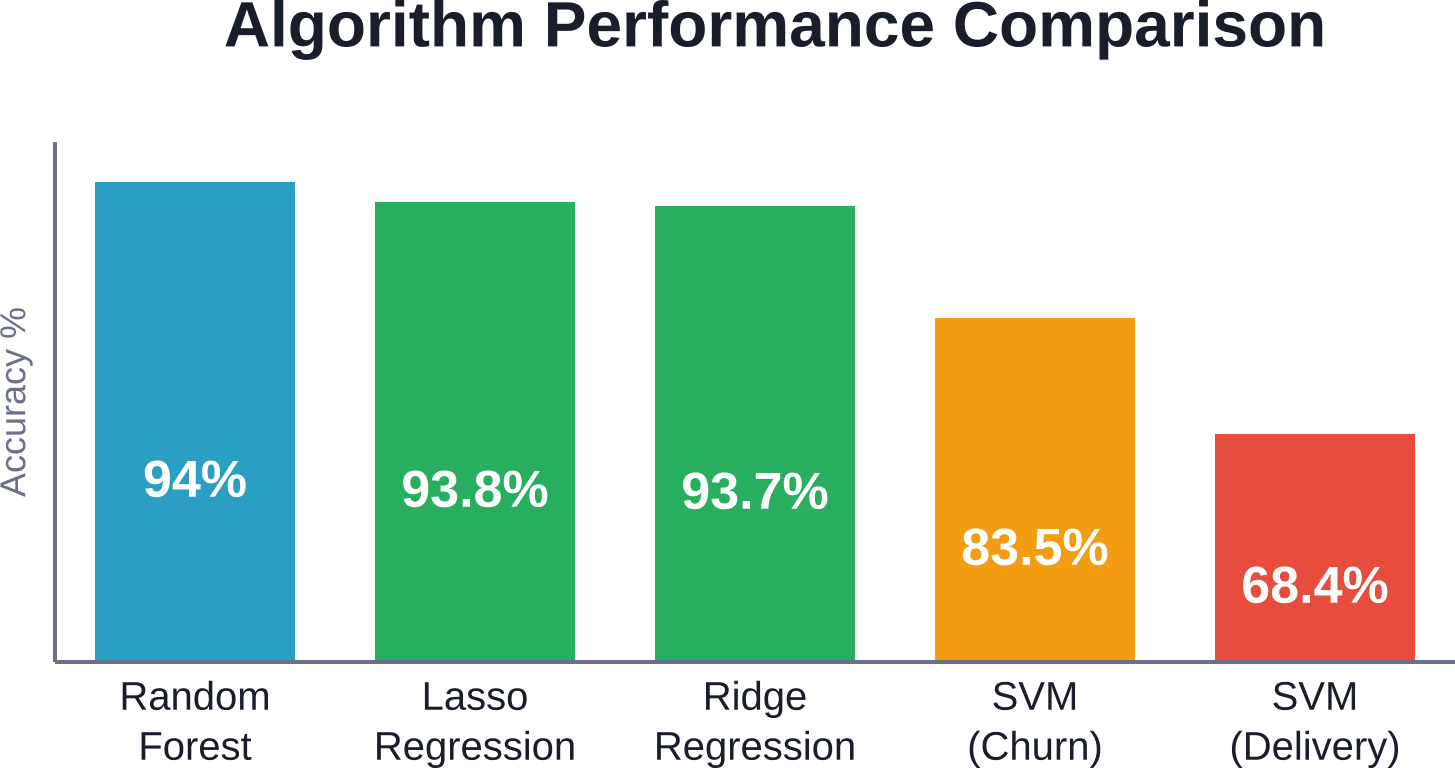
Frequently Asked Questions
What’s the difference between predictive analytics and business intelligence?
Business intelligence focuses on descriptive analytics—reporting what happened in the past through dashboards, charts, and historical summaries. Predictive analytics uses statistical models and machine learning to forecast what will happen in the future. BI tells what sales were last quarter; predictive analytics estimates what sales will be next quarter and which factors will drive those results.
How much data do I need to start using predictive analytics?
The minimum depends on the use case and algorithm complexity. Simple models might work with a few thousand transactions, while sophisticated deep learning requires hundreds of thousands of data points. Most ecommerce businesses with at least 6-12 months of operational history have sufficient data for initial predictions. Data quality matters more than sheer volume—clean, consistent data from 10,000 customers beats messy data from 100,000.
Can small ecommerce businesses benefit from predictive analytics?
Absolutely. Modern platforms include predictive features accessible to businesses of all sizes. Shopify’s built-in segmentation tools and BigCommerce’s analytics capabilities don’t require enterprise budgets or data science teams. Start with platform-native features for quick wins, then consider specialized tools as needs and resources grow. The key is choosing use cases with clear ROI and manageable data requirements.
How accurate do predictions need to be to provide value?
It depends on the business context and cost of errors. Demand forecasting that’s 70% accurate still beats guessing, especially if it helps avoid major stockouts or overstock situations. Churn prediction with 80% accuracy catches most at-risk customers even if some false positives receive unnecessary retention offers. The threshold is whether predictions improve decisions compared to current methods—not whether they achieve perfection.
What’s the typical ROI timeline for predictive analytics projects?
Quick wins like personalized recommendations can show measurable impact within 2-3 months. Demand forecasting improvements typically require a full seasonal cycle (3-6 months) to validate accuracy gains. More complex implementations involving custom models and data integration might take 6-12 months to demonstrate full ROI. Starting with high-impact, lower-complexity use cases accelerates time to value.
How do I ensure predictive models don’t discriminate or create unfair outcomes?
Model fairness requires intentional design and ongoing monitoring. Audit training data for historical biases that algorithms might perpetuate. Test model predictions across demographic groups to identify disparate impacts. Implement fairness constraints that prevent decisions based on protected characteristics. Maintain human oversight for consequential predictions. Transparency about how models work and what data they use builds trust and enables accountability.
Do predictive models replace human decision-making?
No—they augment it. Models excel at processing vast data volumes and identifying subtle patterns humans miss. But they lack contextual understanding, ethical judgment, and strategic thinking. The most effective approach combines algorithmic predictions with human expertise. Use models to surface insights and recommendations, but maintain human oversight for final decisions, especially those affecting customer relationships or brand reputation.
Taking Action: Your Next Steps
Predictive analytics transforms ecommerce from reactive to proactive. Instead of responding to what already happened, businesses anticipate what comes next and position accordingly. The competitive advantage goes to retailers that forecast demand accurately, personalize effectively, and optimize continuously. Research demonstrates the technical feasibility—Random Forest models achieve 94% classification accuracy, and implementations deliver measurable business impact. Forecasting errors drop by up to 50%. Inventory accuracy improves by 20-30%. Leading retailers attribute 35% of sales to predictive recommendations. But success requires more than just technology. Start with clear business objectives. Focus on high-impact use cases with measurable outcomes. Invest in data quality and integration. Build or acquire the necessary analytical capabilities. Monitor model performance continuously and refine based on results. The barriers to entry continue falling as platforms incorporate predictive features and automated machine learning democratizes advanced techniques. Small businesses can leverage built-in tools while enterprises build proprietary competitive advantages through custom implementations. The question isn’t whether to adopt predictive analytics—it’s how quickly to move and which applications to prioritize. Customer expectations around personalization and availability continue rising. Competitors deploying predictive capabilities gain sustainable advantages. Waiting means falling behind. Evaluate current capabilities and data readiness. Identify the use case with highest potential impact and clearest path to implementation. Start small, prove value, then expand. The compounding benefits of better predictions accumulate over time, making early adoption increasingly valuable.